Online Appendix
Research Integrity Issues in Voigtländer and Voth (2012)
by Joseph Francis
Select Town
Black Death Pogroms (1349)
1920s Pogroms
Synagogue Attacks (1938)
Black Death Pogroms (1349)
Aachen (1 & 2)
Error
Voigtländer and Voth code a "confirmed Jewish settlement" here during the Black Death. However, their sources do not provide "unambiguous information" to support this.
Reality
Avneri documents a 1330 mention of a "Judengasse" and a 1349 letter warning about well poisoning, which implies a Jewish presence.
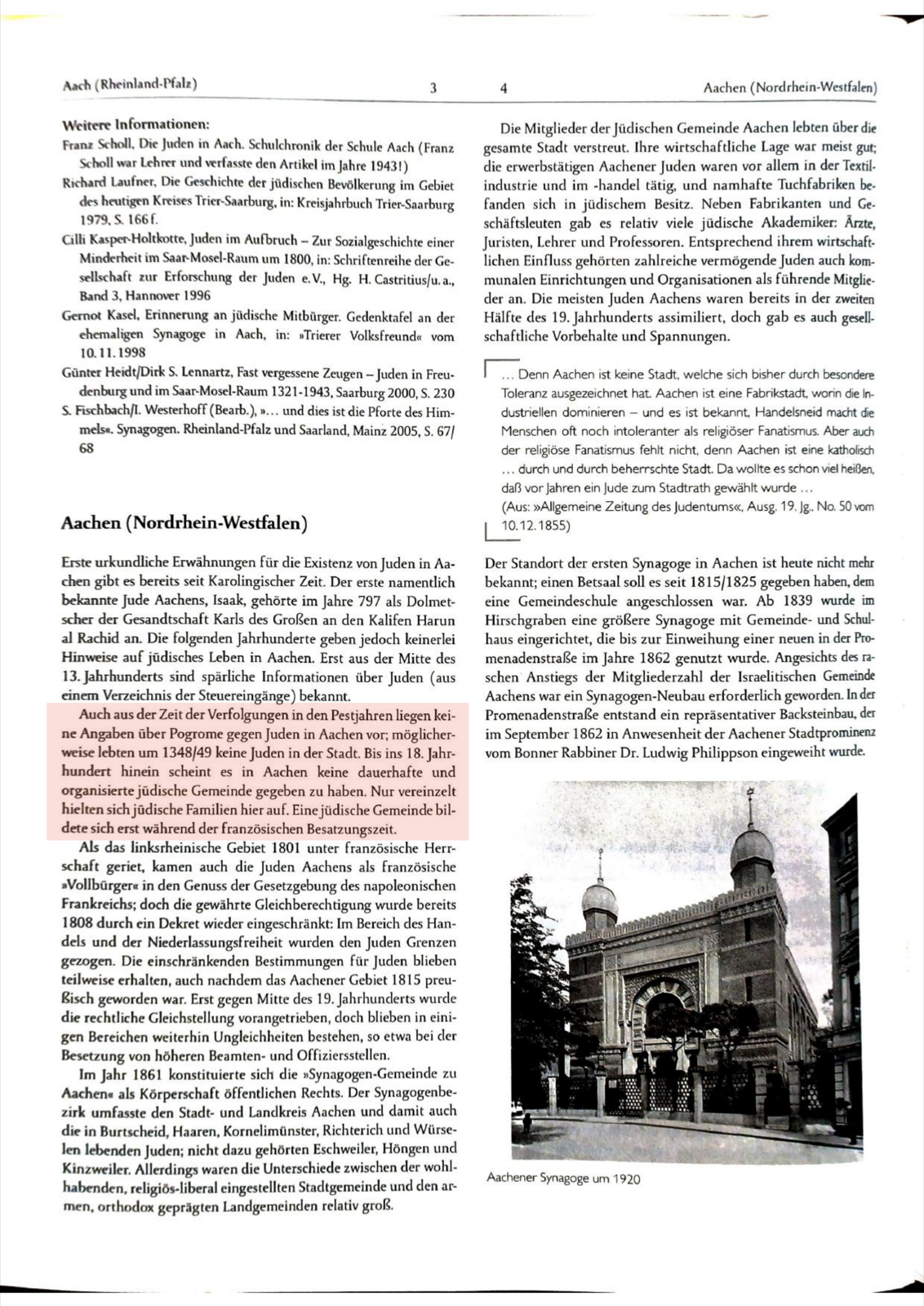
However, Alicke states that "possibly no Jews lived in the city around 1348-1349" („möglicherweise lebten um 1348/49 keine Juden in der Stadt").
The existence of a Jewish community during the Black Death is uncertain.
Correction
EXIST1349 1 -> NA; POG1349 0 -> NA
Sources:
Avneri · Page 1
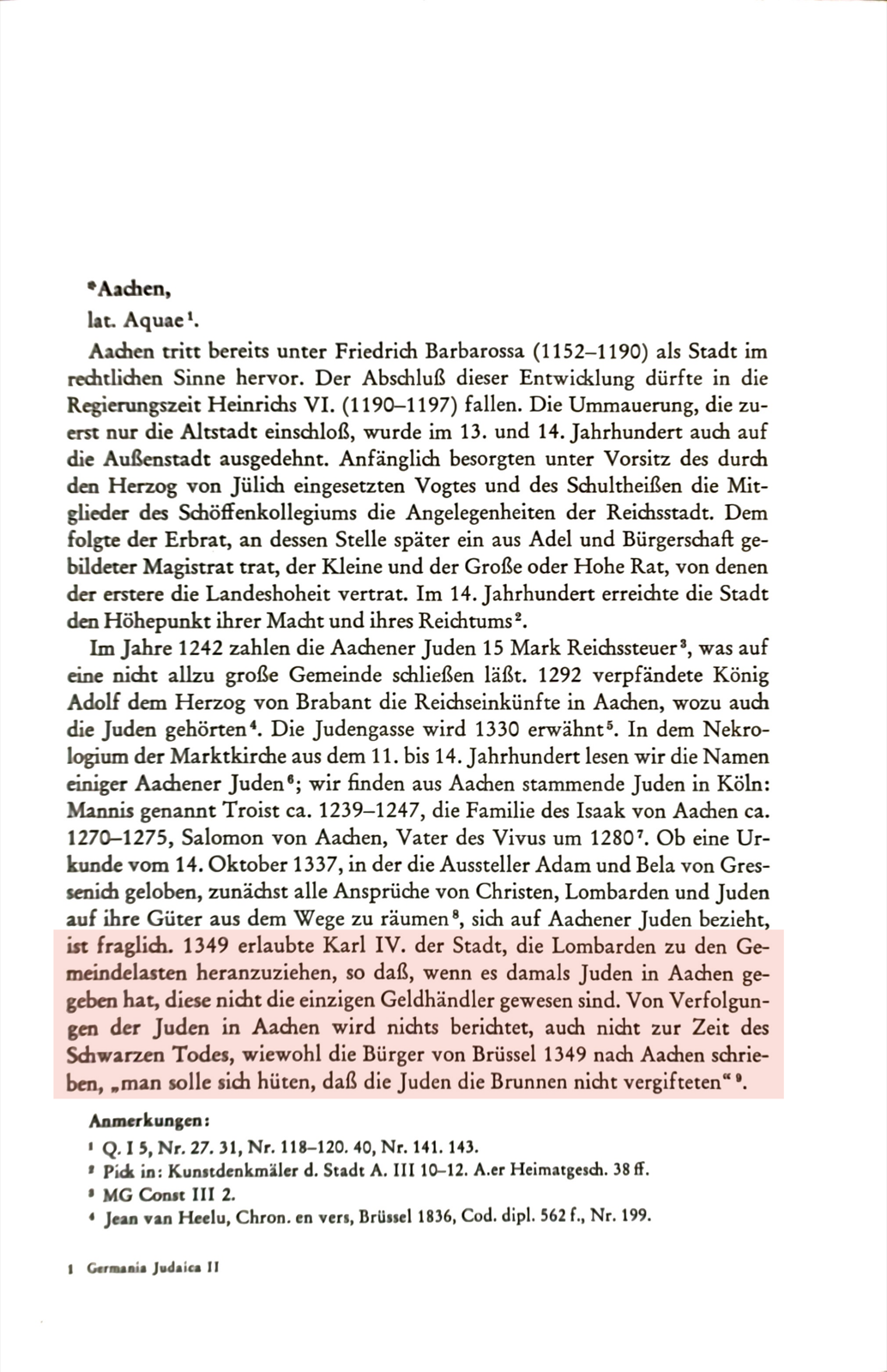
Alicke · Page 3
Amberg (3)
Error
Voigtländer and Voth failed to code a 0 for a pogrom here during the Black Death, despite their rule that a lack of information should be coded as 0.
Reality
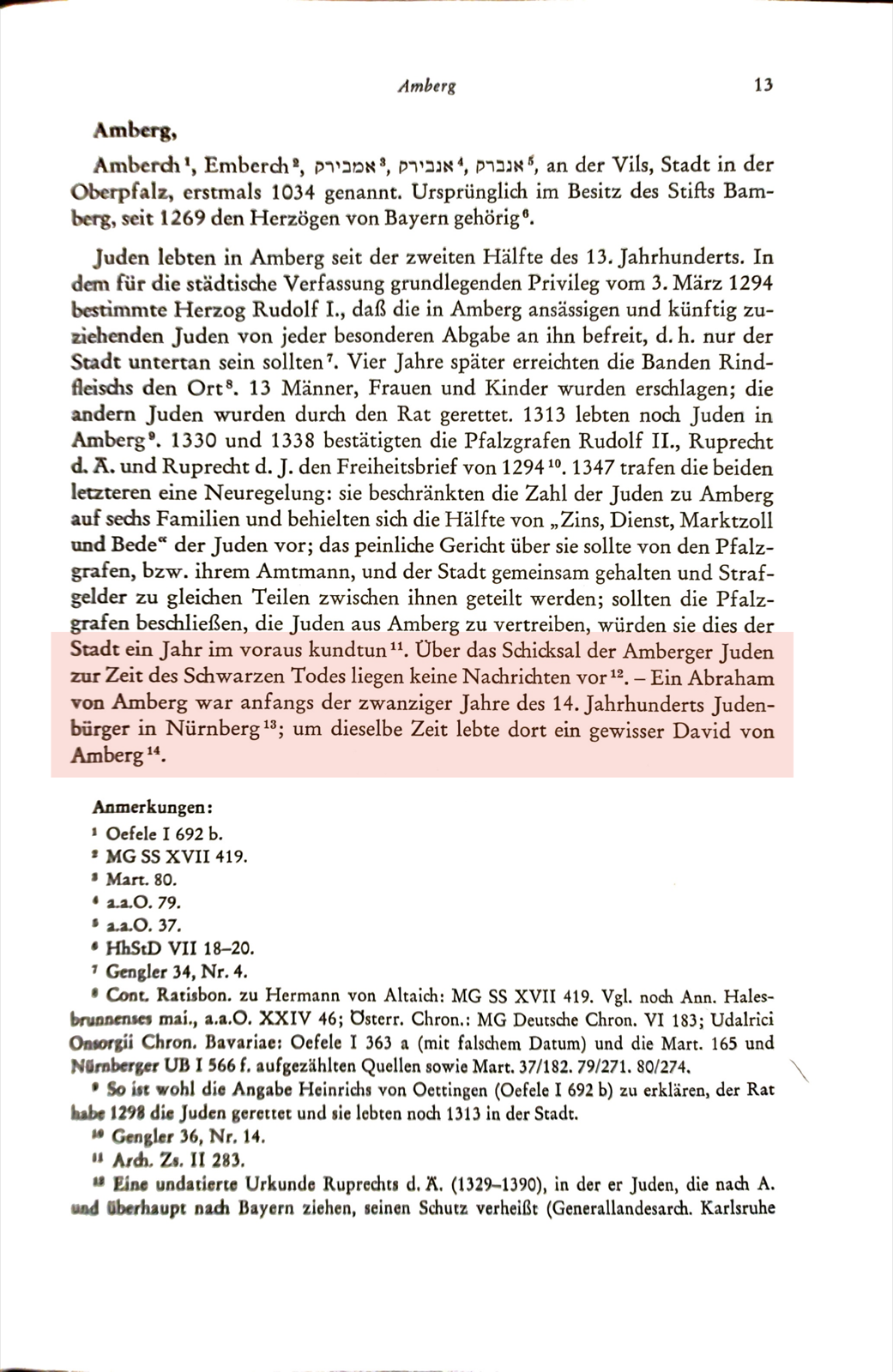
Avneri states that "no news is available about the fate of the Jews of Amberg at the time of the Black Death" („Über das Schicksal der Amberger Juden zur Zeit des Schwarzen Todes liegen keine Nachrichten vor").
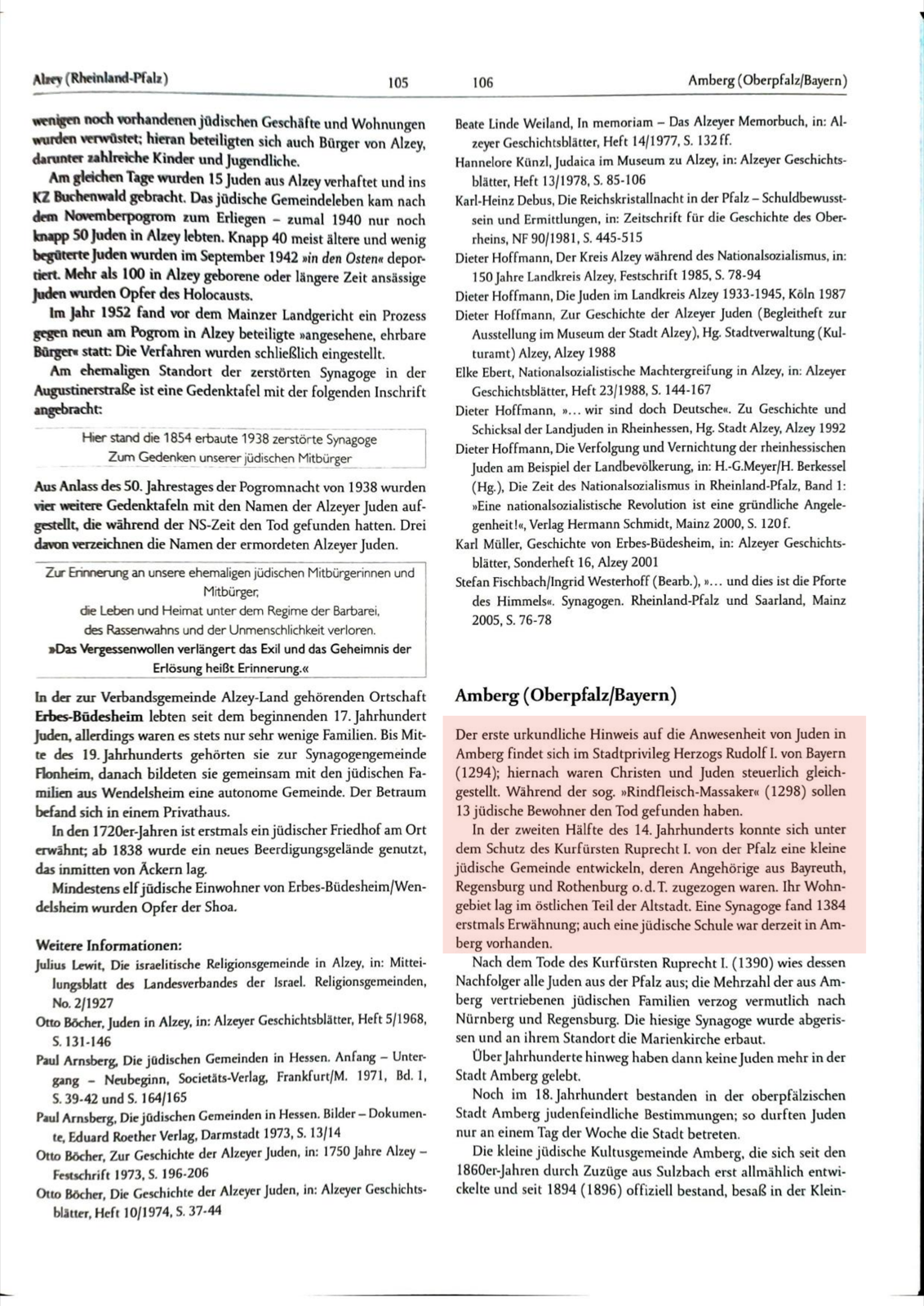
Alicke mentions earlier persecutions in 1298 but provides no information regarding pogroms during the 1348-1350 period.
Following Voigtländer and Voth's rules, this should be coded as 0.
Correction
POG1349 NA -> 0
Sources:
Avneri · Page 13
Alicke · Page 106
Arnstein (4 & 5)
Error
Voigtländer and Voth code a "confirmed Jewish settlement" here during the Black Death. However, their sources do not provide "unambiguous information" to support this.
Reality
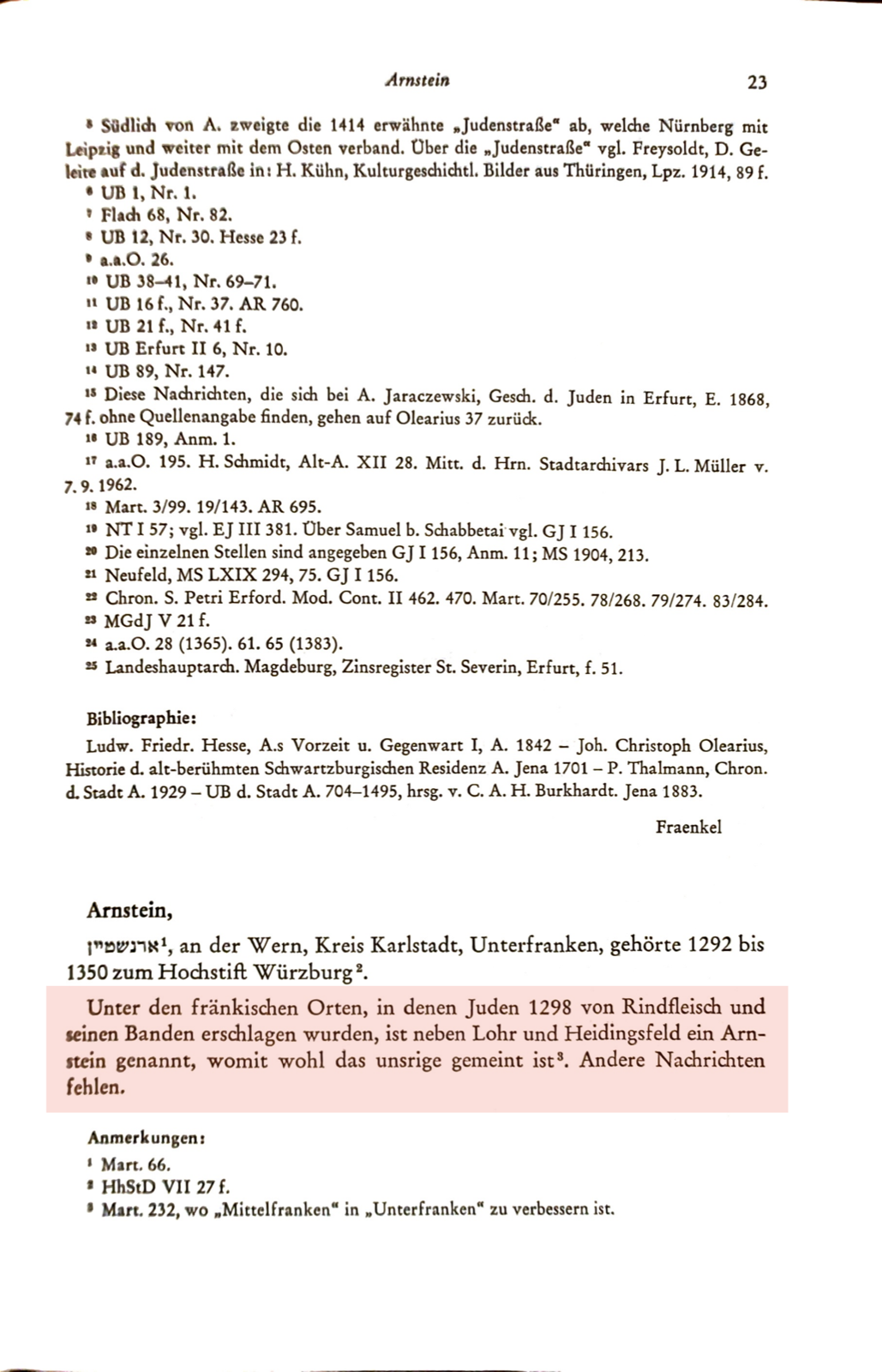
Avneri mentions that an "Arnstein" is named among places where Jews were killed in 1298, but explicitly states that "other reports are missing" („Andere Nachrichten fehlen").
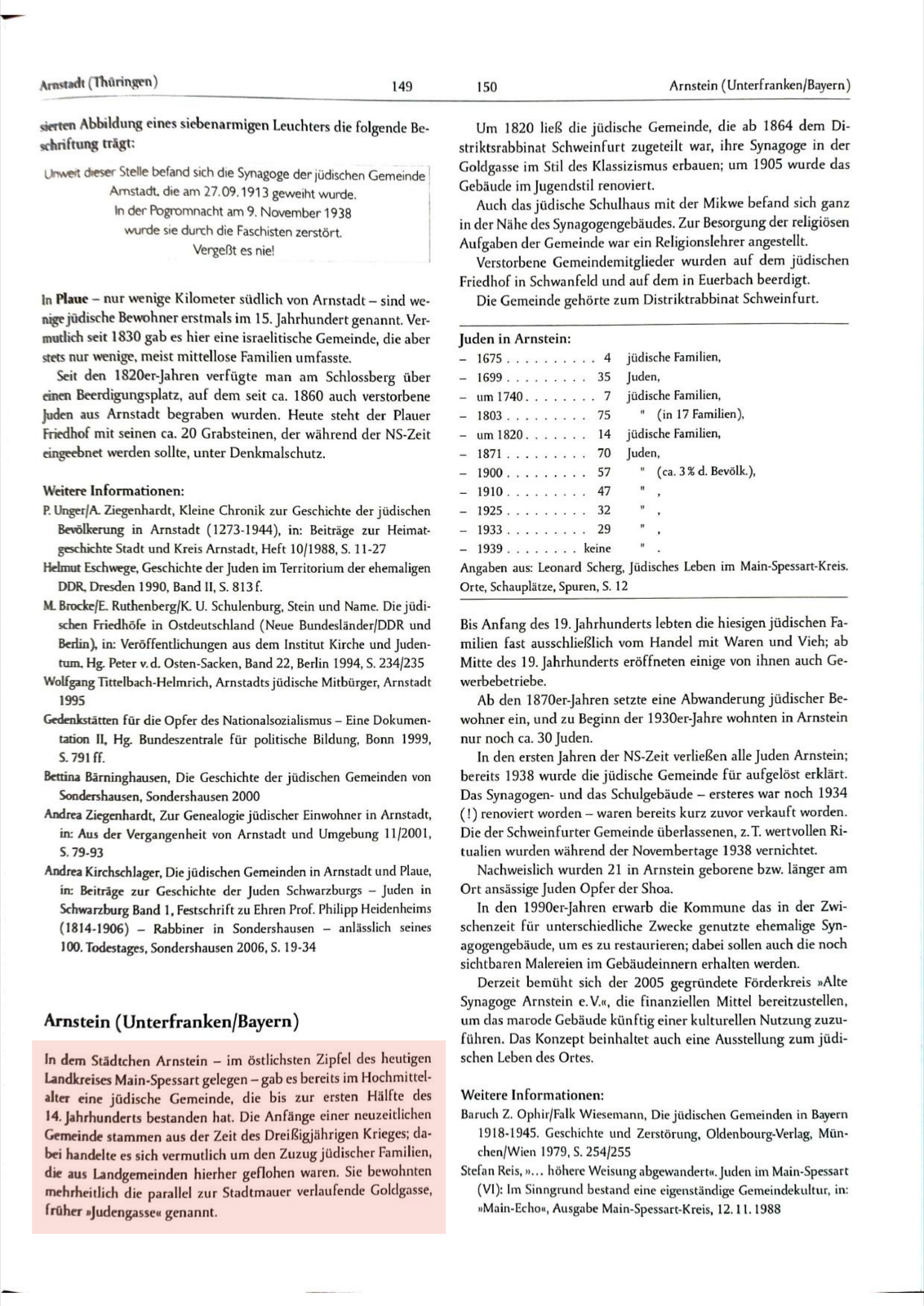
Alicke notes that the community "is said to have existed until the first half of the fourteenth century" („die bis zur ersten Hälfte des 14. Jahrhunderts bestanden haben soll").
The existence of a Jewish community during the Black Death is uncertain.
Correction
EXIST1349 1 -> NA; POG1349 0 -> NA
Sources:
Avneri · Page 23
Alicke · Page 149
Aub (6 & 7)
Error
Voigtländer and Voth code a "confirmed Jewish settlement" here during the Black Death. However, their sources do not provide "unambiguous information" to support this.
Reality
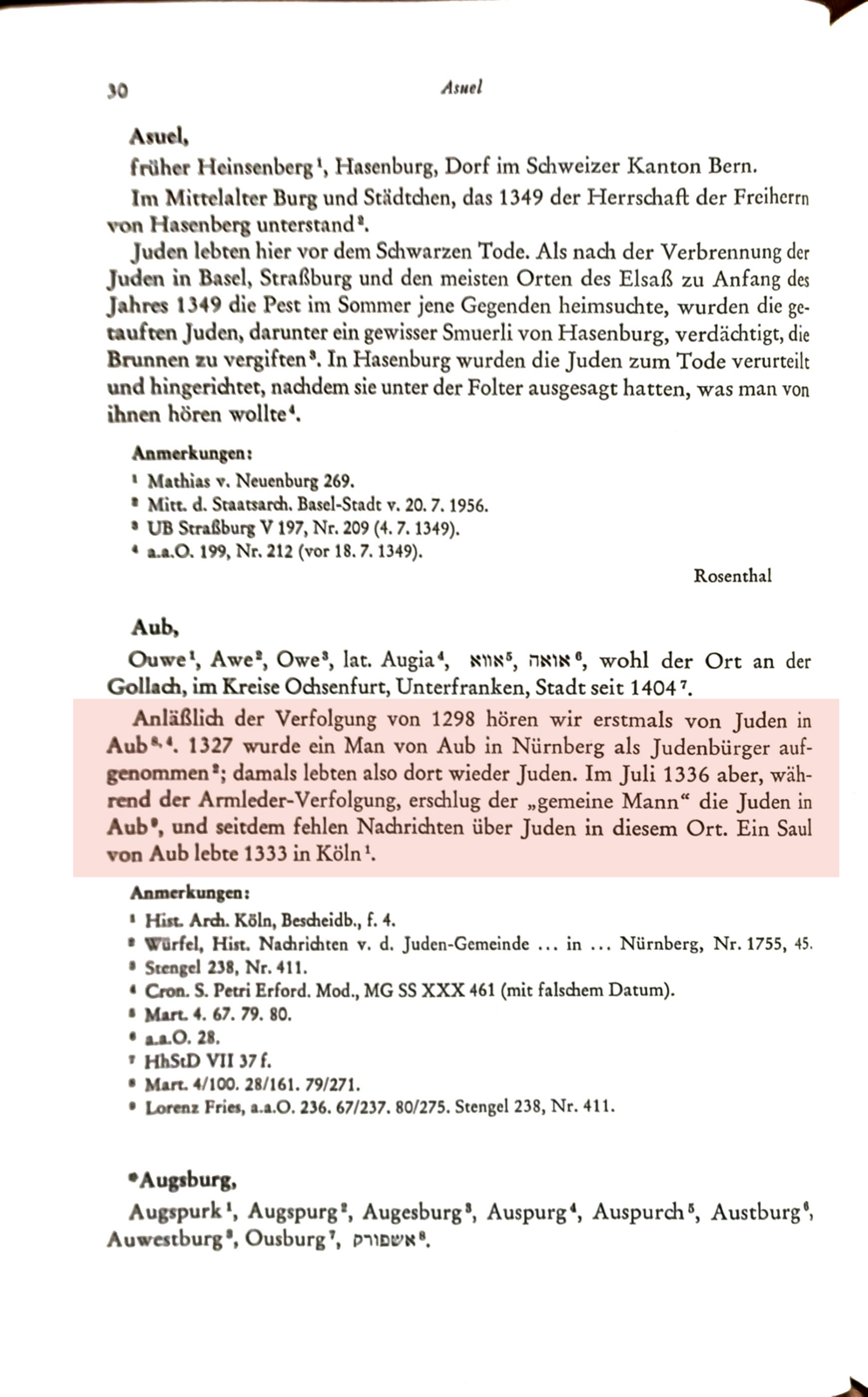
Avneri states that after a massacre in July 1336, "since then, there are no reports of Jews in this place" („seitdem fehlen Nachrichten über Juden in diesem Ort").
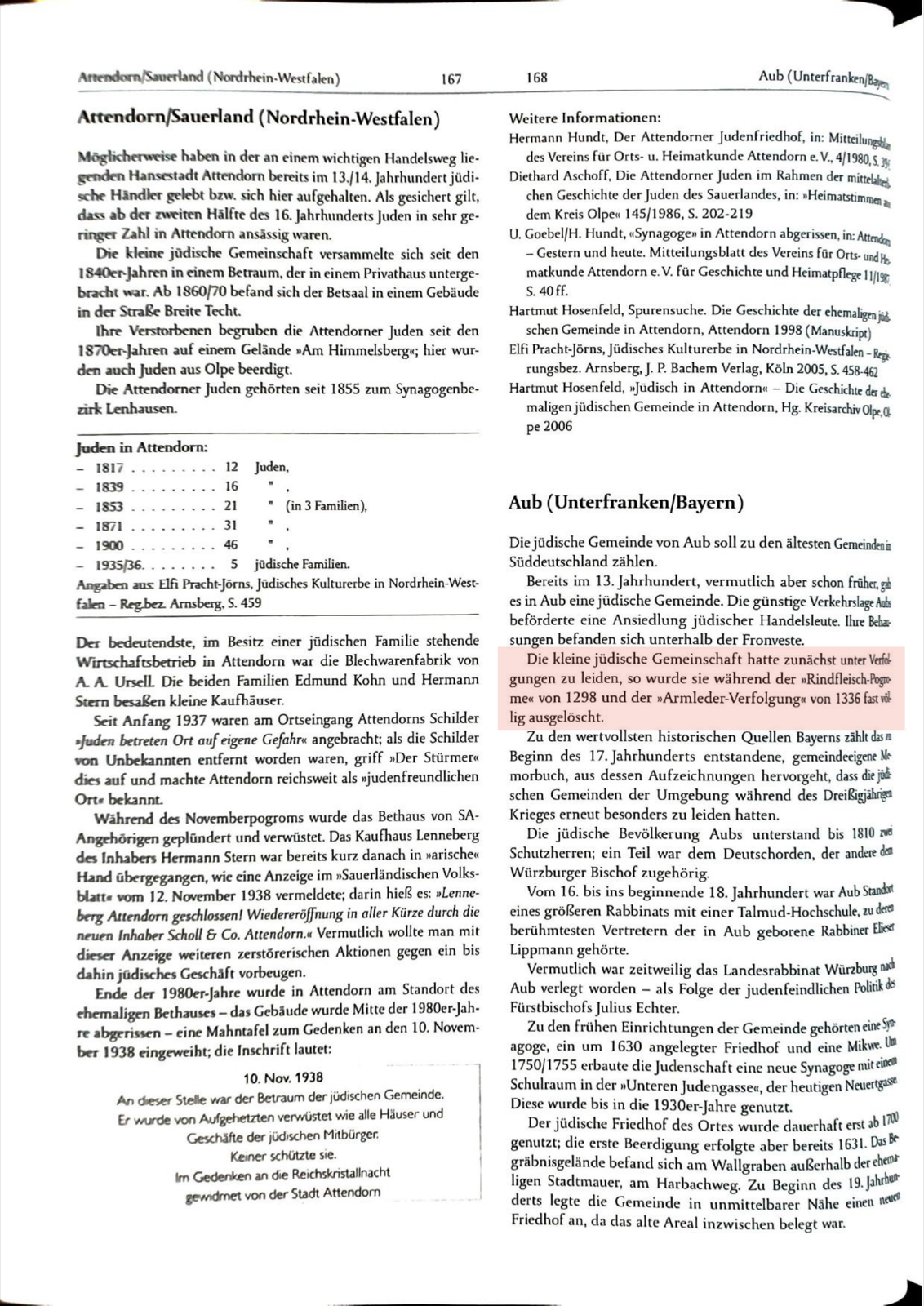
Alicke corroborates that the community was "almost completely wiped out" („fast völlig ausgelöscht") in 1336.
The existence of a Jewish community during the Black Death is uncertain.
Correction
EXIST1349 1 -> NA; POG1349 0 -> NA
Sources:
Avneri · Page 30
Alicke · Page 168
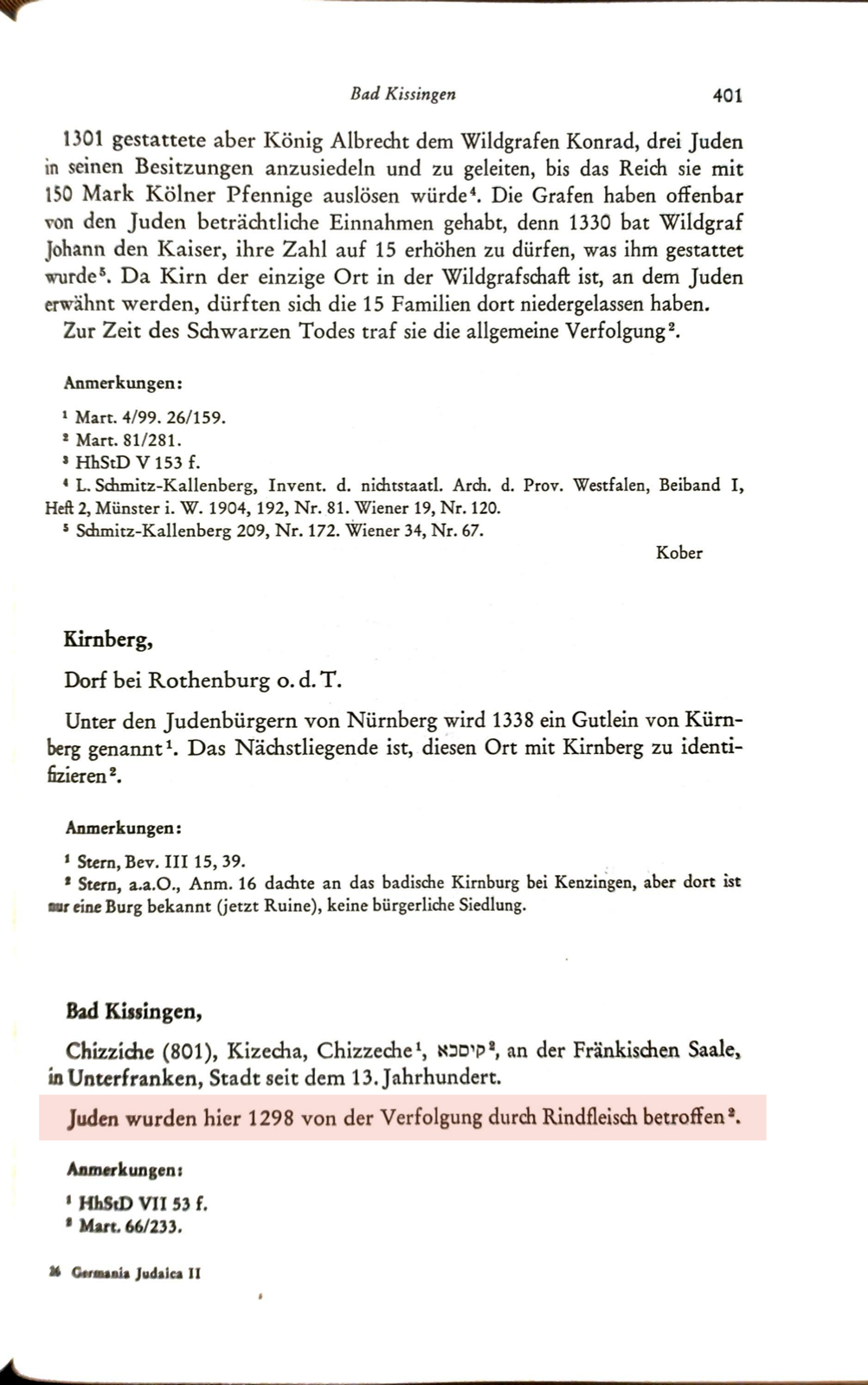
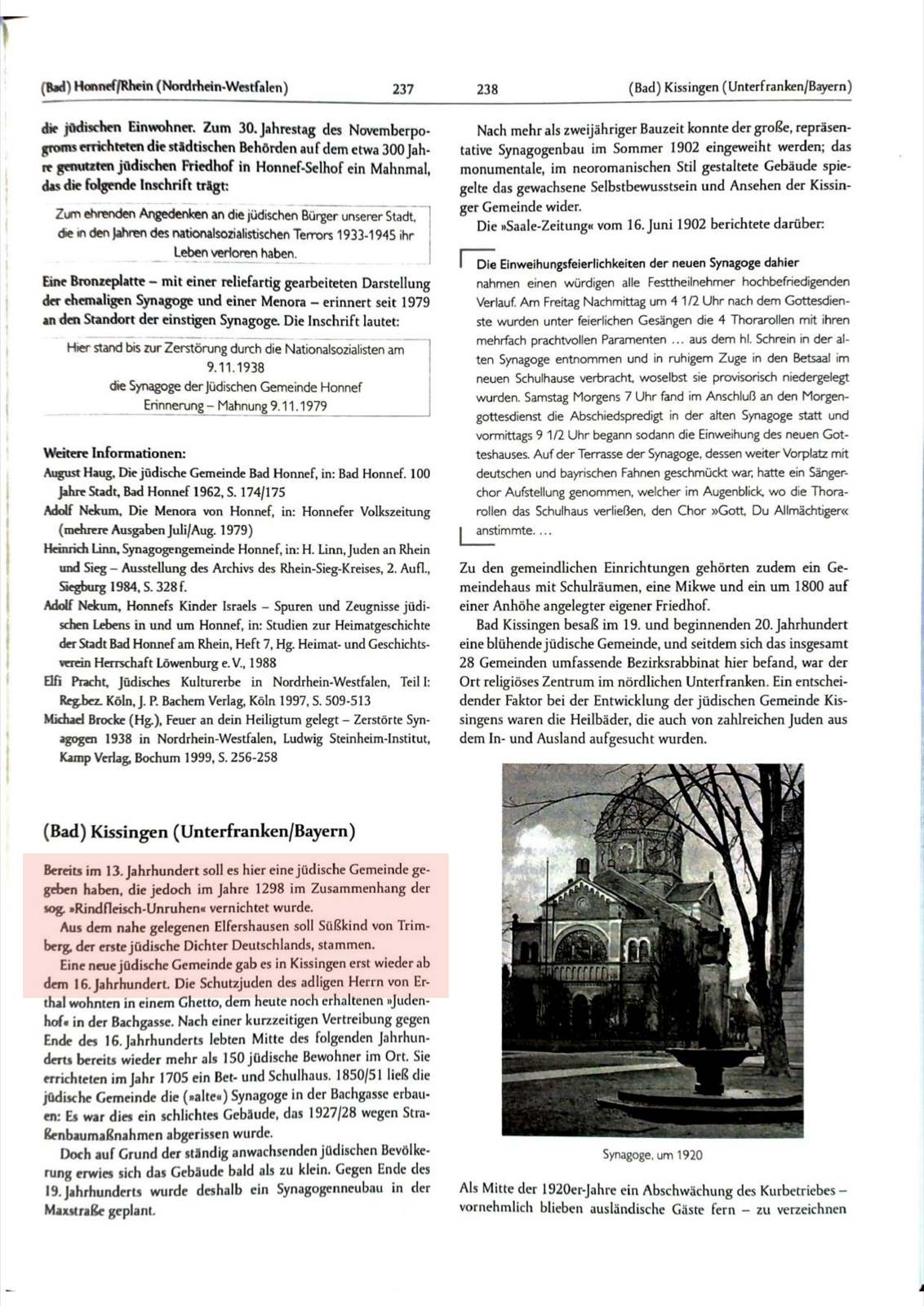
Bad Kissingen (8)
Error
Voigtländer and Voth code a "confirmed Jewish settlement" here during the Black Death. However, their sources provide "unambiguous information" that the community was destroyed before 1349.
Reality
Avneri notes a 1298 persecution.
Alicke clarifies that the community was "destroyed" („vernichtet") in 1298 and that a "new Jewish community did not appear in Kissingen until the sixteenth century" („Eine neue jüdische Gemeinde gab es in Kissingen erst wieder ab dem 16. Jahrhundert").
There is unambiguous information that there was no Jewish community in the town during the Black Death.
Correction
EXIST1349 1 -> 0
Sources:
Avneri · Page 401
Alicke · Page 237
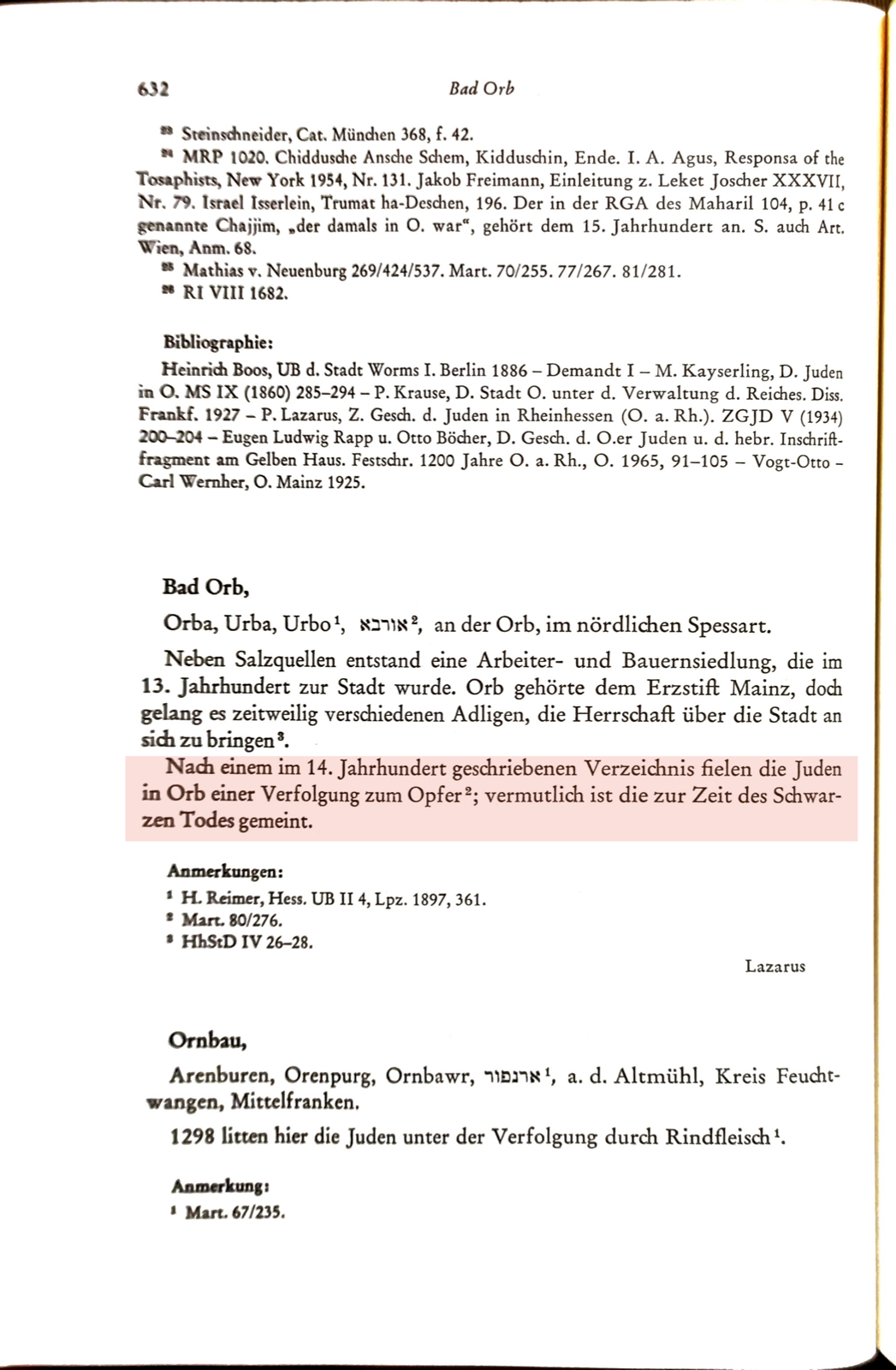
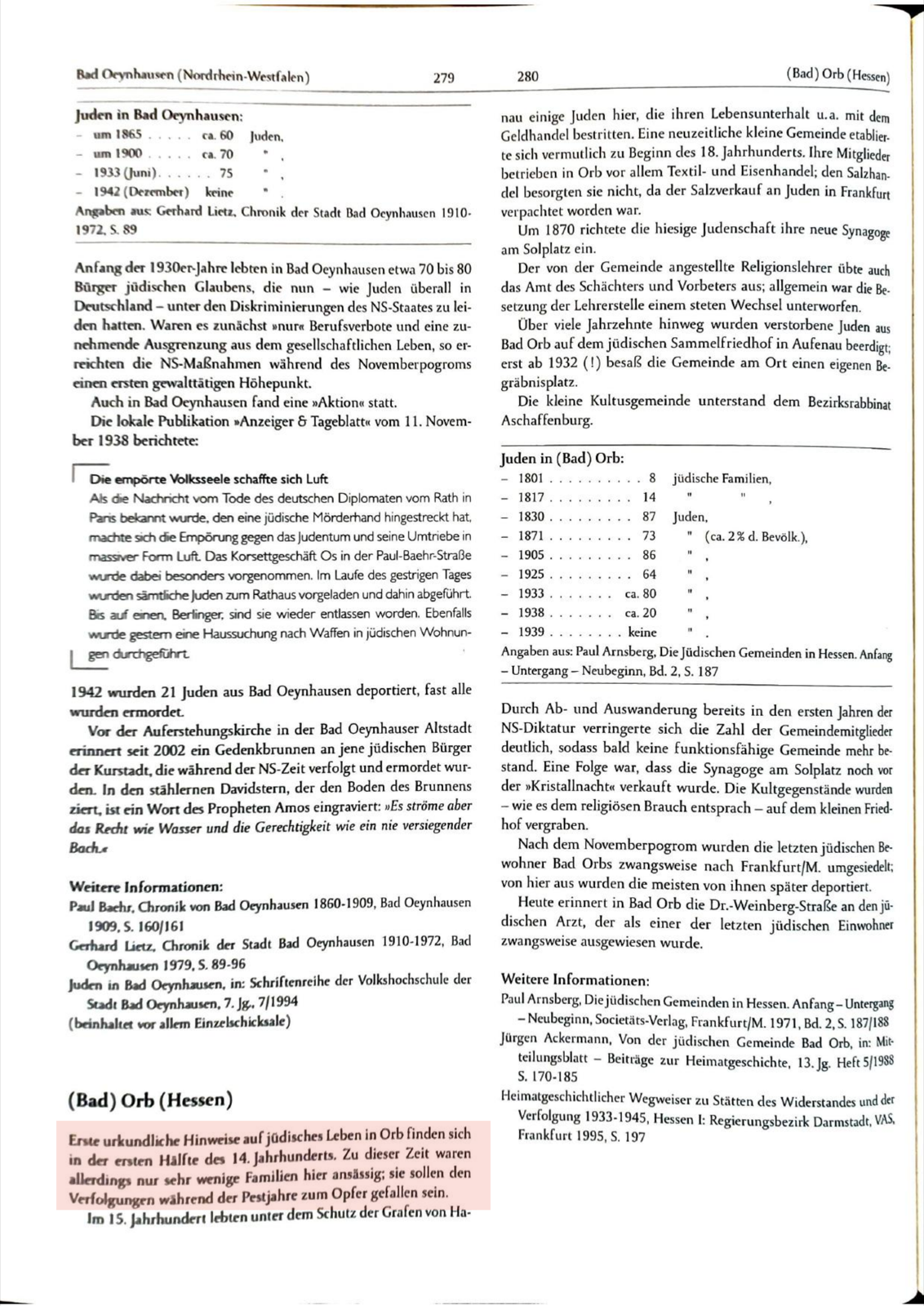
Bad Orb (9)
Error
Voigtländer and Voth failed to code a pogrom here during the Black Death, despite their rule to code as unity if the sources mention "violent attacks" or "extermination".
Reality
Avneri states that according to a record, Jews in Orb "fell victim to persecution" („fielen [...] einer Verfolgung zum Opfer"), presumably during the plague.
Alicke also notes that they "are said to have fallen victim to the persecutions during the plague years" („sie sollen den Verfolgungen während der Pestjahre zum Opfer gefallen sein").
The occurrence of a pogrom is confirmed by the sources.
Correction
POG1349 NA -> 1
Sources:
Avneri · Page 632
Alicke · Page 279
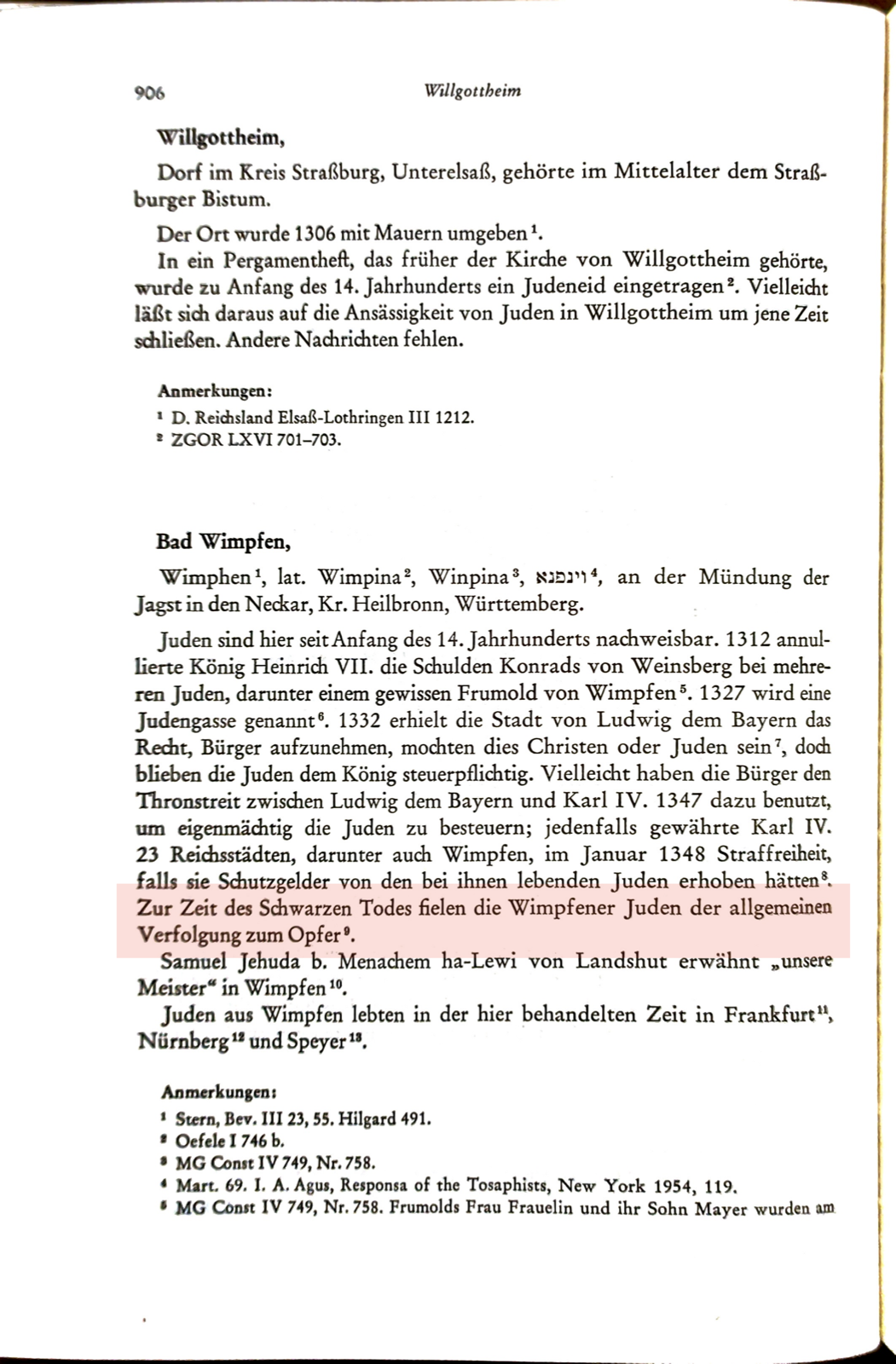
Bad Wimpfen (10)
Error
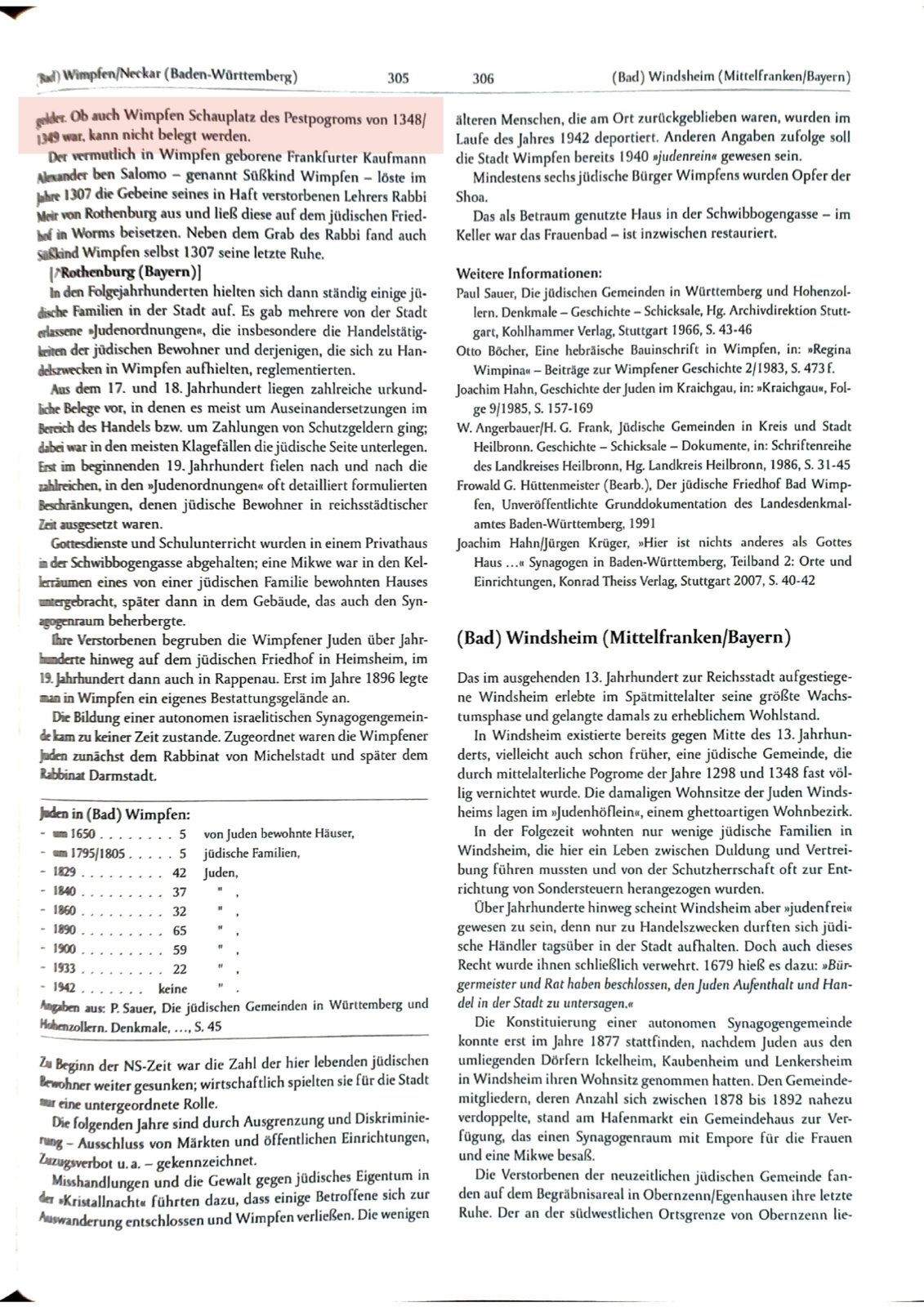
Voigtländer and Voth code "unambiguous information" of a pogrom here during the Black Death, but their sources indicate ambiguity.
Reality
Avneri mentions a general persecution.
However, Alicke explicitly states that "whether Wimpfen was also the scene of the plague pogrom of 1348/1349 cannot be proven" („Ob auch Wimpfen Schauplatz des Pestpogroms von 1348/1349 war, kann nicht belegt werden").
There is ambiguity over whether or not there was a pogrom.
Correction
POG1349 1 -> NA
Sources:
Avneri · Page 906
Alicke · Page 305
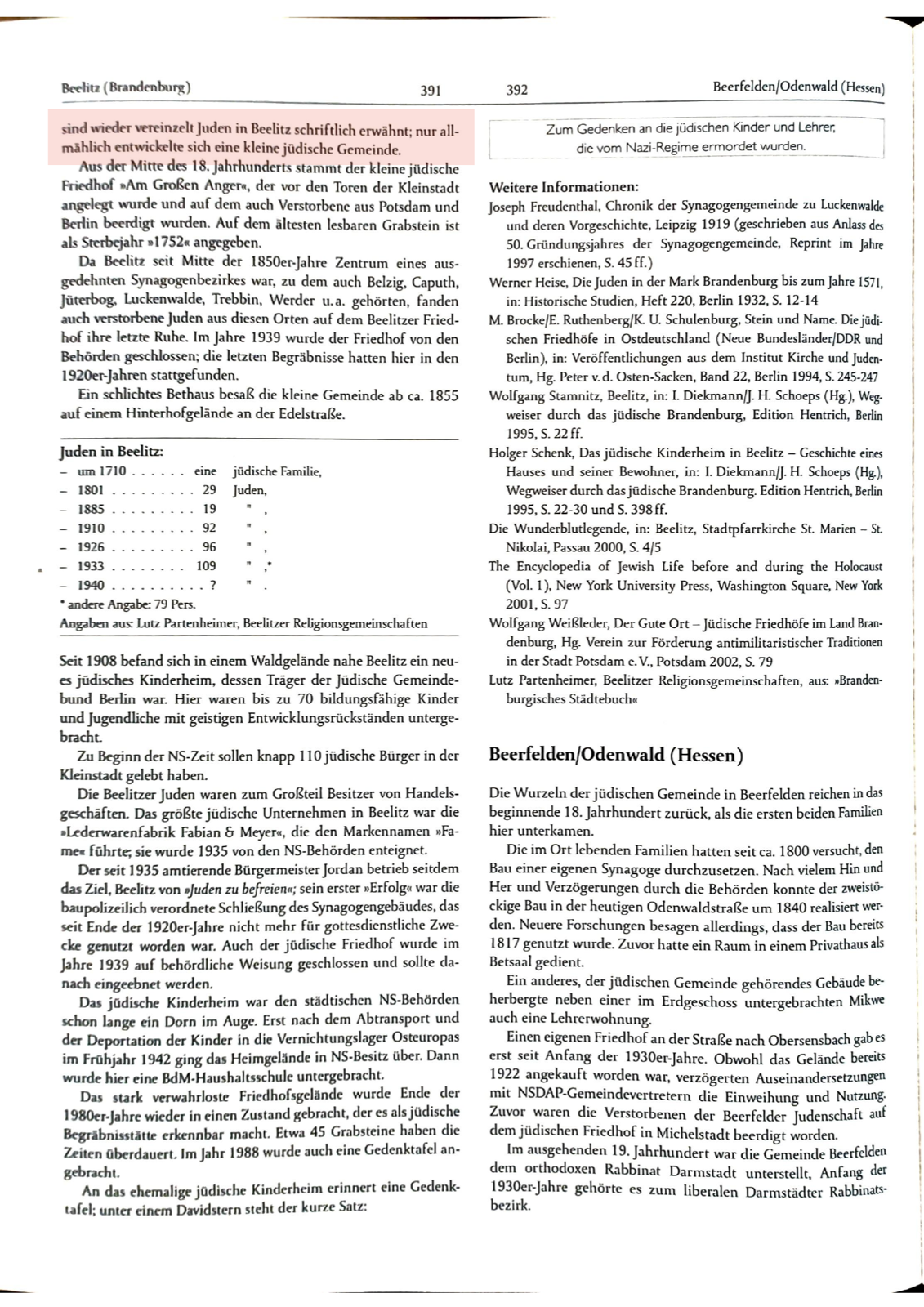
Beelitz (11 & 12)
Error
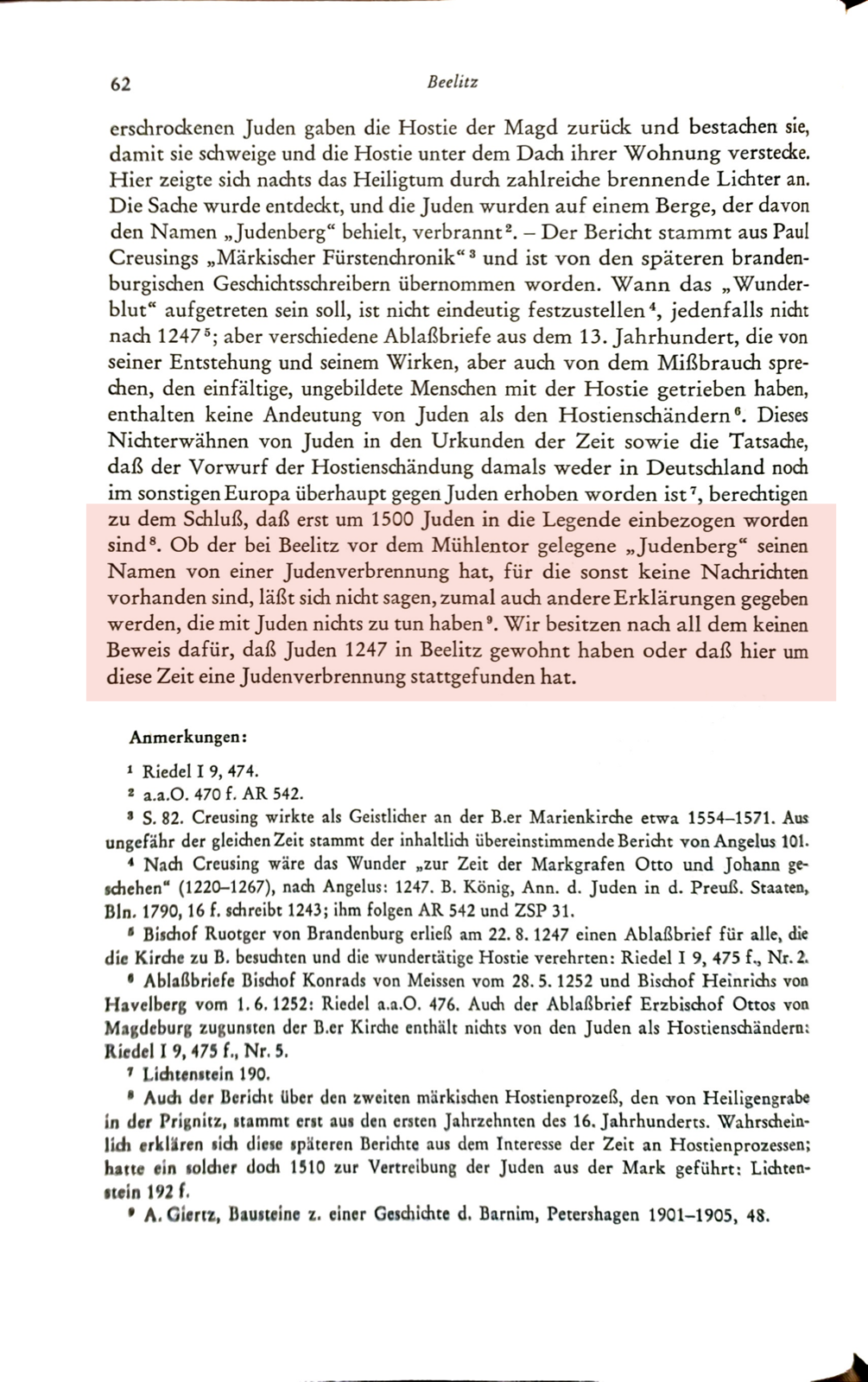
Voigtländer and Voth code a "confirmed Jewish settlement" here during the Black Death, but their sources do not provide "unambiguous information" to support this.
Reality
Avneri concludes there is "no proof that Jews lived in Beelitz in 1247" („keinen Beweis dafür, daß Juden 1247 in Beelitz gewohnt haben").
Alicke adds that Jews only reappear in records 500 years later.
The existence of a Jewish community during the Black Death is uncertain.
Correction
EXIST1349 1 -> NA; POG1349 0 -> NA
Sources:
Avneri · Page 62
Alicke · Page 390
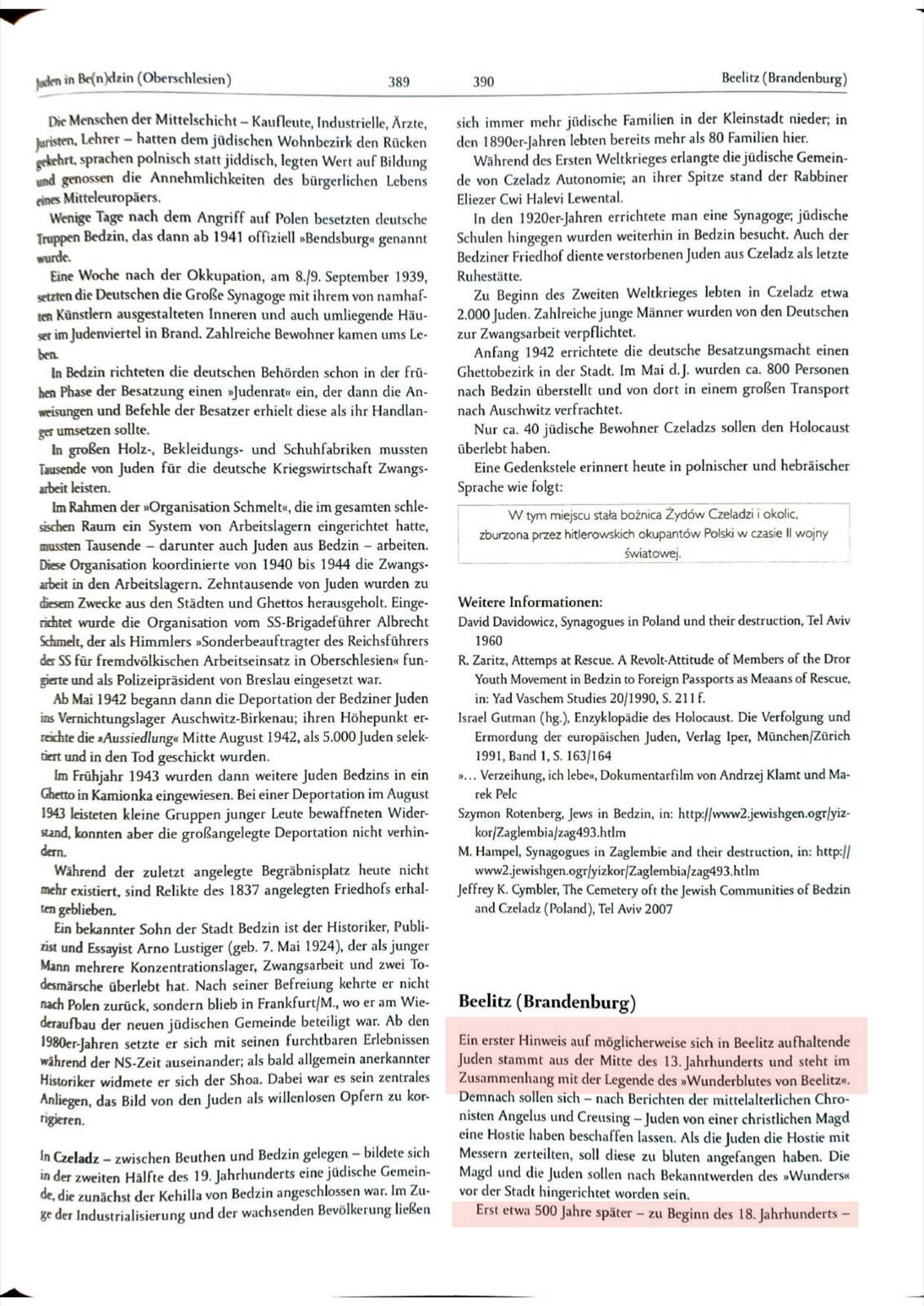
Alicke · Page 391
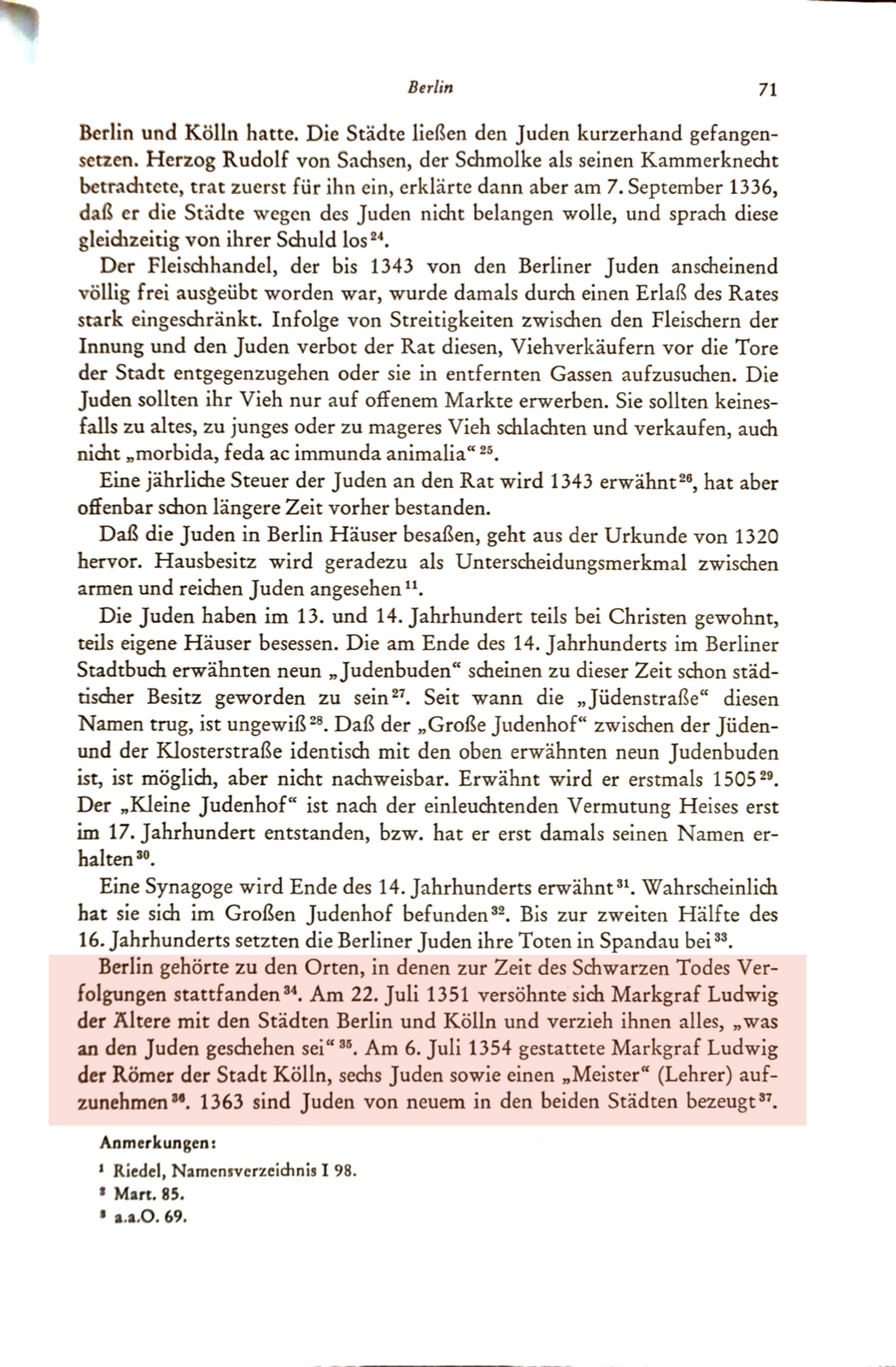
Berlin (13 & 14)
Error
Voigtländer and Voth failed to code a "confirmed Jewish settlement" here during the Black Death, despite "unambiguous information" in their sources.
Reality
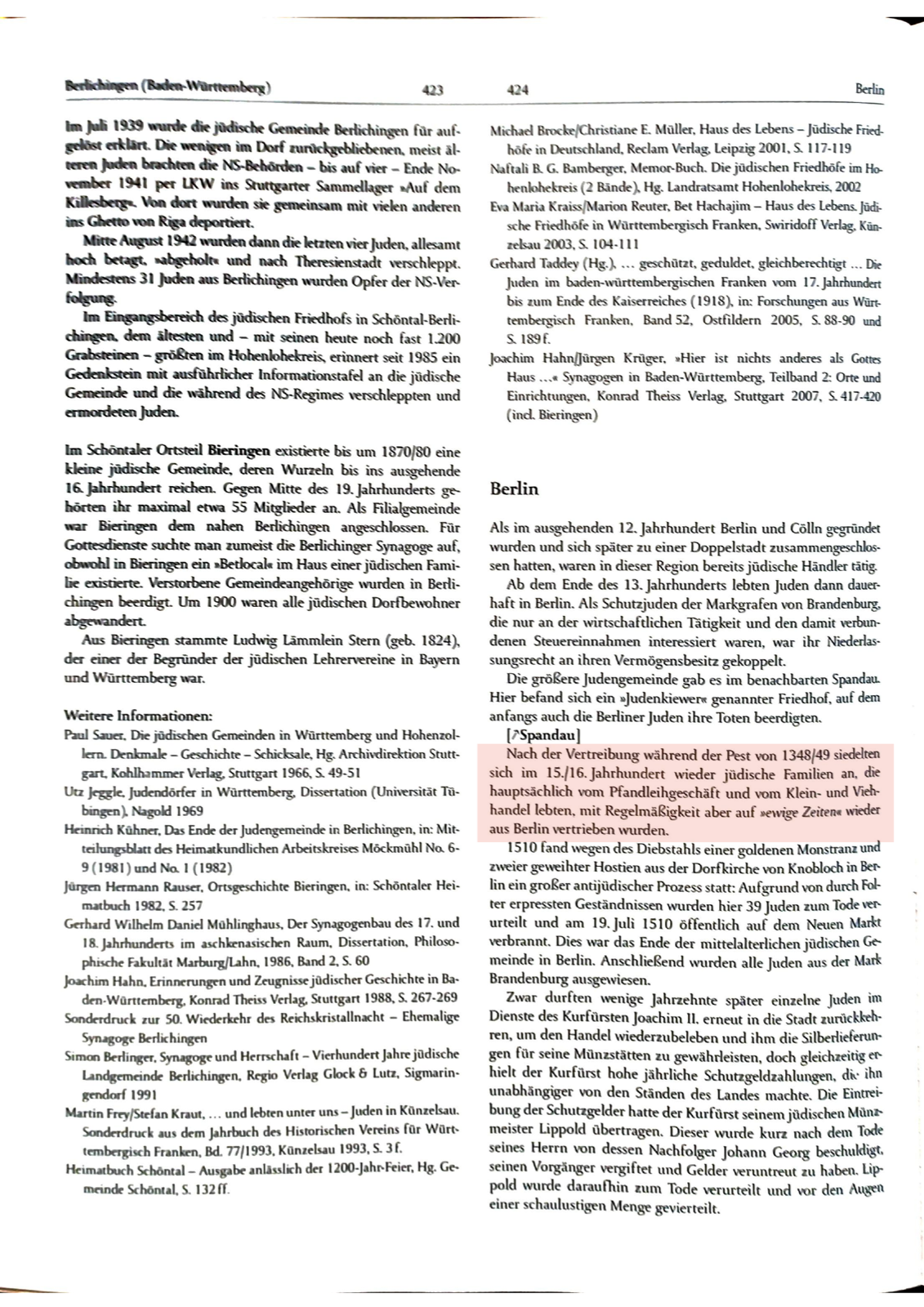
Avneri and Alicke both document a permanent Jewish residence in Berlin since at least 1295, including persecution during the Black Death.
There is unambiguous evidence that there was a Jewish community in the town during the Black Death.
Correction
EXIST1349 0 -> 1; POG1349 0 -> 1
Sources:
Avneri · Page 71
Alicke · Page 424
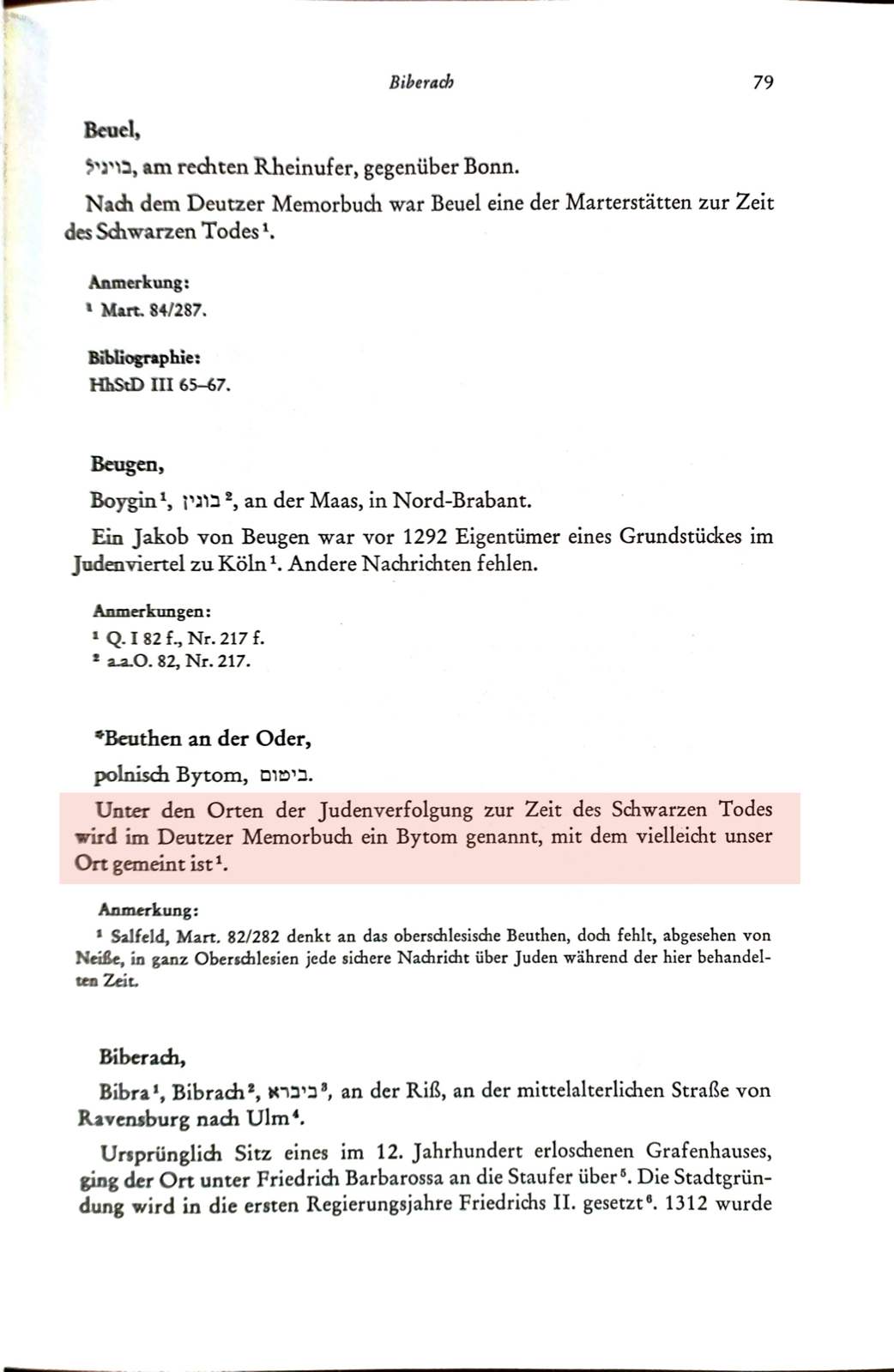
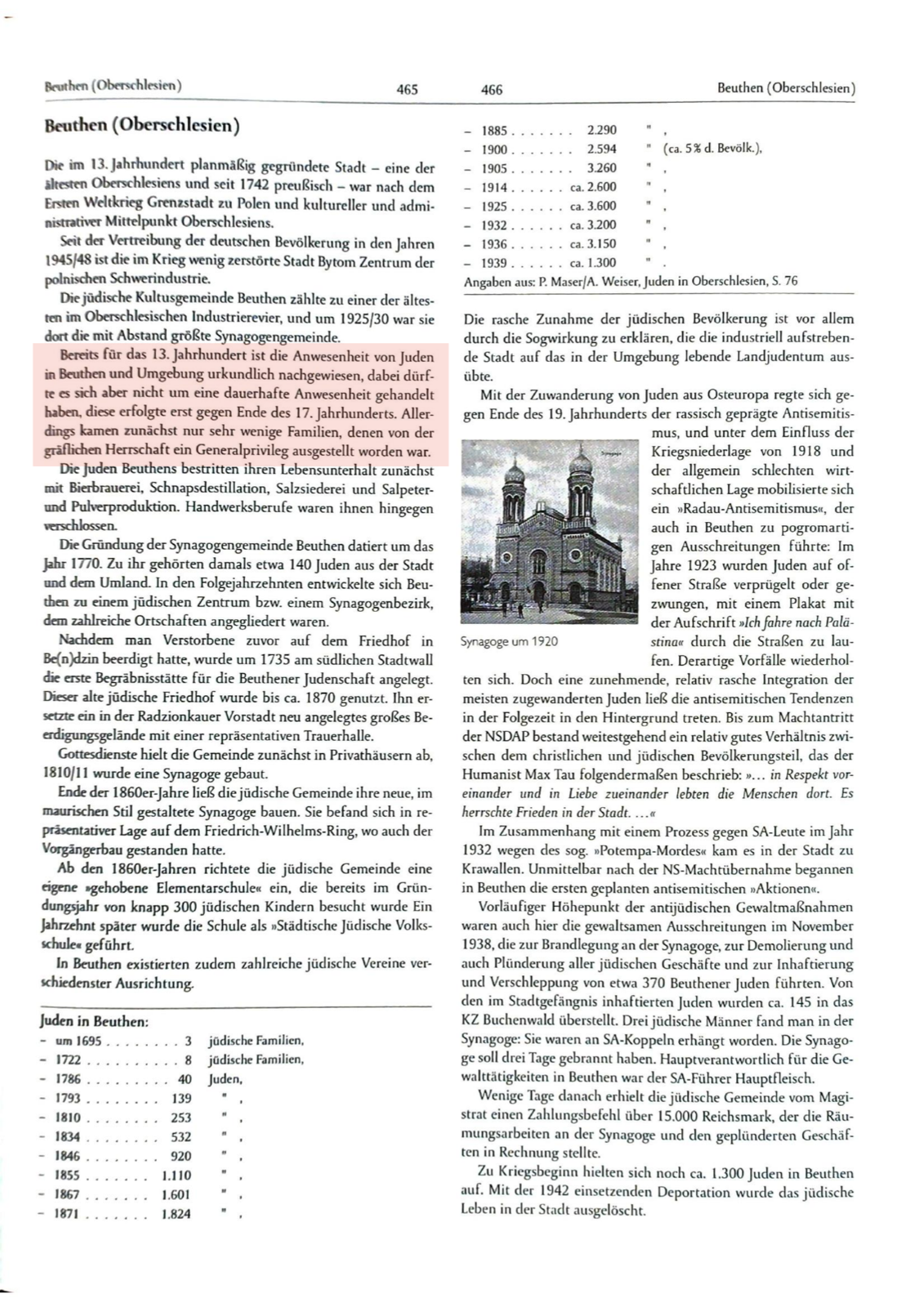
Beuthen (15 & 16)
Error
Voigtländer and Voth claim "unambiguous information" of a confirmed Jewish settlement in Beuthen during the Black Death.
Reality
Avneri notes that a mention of "Bytom" in the Deutz Memorbuch only "perhaps refers" („vielleicht [...] gemeint ist") to this town.
Alicke states that a permanent presence only began at the end of the 17th century.
The presence of a community during the Black Death is uncertain and not "unambiguous".
Correction
EXIST1349 1 -> NA; POG1349 0 -> NA
Sources:
Avneri · Page 79
Alicke · Page 465
Bockenheim a. d. Weinstrasse (17 & 18)
Error
Voigtländer and Voth claim "unambiguous information" of a confirmed Jewish settlement in Bockenheim during the Black Death.
Reality
Avneri mentions a 1309 tax record but notes that "other reports are missing" („Andere Nachrichten fehlen").
Alicke adds that documentary evidence of a permanent community only starts in 1548.
There is no unambiguous evidence that there was a Jewish community in the town during the Black Death.
Correction
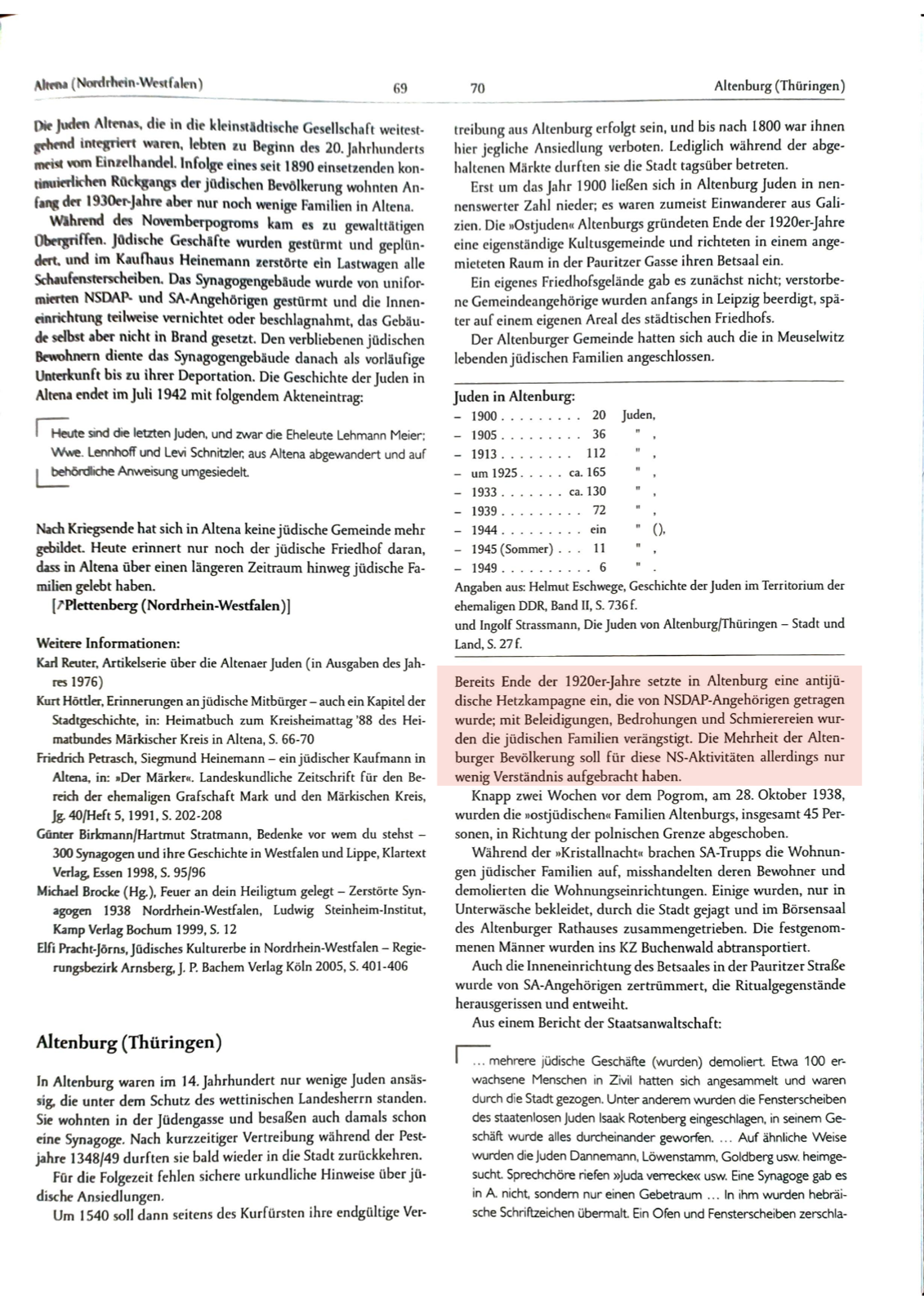
EXIST1349 1 -> NA; POG1349 0 -> NA
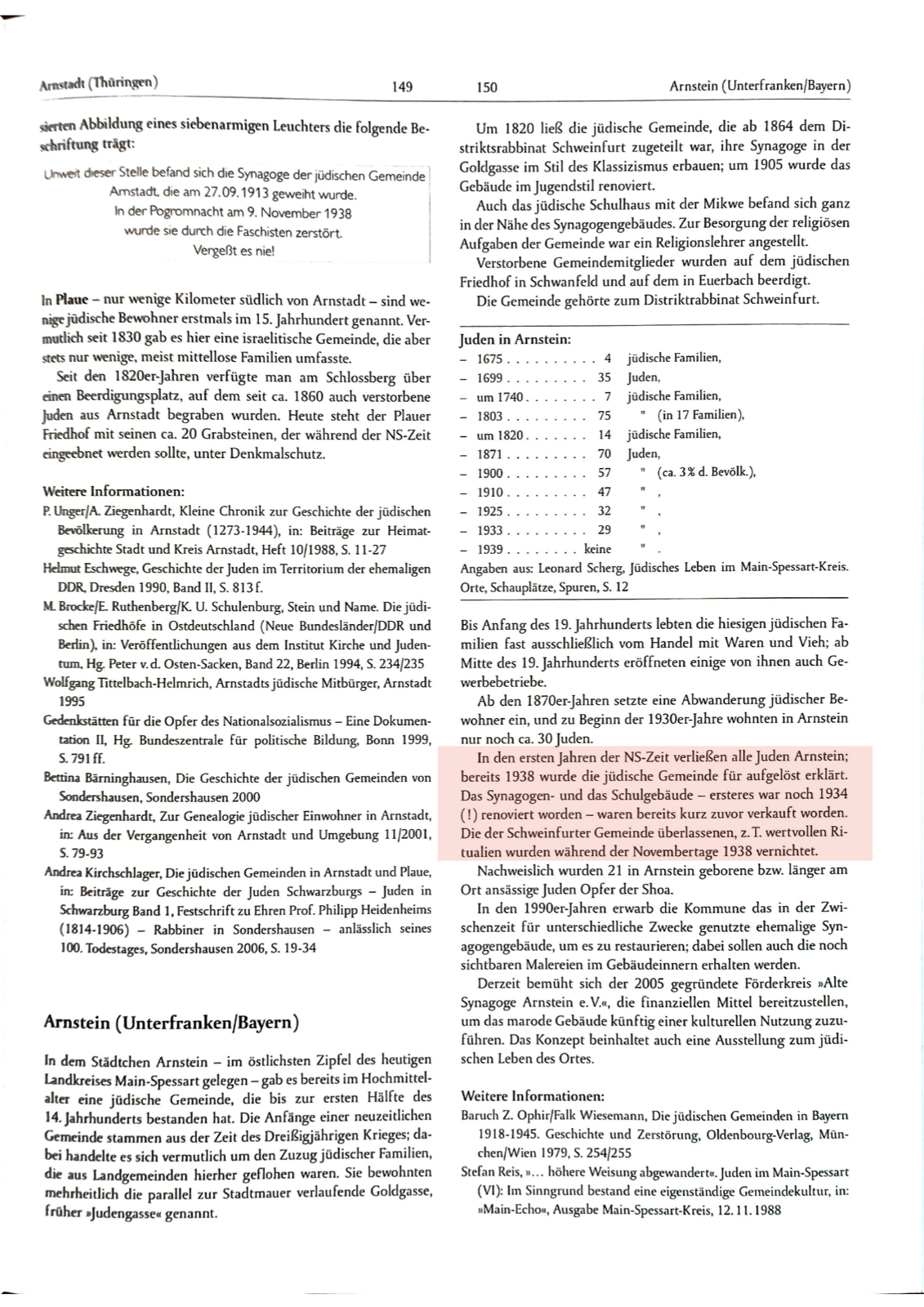
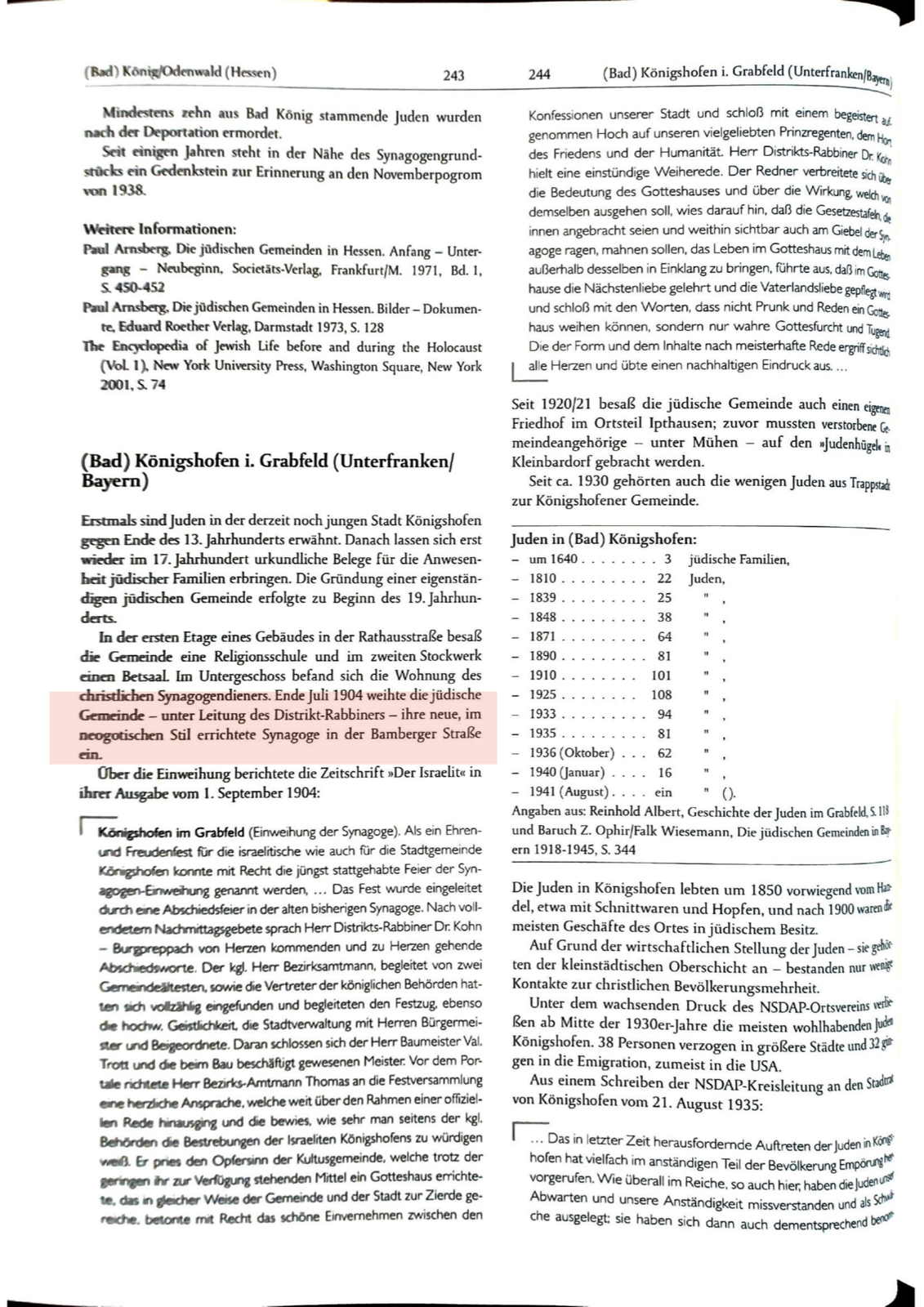
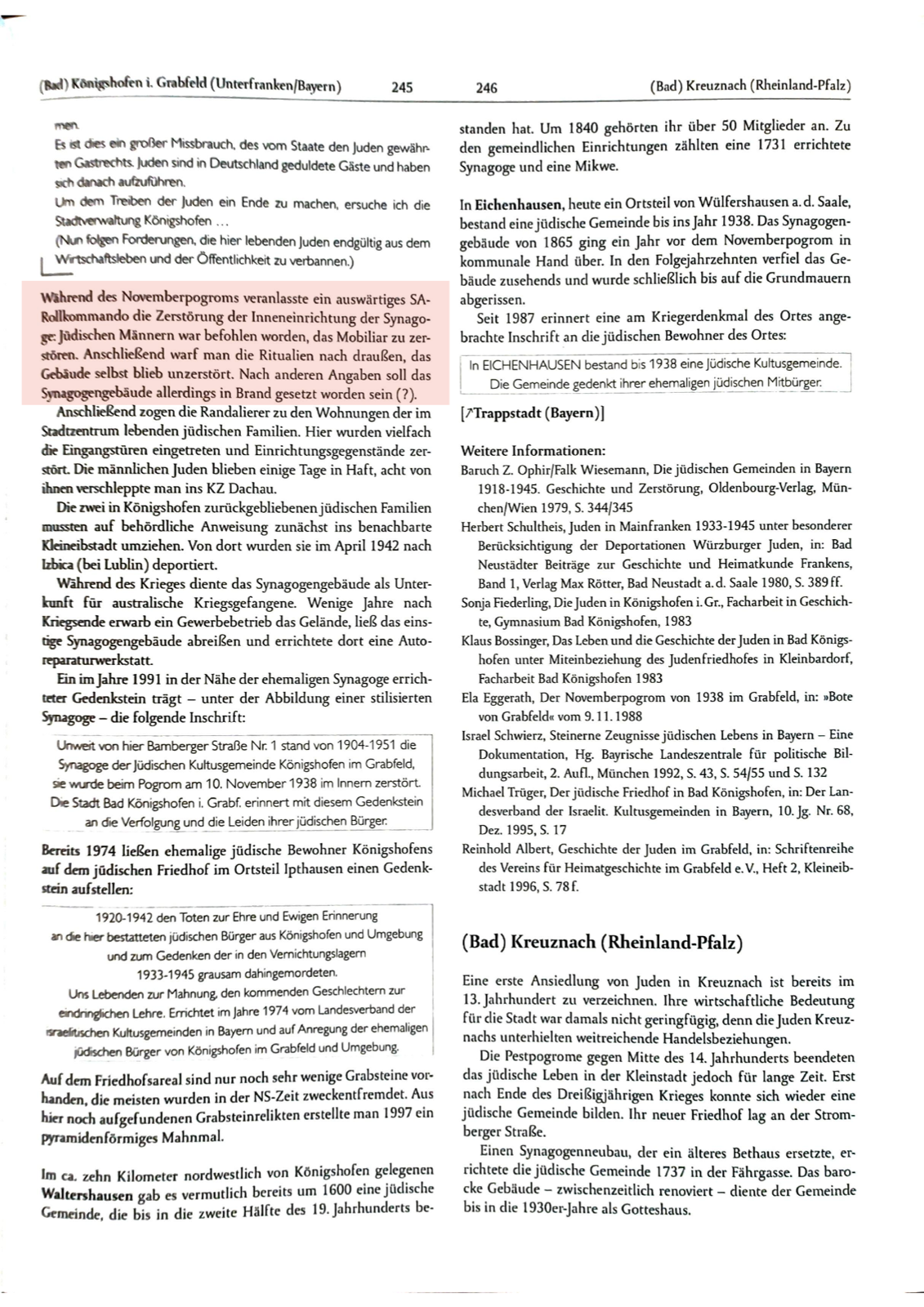
Sources:
Avneri · Page 90
Alicke · Page 554
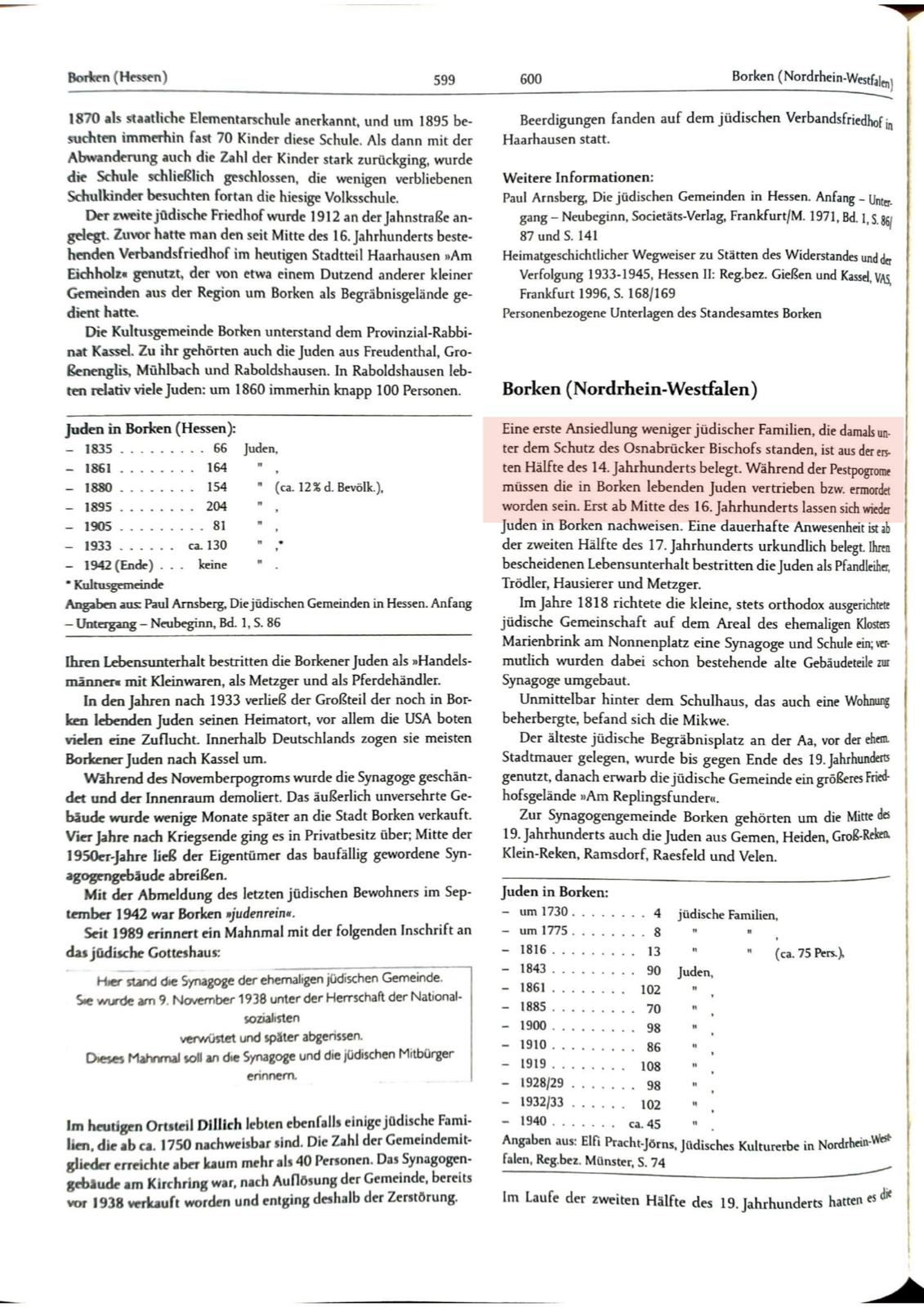
Borken (19)
Error
Voigtländer and Voth failed to code a pogrom in Borken, despite their rule to code as unity if GJ or Alicke mentions "violent attacks" or "extermination".
Reality
While early reports are sparse,
Alicke explicitly states that "[d]uring the plague pogroms, the Jews living in Borken must have been expelled or murdered" („Während der Pestpogrome müssen die in Borken lebenden Juden vertrieben bzw. ermordet worden sein").
The occurrence of a pogrom is confirmed by the evidence.
Correction
POG1349 NA -> 1
Sources:
Avneri · Page 97
Alicke · Page 600
Brühl (20)
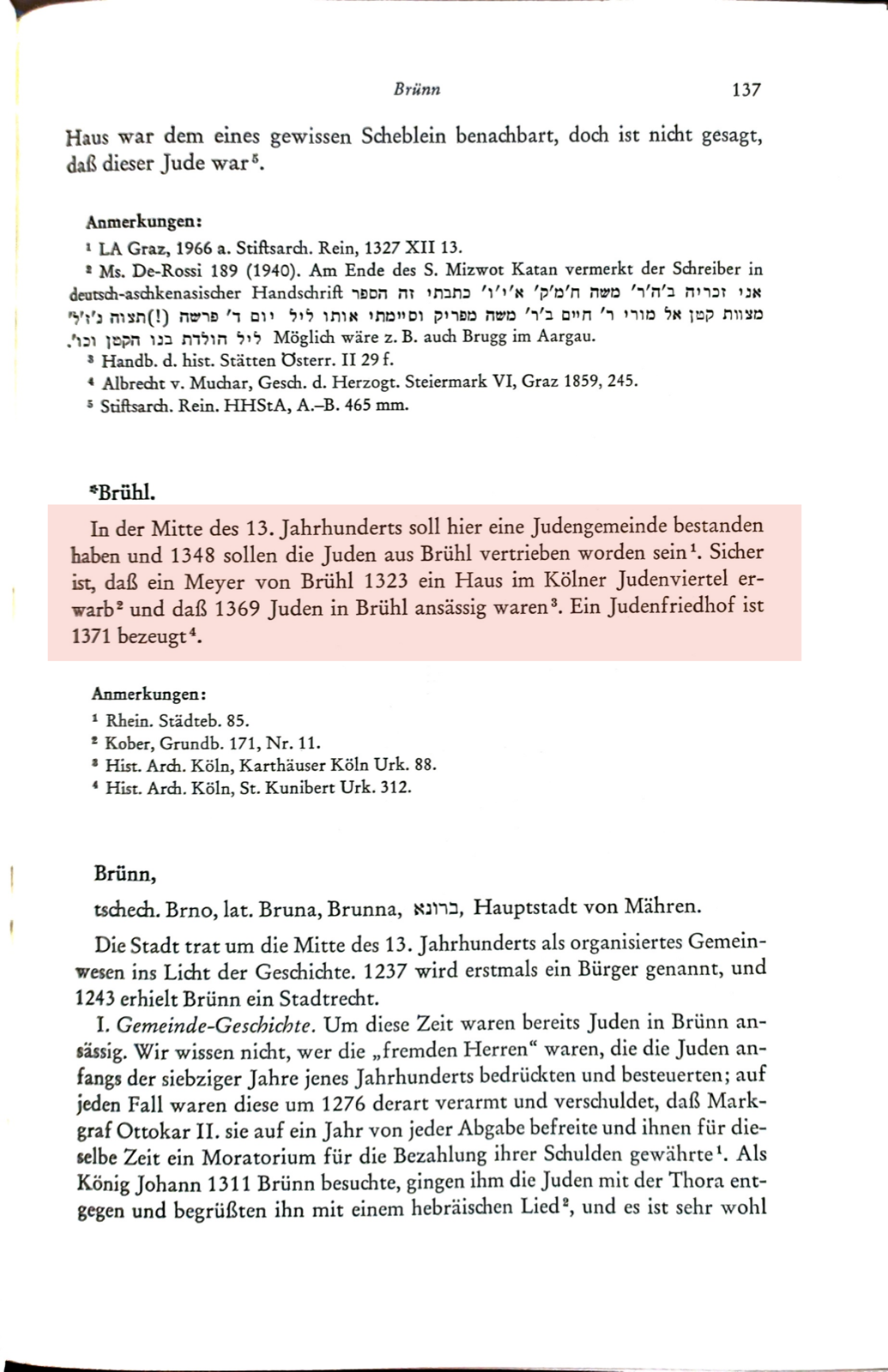
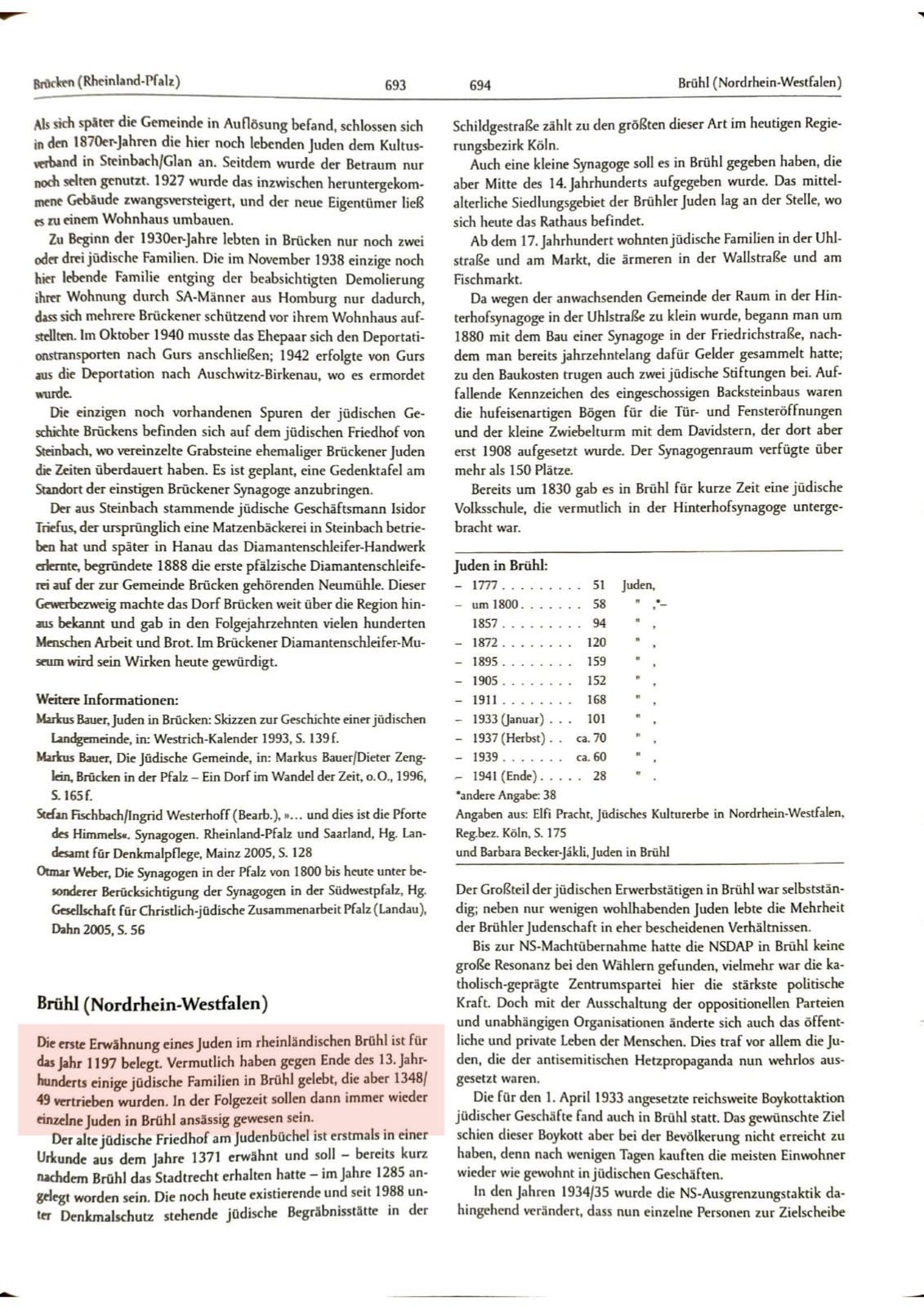
Error
Voigtländer and Voth failed to code a pogrom in Brühl, despite their rule that a mention of expulsion or murder should be coded as unity.
Reality
Avneri reports that in 1348 "the Jews are said to have been expelled from Brühl".
Alicke confirms they "were expelled in 1348/49" (1348/49 vertrieben wurden).
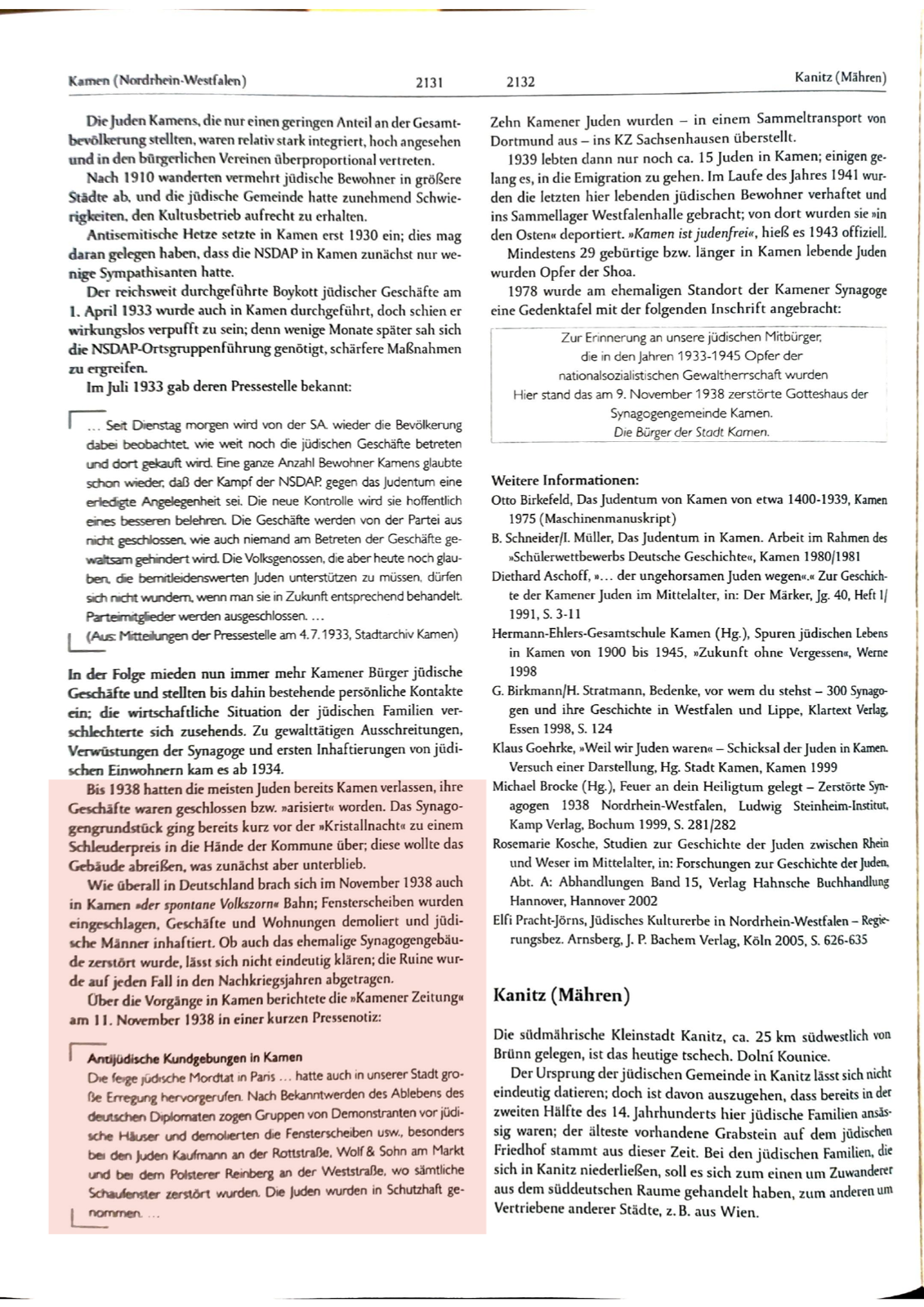
The occurrence of a pogrom is confirmed by the evidence.
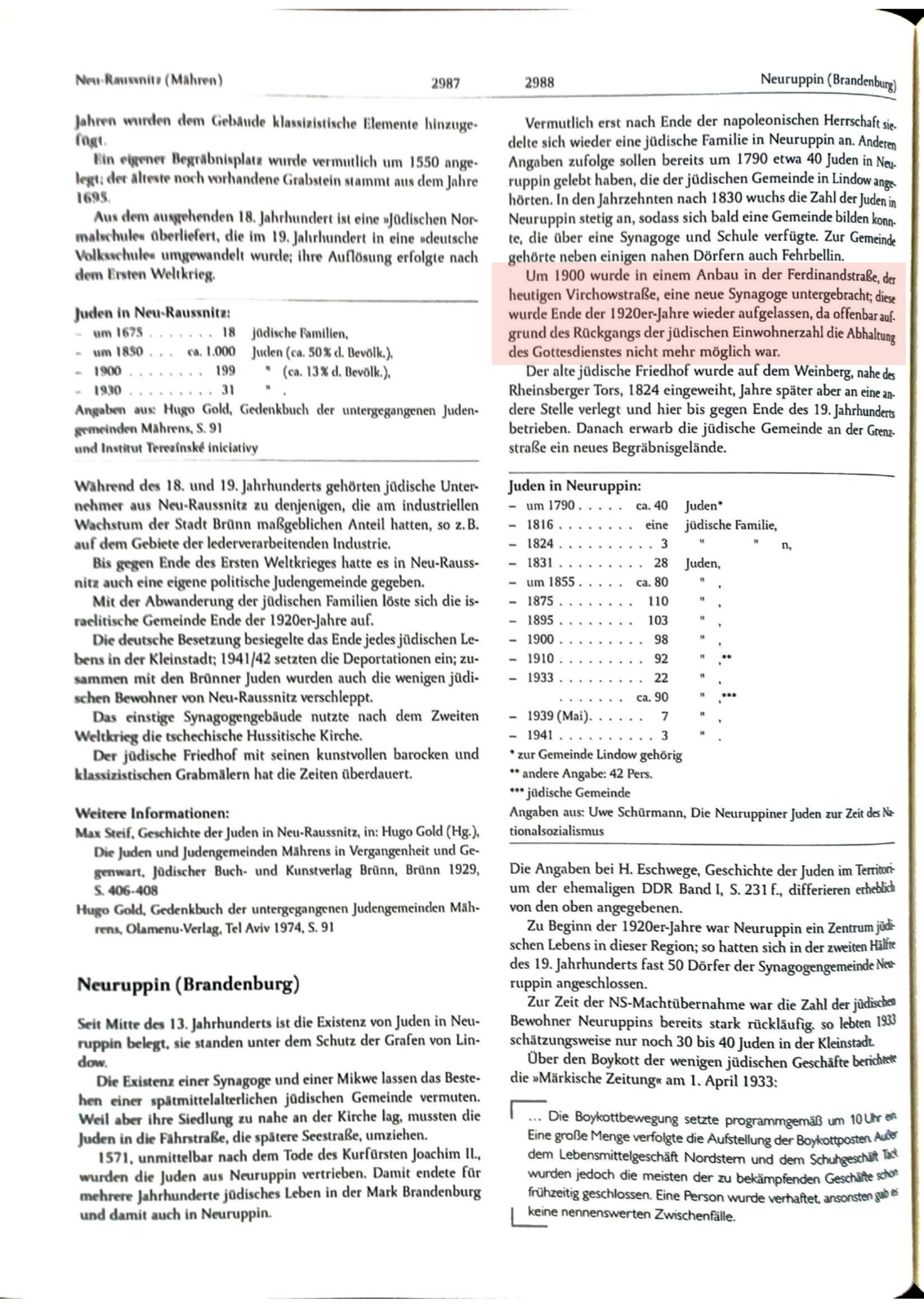
Correction
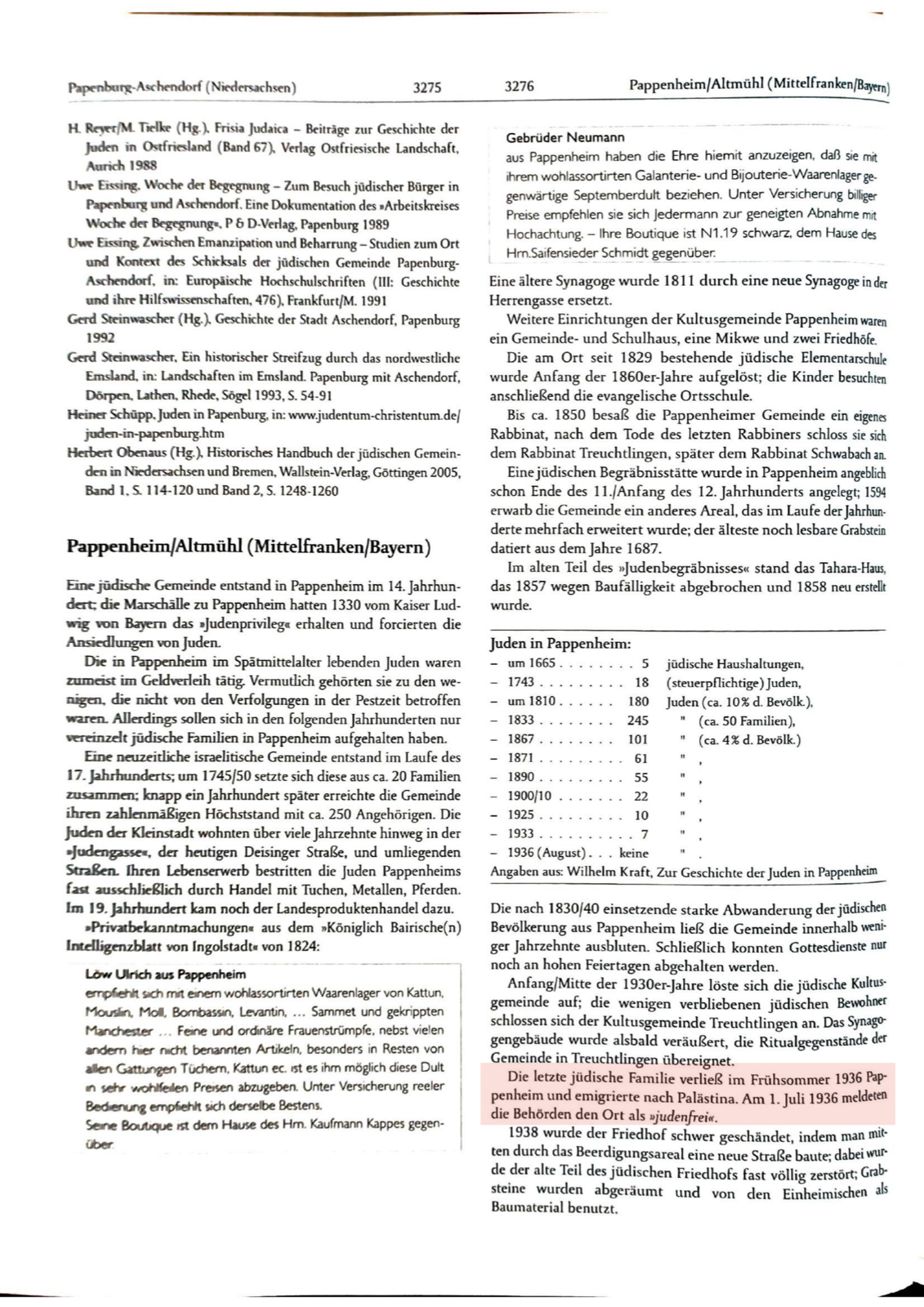
POG1349 NA -> 1
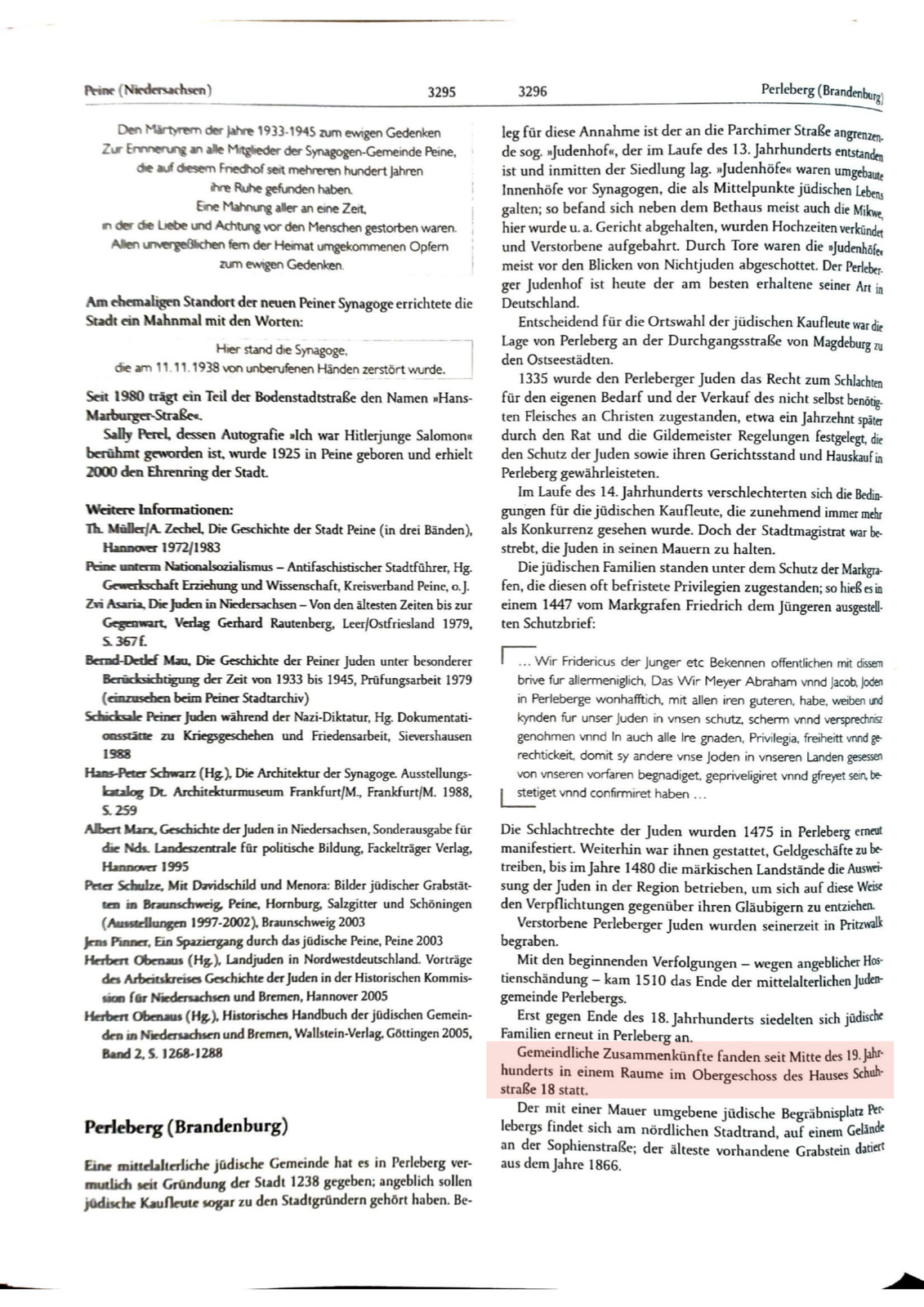
Sources:
Avneri · Page 137
Alicke · Page 693
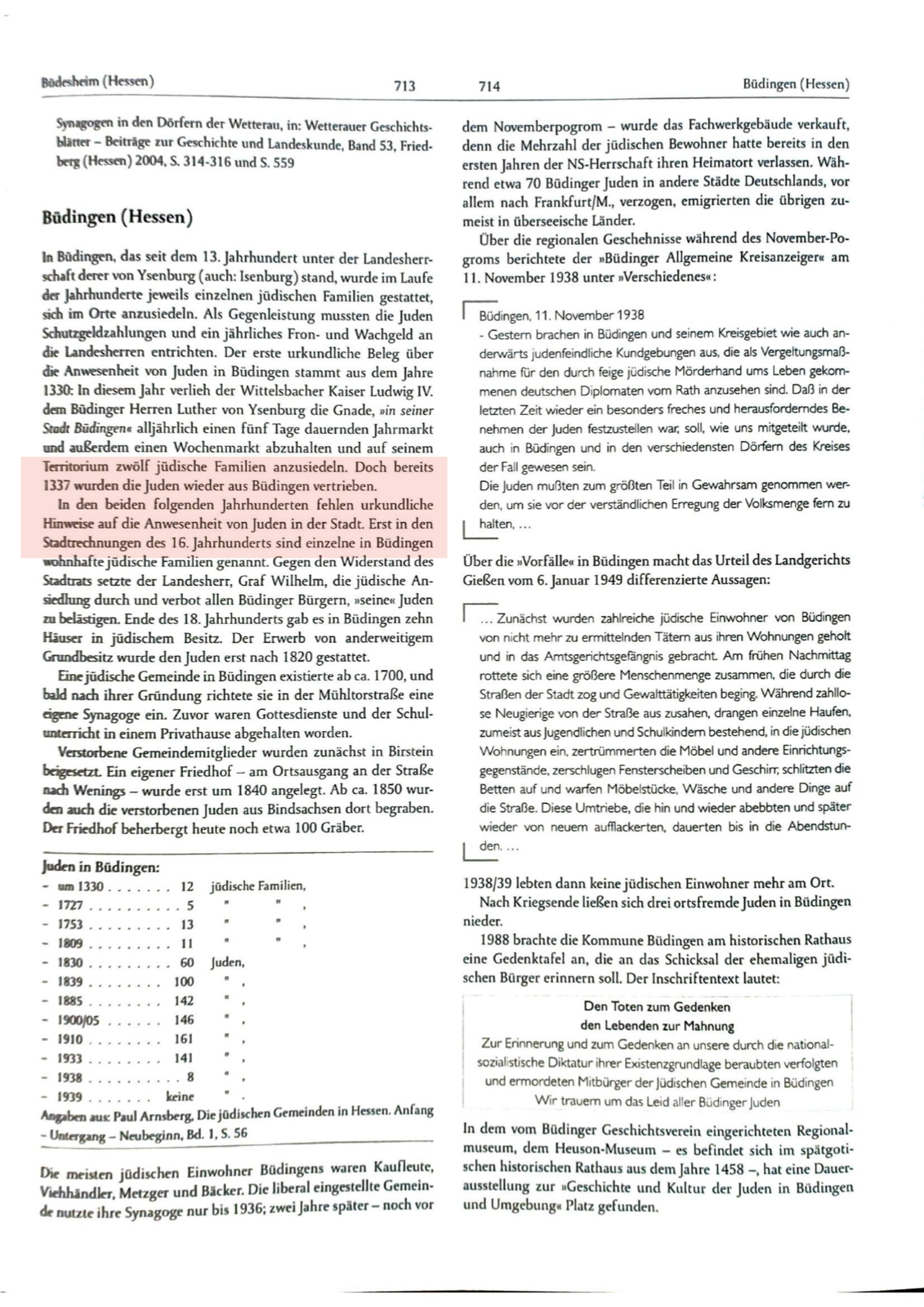
Büdingen (21)
Error
Voigtländer and Voth claim "unambiguous information" of a confirmed Jewish settlement in Büdingen during the Black Death.
Reality
Avneri states that after 1337 "all news of Jews in the city was missing for a long time" („seitdem fehlte lange Zeit jede Nachricht von Juden in der Stadt").
Alicke corroborates that documentary evidence of a community is missing for the next two centuries.
There is unambiguous information that there was no Jewish community in the town during the Black Death.
Correction
EXIST1349 1 -> 0
Sources:
Avneri · Page 142
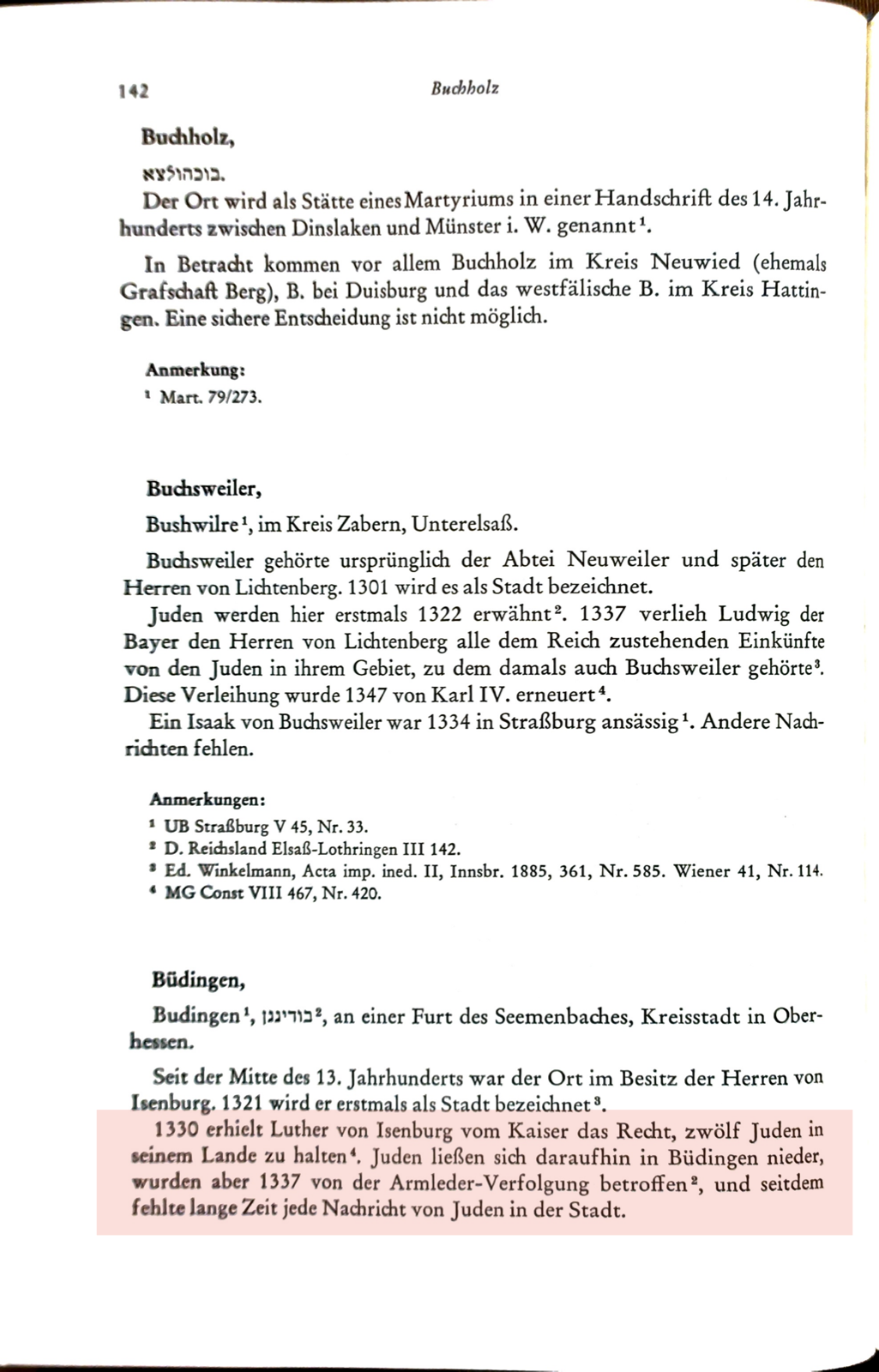
Alicke · Page 713
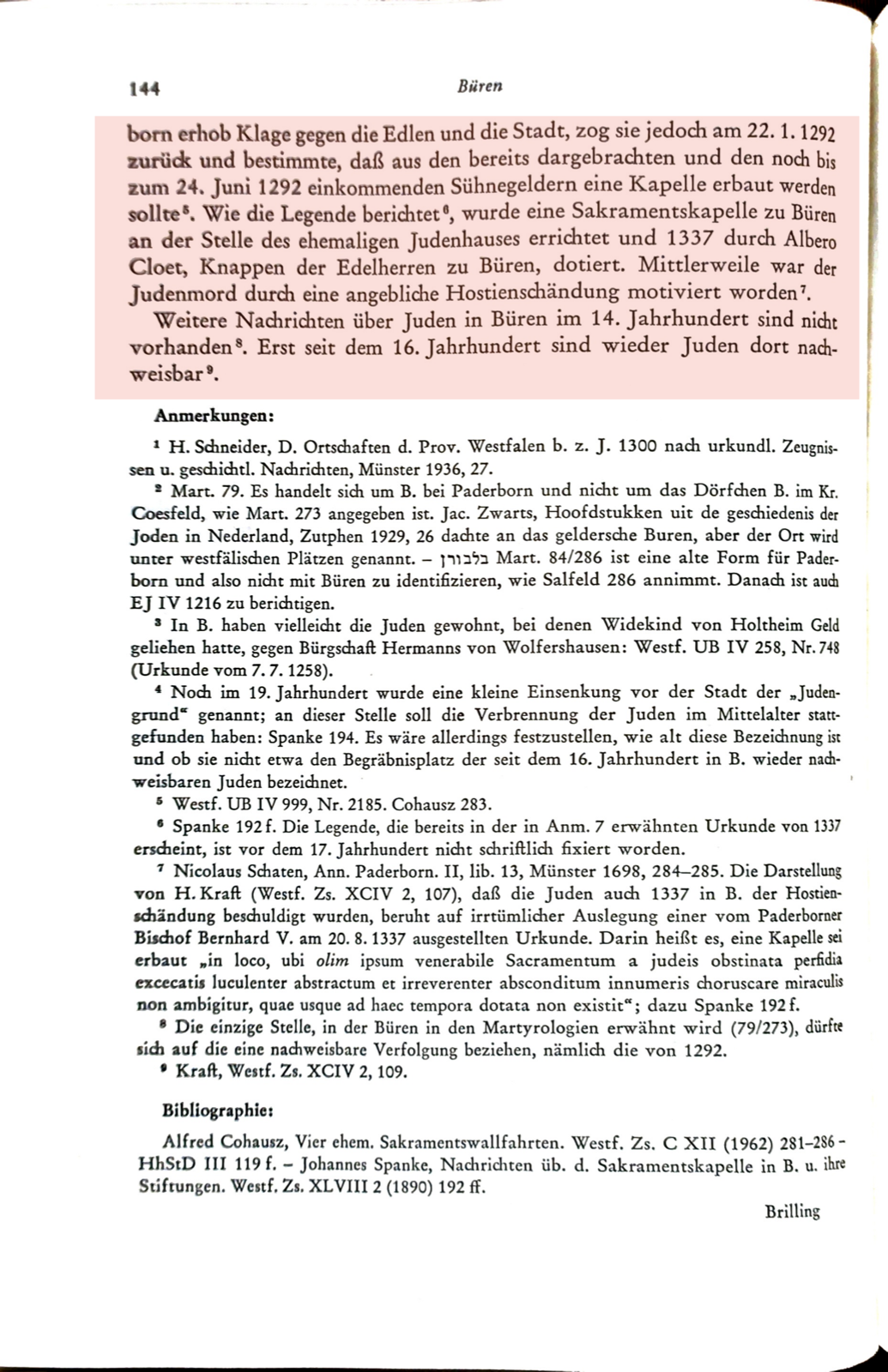
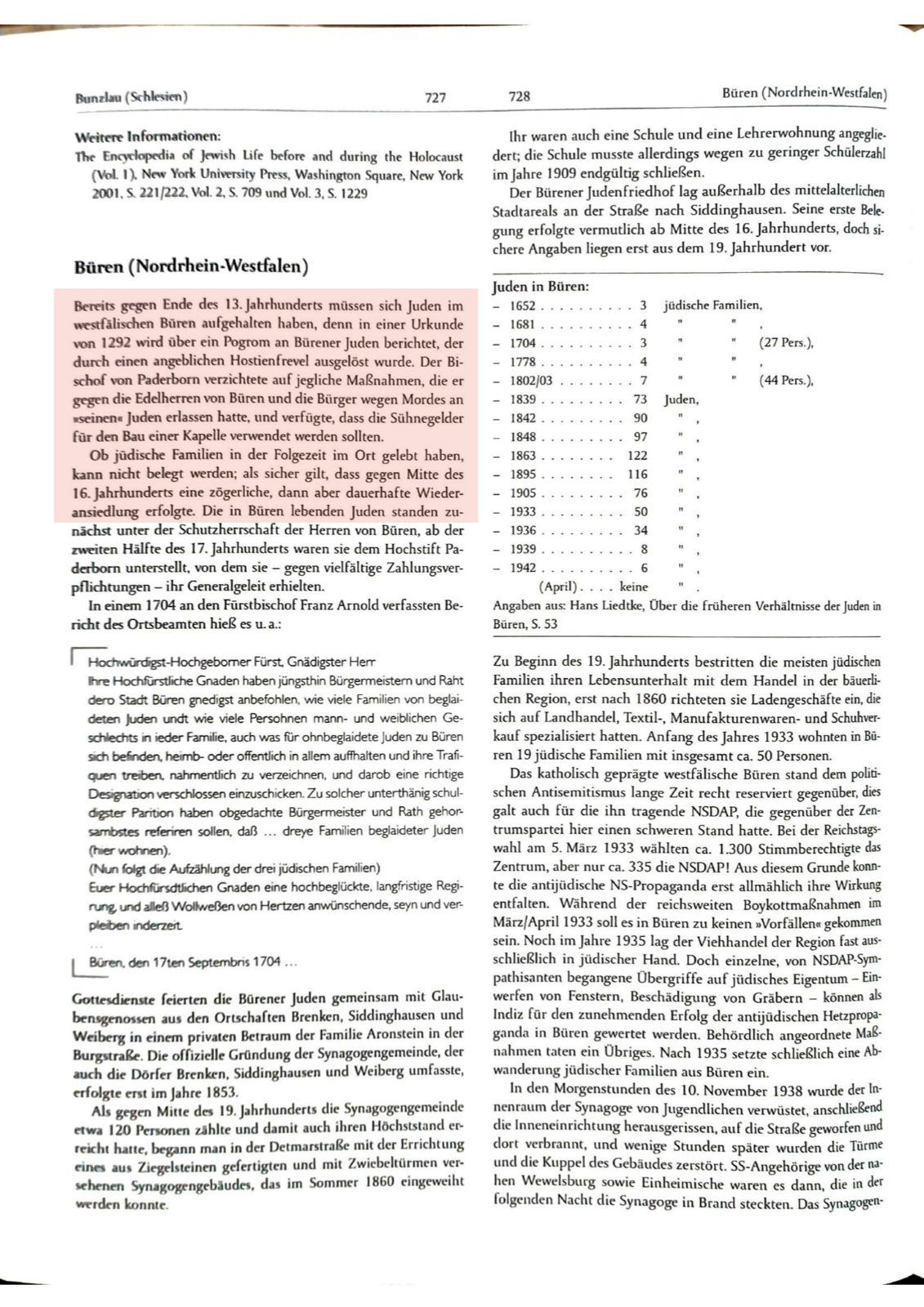
Büren (22 & 23)
Error
Voigtländer and Voth claim "unambiguous information" of a confirmed Jewish settlement in Büren during the Black Death.
Reality
Avneri notes that "further news about Jews in Büren in the fourteenth century is not available" („Weitere Nachrichten über Juden in Büren im 14. Jahrhundert sind nicht vorhanden").
Alicke corroborates that a settlement "cannot be proven" („kann nicht belegt werden").
The existence of a Jewish community during the Black Death is uncertain.
Correction
EXIST1349 1 -> NA; POG1349 0 -> NA
Sources:
Avneri · Page 143
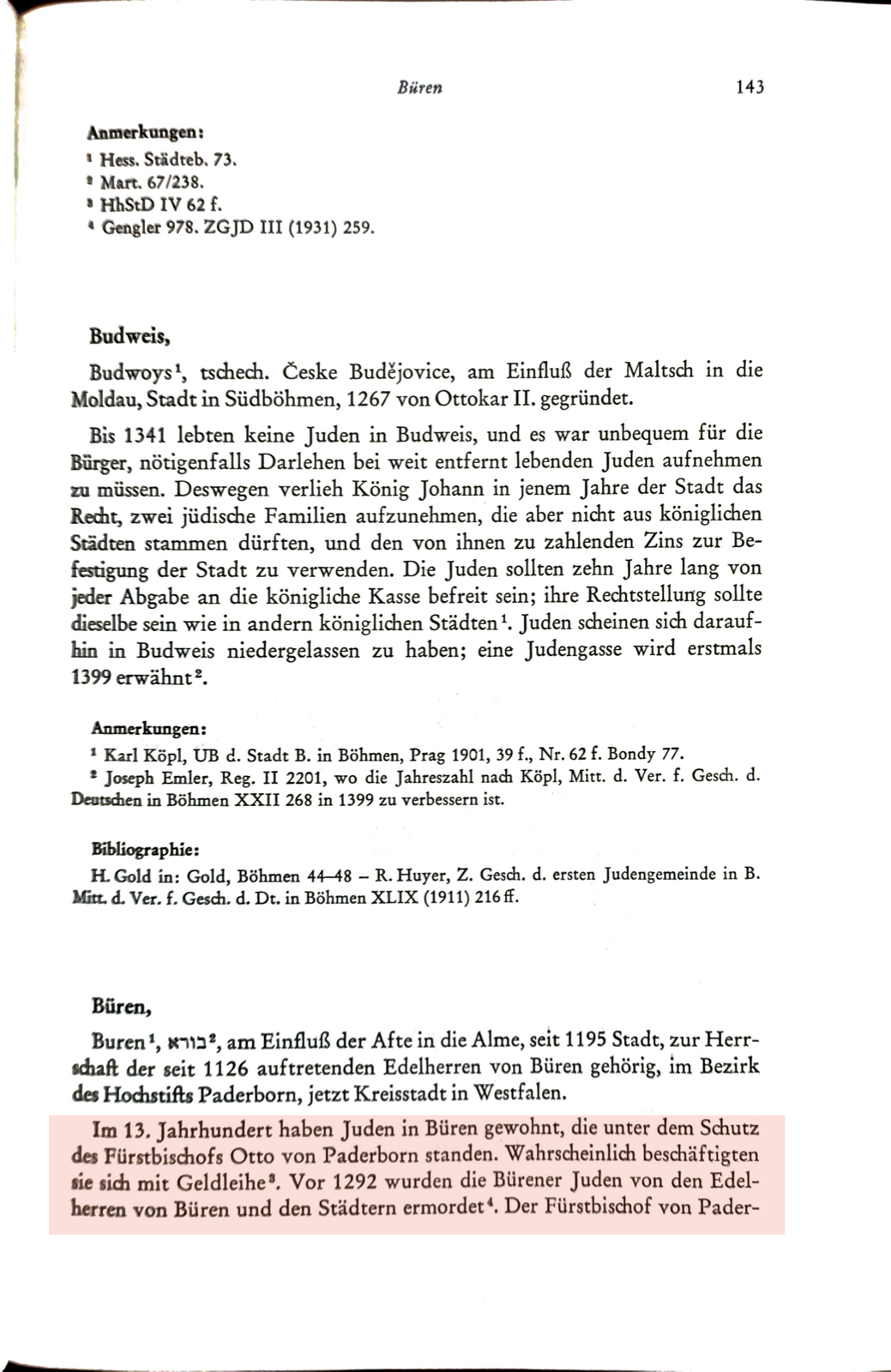
Avneri · Page 144
Alicke · Page 727
Burg (24 & 25)
Error
Voigtländer and Voth claim there is no "unambiguous information" of a confirmed Jewish settlement in Burg during the Black Death.
Reality
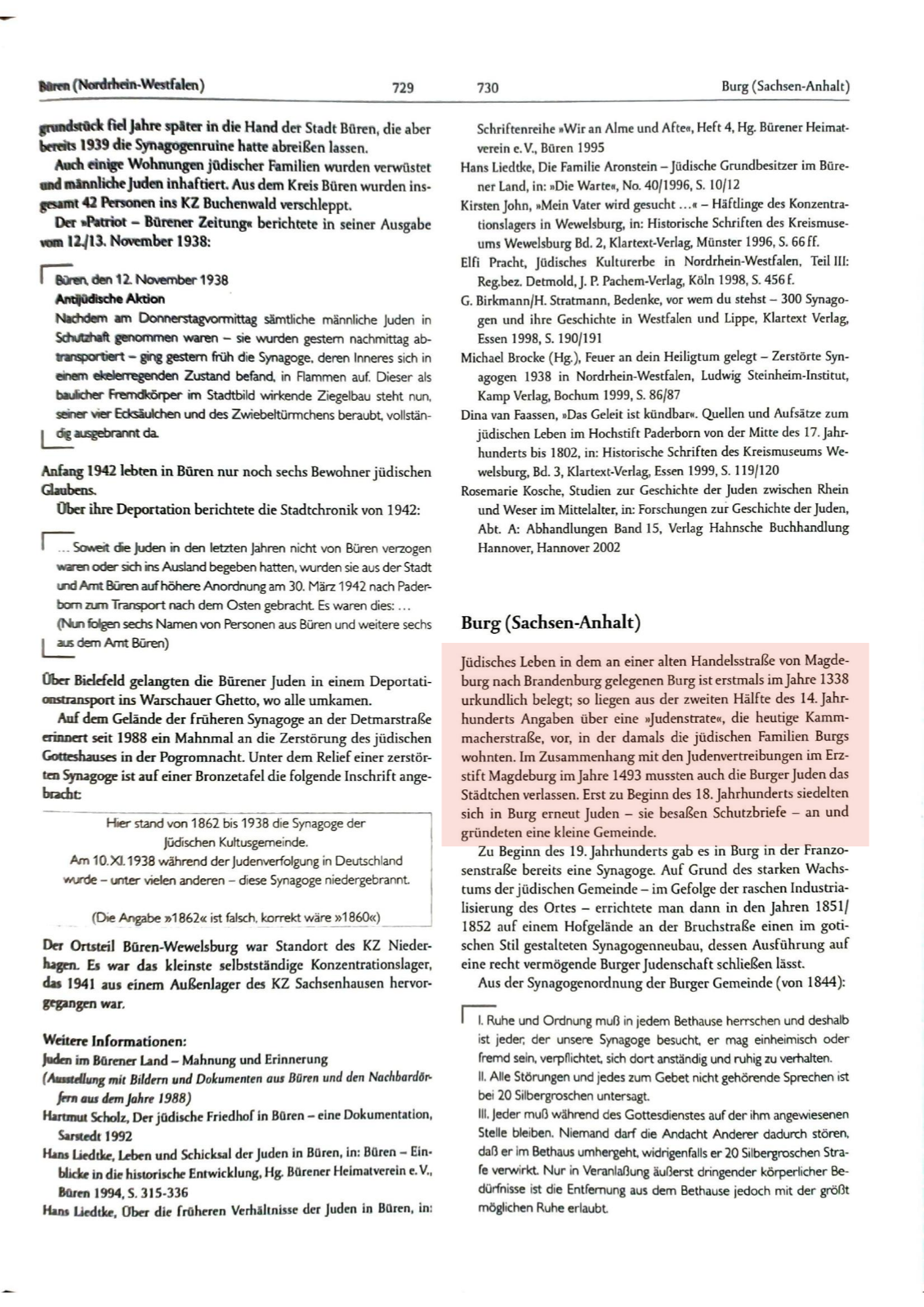
Alicke documents Jewish life in Burg from 1338 and notes that in the second half of the fourteenth century Jewish families lived in a "Judenstrate" („in der damals die jüdischen Familien Burgs wohnten").
There is unambiguous evidence that there was a Jewish community in the town during the Black Death.
Correction
EXIST1349 0 -> 1; POG1349 NA -> 0
Sources:
Avneri · Page 145
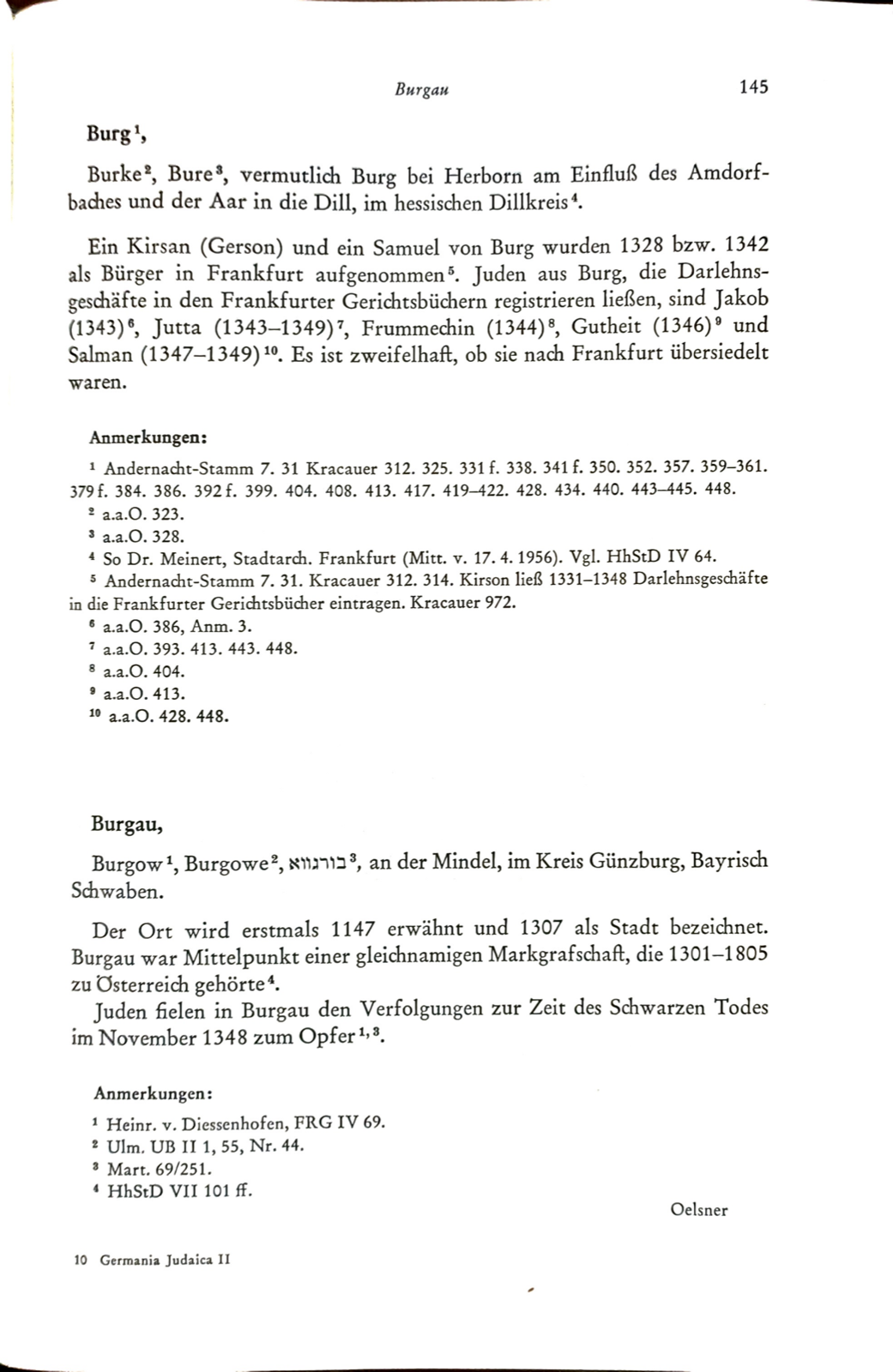
Alicke · Page 730
Burgsteinfurt (26)
Error
Voigtländer and Voth claim "unambiguous information" that no pogrom occurred in Burgsteinfurt during the Black Death.
Reality
Avneri confirms a Jewish presence in 1347 but mentions no persecutions.
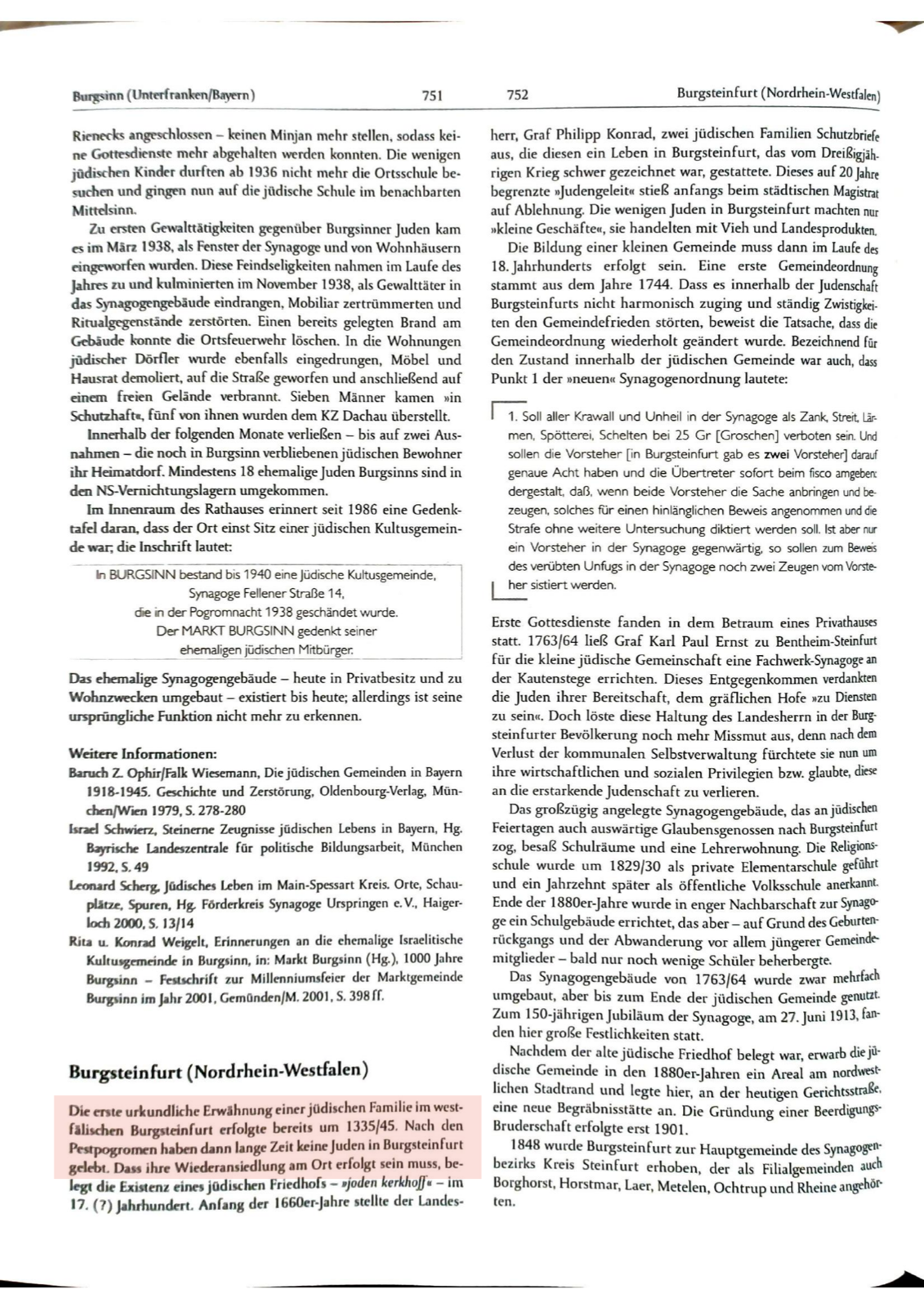
However, Alicke states that "after the plague pogroms, no Jews lived in the County of Steinfurt for a long time" („Nach den Pestpogromen haben dann lange Zeit keine Juden in der Grafschaft Steinfurt gelebt").
There is ambiguity over whether a pogrom occurred.
Correction
POG1349 0 -> NA
Sources:
Avneri · Page 147
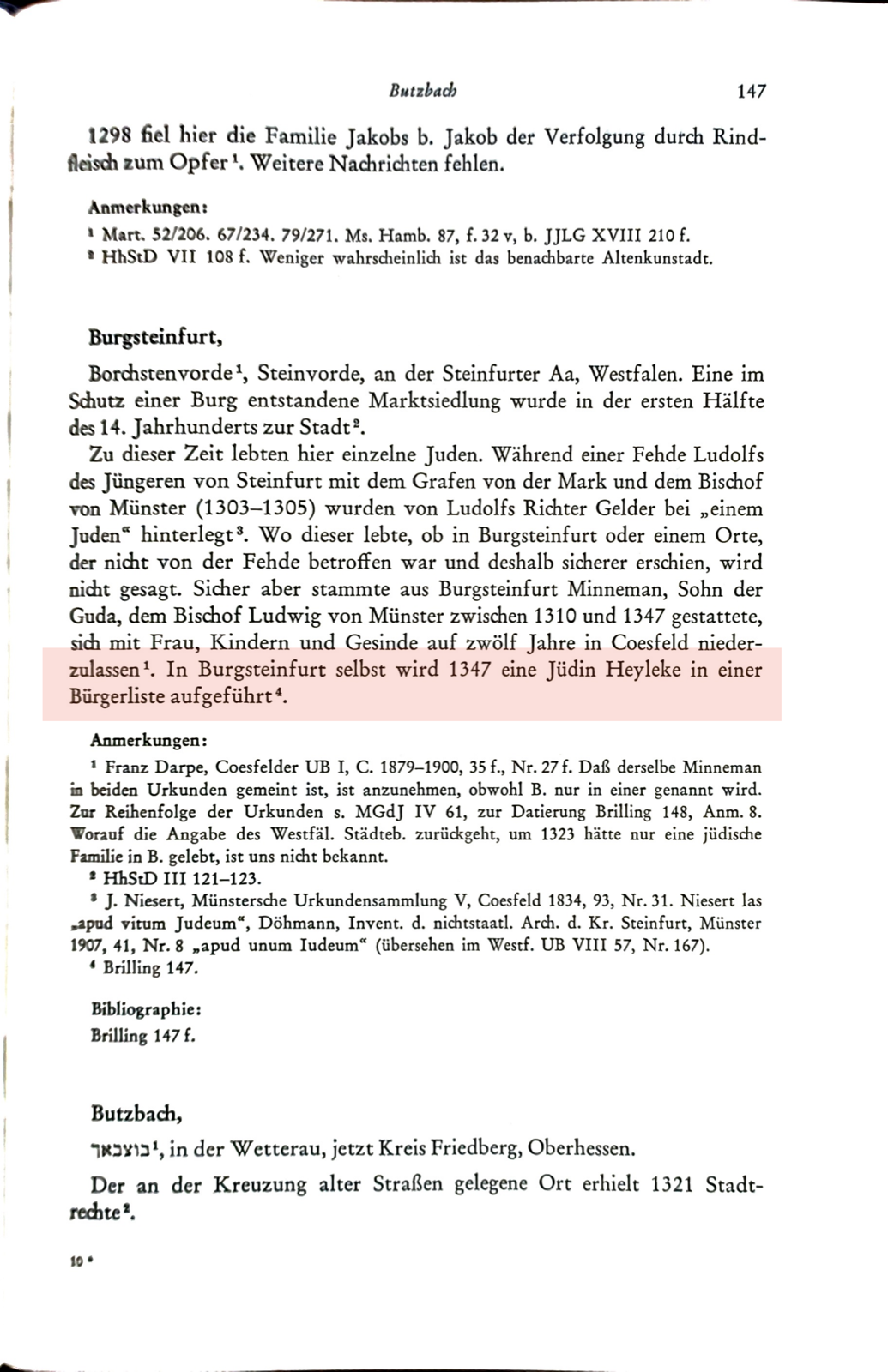
Alicke · Page 751
Coburg (27)
Error
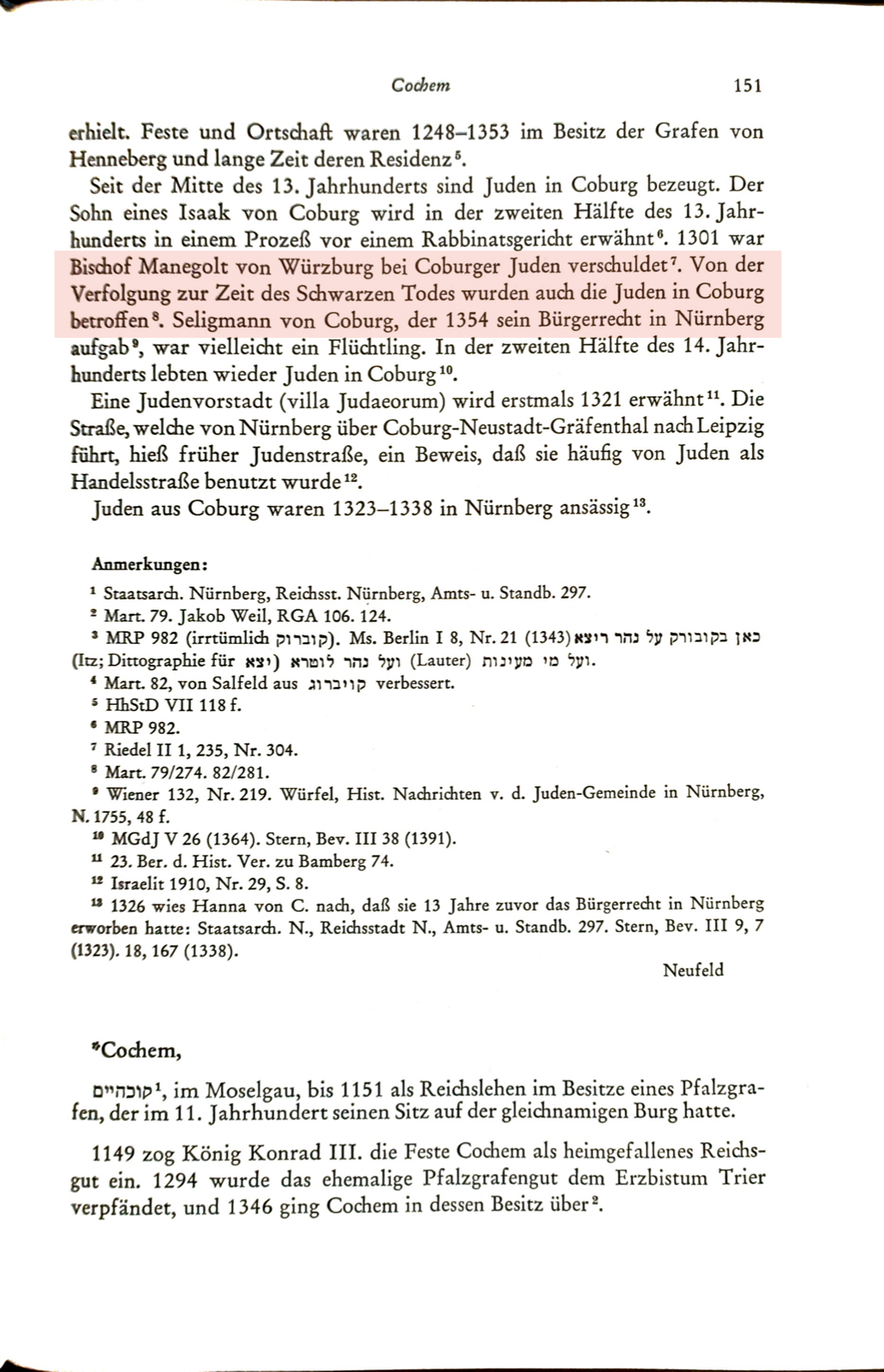
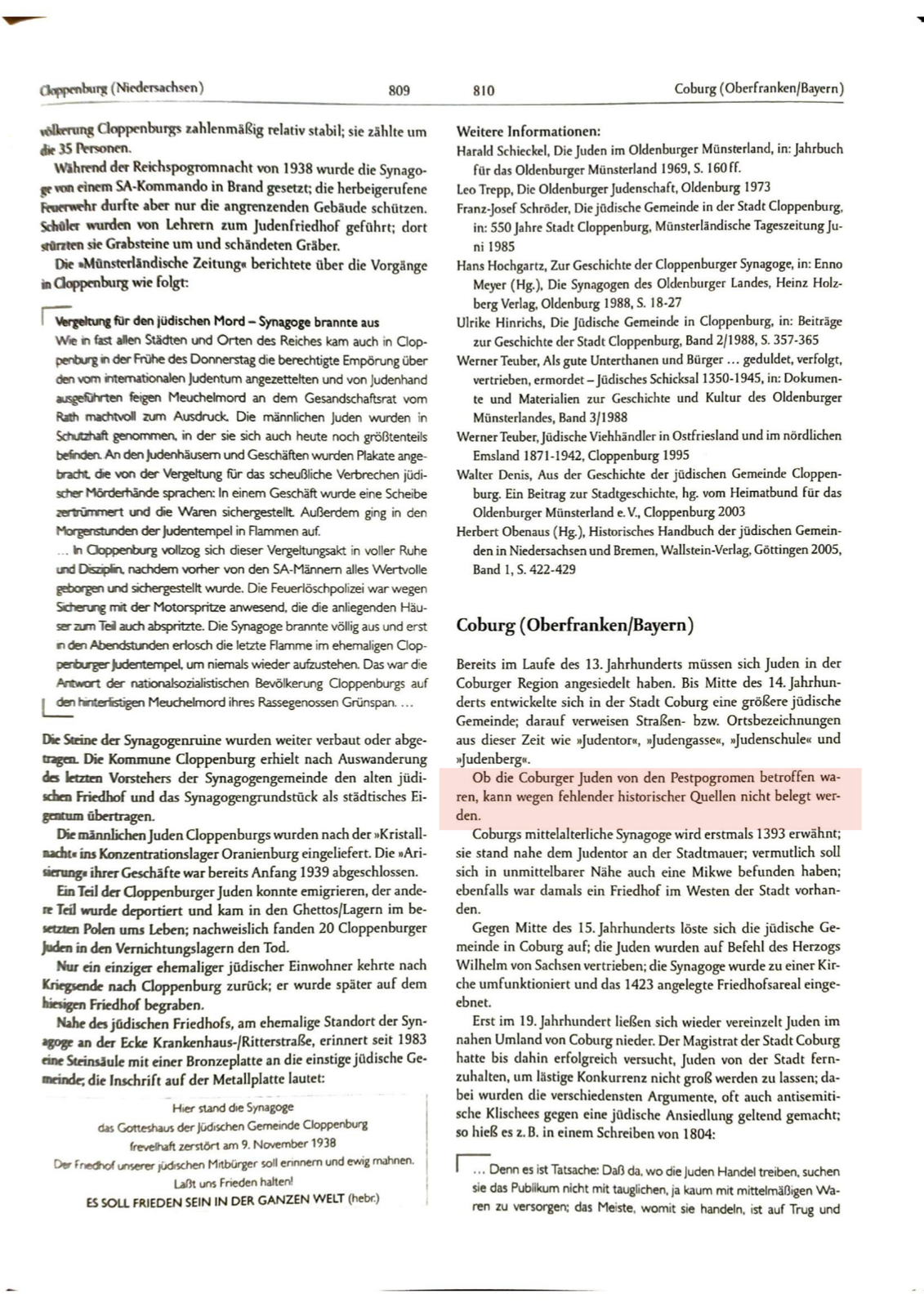
Voigtländer and Voth claim "unambiguous information" of a pogrom in Coburg during the Black Death.
Reality
Avneri states that the Jews in Coburg were affected by the Black Death persecution.
However, Alicke explicitly notes that "whether the Jews of Coburg were affected by the plague pogroms cannot be proven" („Ob die Coburger Juden von den Pestpogromen betroffen waren, kann [...] nicht belegt werden").
The occurrence of a pogrom is uncertain.
Correction
POG1349 1 -> NA
Sources:
Avneri · Page 151
Alicke · Page 810
Creglingen (28)
Error
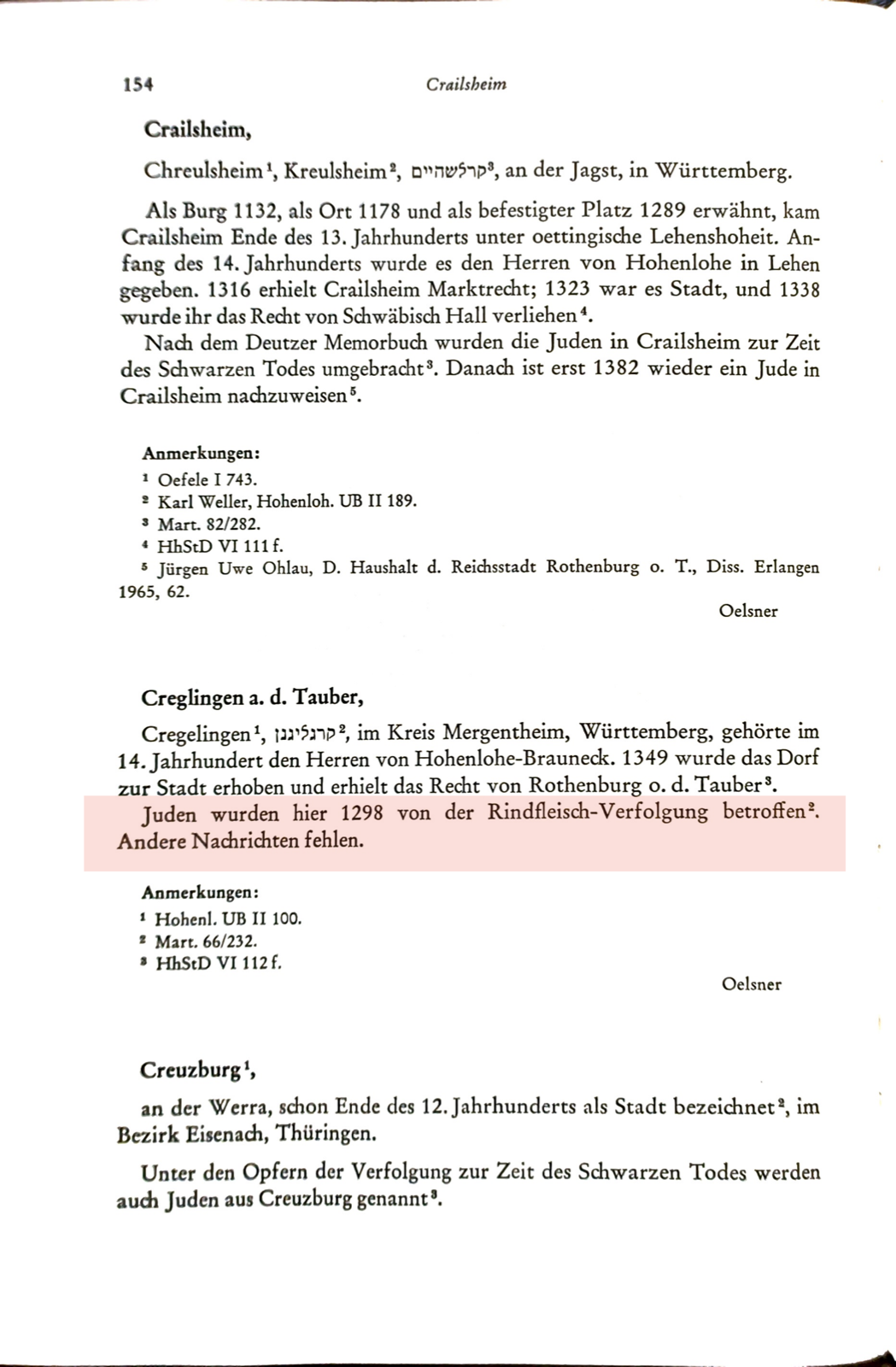
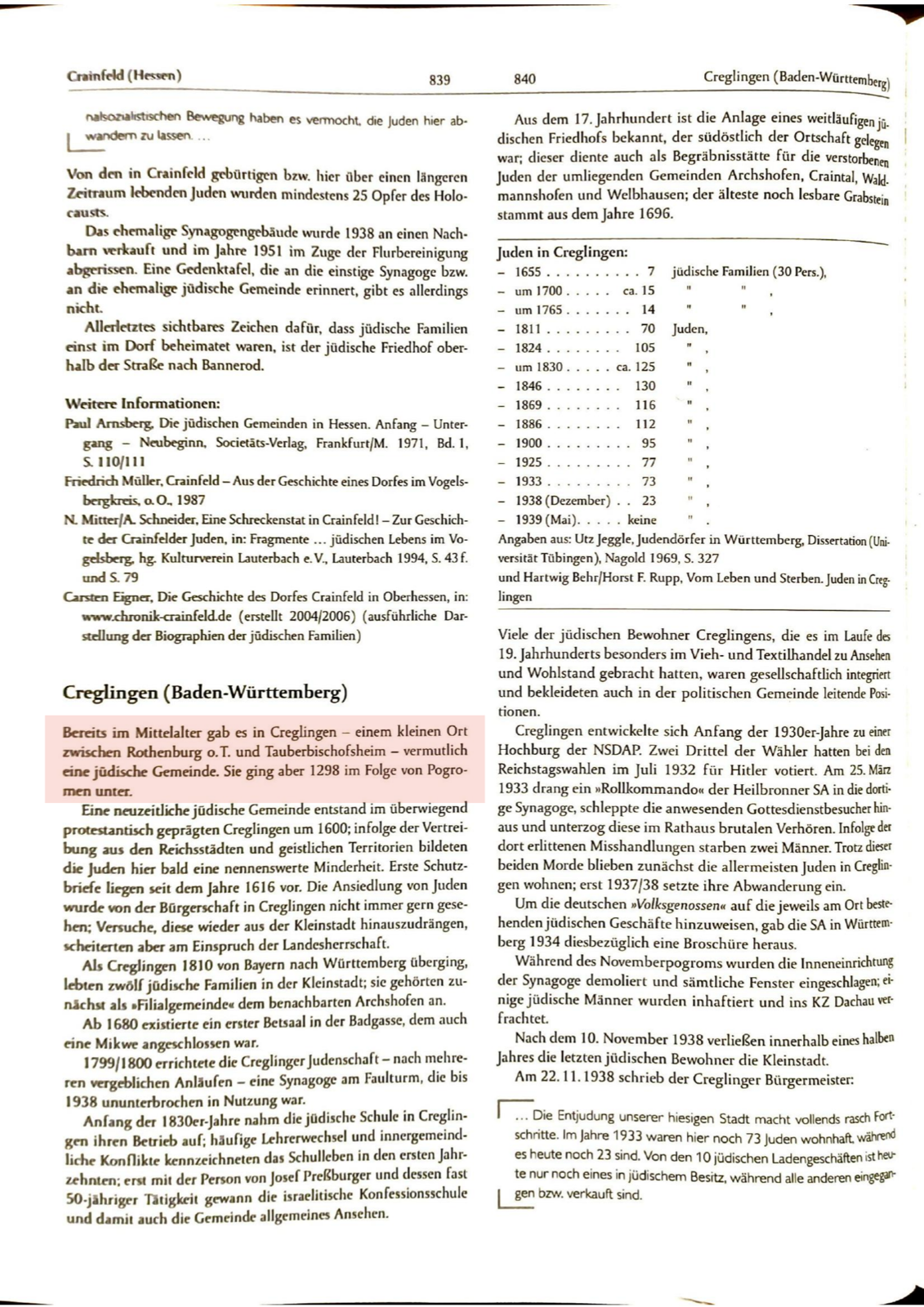
Voigtländer and Voth claim "unambiguous information" of a confirmed Jewish settlement in Creglingen during the Black Death.
Reality
Avneri notes that "other reports are missing" („Andere Nachrichten fehlen") after 1298.
Alicke clarifies that the community "perished in 1298" („Sie ging aber 1298 im Folge von Pogromen unter").
There is relatively unambiguous information that there was no Jewish community in the town during the Black Death.
Correction
EXIST1349 1 -> 0
Sources:
Avneri · Page 154
Alicke · Page 839
Deggendorf (29)
Error
Voigtländer and Voth claim "unambiguous information" of a confirmed Jewish settlement in Deggendorf during the Black Death.
Reality
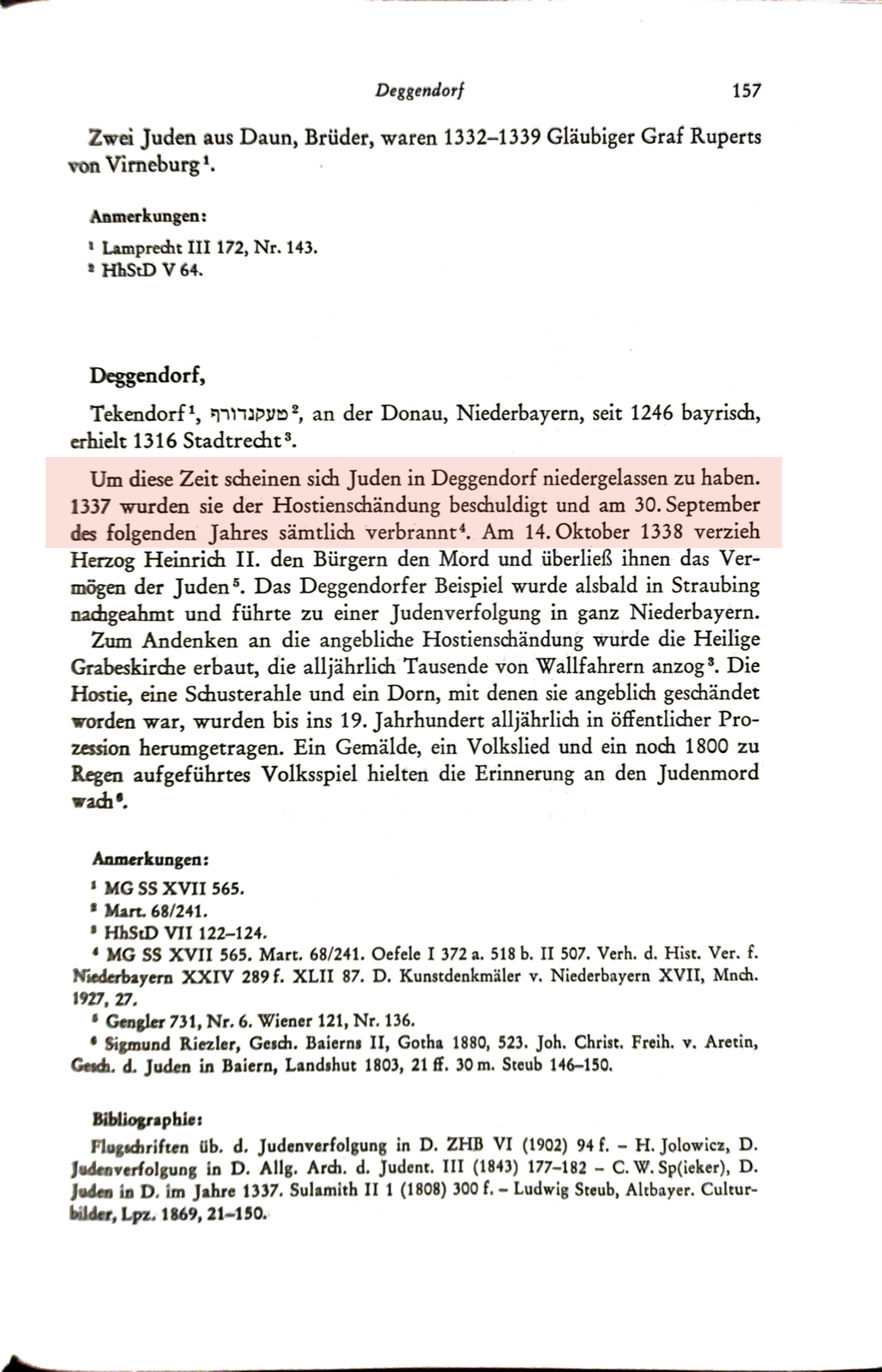
Avneri reports that the town's Jews were all burned in 1338.
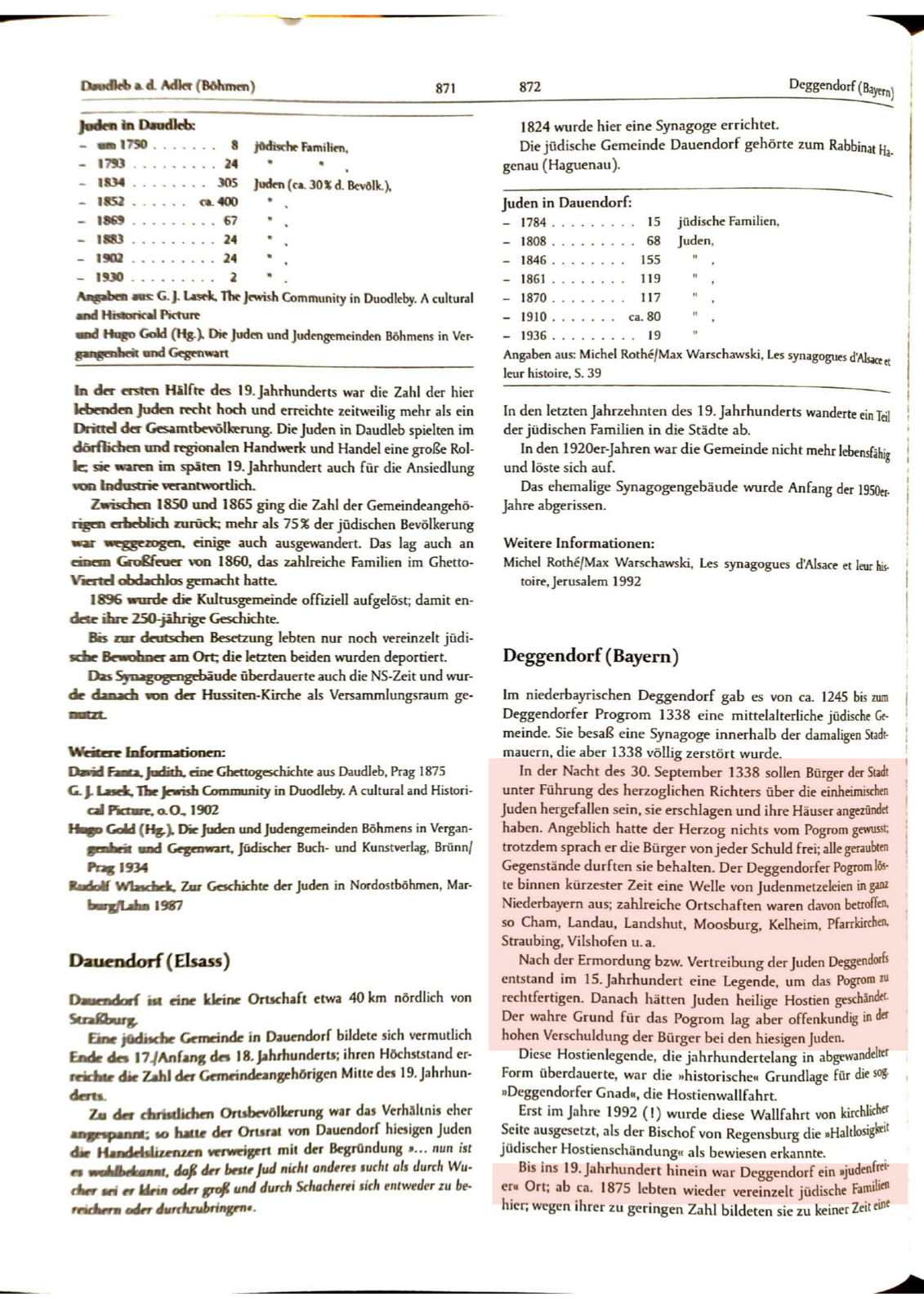
Alicke confirms that Deggendorf remained "a 'Jew-free' place until the nineteenth century" („Bis ins 19. Jahrhundert hinein war Deggendorf ein ,judenfreier' Ort").
There is relatively unambiguous information that there was no Jewish community in the town during the Black Death.
Correction
EXIST1349 1 -> 0
Sources:
Avneri · Page 157
Alicke · Page 872
Eisleben (30)
Error
Voigtländer and Voth claim there is no "unambiguous information" regarding a pogrom in Eisleben during the Black Death.
Reality
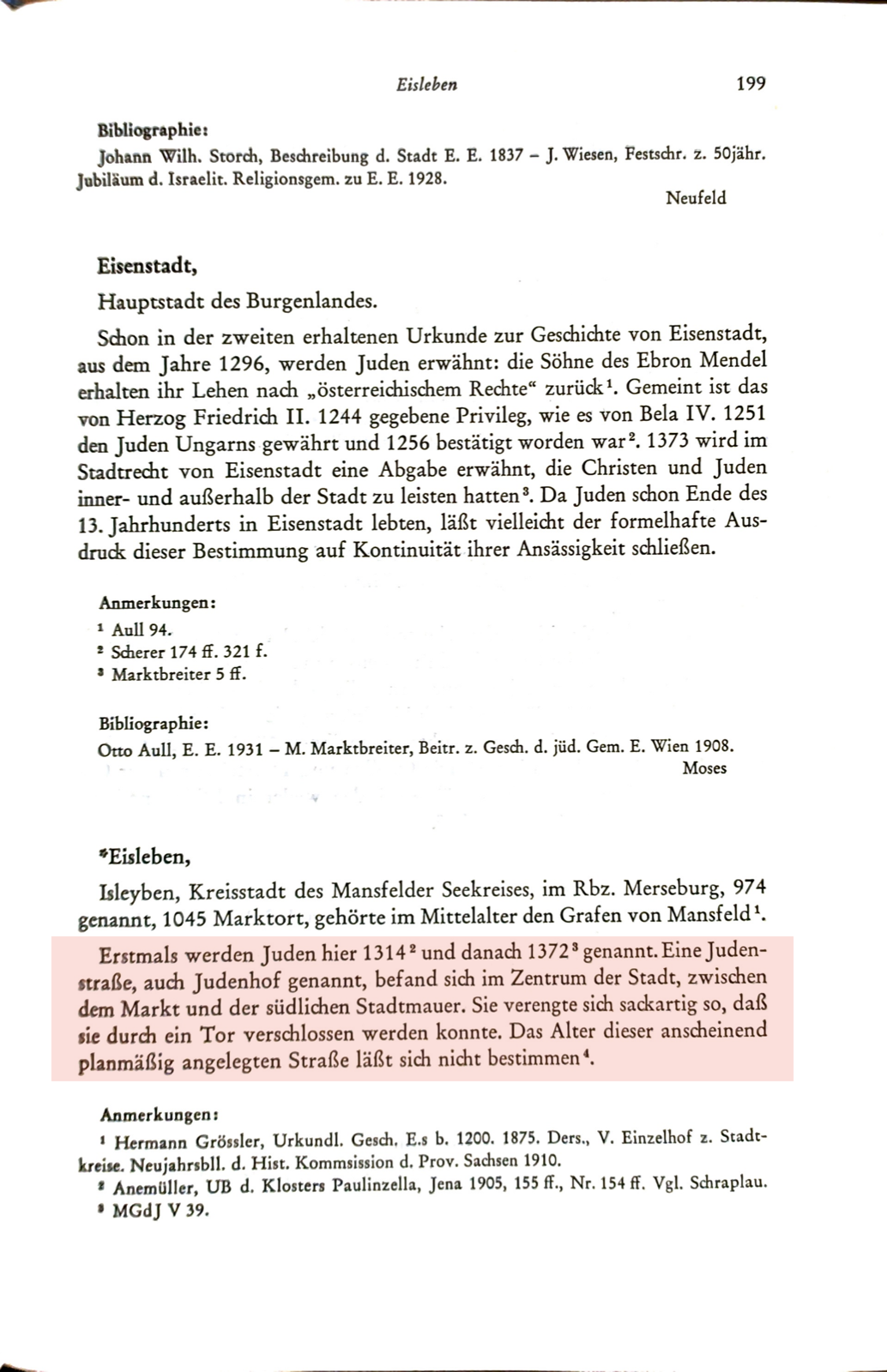
Avneri notes that "Jews are first mentioned here in 1314 and then in 1372" („Erstmals werden Juden hier 1314 und danach 1372 genannt"), confirming Jewish presence in the fourteenth century.
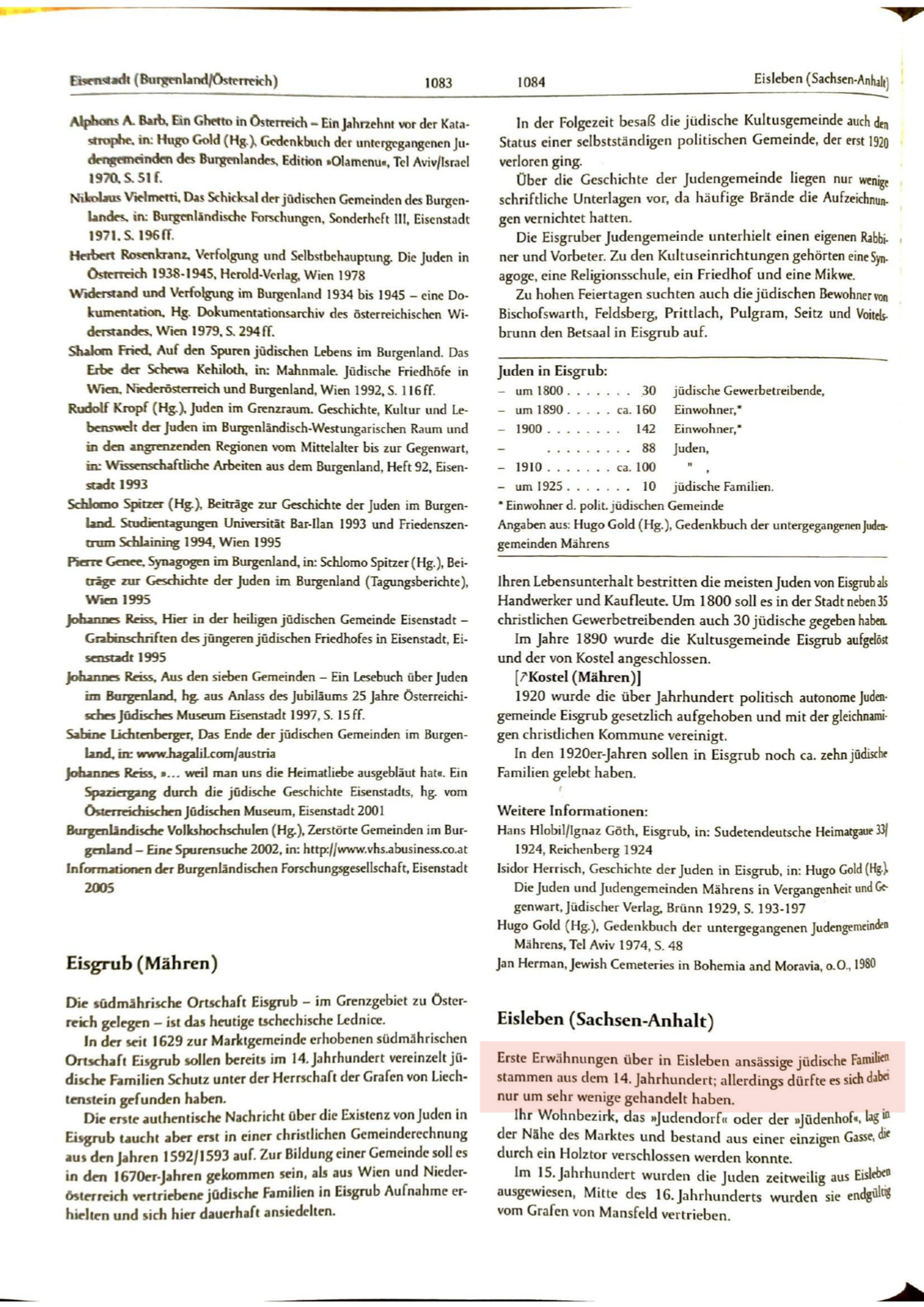
Alicke similarly notes that first mentions of Jewish families in Eisleben date from the fourteenth century, although "there were probably very few" („allerdings dürfte es sich dabei nur um sehr wenige gehandelt haben").
Neither source mentions persecution during the Black Death. Following Voigtländer and Voth's rules, the absence of a persecution report should be coded as 0.
Correction
POG1349 NA -> 0
Sources:
Avneri · Page 199
Alicke · Page 1084
Emden (31 & 32)
Error
Voigtländer and Voth claim "unambiguous information" of a confirmed Jewish settlement in Emden during the Black Death.
Reality
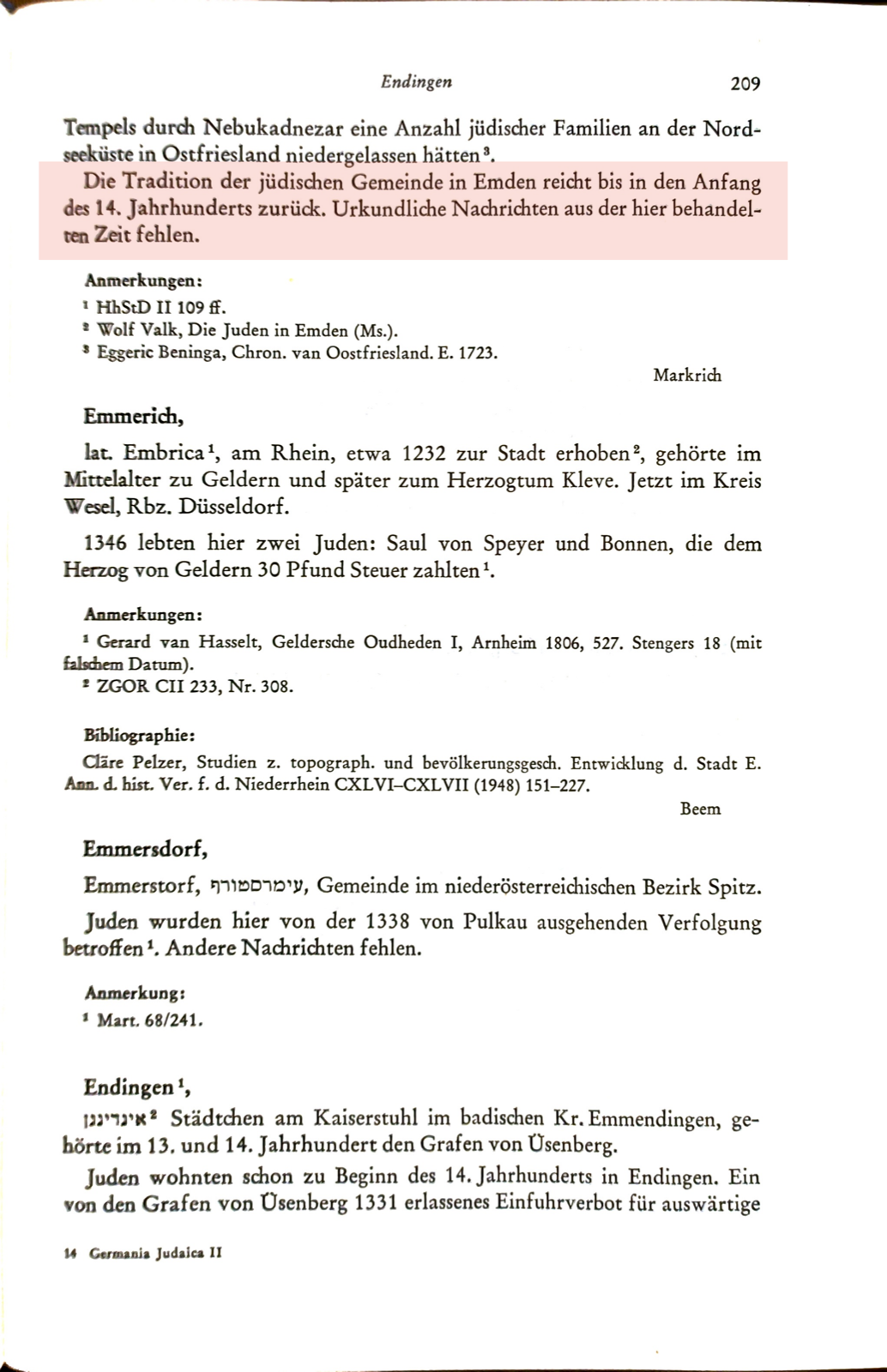
Avneri states that "documentary evidence from the period treated here is missing" („Urkundliche Nachrichten [...] fehlen").
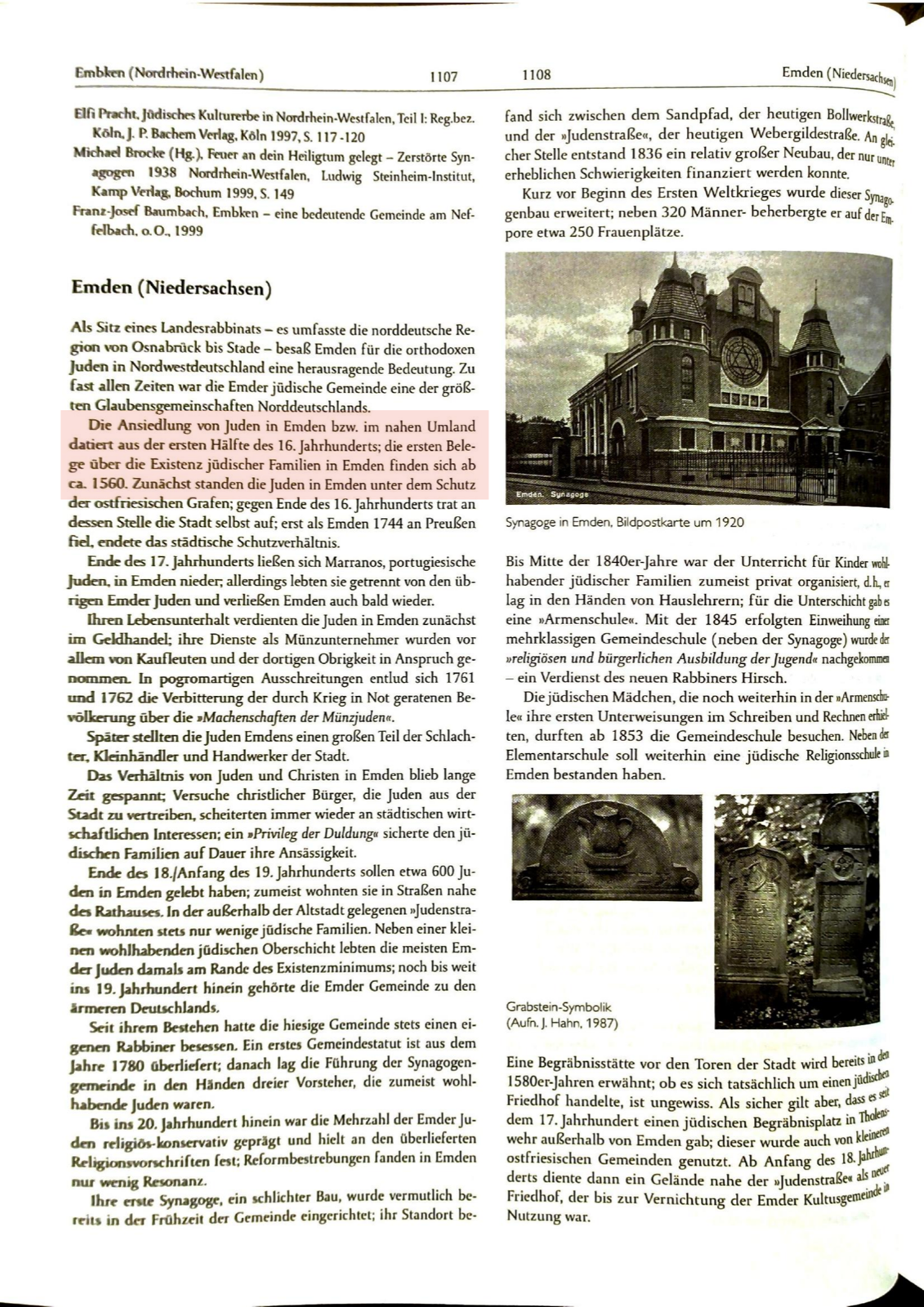
Alicke notes that the first evidence of Jews in the town only dates from around 1560.
The existence of a Jewish community during the Black Death is uncertain.
Correction
EXIST1349 1 -> NA; POG1349 0 -> NA
Sources:
Avneri · Page 209
Alicke · Page 1107
Eschenau (33 & 34)
Error
Voigtländer and Voth claim "unambiguous information" of a confirmed Jewish settlement in Eschenau during the Black Death.
Reality
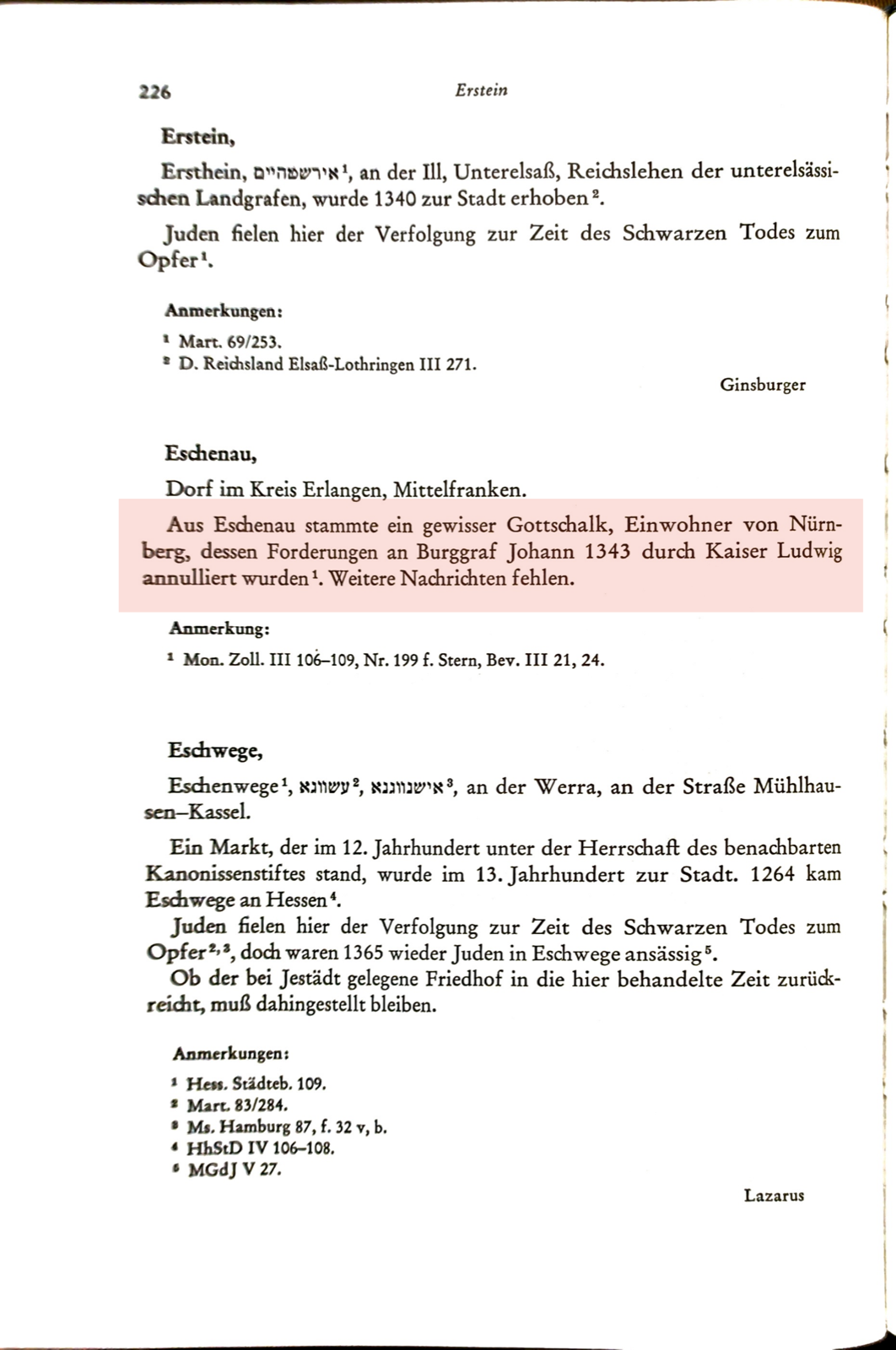
Avneri mentions a Jew in 1343 but adds that "further news is missing" („Weitere Nachrichten fehlen").
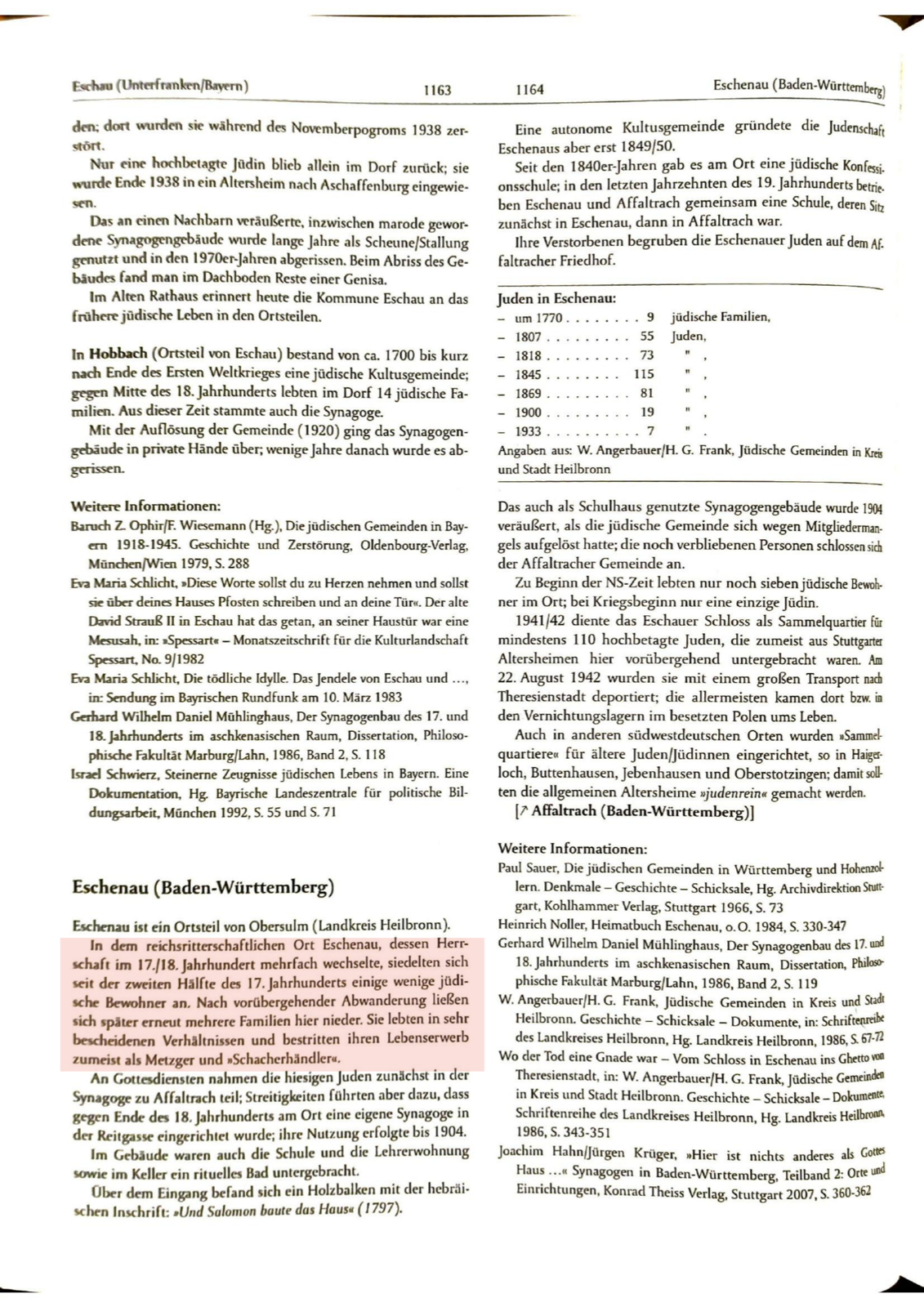
Alicke clarifies that Jewish inhabitants only settled in the town from the second half of the 17th century.
The existence of a Jewish community during the Black Death is uncertain.
Correction
EXIST1349 1 -> NA; POG1349 0 -> NA
Sources:
Avneri · Page 226
Alicke · Page 1163
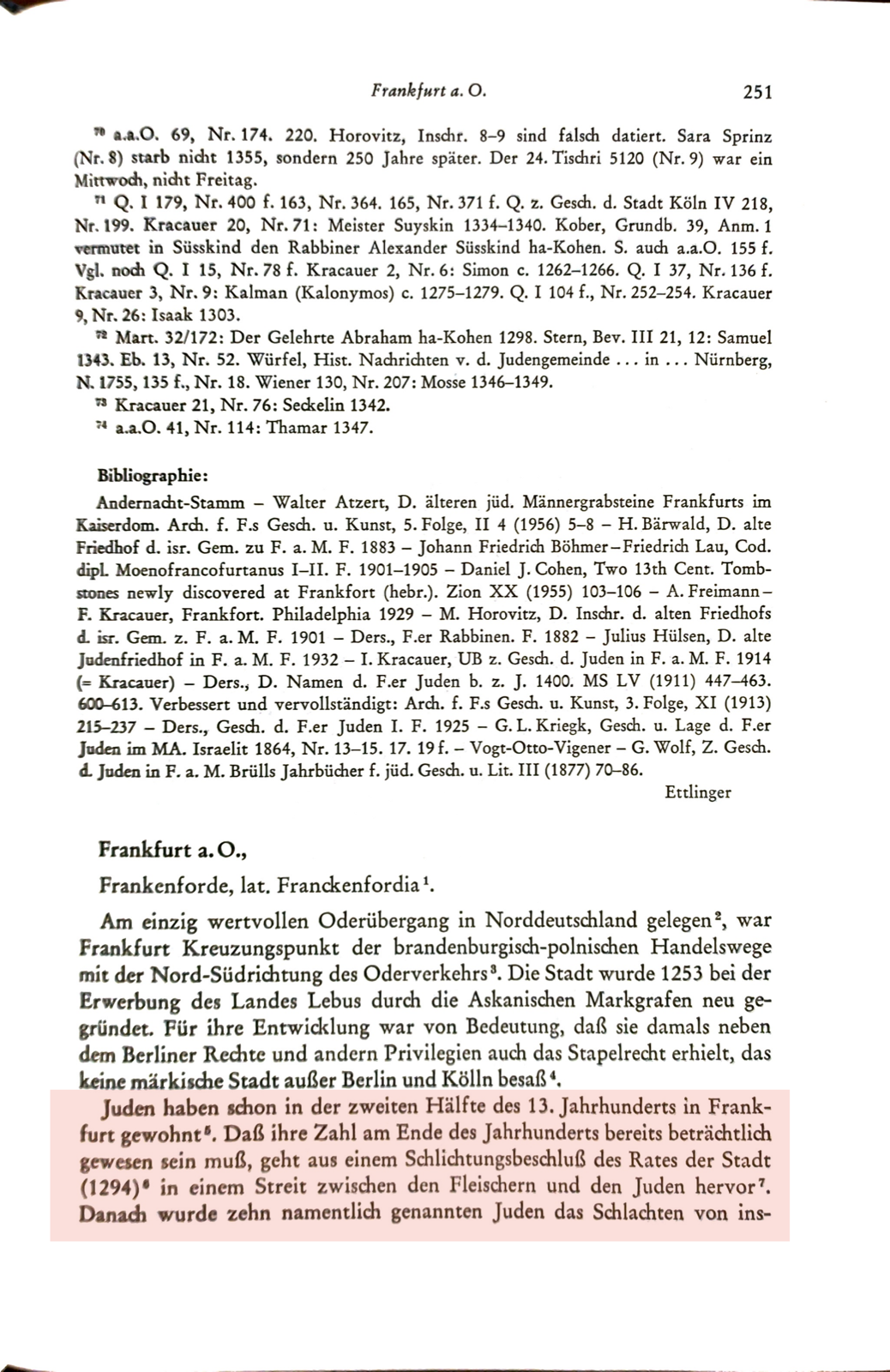
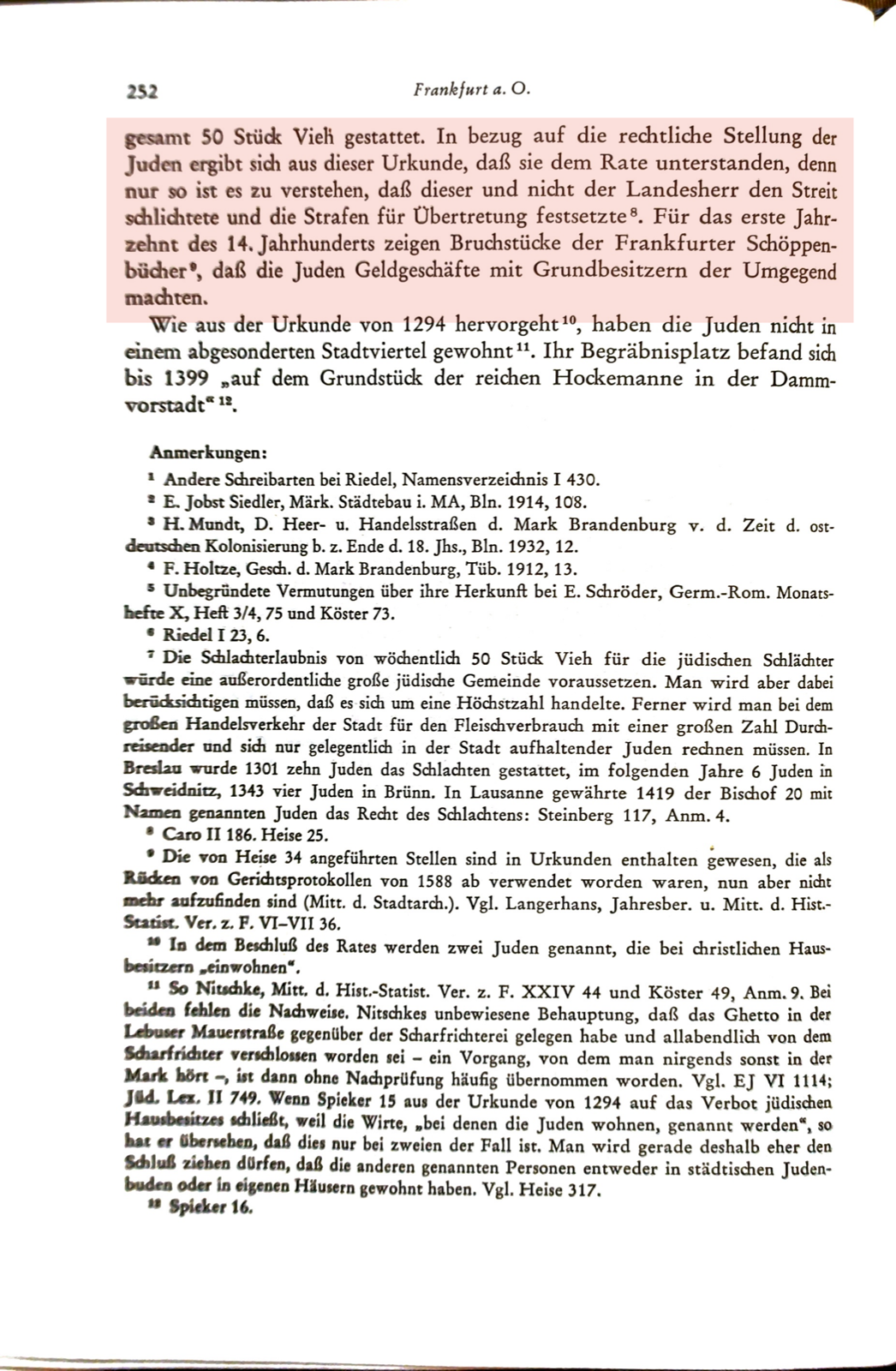
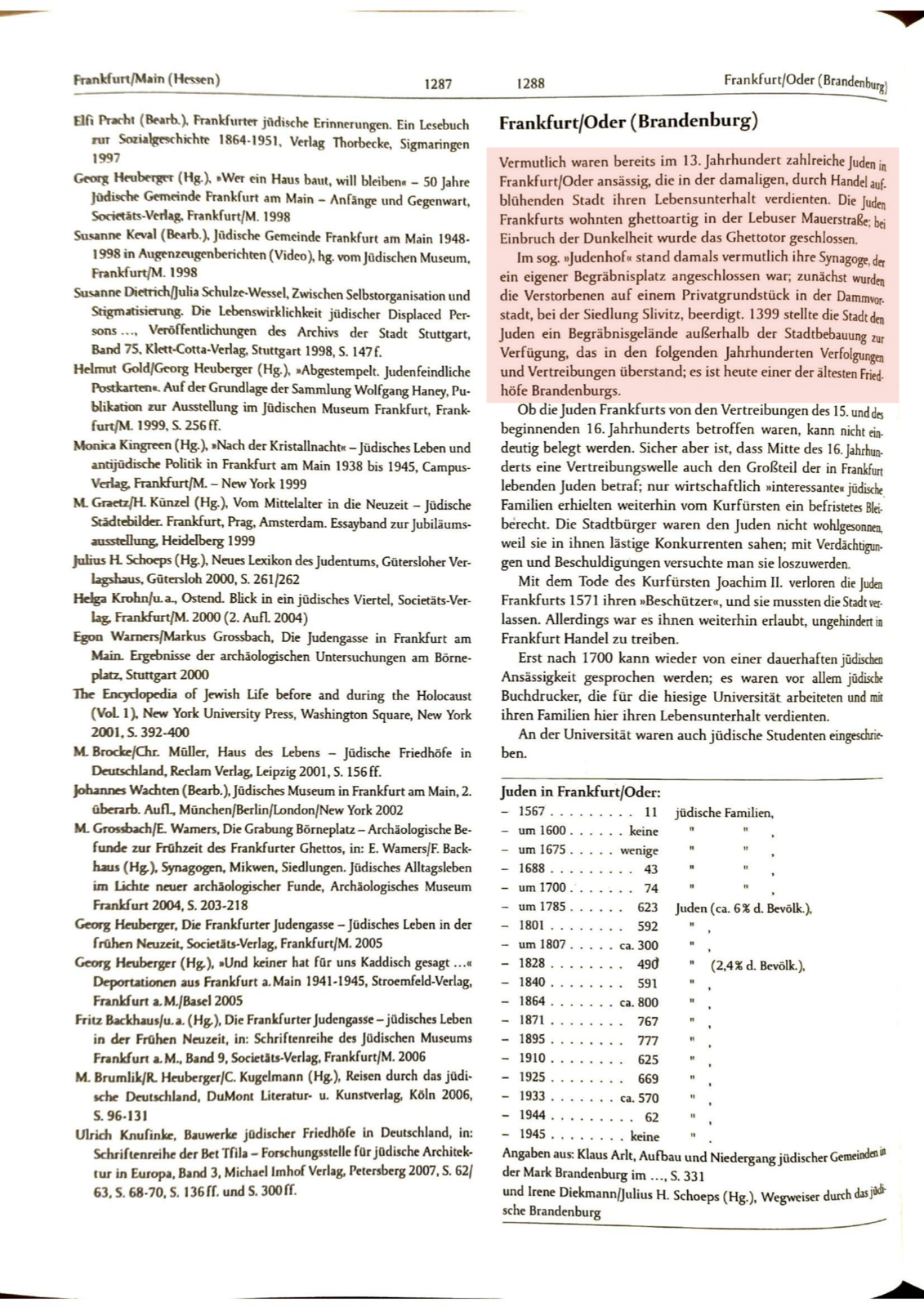
Frankfurt-Oder (35)
Error
Voigtländer and Voth claim there is no "unambiguous information" regarding a pogrom in Frankfurt-Oder during the Black Death.
Reality
Avneri confirms that "Jews lived in Frankfurt in the second half of the thirteenth century" („Juden haben schon in der zweiten Hälfte des 13. Jahrhunderts in Frankfurt gewohnt").
Alicke similarly states that "Jews were presumably settled in Frankfurt/Oder in the thirteenth century" („Vermutlich waren Juden im 13. Jahrhundert [...] in Frankfurt/Oder ansässig").
Neither source mentions persecution during the Black Death. Following Voigtländer and Voth's rules, the absence of a persecution report should be coded as 0.
Correction
POG1349 NA -> 0
Sources:
Avneri · Page 251
Avneri · Page 252
Alicke · Page 1288
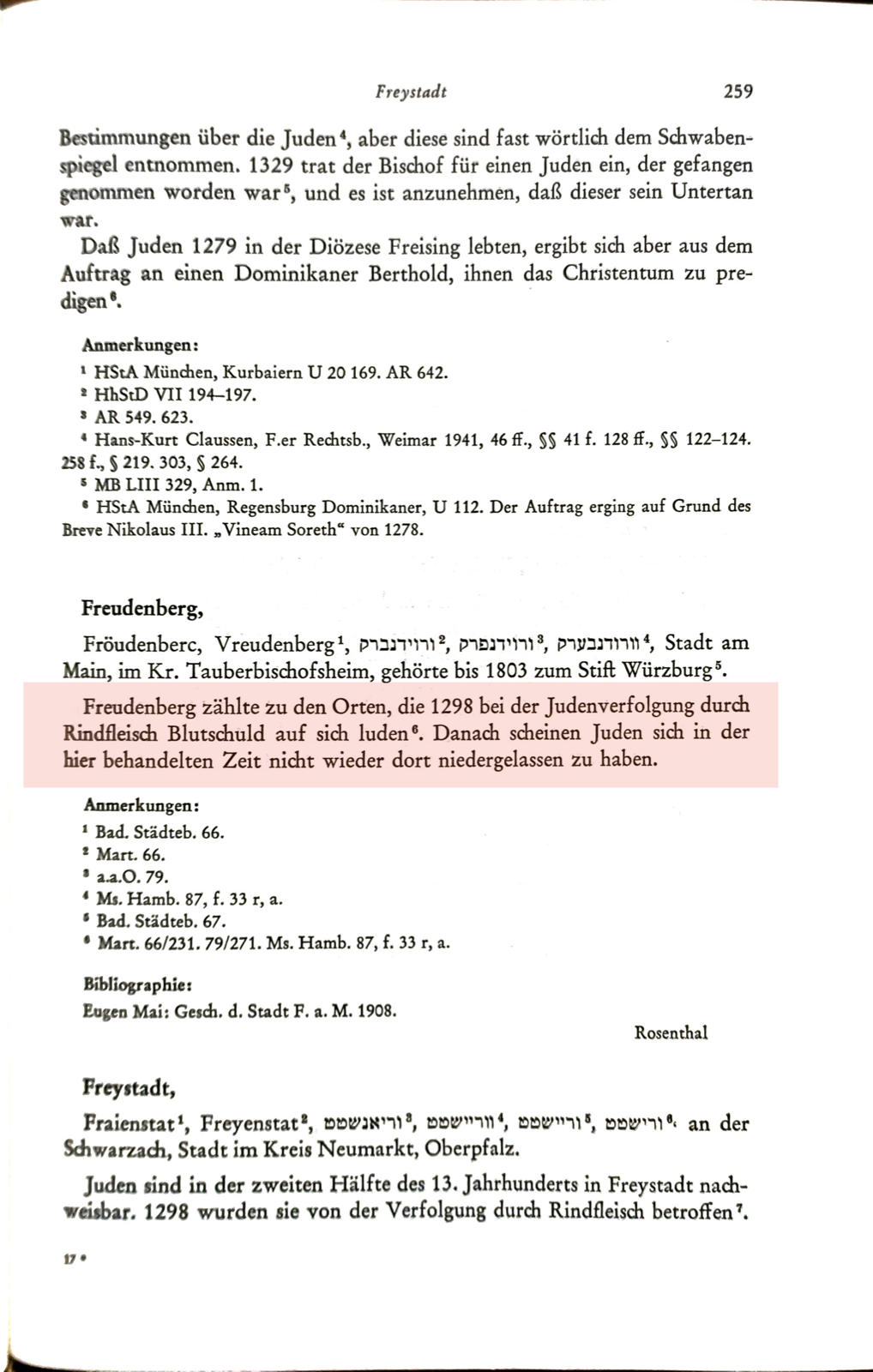
Freudenberg-Main (36)
Error
Voigtländer and Voth claim "unambiguous information" of a confirmed Jewish settlement in Freudenberg-Main during the Black Death.
Reality
Avneri notes that after 1298 "Jews do not seem to have settled there again" („Danach scheinen Juden sich [...] nicht wieder dort niedergelassen zu haben").
Alicke corroborates that the few residents were murdered or expelled in 1298.
There is relatively unambiguous information that there was no Jewish community in the town during the Black Death.
Correction
EXIST1349 1 -> 0
Sources:
Avneri · Page 259
Alicke · Page 1315-1316
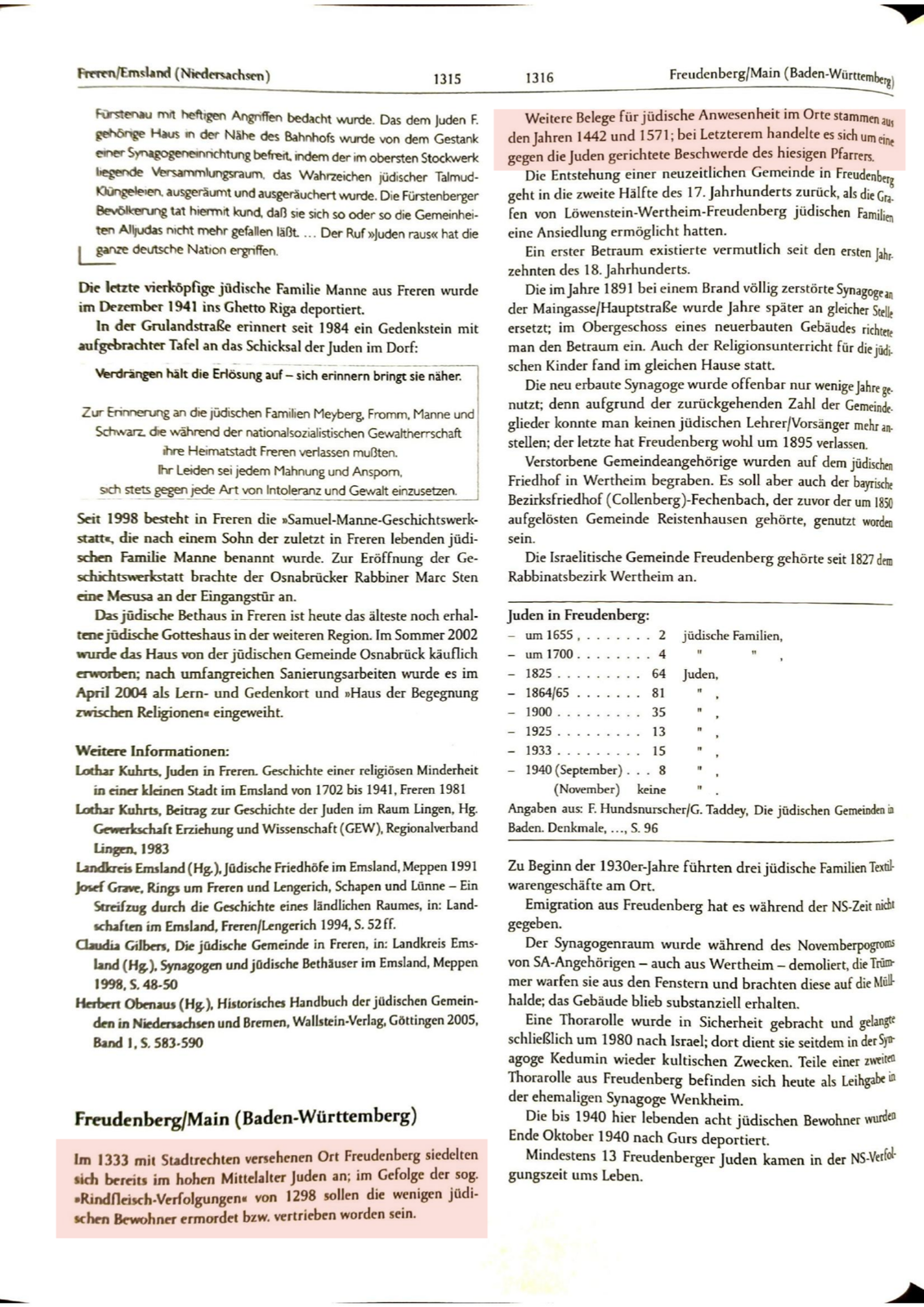
Genthin (37)
Error
Voigtländer and Voth claim there is no "unambiguous information" regarding a pogrom in Genthin during the Black Death.
Reality
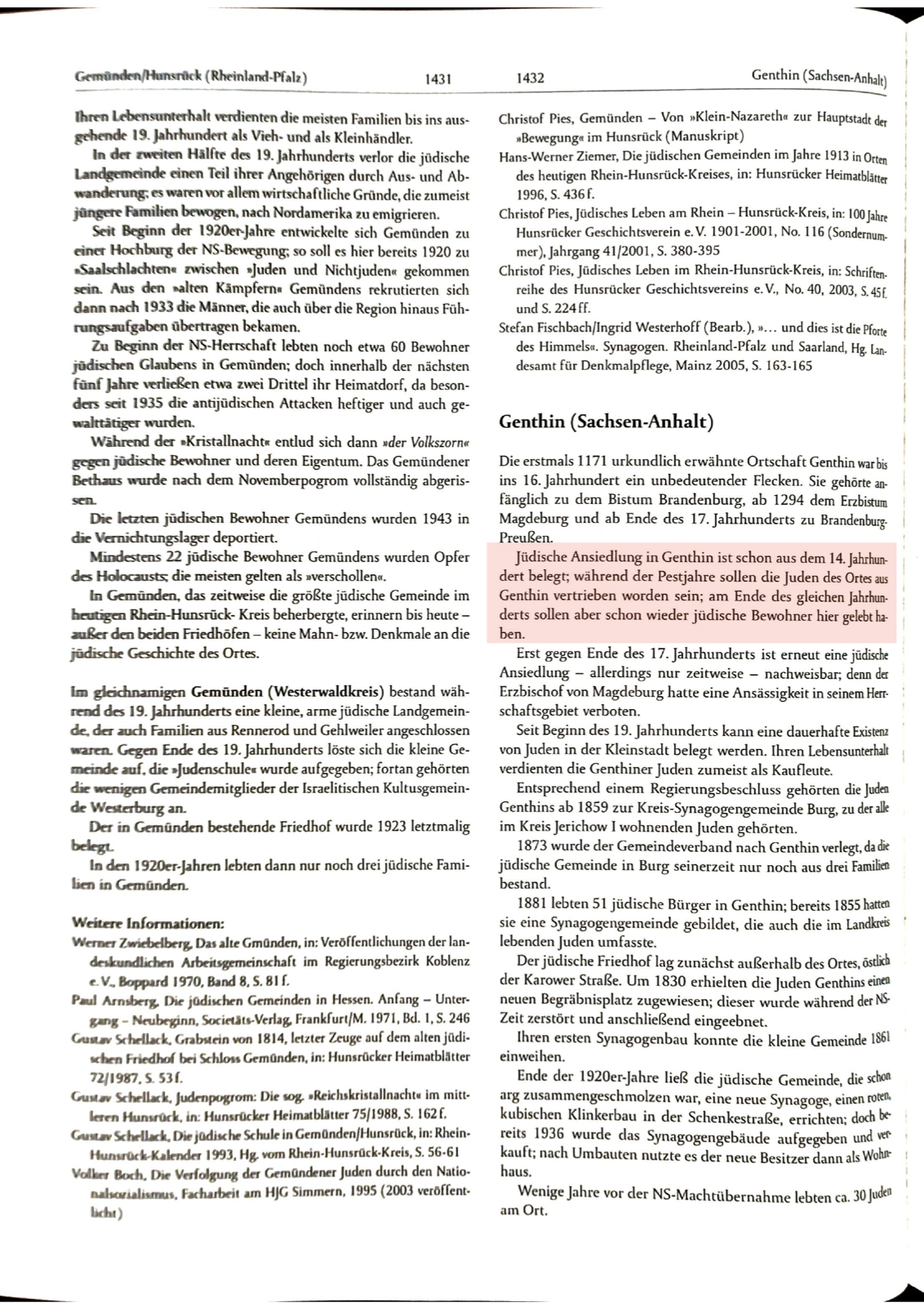
Alicke documents that "during the plague years, the Jews of the place are said to have been expelled from Genthin" („während der Pestjahre sollen die Juden des Ortes aus Genthin vertrieben worden sein").
Avneri does not discuss the town.
Although Alicke uses the hedging construction sollen ("are said to have"), the specific reference to expulsion during the plague years constitutes unambiguous evidence of a pogrom under Voigtländer and Voth's coding rules.
Correction
POG1349 NA -> 1
Source:
Alicke · Page 1432
Glehn (38 & 39)
Error
Voigtländer and Voth claim there is no "unambiguous information" of a confirmed Jewish settlement in Glehn during the Black Death.
Reality
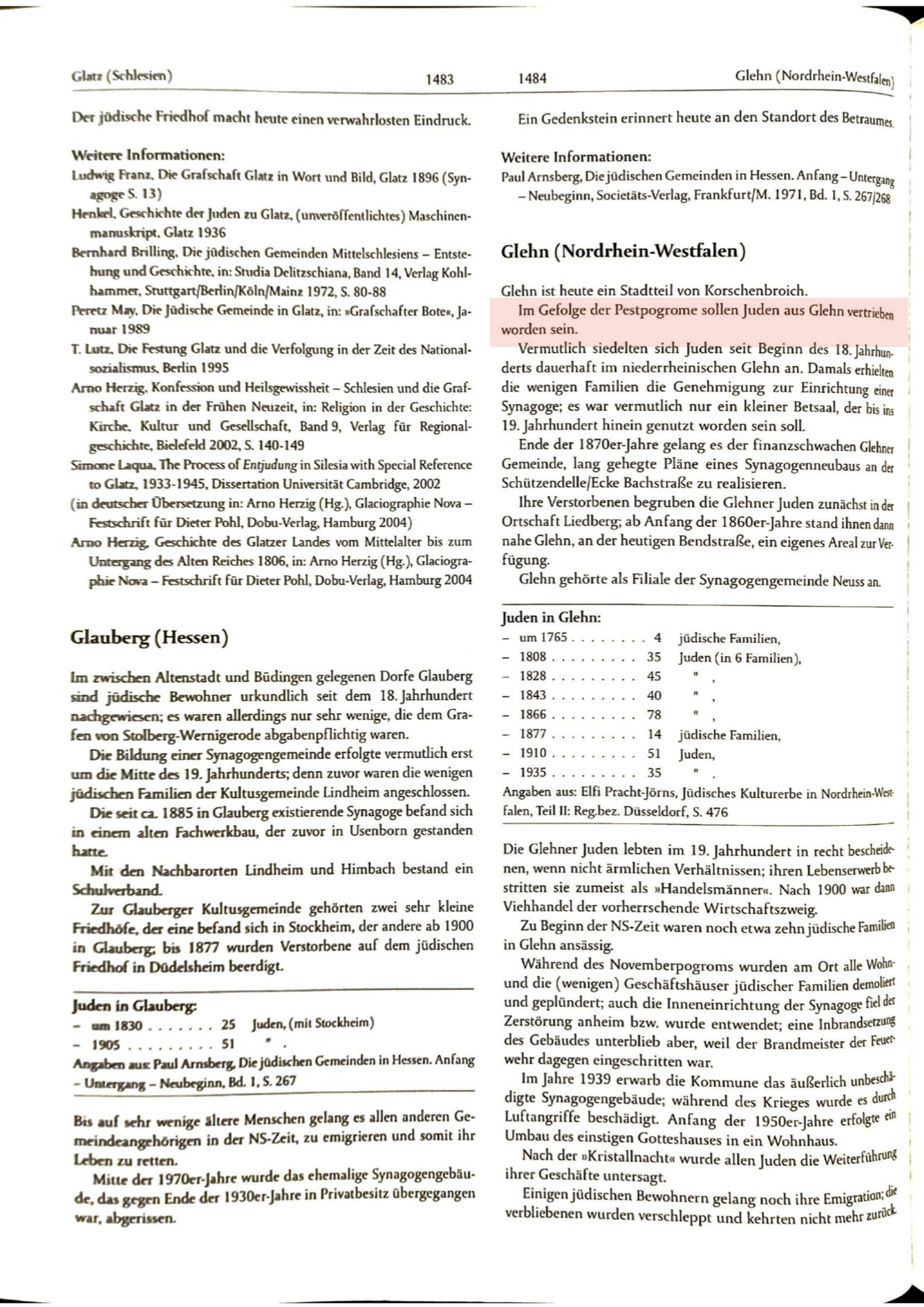
Alicke documents that "in the wake of the plague pogroms, Jews are said to have been expelled from Glehn" („Im Gefolge der Pestpogrome sollen Juden aus Glehn vertrieben worden sein").
There is unambiguous evidence that there was a Jewish community in the town during the Black Death.
Correction
EXIST1349 0 -> 1; POG1349 NA -> 1
Source:
Alicke · Page 1484
Goch (40)
Error
Voigtländer and Voth claim "unambiguous information" that no pogrom occurred in Goch during the Black Death.
Reality
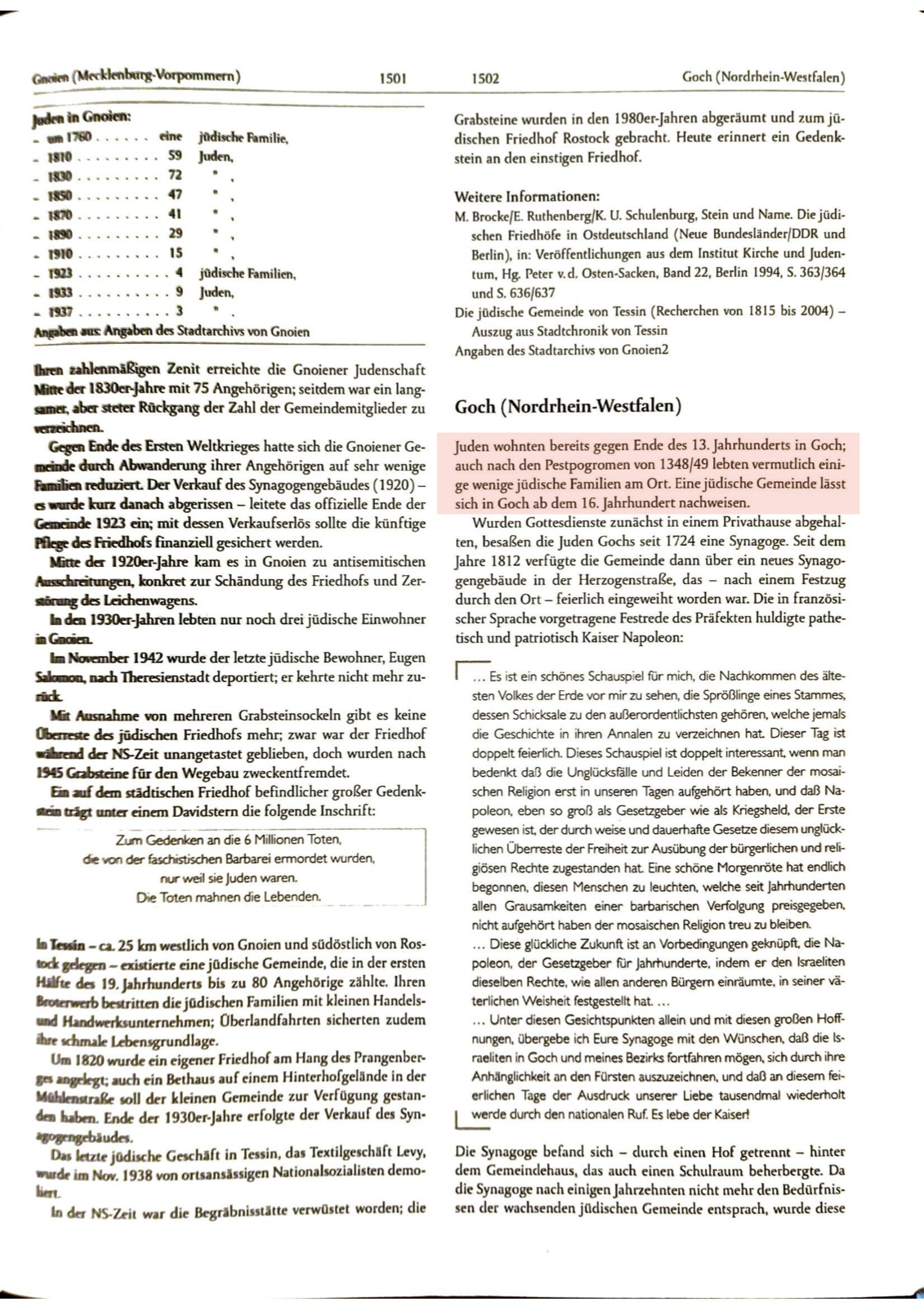
Avneri mentions a Jewish presence before 1349, and Alicke states that "even after the plague pogroms of 1348/49, presumably a few Jewish families lived in the place" („auch nach den Pestpogromen von 1348/49 lebten vermutlich einige wenige jüdische Familien am Ort").
There is ambiguity over whether a pogrom occurred.
Correction
POG1349 0 -> NA
Sources:
Avneri · Page 281
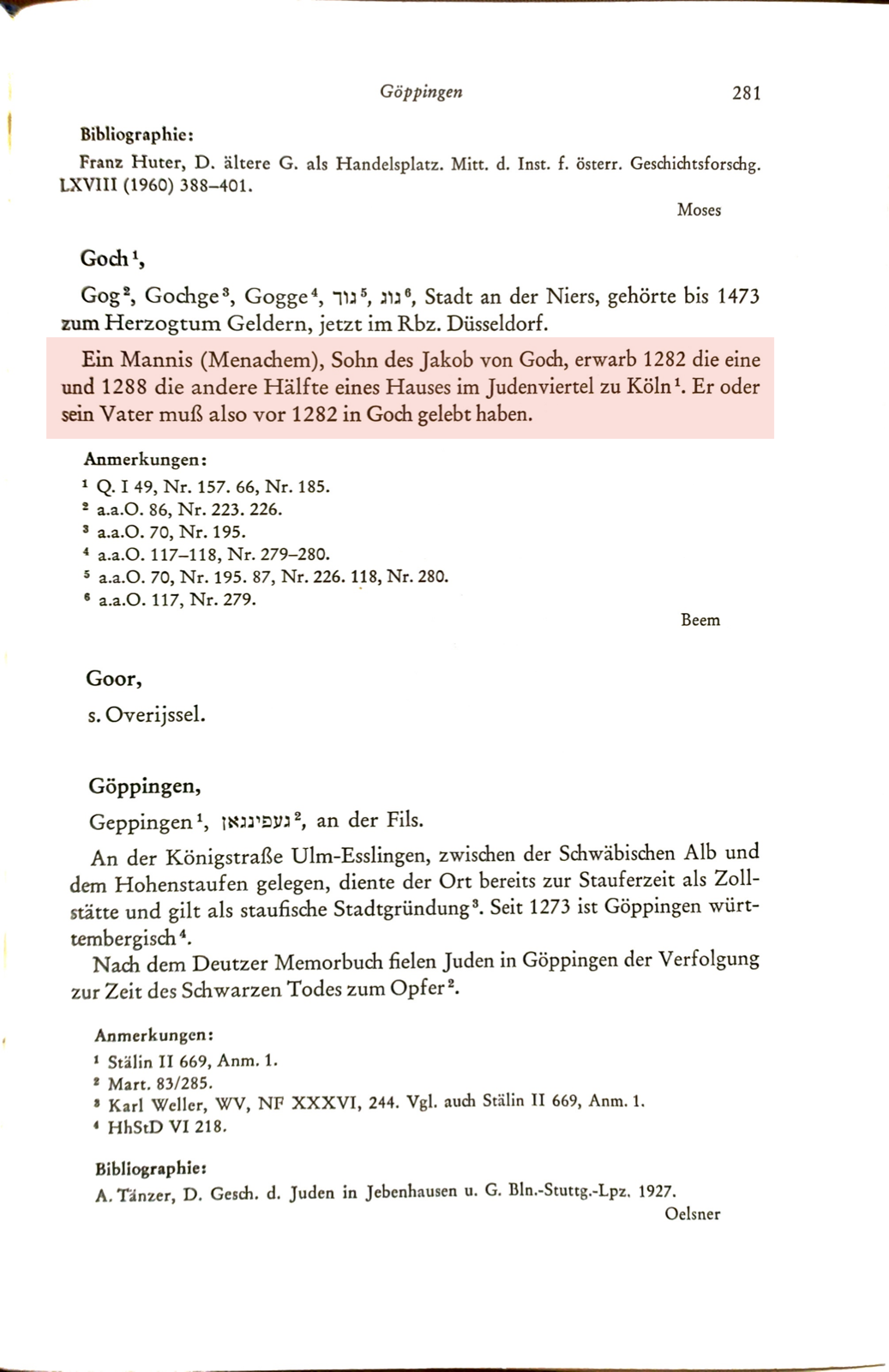
Alicke · Page 1502
Grossostheim (41 & 42)
Error
Voigtländer and Voth code a "confirmed Jewish settlement" here during the Black Death. However, their sources do not provide "unambiguous information" to support this.
Reality
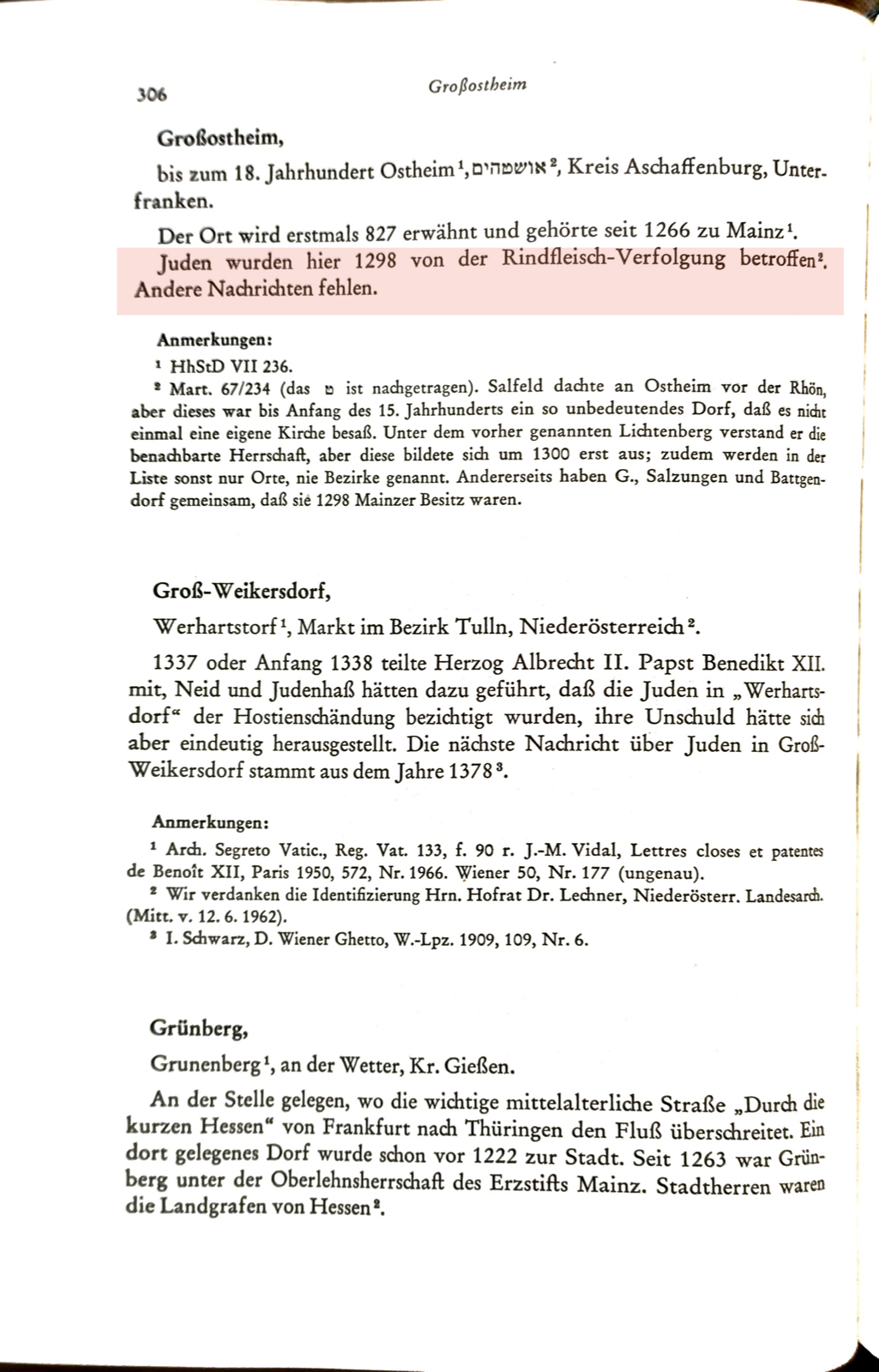
Avneri notes that Jews were affected by the Rindfleisch persecution in 1298, but explicitly states that "other reports are missing" („Andere Nachrichten fehlen").
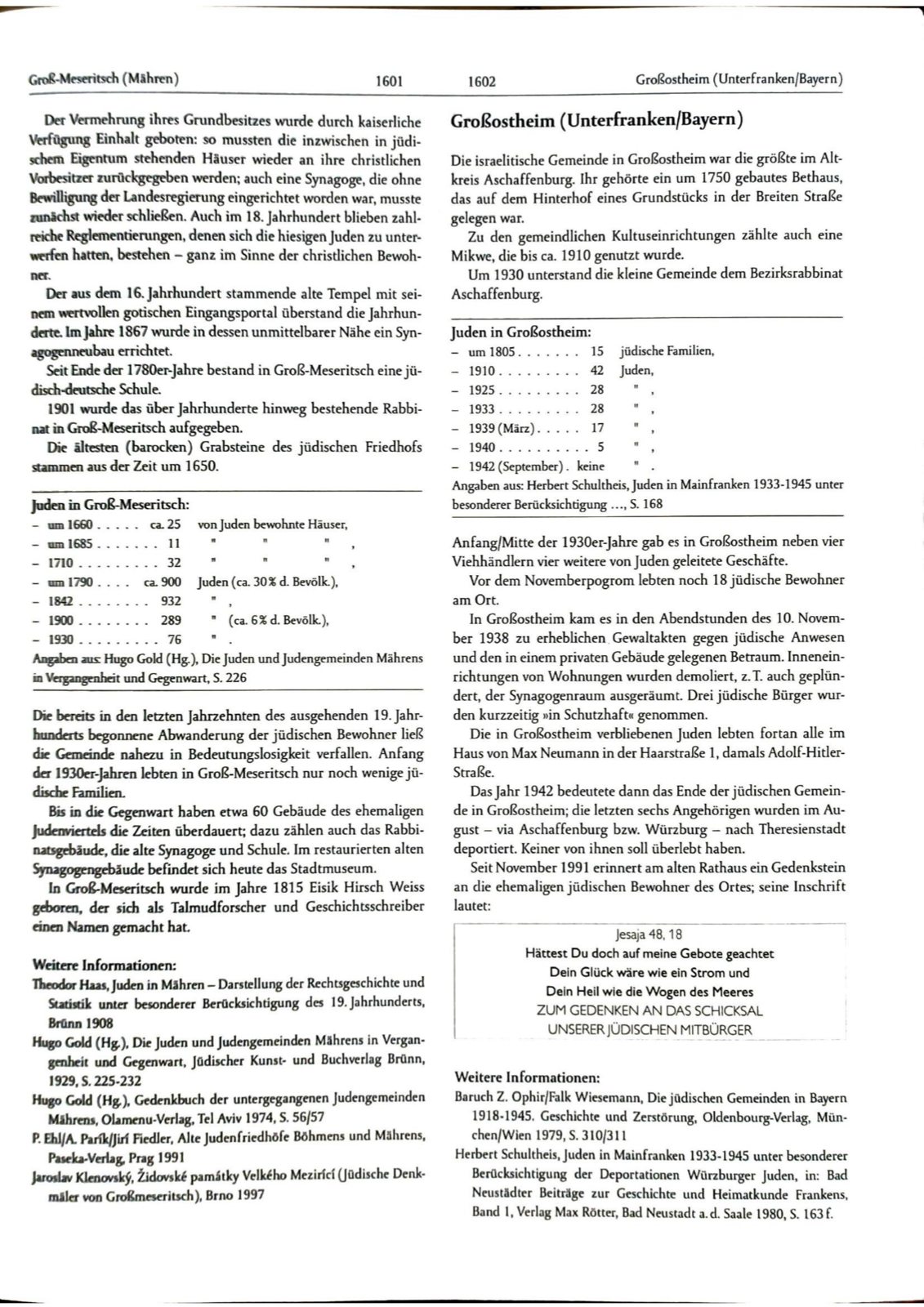
Alicke begins his account in the eighteenth century.
The existence of a Jewish community during the Black Death is uncertain.
Correction
EXIST1349 1 -> NA; POG1349 0 -> NA
Sources:
Avneri · Page 306
Alicke · Page 1602
Grünsfeld (43)
Error
Voigtländer and Voth code a "confirmed Jewish settlement" here during the Black Death. However, their sources provide "unambiguous information" that the community was destroyed before 1349.
Reality
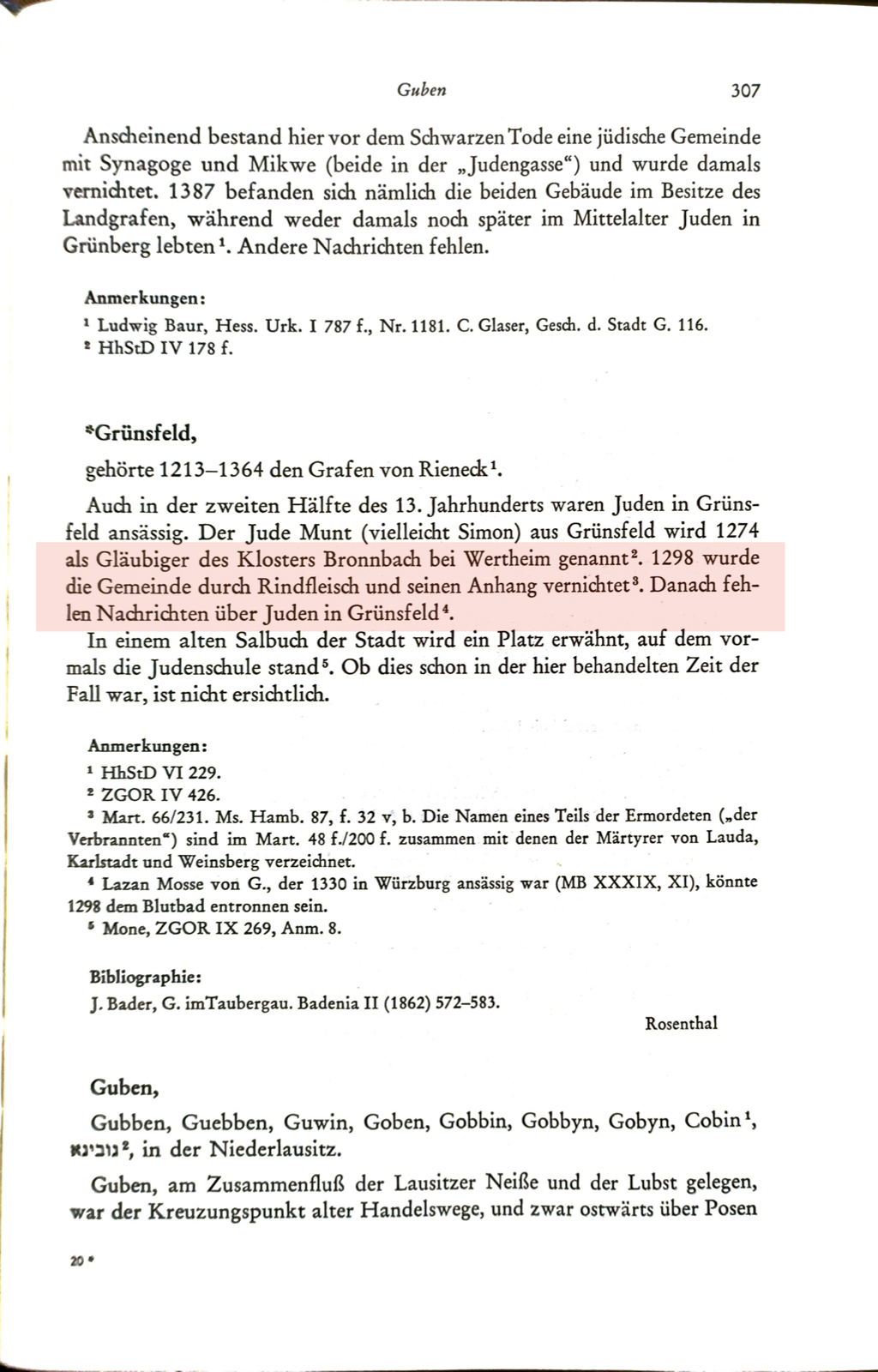
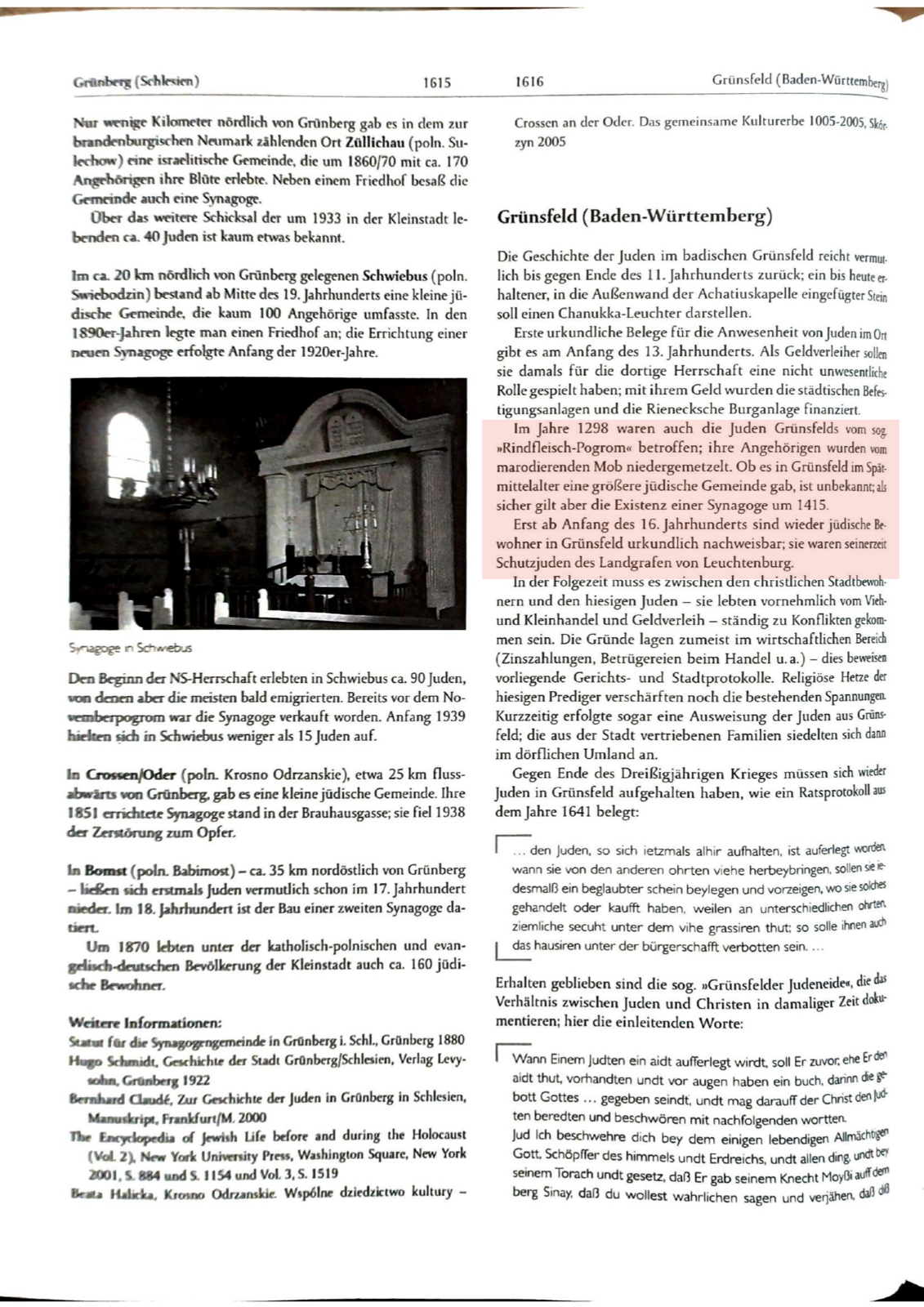
Avneri states that in 1298 "the community was annihilated [...] After that, reports about Jews in Grünsfeld are missing" (1298 wurde die Gemeinde [...] vernichtet. Danach fehlen Nachrichten über Juden in Grünsfeld).
Alicke corroborates this, noting that Jewish residents are only documented again from the beginning of the sixteenth century.
There was no Jewish community in the town during the Black Death.
Correction
EXIST1349 1 -> 0
Sources:
Avneri · Page 307
Alicke · Page 1616
Harmuthsachsen (44)
Error
Voigtländer and Voth failed to code a "confirmed Jewish settlement" here during the Black Death, despite "unambiguous information" in their sources.
Reality
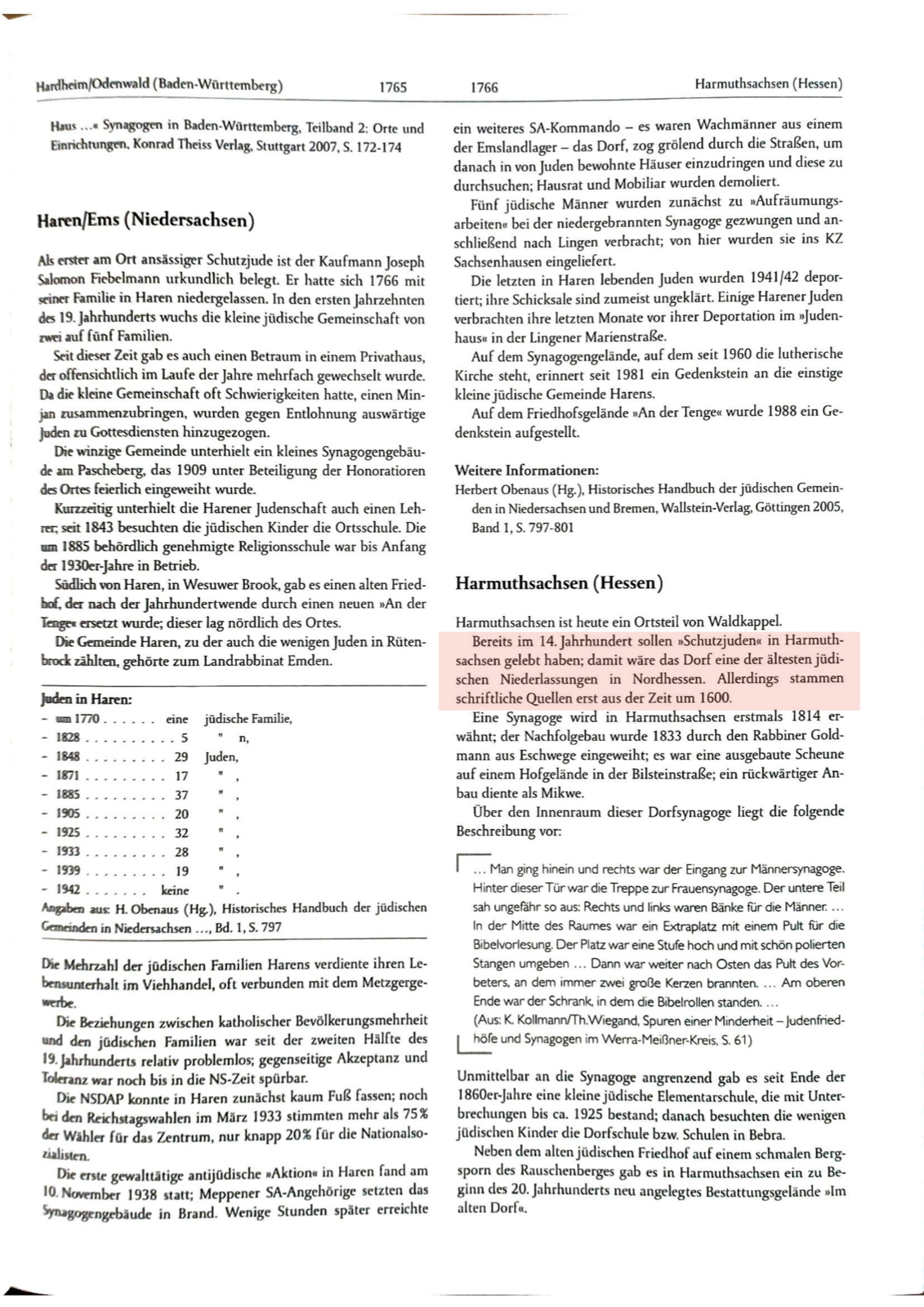
Alicke states that "already in the fourteenth century, ‘protected Jews’ are said to have lived in Harmuthsachsen; thus the village would be one of the oldest Jewish settlements in North Hesse" („Bereits im 14. Jahrhundert sollen ‚Schutzjuden’ in Harmuthsachsen gelebt haben; damit wäre das Dorf eine der ältesten jüdischen Niederlassungen in Nordhessen"). He notes, however, that "written sources only date back to around 1600" („Allerdings stammen schriftliche Quellen erst aus der Zeit um 1600").
Although Alicke’s account relies on tradition rather than contemporary documents, his specific claim of fourteenth-century settlement is sufficient to establish Jewish presence during the Black Death.
Correction
EXIST1349 0 -> 1
Source:
Alicke · Page 1766
Heidenheim a. d. Brenz (45 & 46)
Error
Voigtländer and Voth code a "confirmed Jewish settlement" here during the Black Death. However, their sources do not provide "unambiguous information" to support this.
Reality
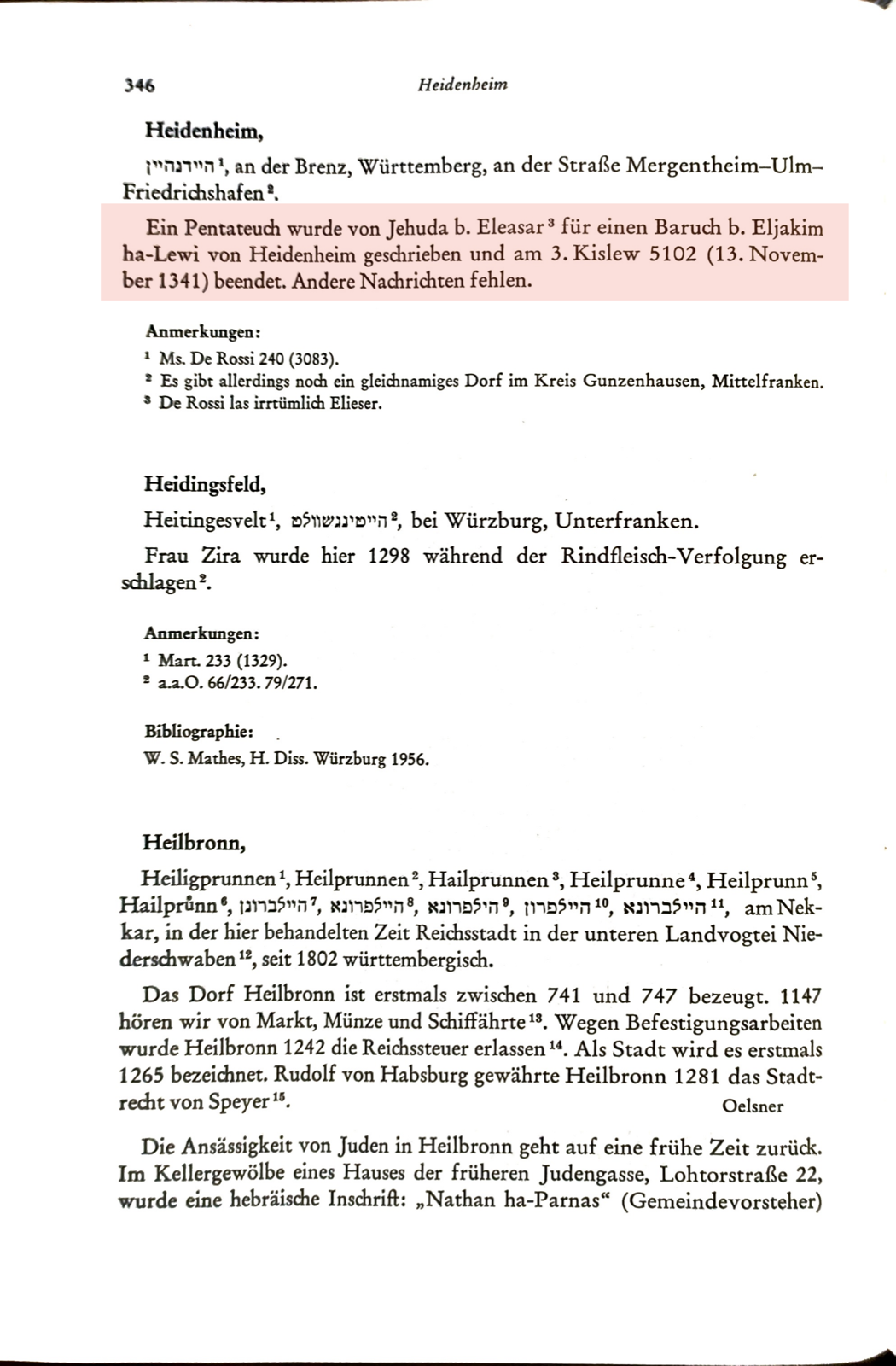
Avneri mentions a Pentateuch written for a local Jew in 1341 but notes that "other reports are missing" („Andere Nachrichten fehlen").
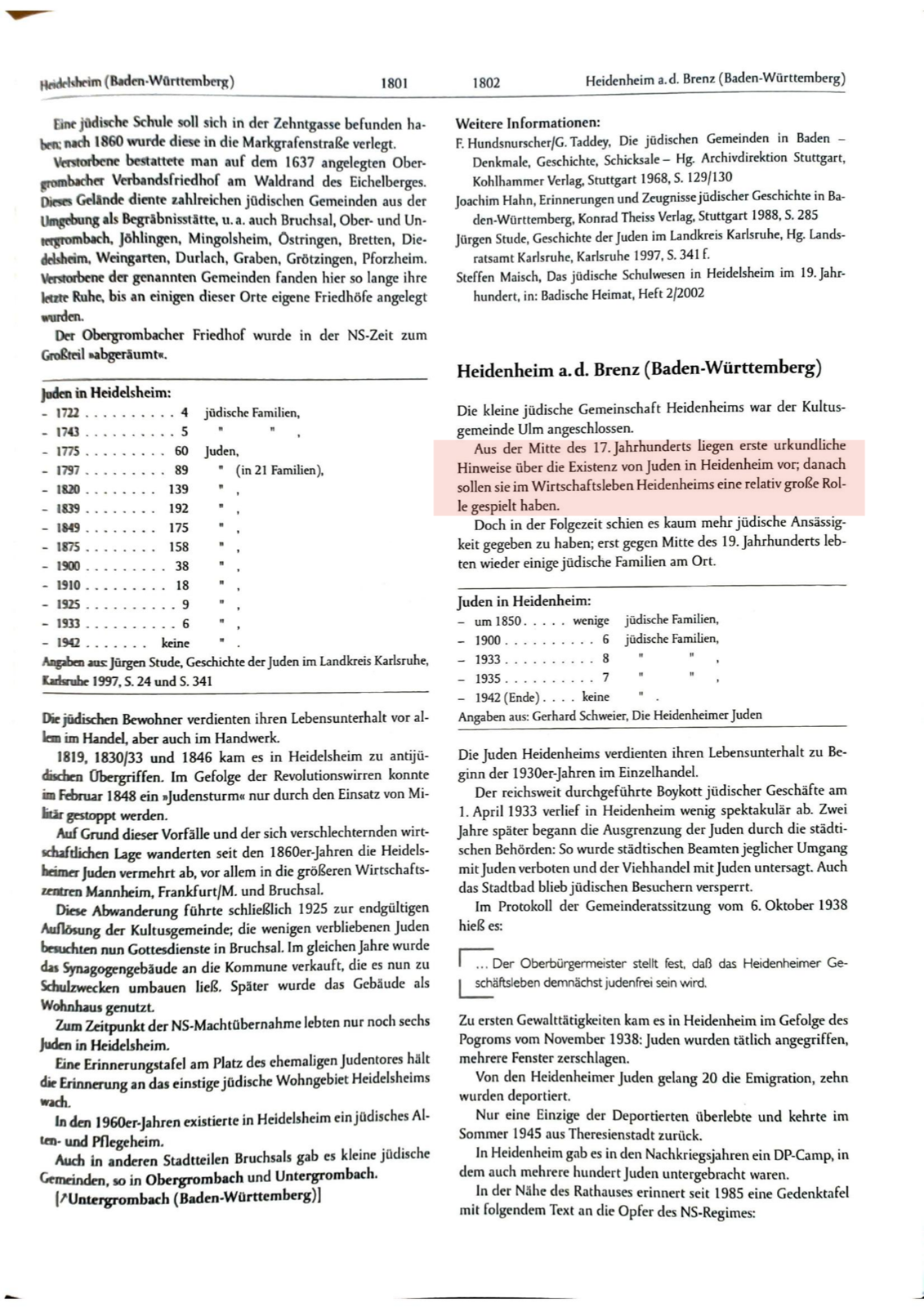
Alicke states that the first documentary evidence of Jewish existence in the town is only available from "the mid-seventeenth century" („Aus der Mitte des 17. Jahrhunderts liegen erste urkundliche Hinweise über die Existenz von Juden in Heidenheim vor").
The existence of a Jewish community during the Black Death is uncertain.
Correction
EXIST1349 1 -> NA; POG1349 0 -> NA
Sources:
Avneri · Page 346
Alicke · Page 1802
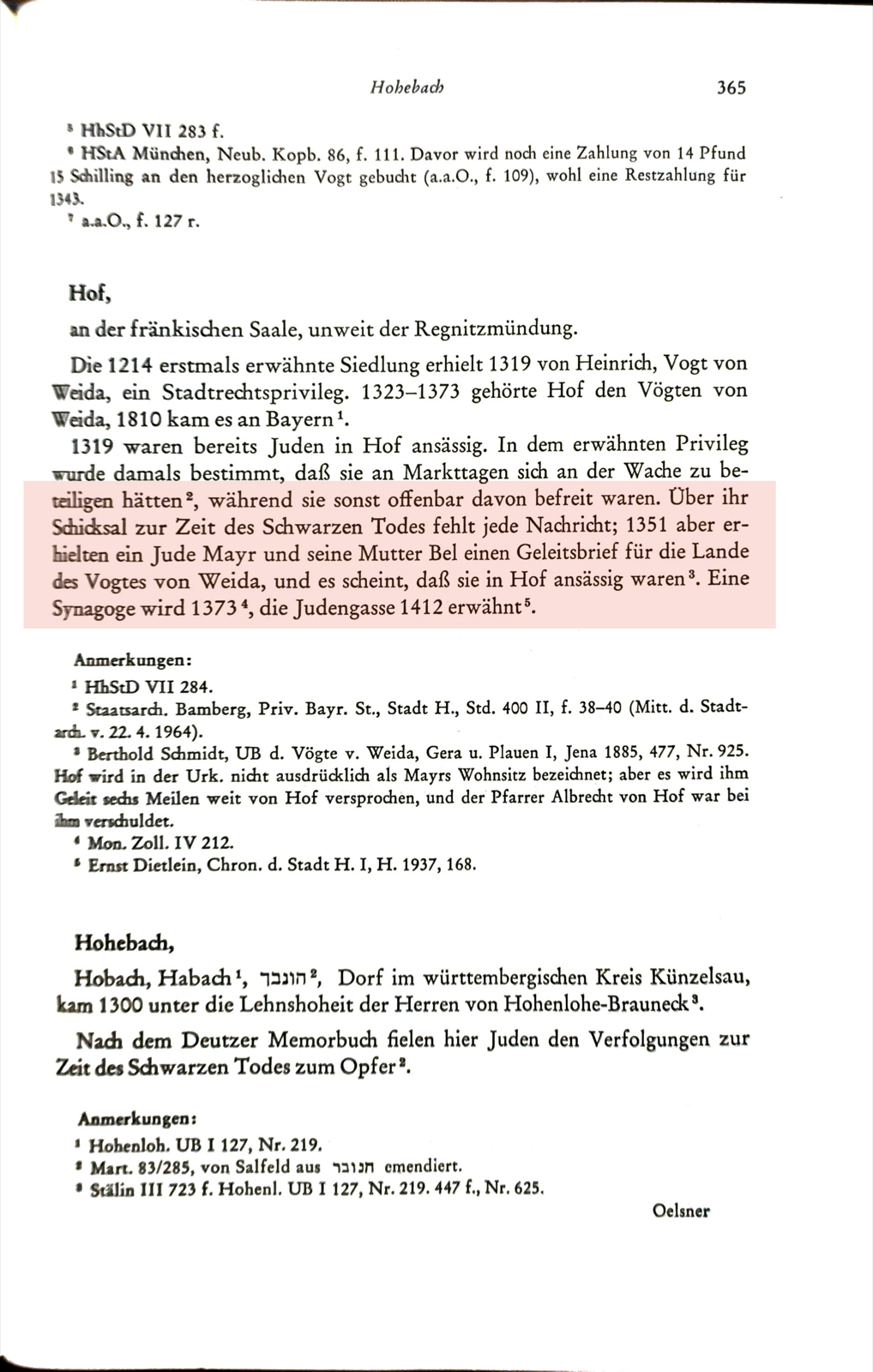
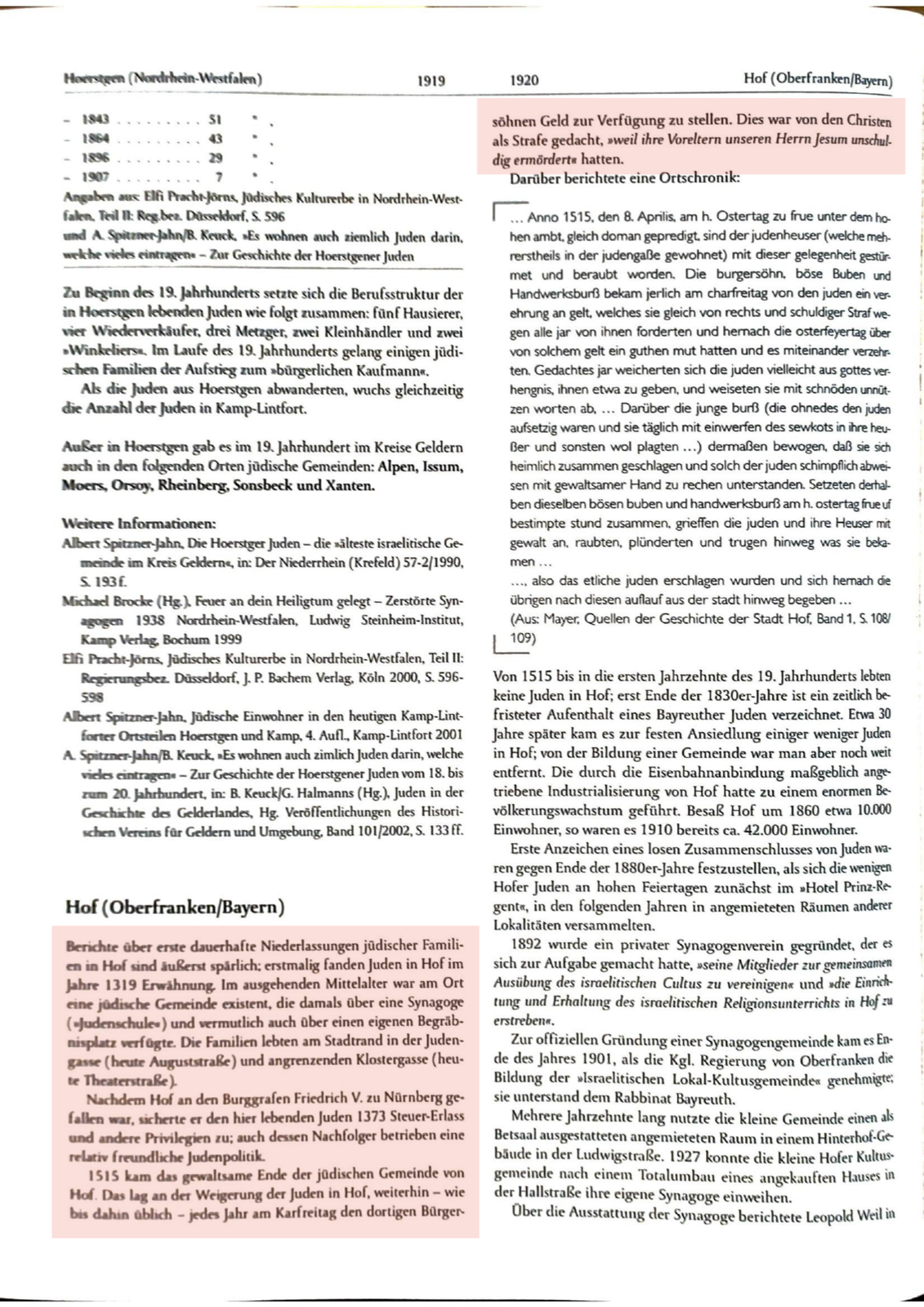
Hof (47)
Error
Voigtländer and Voth failed to code a 0 for a pogrom here during the Black Death, despite their rule that a lack of information should be coded as 0.
Reality
Avneri notes the presence of Jews in Hof by 1319 but states explicitly that there is "no information about their fate during the time of the Black Death" („Über ihr Schicksal zur Zeit des Schwarzen Todes fehlt jede Nachricht"). He further notes that in 1351 a Jew and his mother received a letter of safe conduct implying continued settlement, and that a synagogue is mentioned in 1373.
Alicke confirms the existence of a small Jewish community in the late Middle Ages but similarly provides no evidence of a pogrom.
Absence of a persecution report, combined with evidence of Jewish continuity after 1349, indicates that no pogrom occurred.
Correction
POG1349 NA -> 0
Sources:
Avneri · Page 365
Alicke · Page 1919-1920
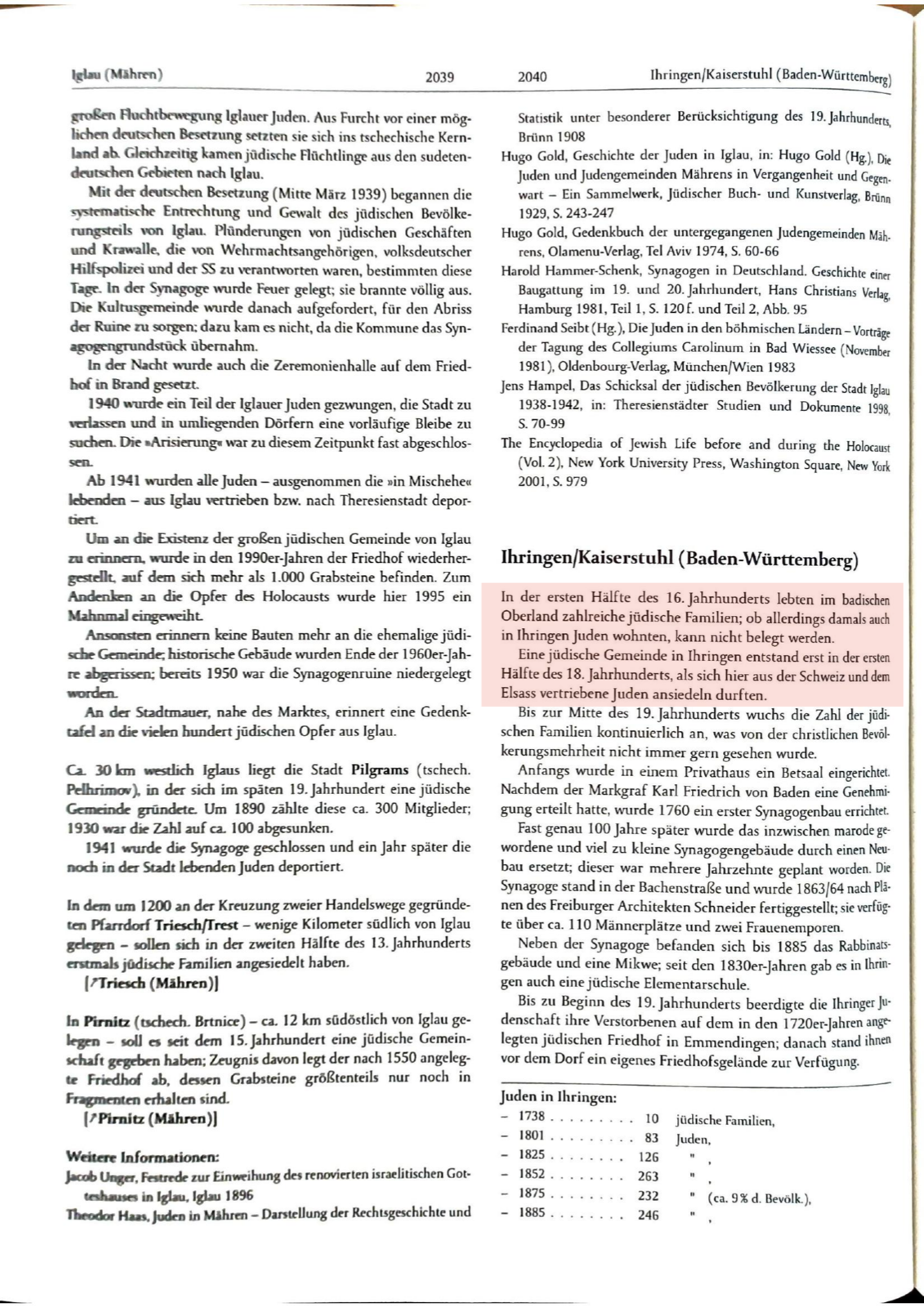
Ihringen-Kaiserstuhl (48 & 49)
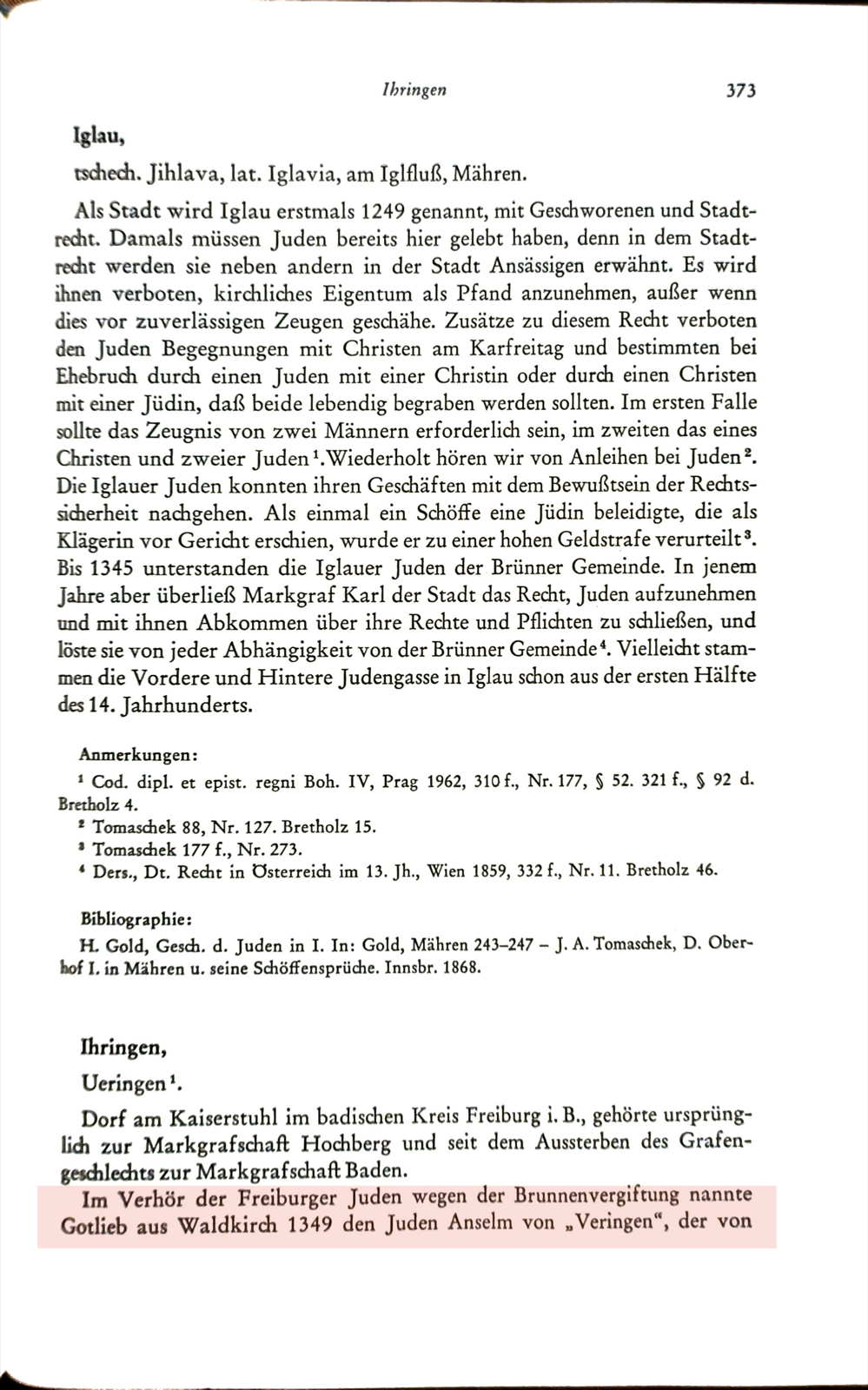
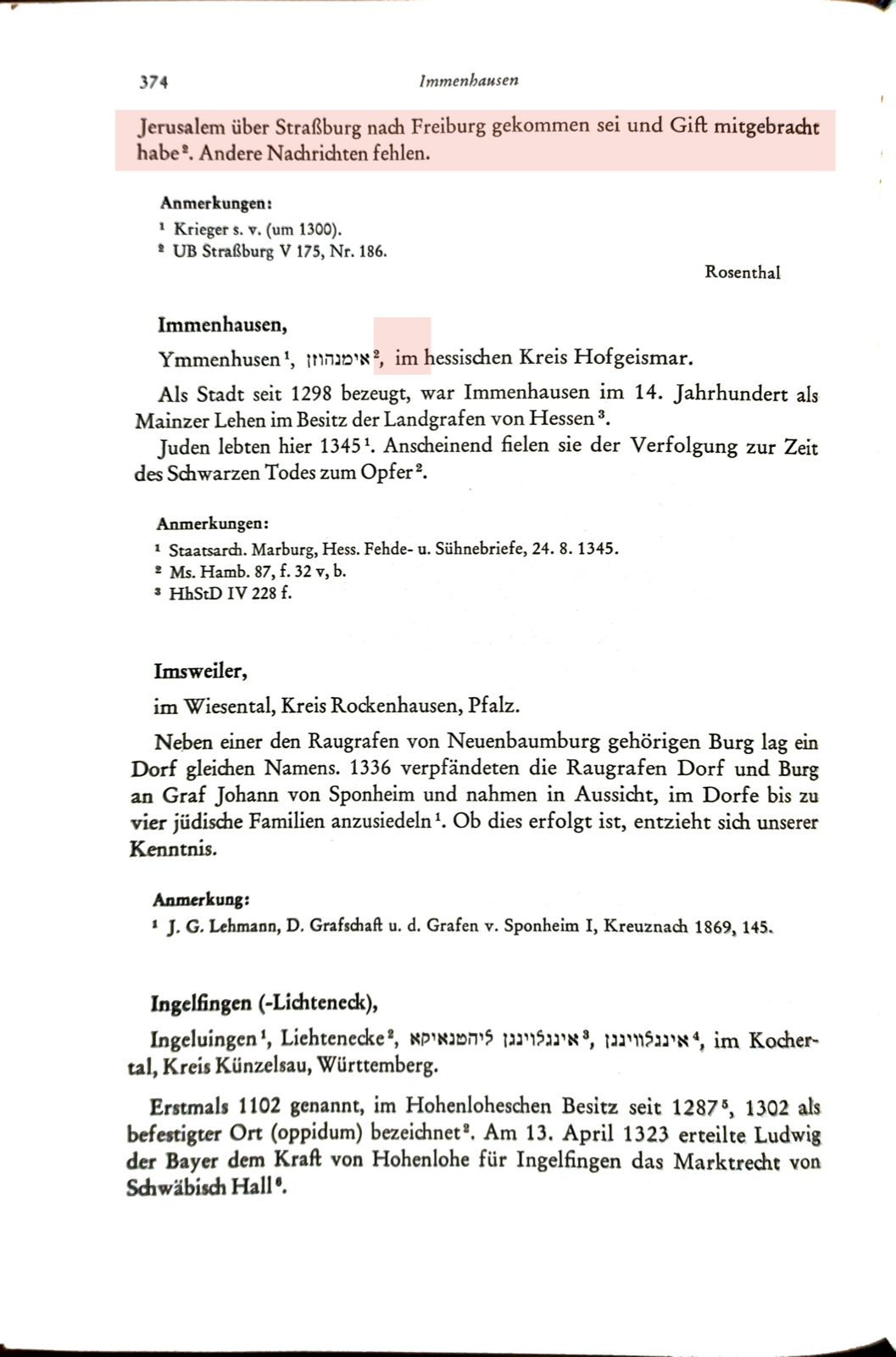
Error
Voigtländer and Voth code a "confirmed Jewish settlement" here during the Black Death. However, their sources do not provide "unambiguous information" to support this.
Reality
Avneri mentions a tortured confession naming a local Jew but notes that "other reports are missing" („Andere Nachrichten fehlen").
Alicke also provides no evidence of a presence during the Black Death, noting instead that a "Jewish community in Ihringen only emerged in the first half of the eighteenth century" („Eine jüdische Gemeinde in Ihringen entstand erst in der ersten Hälfte des 18. Jahrhunderts").
The existence of a Jewish community during the Black Death is uncertain.
Correction
EXIST1349 1 -> NA; POG1349 0 -> NA
Sources:
Avneri · Page 373
Avneri · Page 374
Alicke · Page 2040
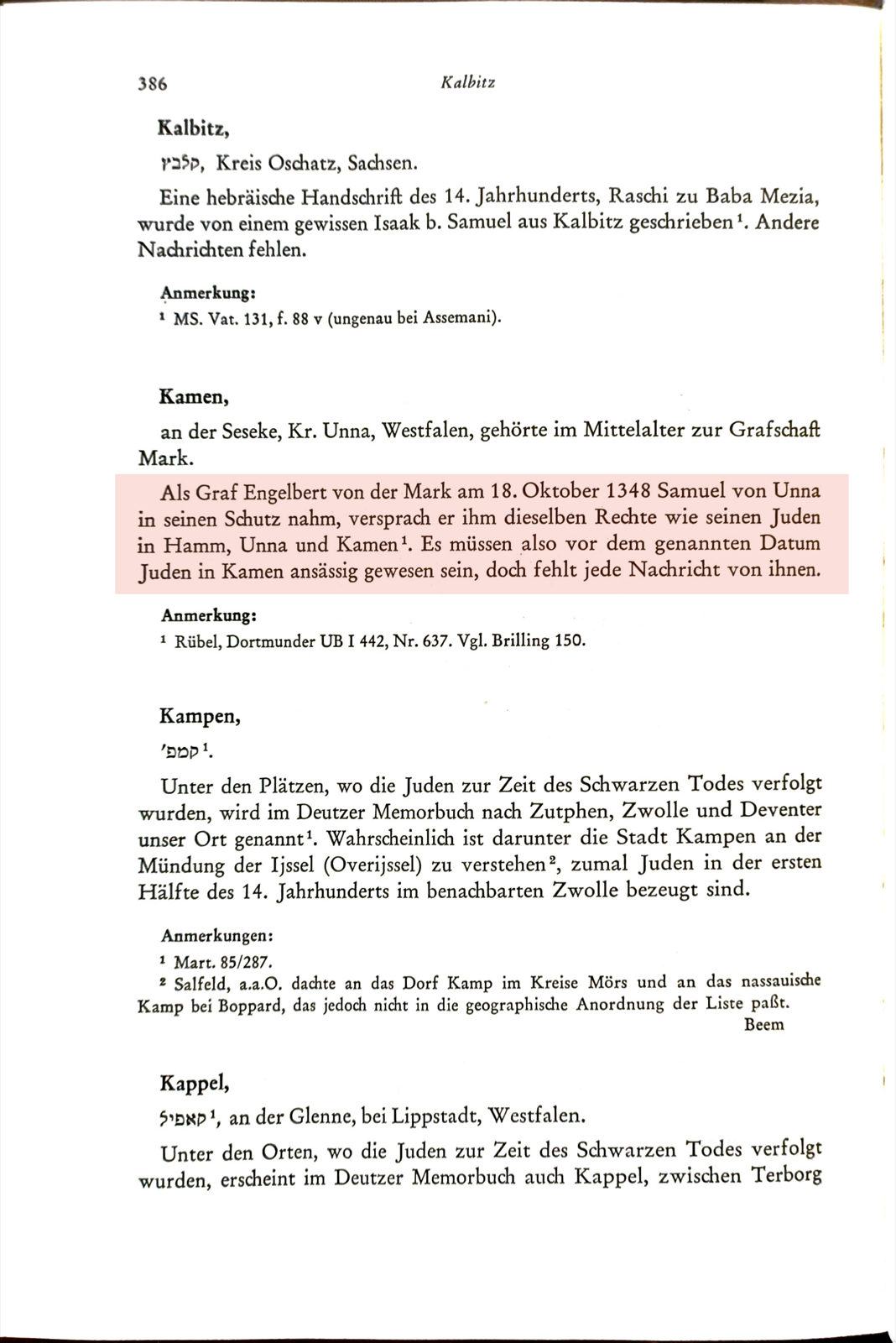
Kamen (50)
Error
Voigtländer and Voth code "unambiguous information" that no pogrom occurred in Kamen during the Black Death. However, their sources indicate ambiguity.
Reality
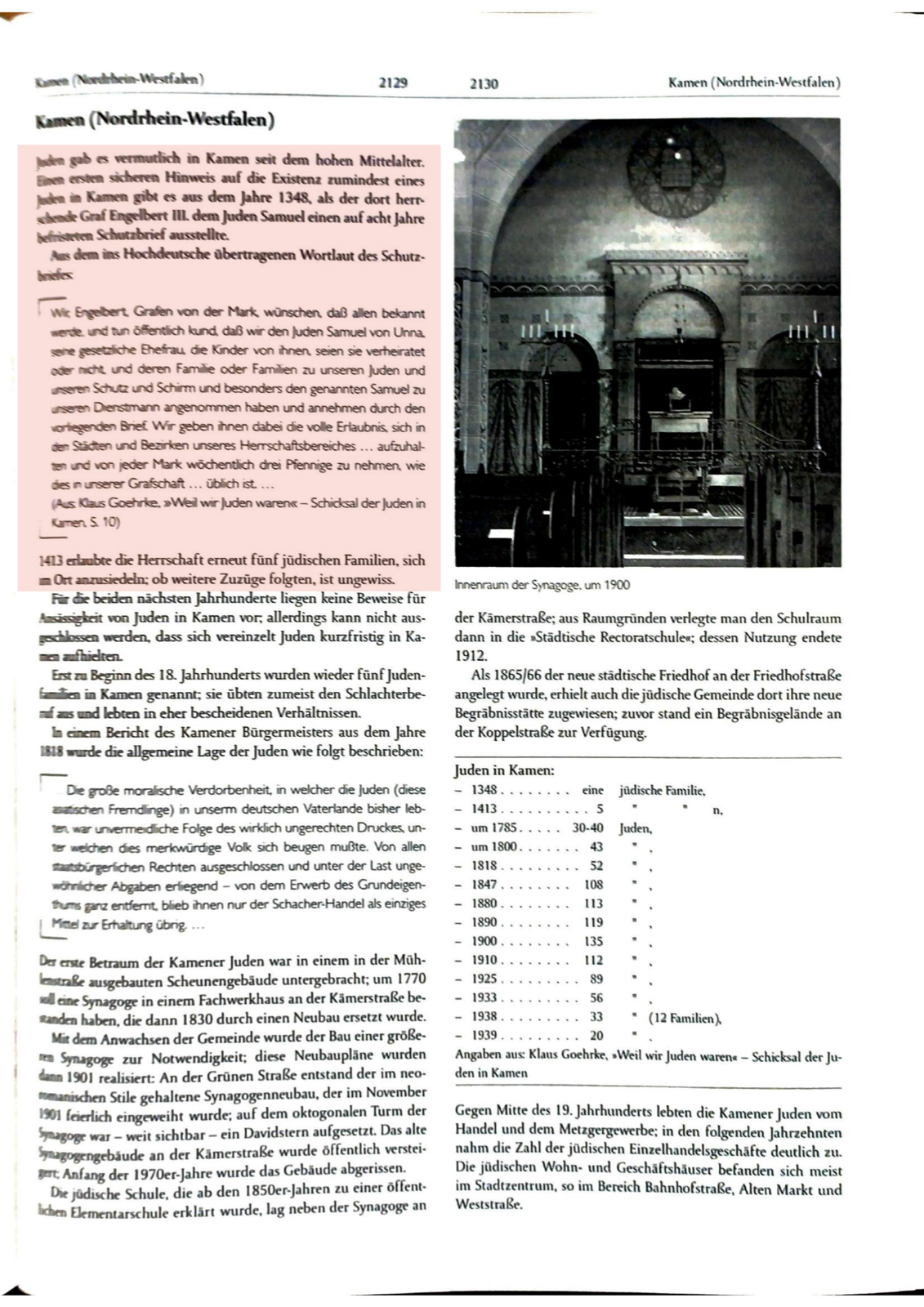
Avneri mentions that in 1348 "every report of them is missing" („doch fehlt jede Nachricht von ihnen").
Alicke reports that in 1413 the authorities "again allowed five Jewish families to settle" („erlaubte die Herrschaft erneut fünf jüdischen Familien, sich im Ort anzusiedeln").
The word "again" implies the community disappeared at some point, making it uncertain whether they were persecuted during the Black Death.
Correction
POG1349 0 -> NA
Sources:
Avneri · Page 386
Alicke · Page 2129
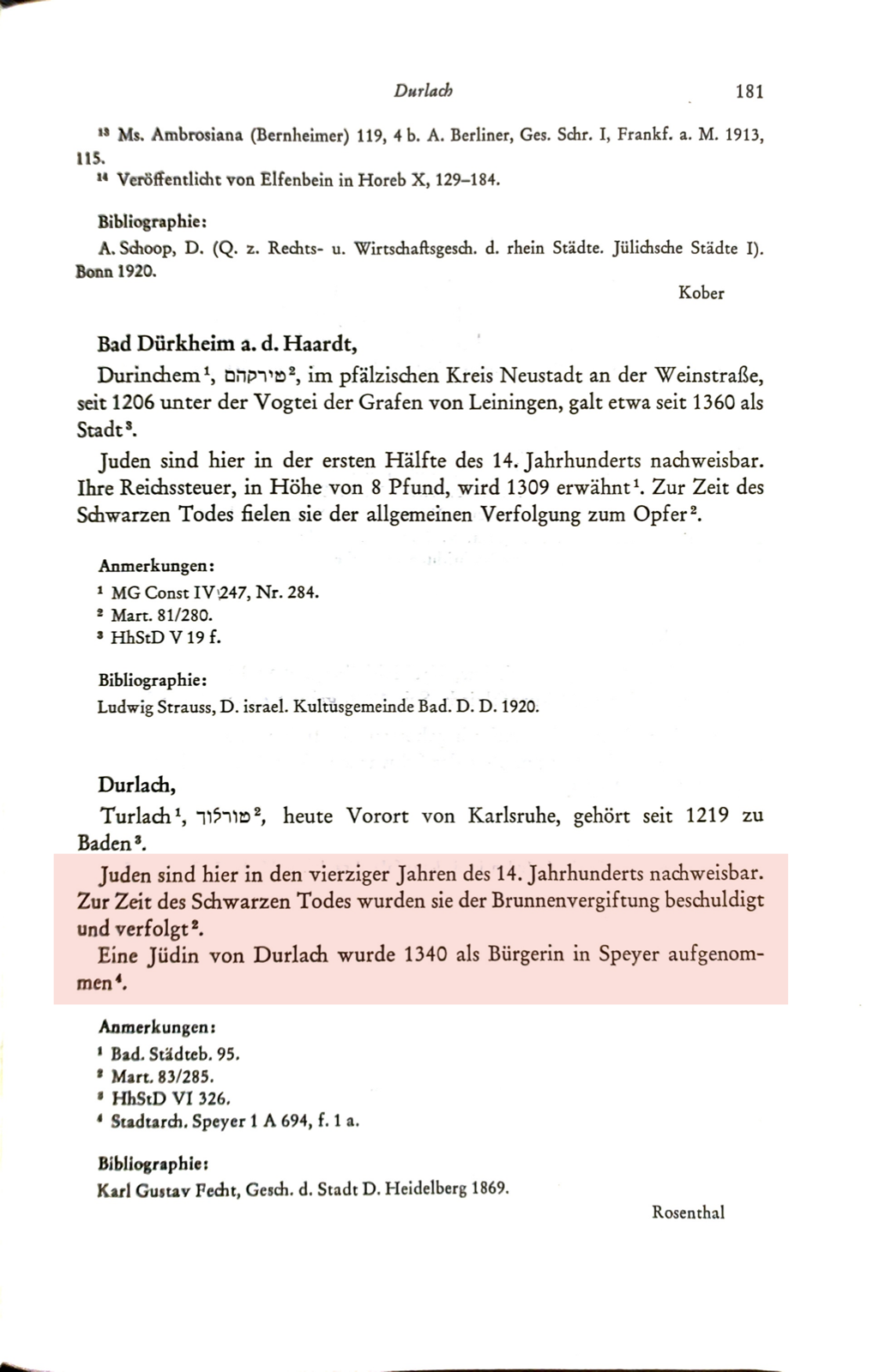
Karlsruhe (51 & 52)
Error
Voigtländer and Voth failed to code a "confirmed Jewish settlement" here during the Black Death, despite "unambiguous information" in their sources.
Reality
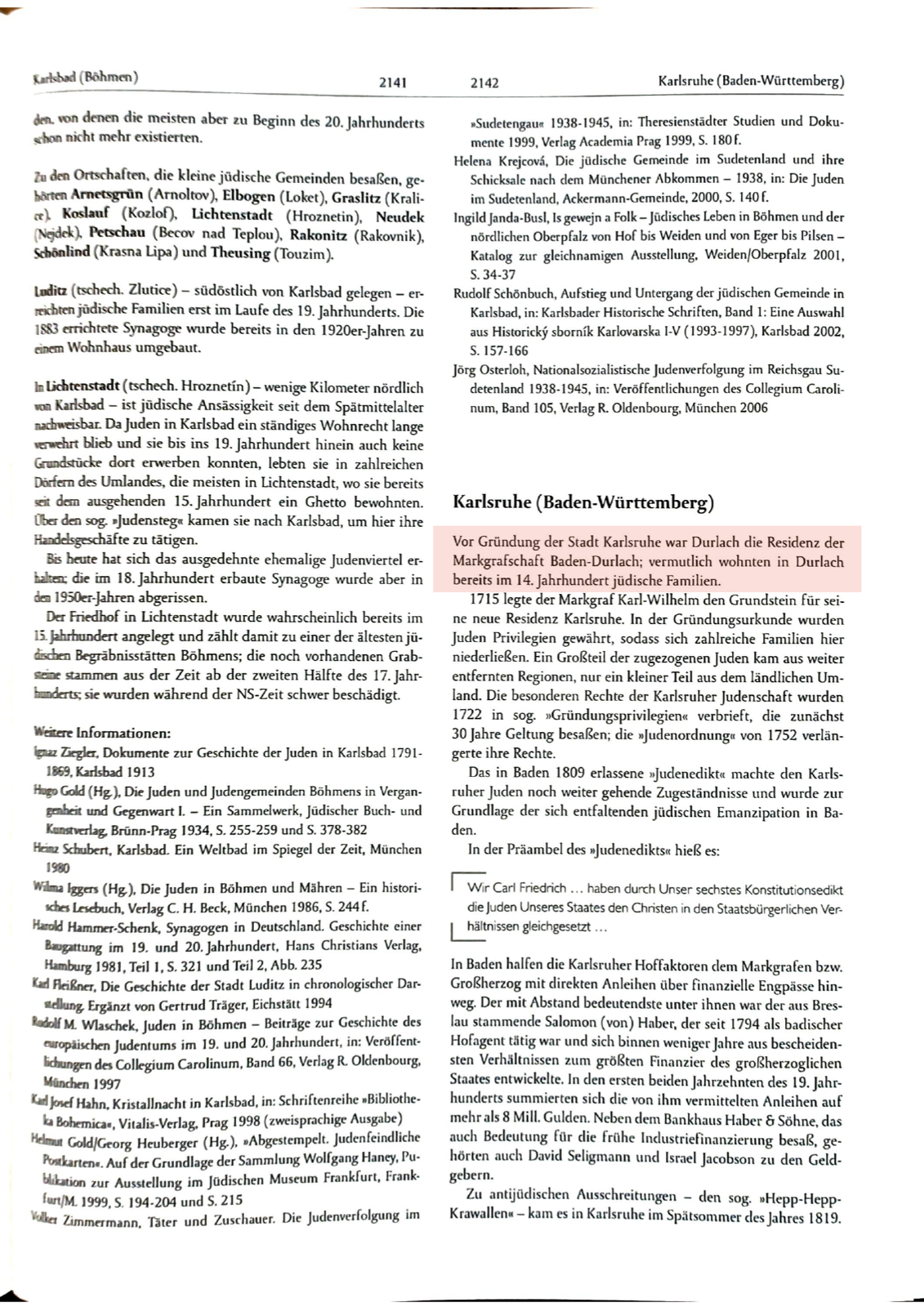
Avneri confirms for Durlach, which he identifies as "today a suburb of Karlsruhe" („heute Vorort von Karlsruhe"), that "Jews are verifiable here in the 1340s" („Juden sind hier in den vierziger Jahren des 14. Jahrhunderts nachweisbar"). He further states that "at the time of the Black Death, they were accused of poisoning wells and persecuted" („Zur Zeit des Schwarzen Todes wurden sie der Brunnenvergiftung beschuldigt und verfolgt").
Alicke similarly notes that Jewish families presumably lived in Durlach already in the fourteenth century.
Since Avneri himself identifies Durlach as part of Karlsruhe, there is unambiguous evidence of Jewish presence during the Black Death.
Correction
EXIST1349 0 -> 1; POG1349 0 -> 1
Sources:
Avneri · Page 181
Alicke · Page 2142
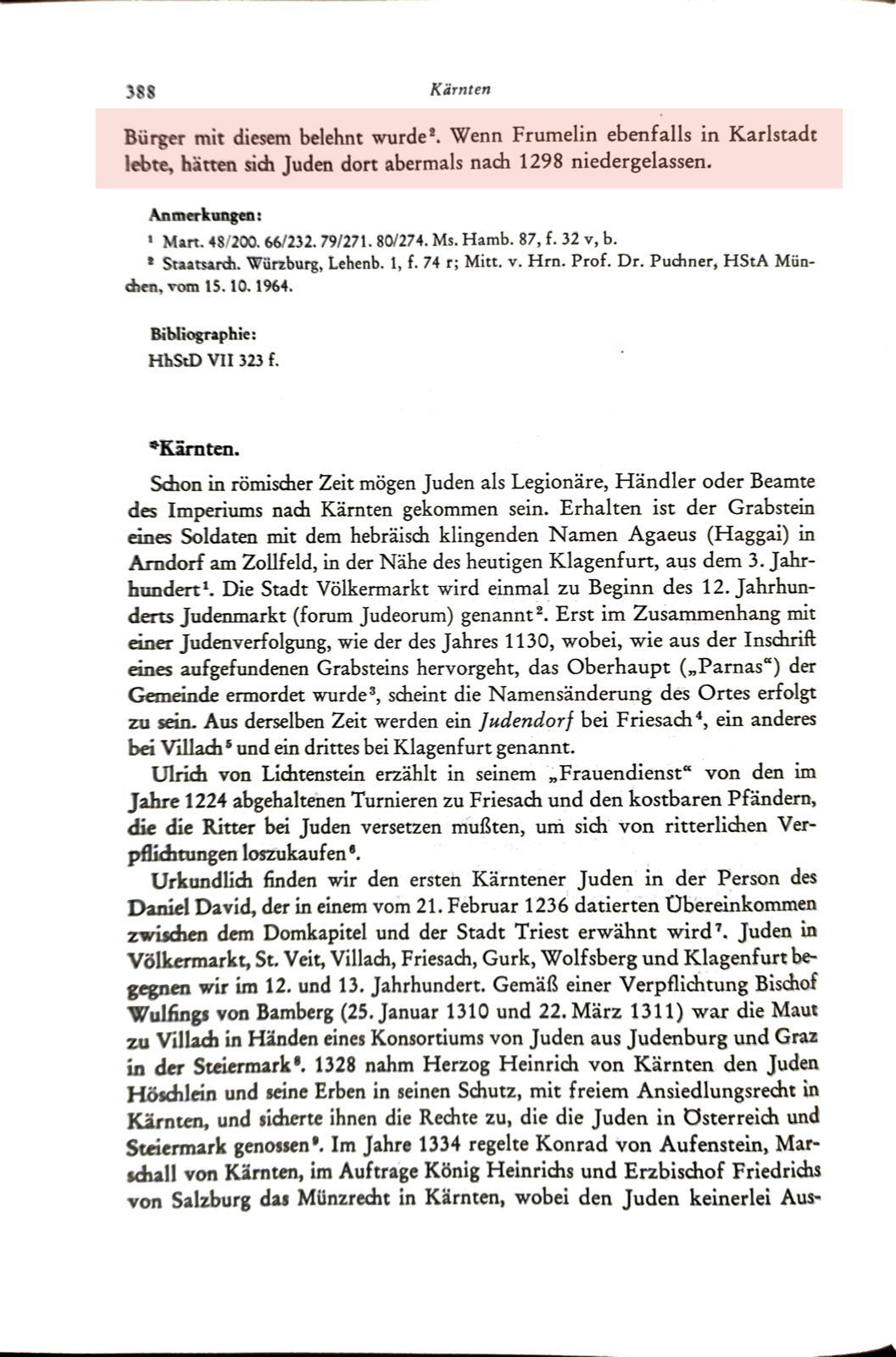
Karlstadt (53 & 54)
Error
Voigtländer and Voth code a "confirmed Jewish settlement" here during the Black Death. However, their sources do not provide "unambiguous information" to support this.
Reality
Avneri notes that Jews fell victim to persecution in 1298 and provides only indirect speculation about a later presence.
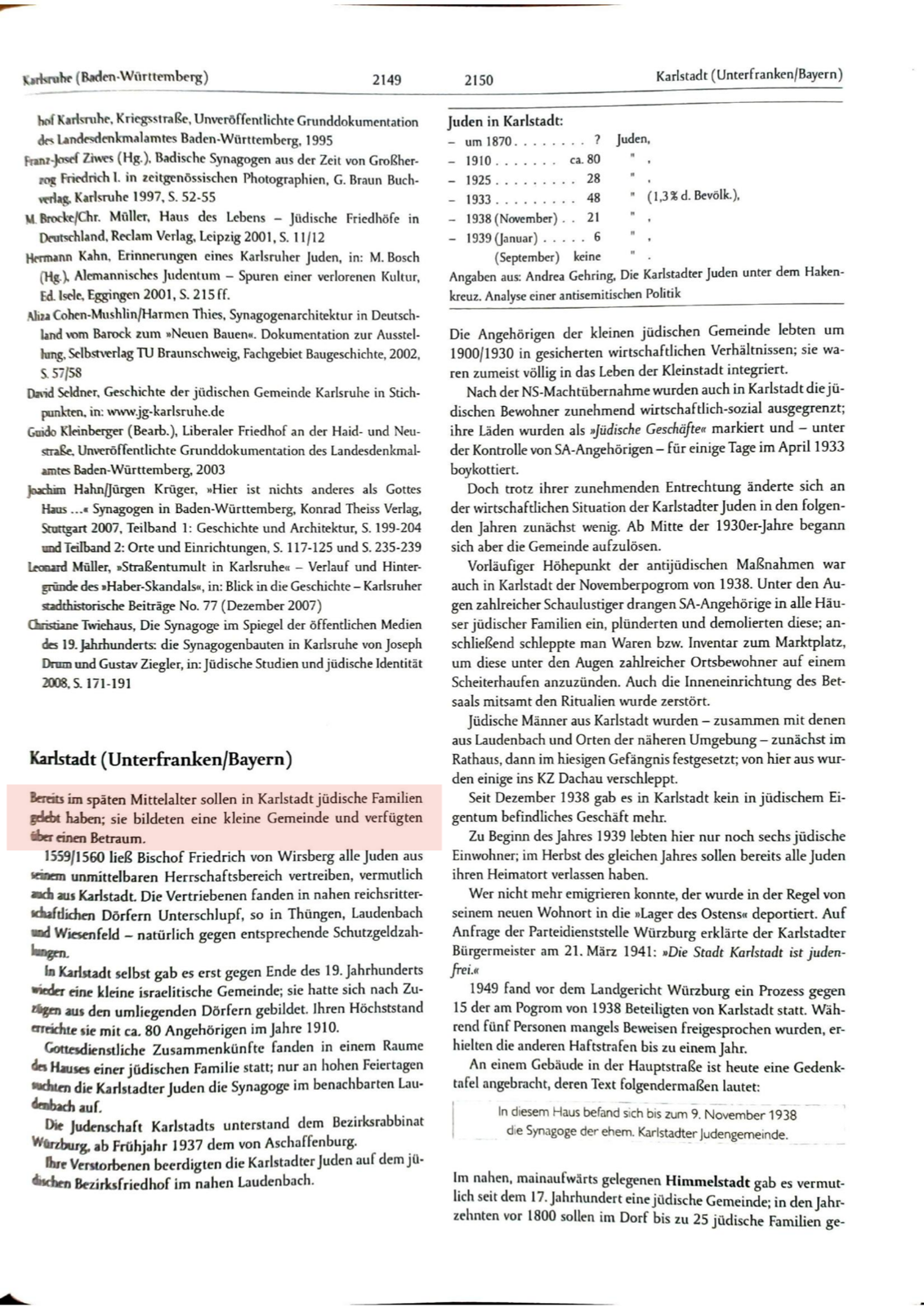
Alicke states that families "are said to have lived in Karlstadt as early as the late Middle Ages" („Bereits im späten Mittelalter sollen in Karlstadt jüdische Familien gelebt haben"), but the timing relative to 1298 is unclear.
The existence of a Jewish community during the Black Death is uncertain.
Correction
EXIST1349 1 -> NA; POG1349 0 -> NA
Sources:
Avneri · Page 387
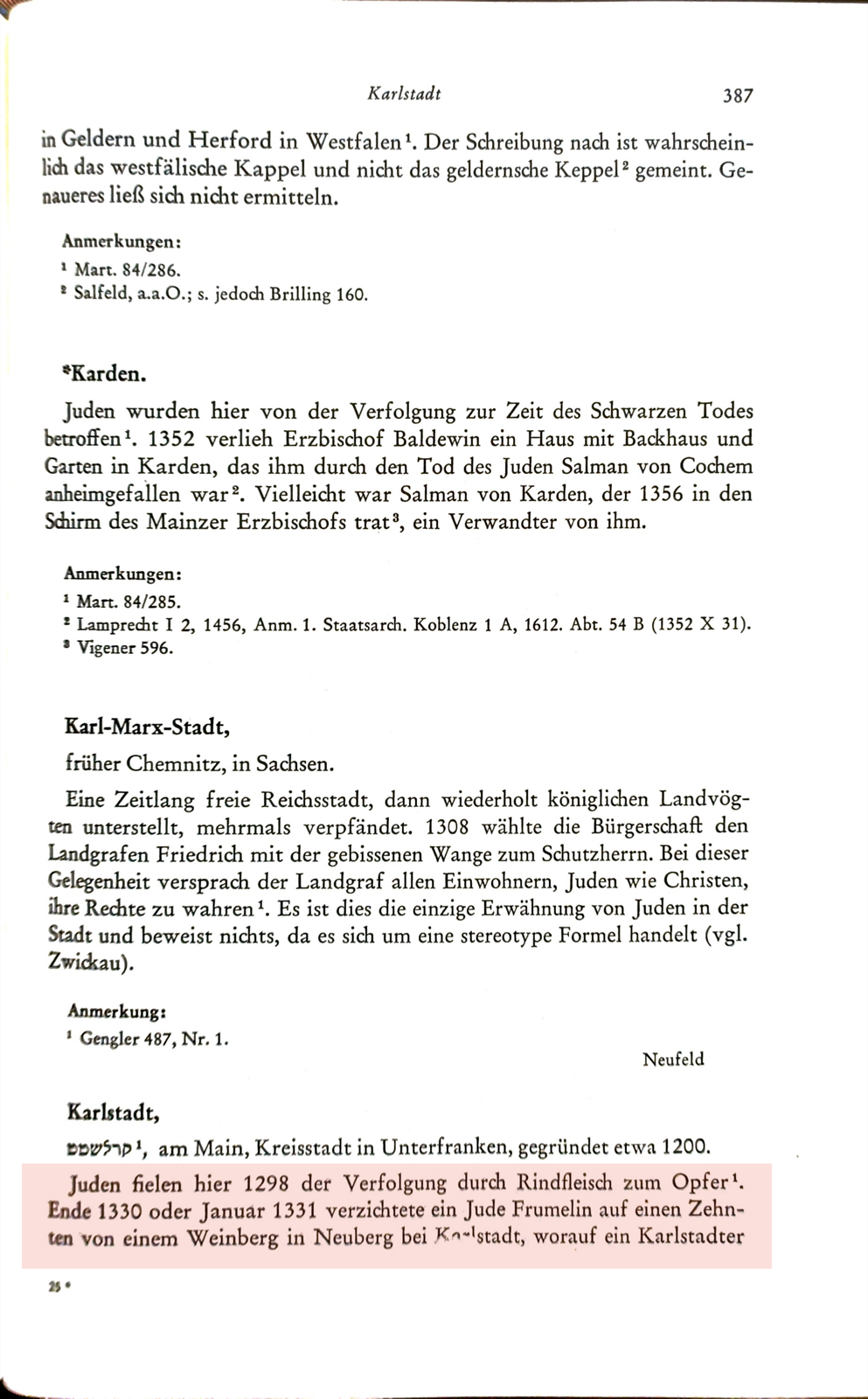
Avneri · Page 388
Alicke · Page 2149
Kempten-Allgäu (55 & 56)
Error
Voigtländer and Voth code a "confirmed Jewish settlement" here during the Black Death. However, their sources do not provide "unambiguous information" to support this.
Reality
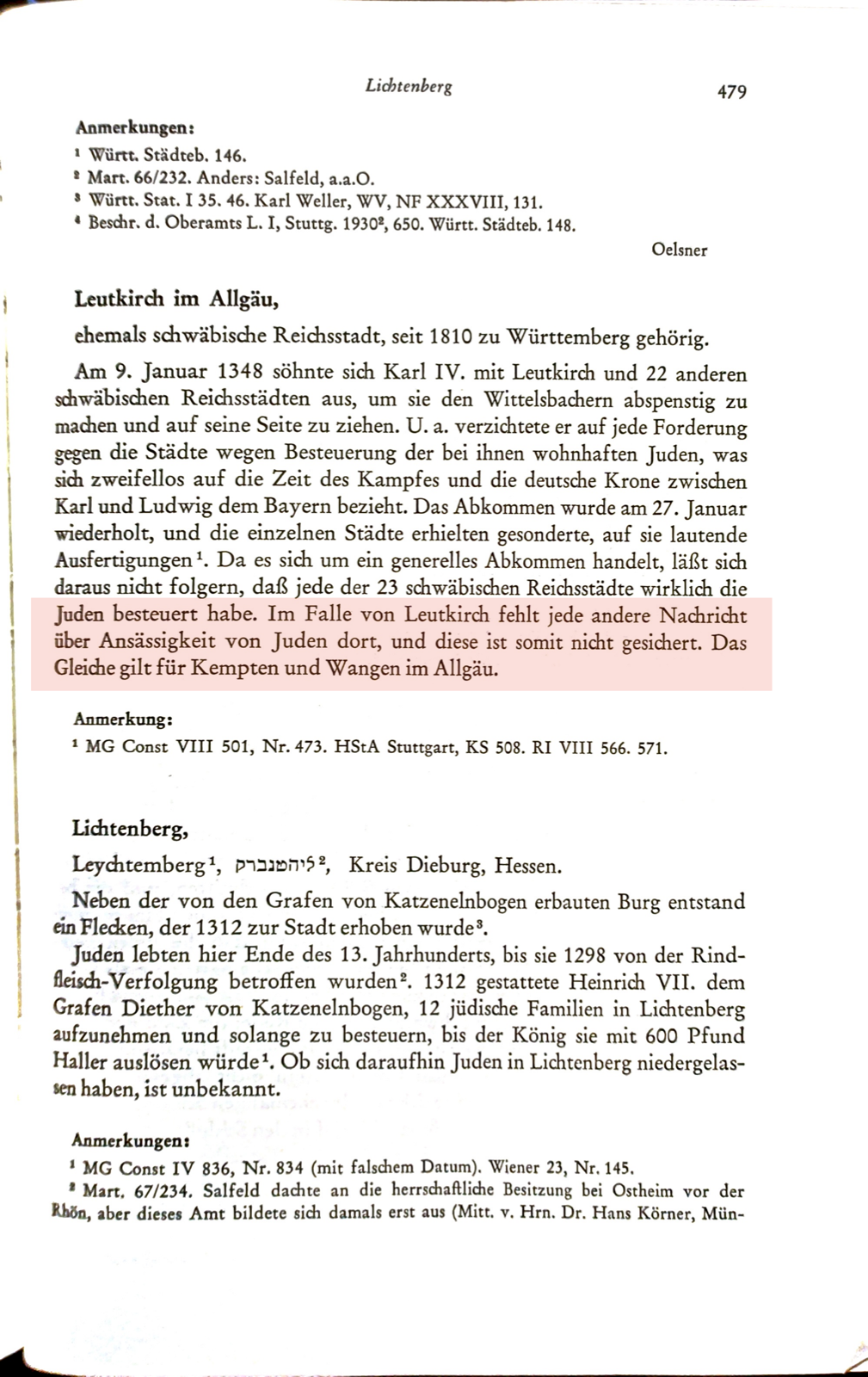
Avneri speculates about tax records but notes that "any other news about the residency of Jews there is missing, and thus it is not certain" („fehlt jede andere Nachricht über Ansässigkeit von Juden dort, und diese ist somit nicht gesichert").
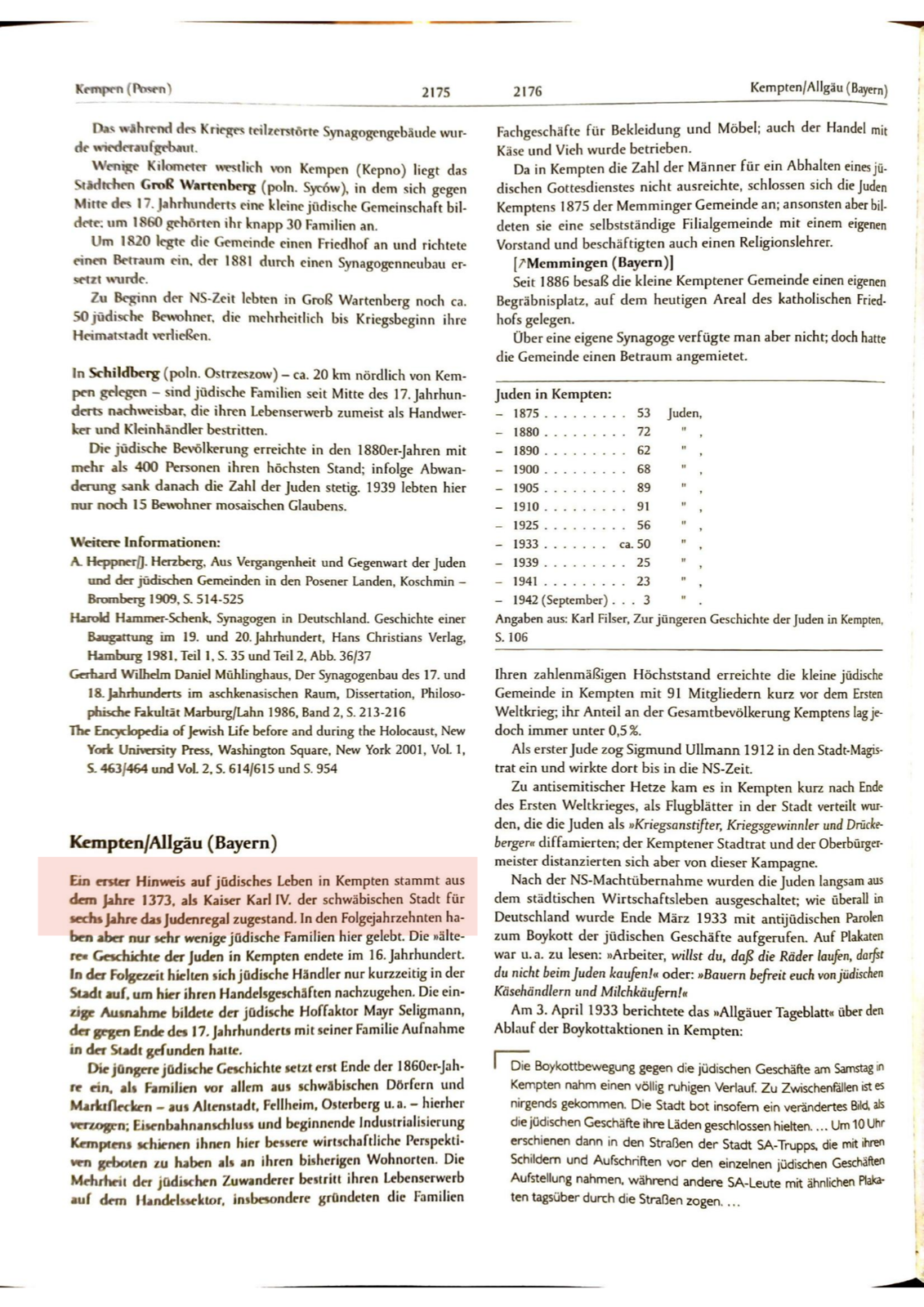
Alicke states that "a first reference to Jewish life in Kempten dates from 1373" („Ein erster Hinweis auf jüdisches Leben in Kempten stammt aus dem Jahre 1373").
The existence of a Jewish community during the Black Death is uncertain.
Correction
EXIST1349 1 -> NA; POG1349 0 -> NA
Sources:
Avneri · Page 479
Alicke · Page 2175
Königstein im Taunus (57 & 58)
Error
Voigtländer and Voth code a "confirmed Jewish settlement" here during the Black Death. However, their sources do not provide "unambiguous information" to support this.
Reality
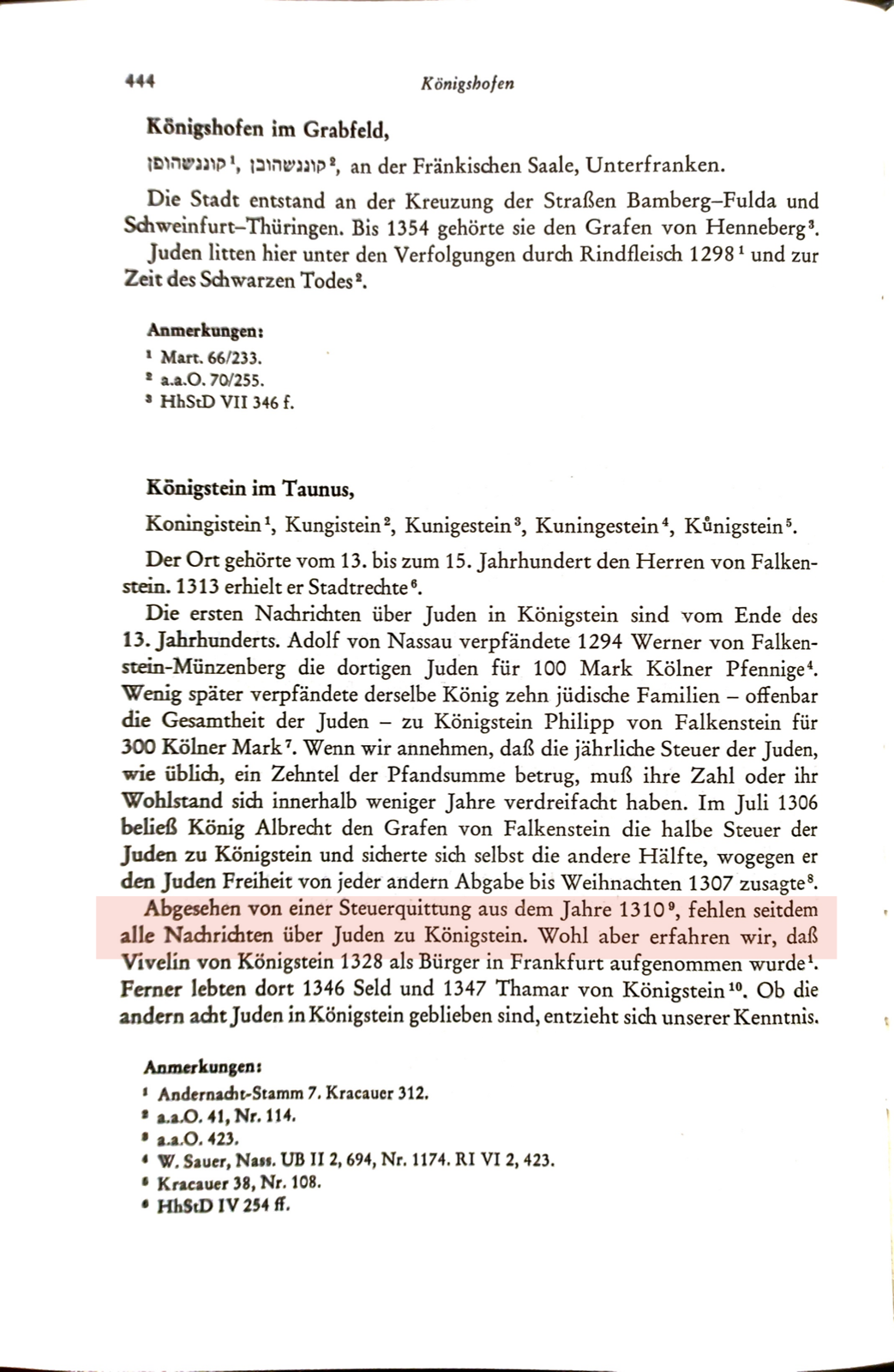
Avneri notes that tax records show a presence in 1310, but "all news about Jews in Königstein are missing since then" („fehlen seitdem alle Nachrichten über Juden zu Königstein").
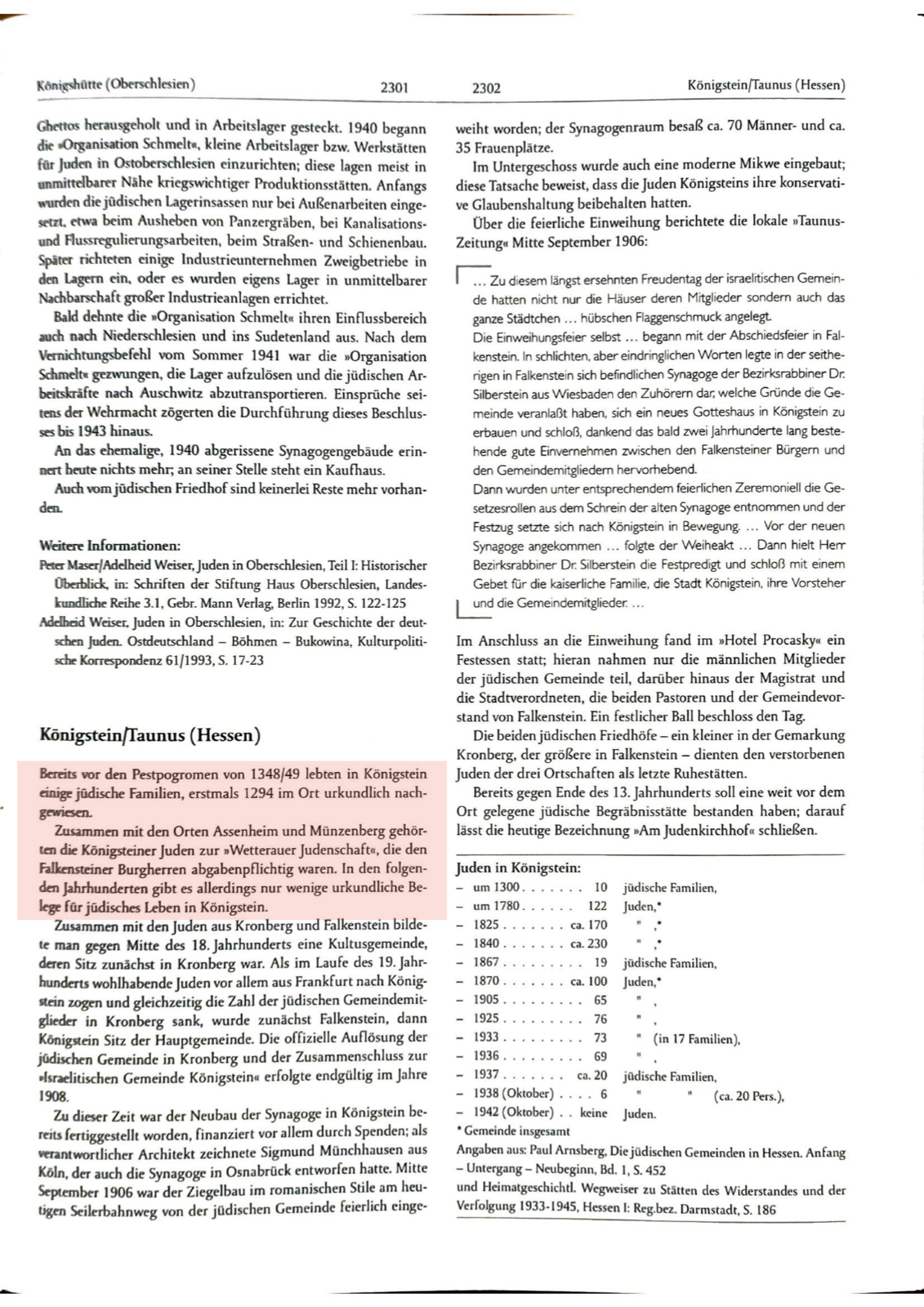
Alicke confirms they were taxed in 1294, but "in the following centuries [...] there is little documentary evidence of Jewish life in Königstein" („In den folgenden Jahrhunderten gibt es allerdings nur wenige urkundliche Belege für jüdisches Leben in Königstein").
It is unclear whether the Jewish presence persisted until the Black Death.
Correction
EXIST1349 1 -> NA; POG1349 0 -> NA
Sources:
Avneri · Page 444
Alicke · Page 2301
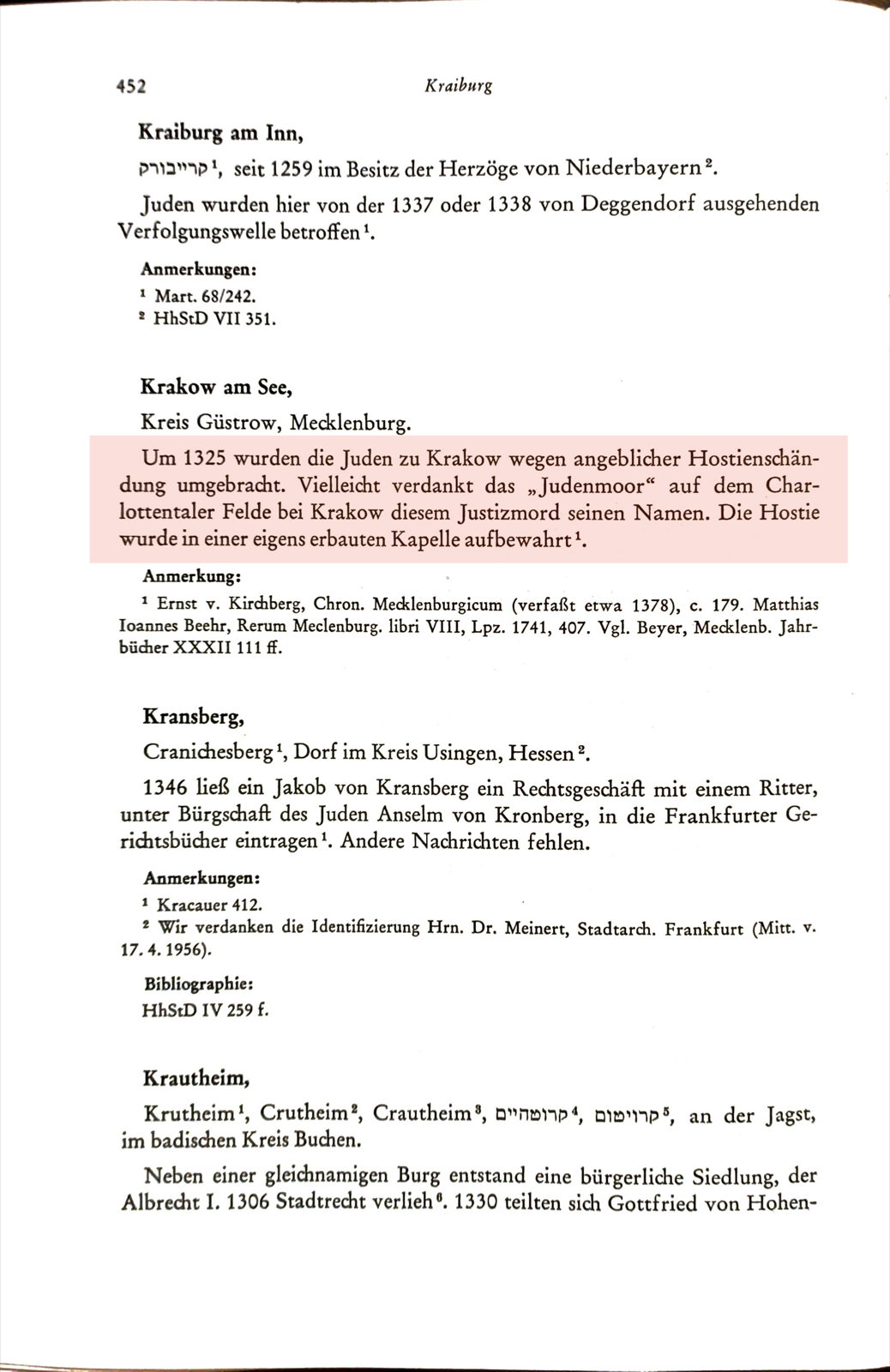
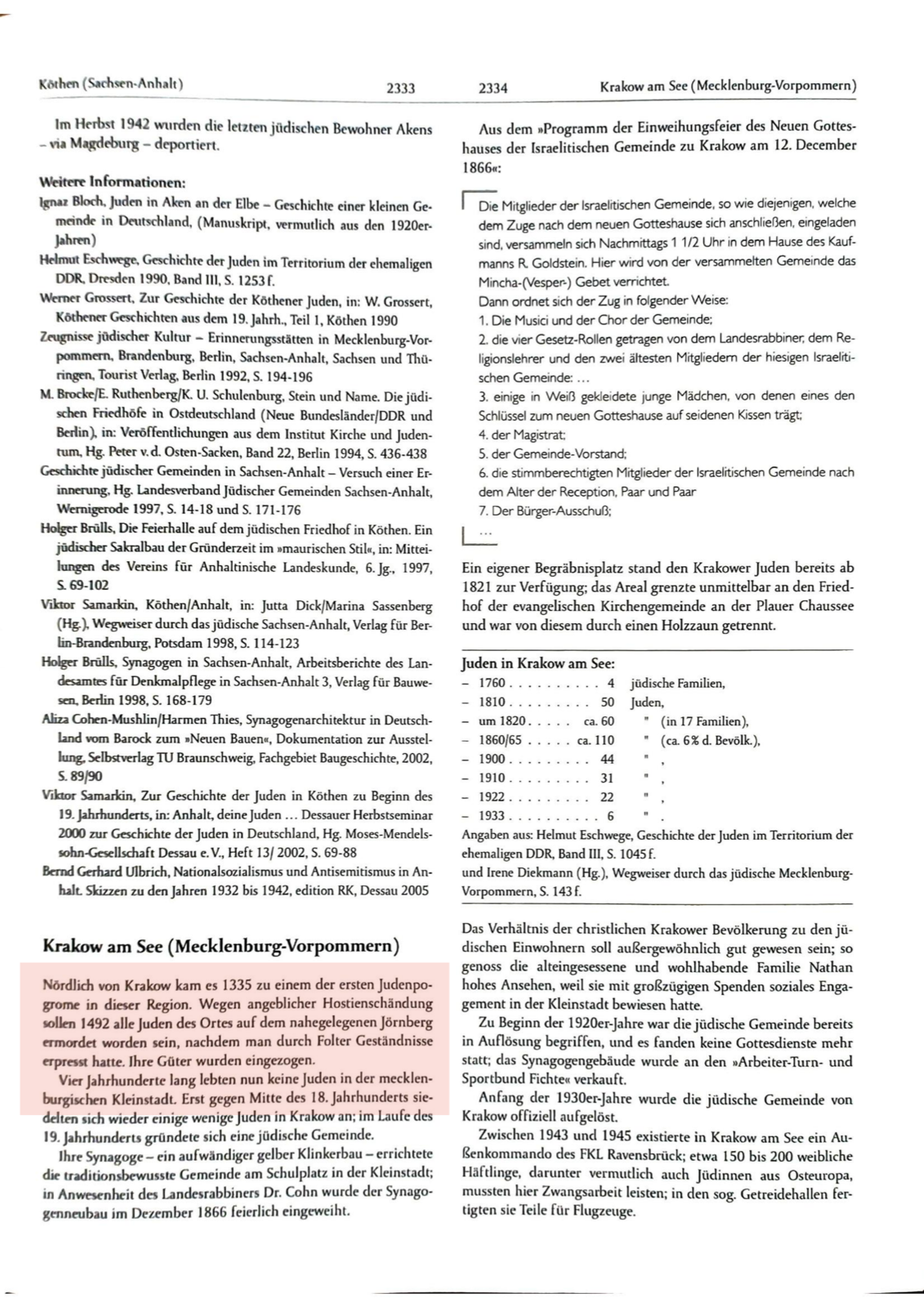
Krakow am See (59)
Error
Voigtländer and Voth code a "confirmed Jewish settlement" here during the Black Death. However, their sources provide "unambiguous information" that the community was destroyed before 1349.
Reality
Avneri mentions the killing of Jews in Krakow around 1325 due to an alleged host desecration.
Alicke details the execution and explicitly notes that "for four centuries thereafter, no Jews lived in the small Mecklenburg town" („Vier Jahrhunderte lang lebten fortan keine Juden in der mecklenburgischen Kleinstadt").
There is unambiguous information that there was no Jewish community in the town during the Black Death.
Correction
EXIST1349 1 -> 0
Sources:
Avneri · Page 452
Alicke · Page 2333
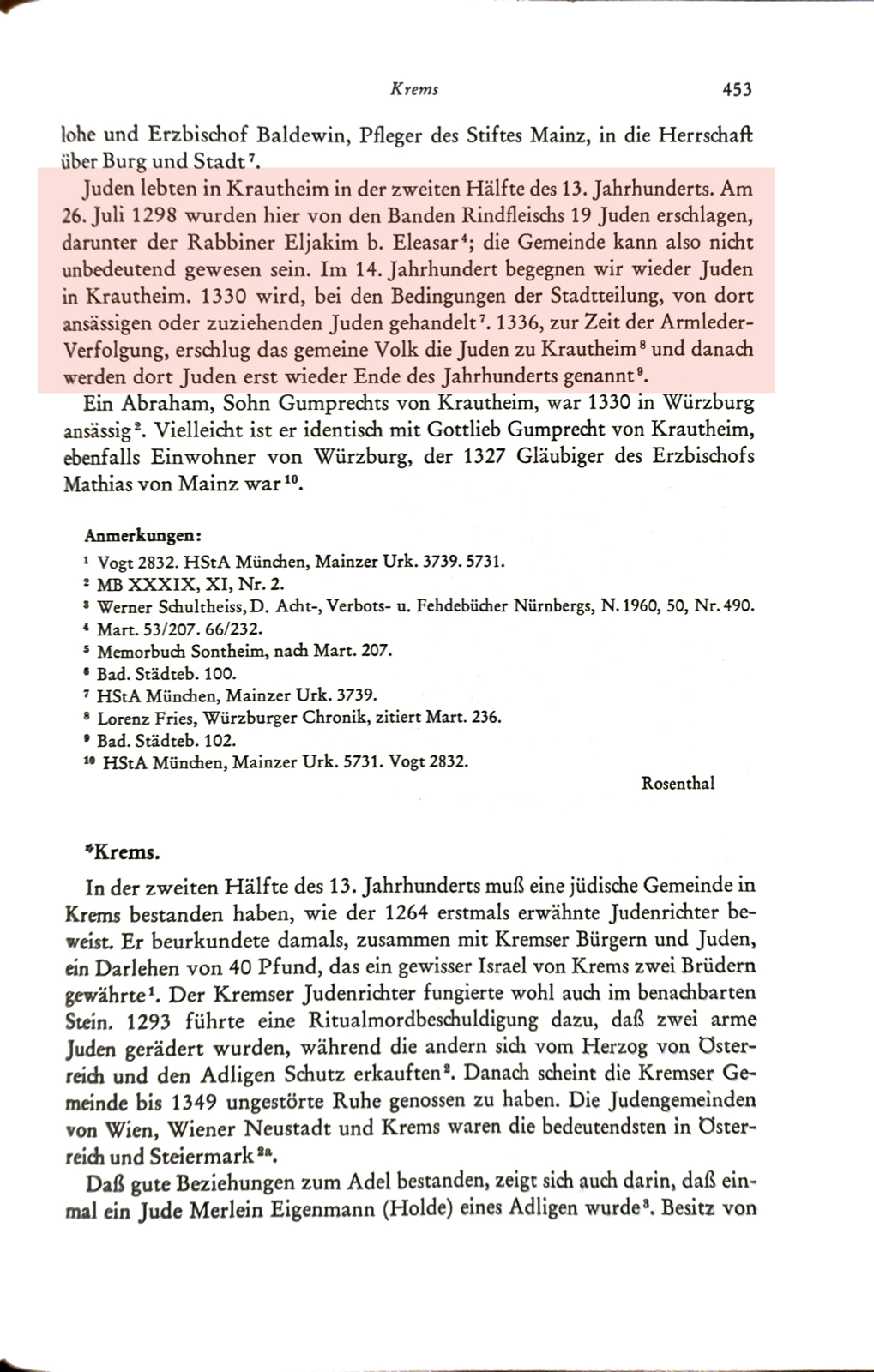
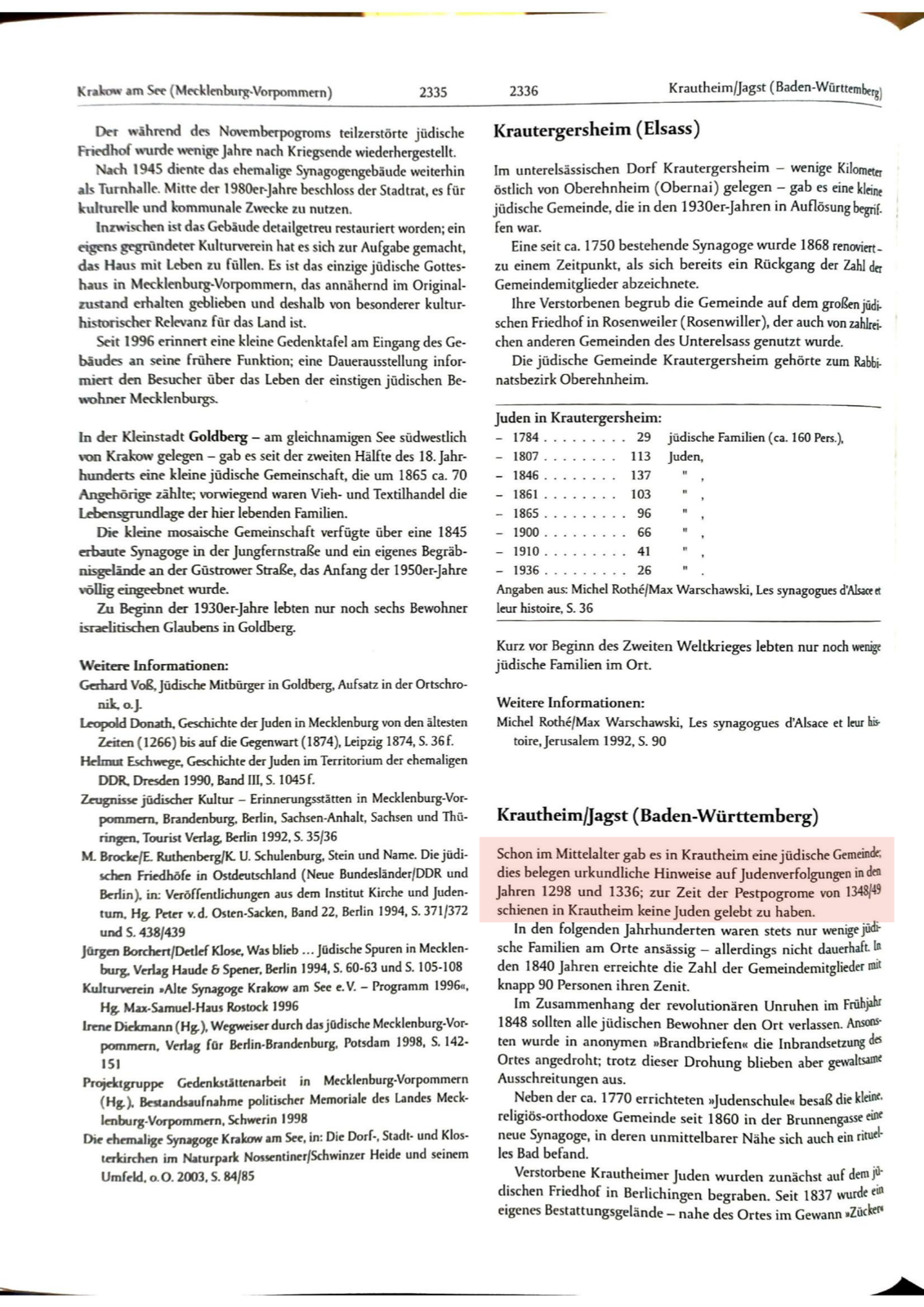
Krautheim-Jagst (60)
Error
Voigtländer and Voth code a "confirmed Jewish settlement" here during the Black Death. However, their sources provide "unambiguous information" that the community was absent at the time.
Reality
Avneri notes that the town's Jews were persecuted in 1336 and are "only mentioned there again at the end of the century" („danach werden dort Juden erst wieder Ende des Jahrhunderts genannt").
Alicke states explicitly that "at the time of the plague pogroms of 1348-1349, no Jews seemed to have lived in Krautheim" („zur Zeit der Pestpogrome von 1348/49 schienen in Krautheim keine Juden gelebt zu haben").
There is unambiguous information that there was no Jewish community in the town during the Black Death.
Correction
EXIST1349 1 -> 0
Sources:
Avneri · Page 453
Alicke · Page 2336
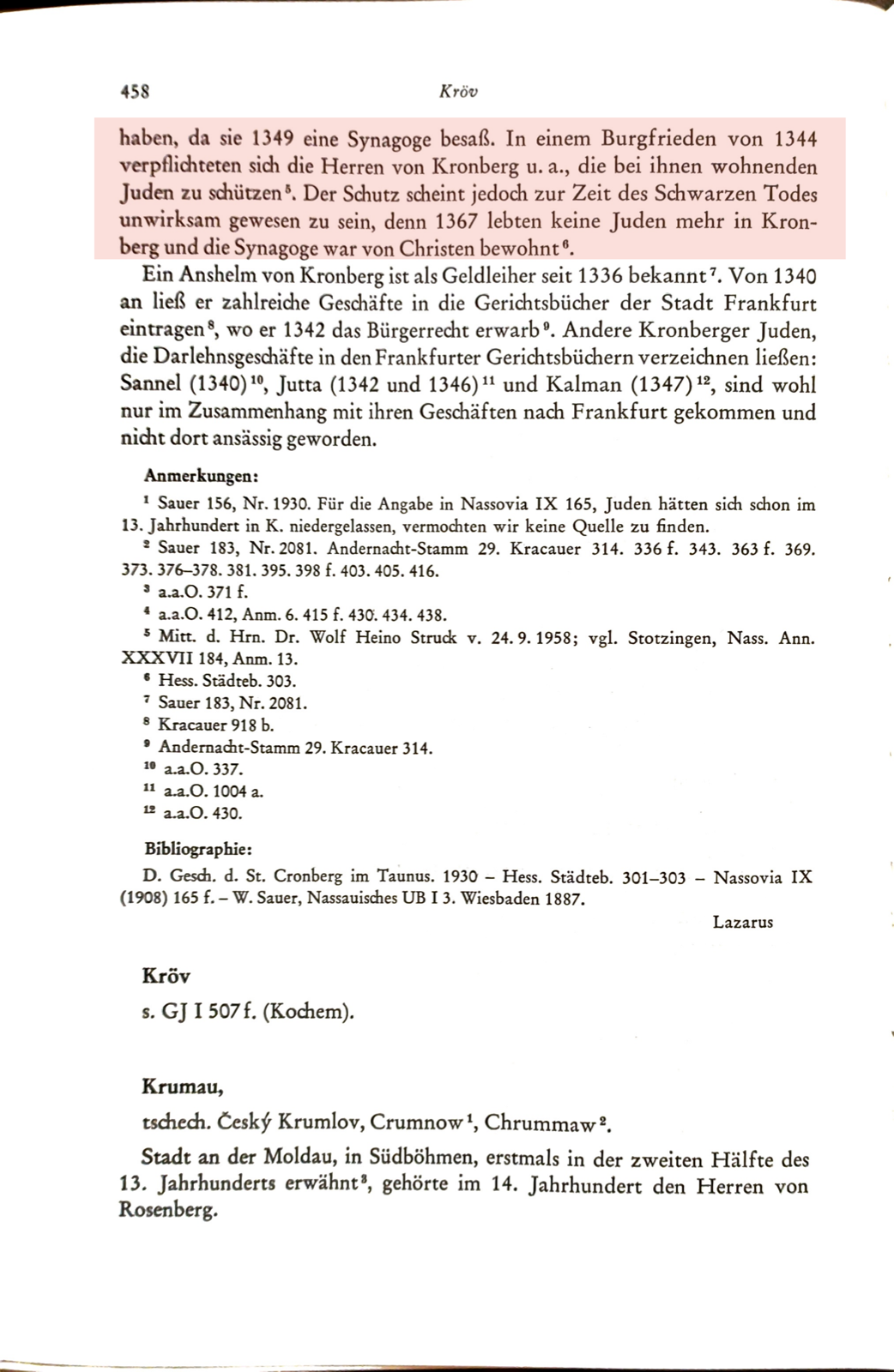
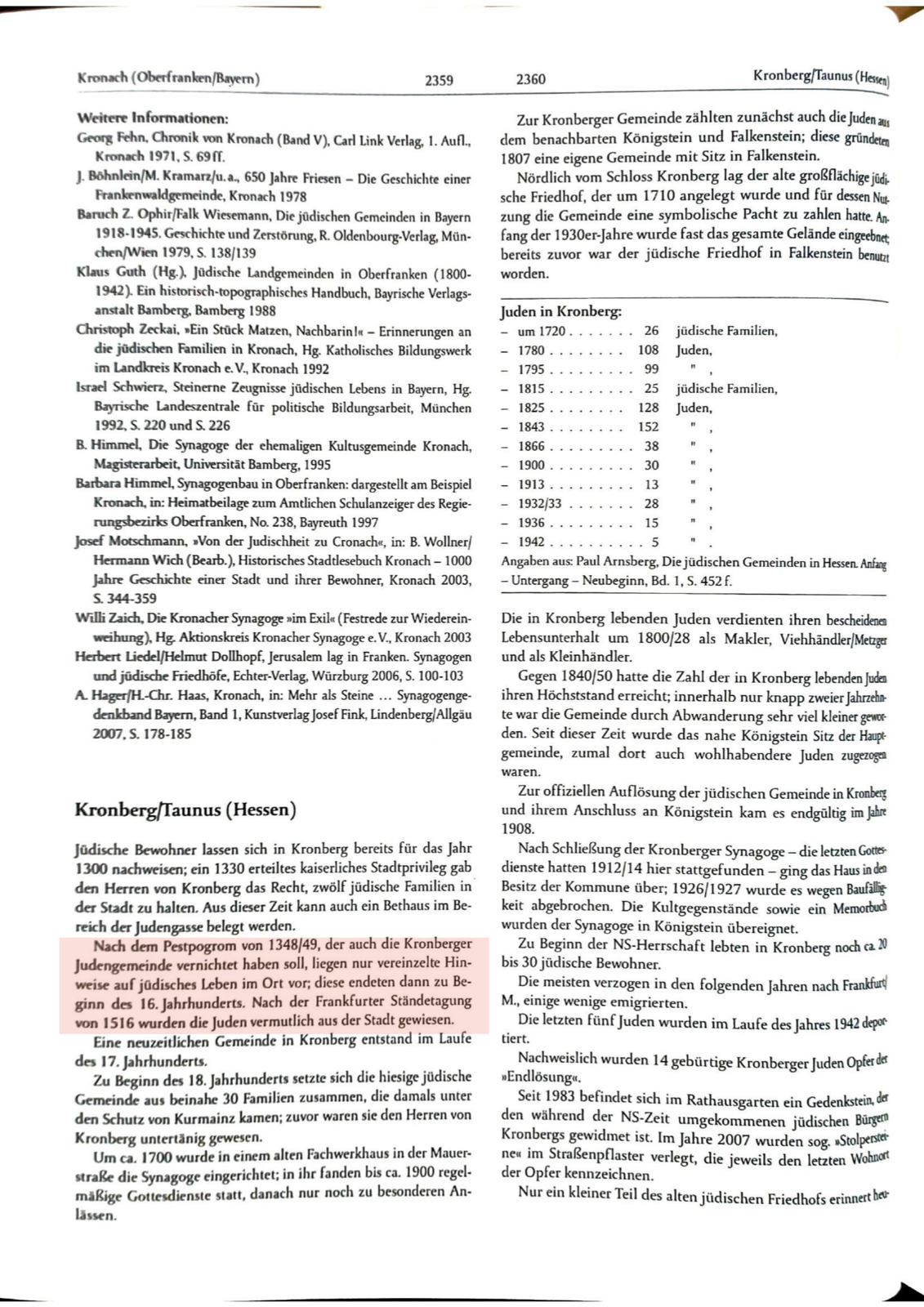
Kronberg Taunus (61)
Error
Voigtländer and Voth failed to code a pogrom here during the Black Death, despite their rule to code as unity if Alicke mentions "extermination".
Reality
Avneri states that the Lords of Kronberg committed to protect local Jews in 1344, but that this protection "seems to have been ineffective at the time of the Black Death, because by 1367 no Jews lived in Kronberg and the synagogue was inhabited by Christians" („Der Schutz scheint jedoch zur Zeit des Schwarzen Todes unwirksam gewesen zu sein, denn 1367 lebten keine Juden mehr in Kronberg und die Synagoge war von Christen bewohnt").
Alicke corroborates this independently, reporting that "after the plague pogrom of 1348–1349, which is said to have destroyed the Jewish community of Kronberg, only isolated references to Jewish life in the town exist" („Nach dem Pestpogrom von 1348/49, der auch die Kronberger Judengemeinde vernichtet haben soll, liegen nur vereinzelte Hinweise auf jüdisches Leben im Ort vor").
Both sources confirm a pogrom occurred.
Correction
POG1349 0 -> 1
Sources:
Avneri · Page 458
Alicke · Page 2359
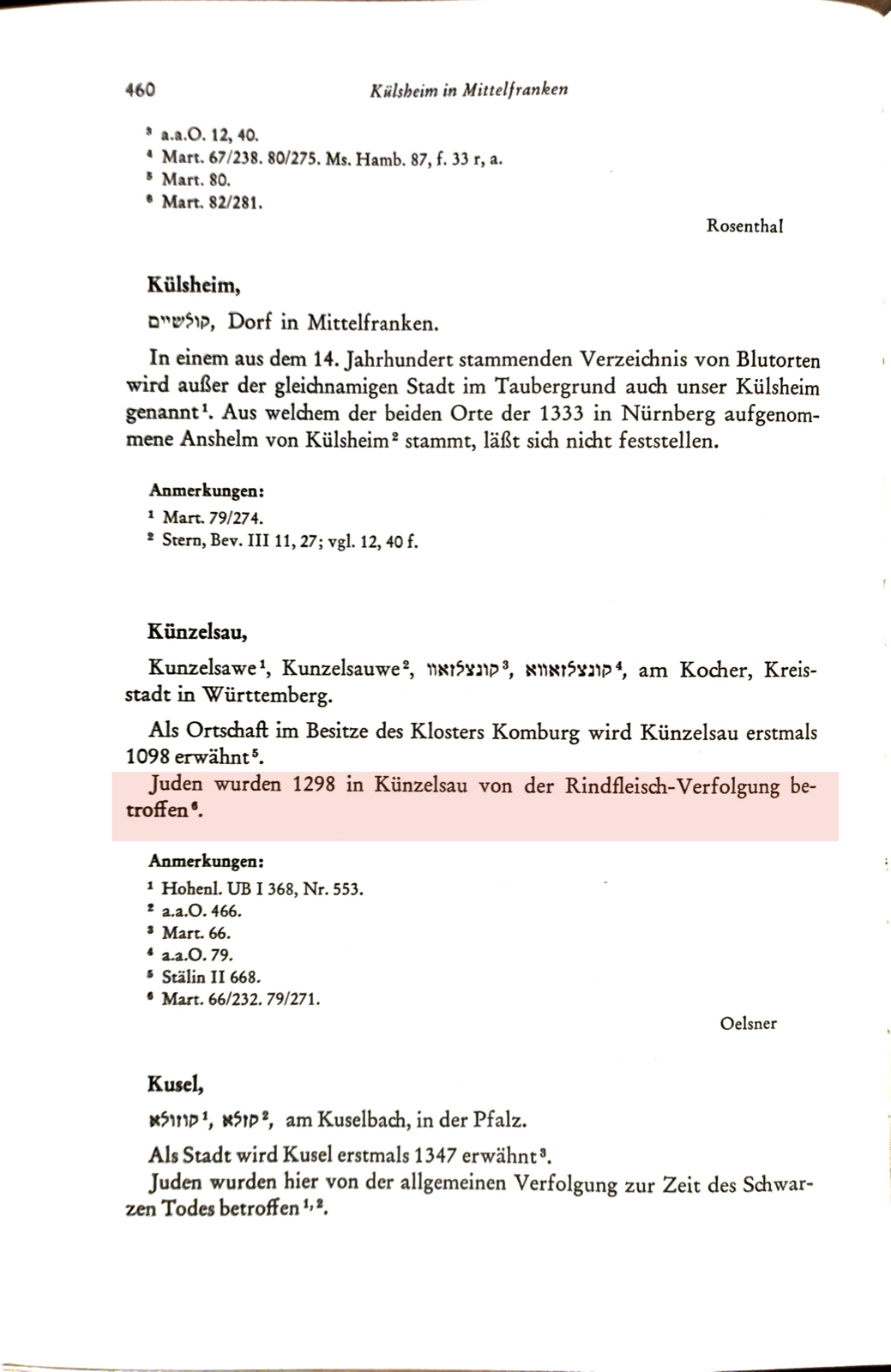
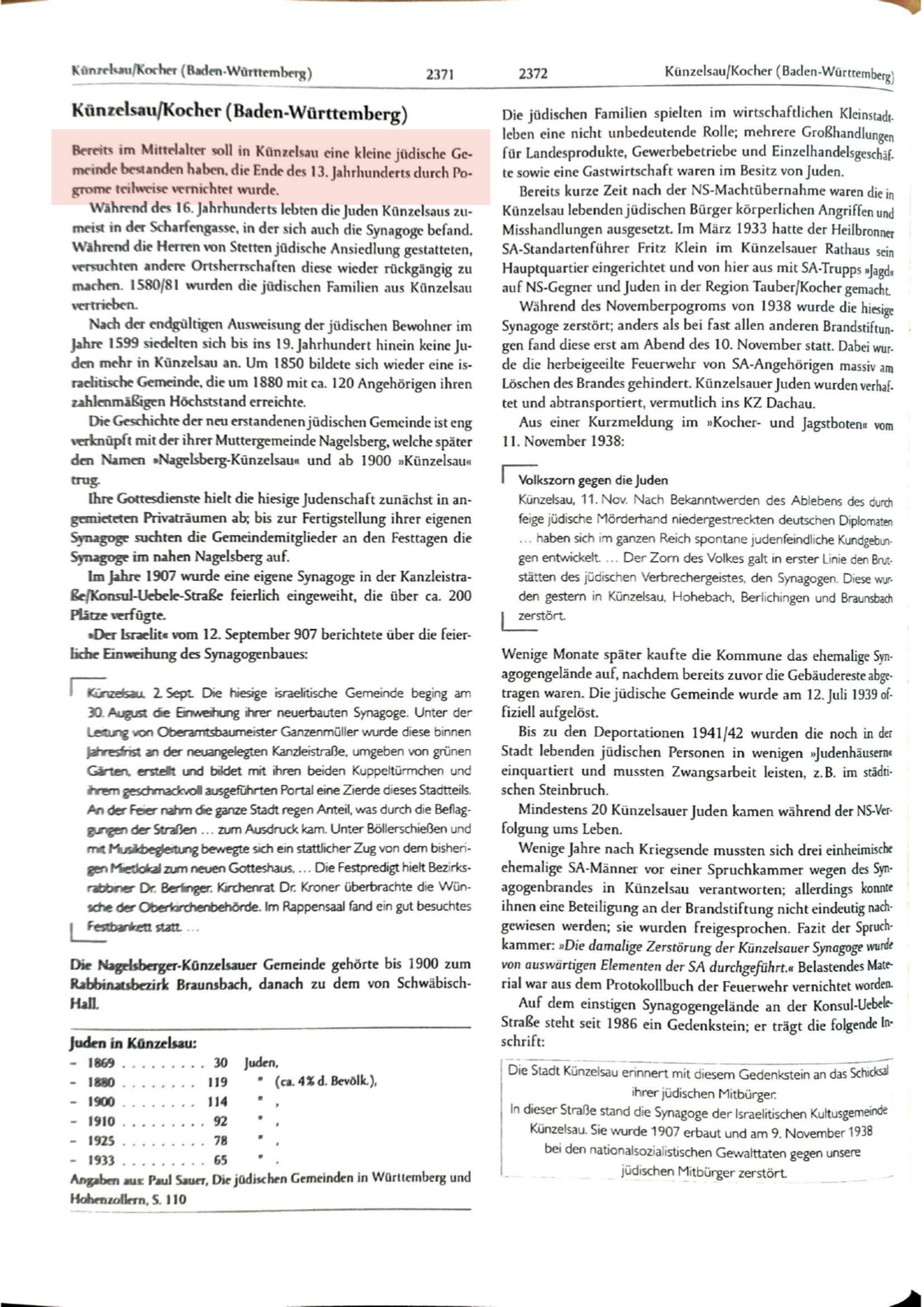
Künzelsau-Kocher (62 & 63)
Error
Voigtländer and Voth code a "confirmed Jewish settlement" here during the Black Death. However, their sources do not provide "unambiguous information" to support this.
Reality
Avneri states that "Jews in Künzelsau were affected by the Rindfleisch persecution in 1298" and provides no further information about the fourteenth century.
Alicke similarly notes that a small community was established in the thirteenth century but was "partially destroyed by pogroms at the end of the thirteenth century" („Ende des 13. Jahrhunderts durch Pogrome teilweise vernichtet"), without giving any account of its subsequent history.
As neither source establishes whether the community survived or was re-established between 1298 and 1349, the existence of a Jewish community during the Black Death is uncertain.
Correction
EXIST1349 1 -> NA; POG1349 0 -> NA
Sources:
Avneri · Page 460
Alicke · Page 2371
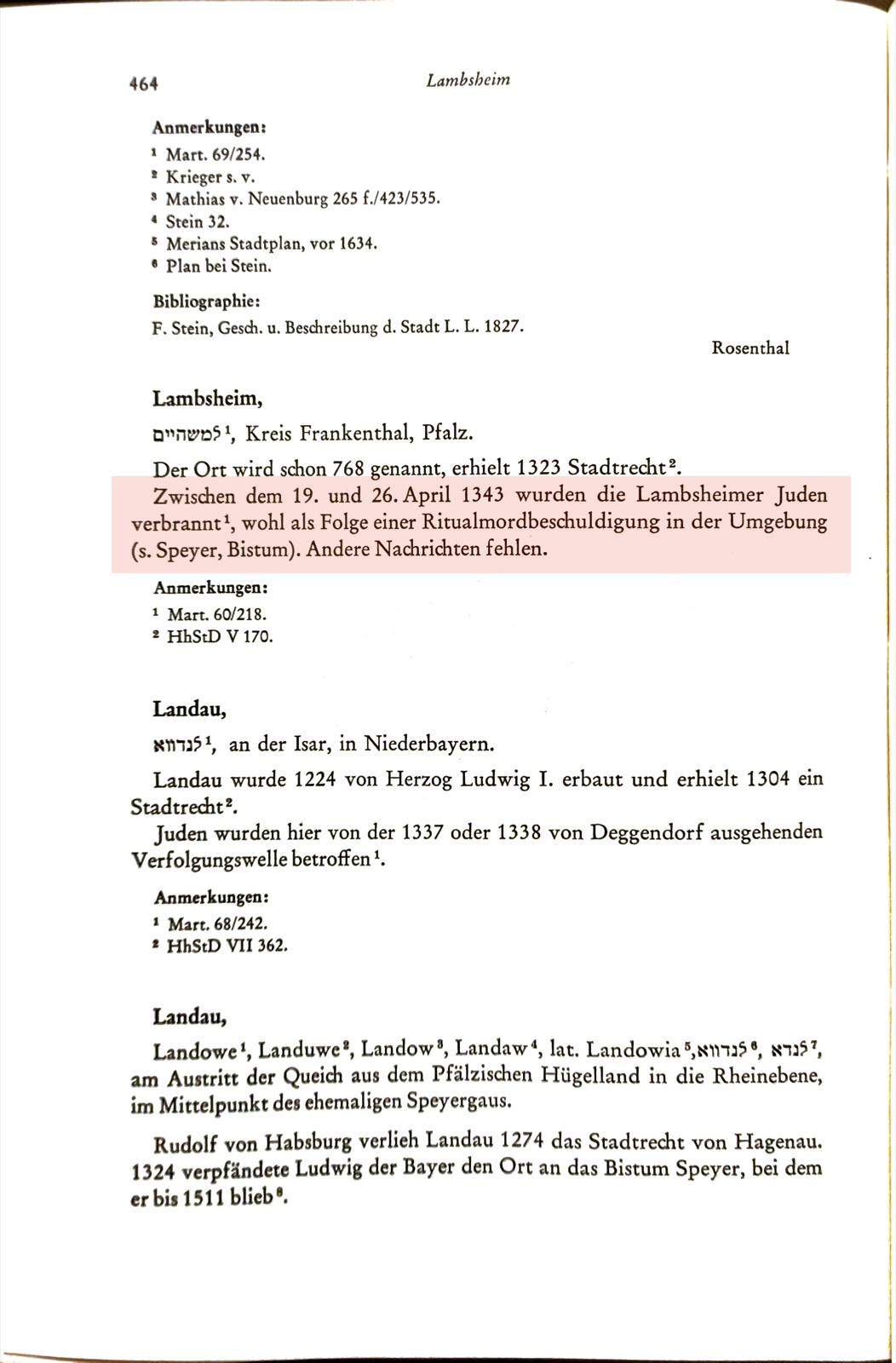
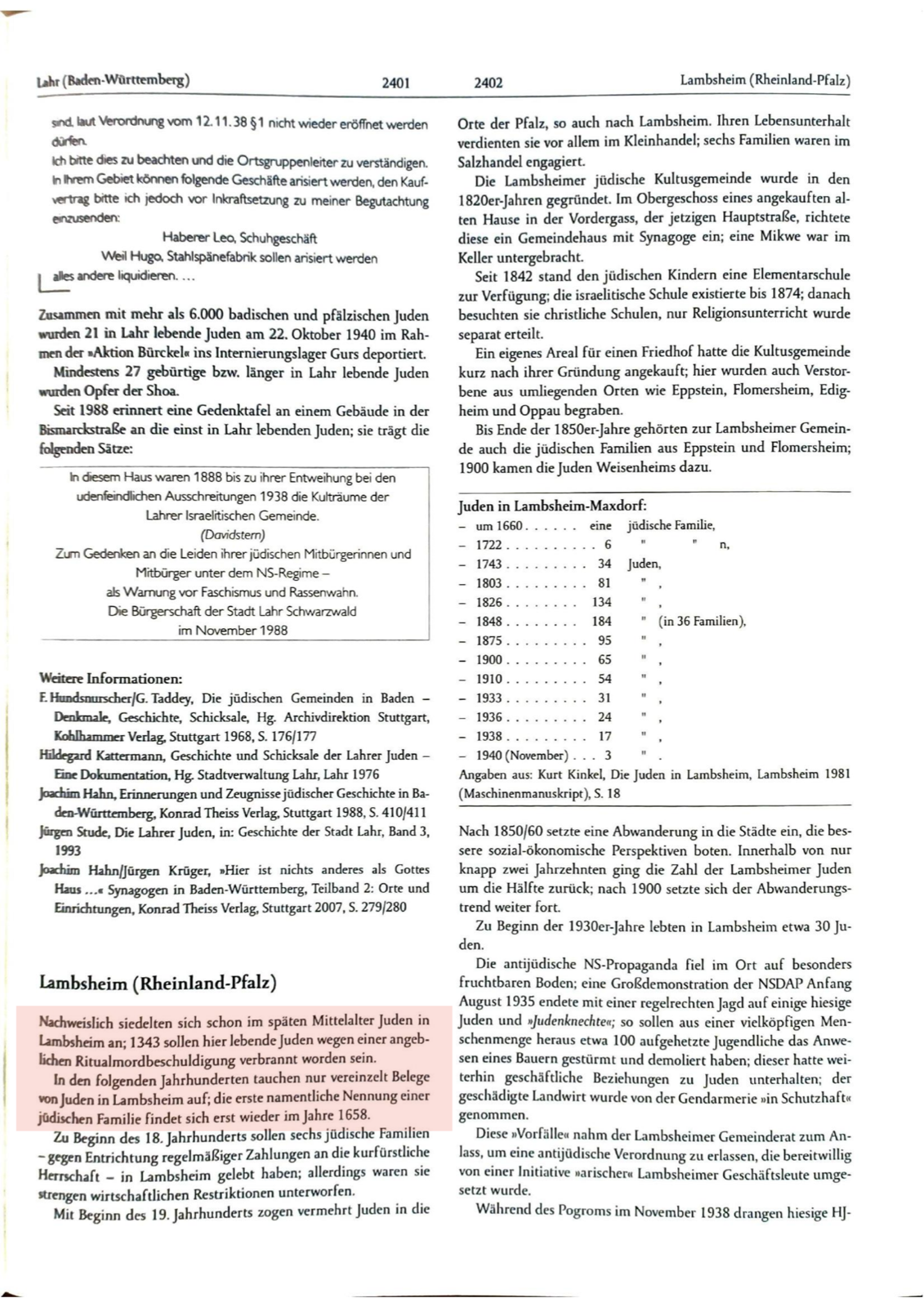
Lambsheim (64 & 65)
Error
Voigtländer and Voth code a "confirmed Jewish settlement" here during the Black Death. However, their sources do not provide "unambiguous information" to support this.
Reality
Avneri and Alicke both report that the Jews of Lambsheim were burned in 1343 due to a ritual murder accusation, after which "other reports are missing" („Andere Nachrichten fehlen").
The existence of a Jewish community during the Black Death is uncertain.
Correction
EXIST1349 1 -> NA; POG1349 0 -> NA
Sources:
Avneri · Page 464
Alicke · Page 2401
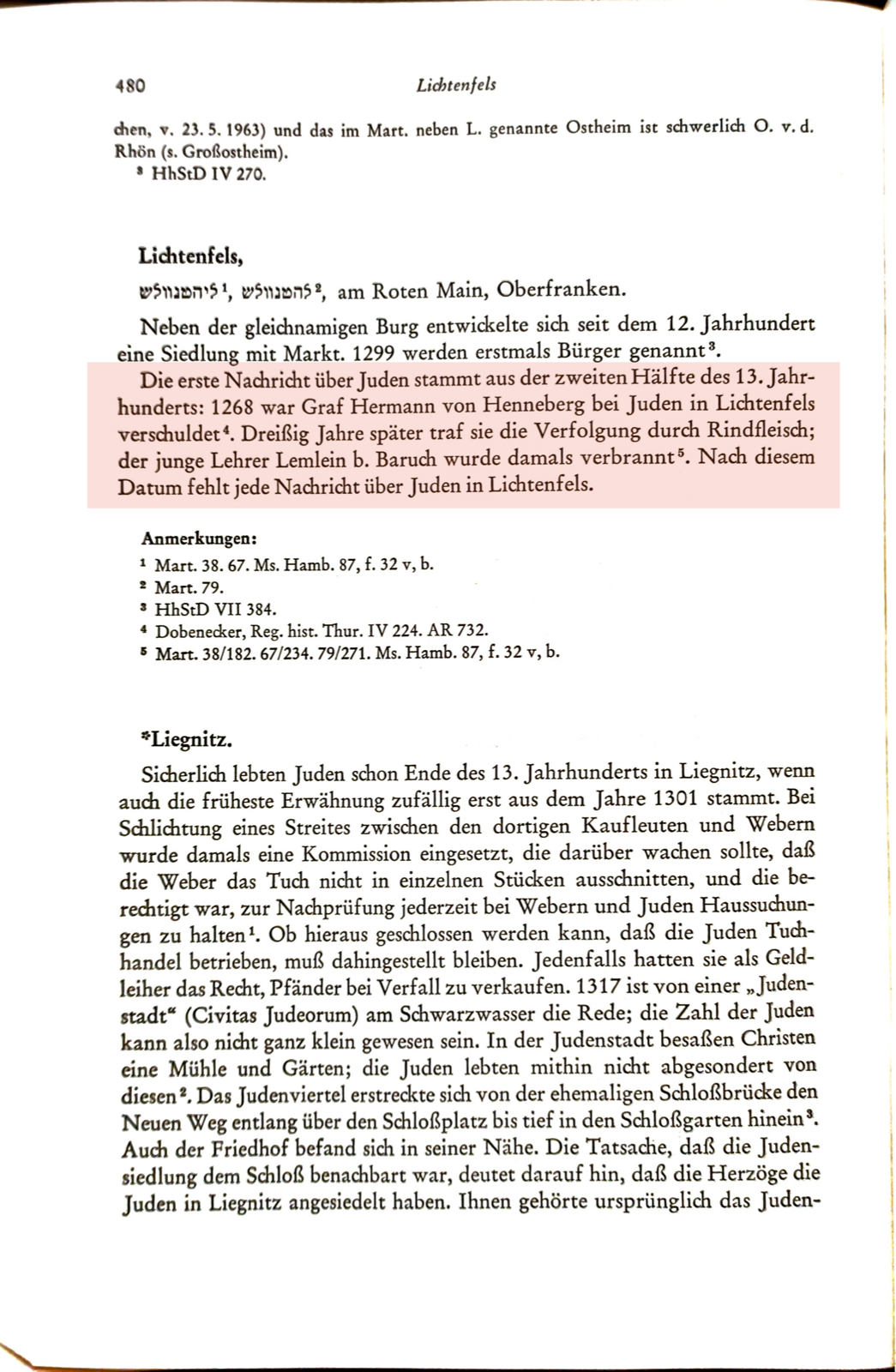
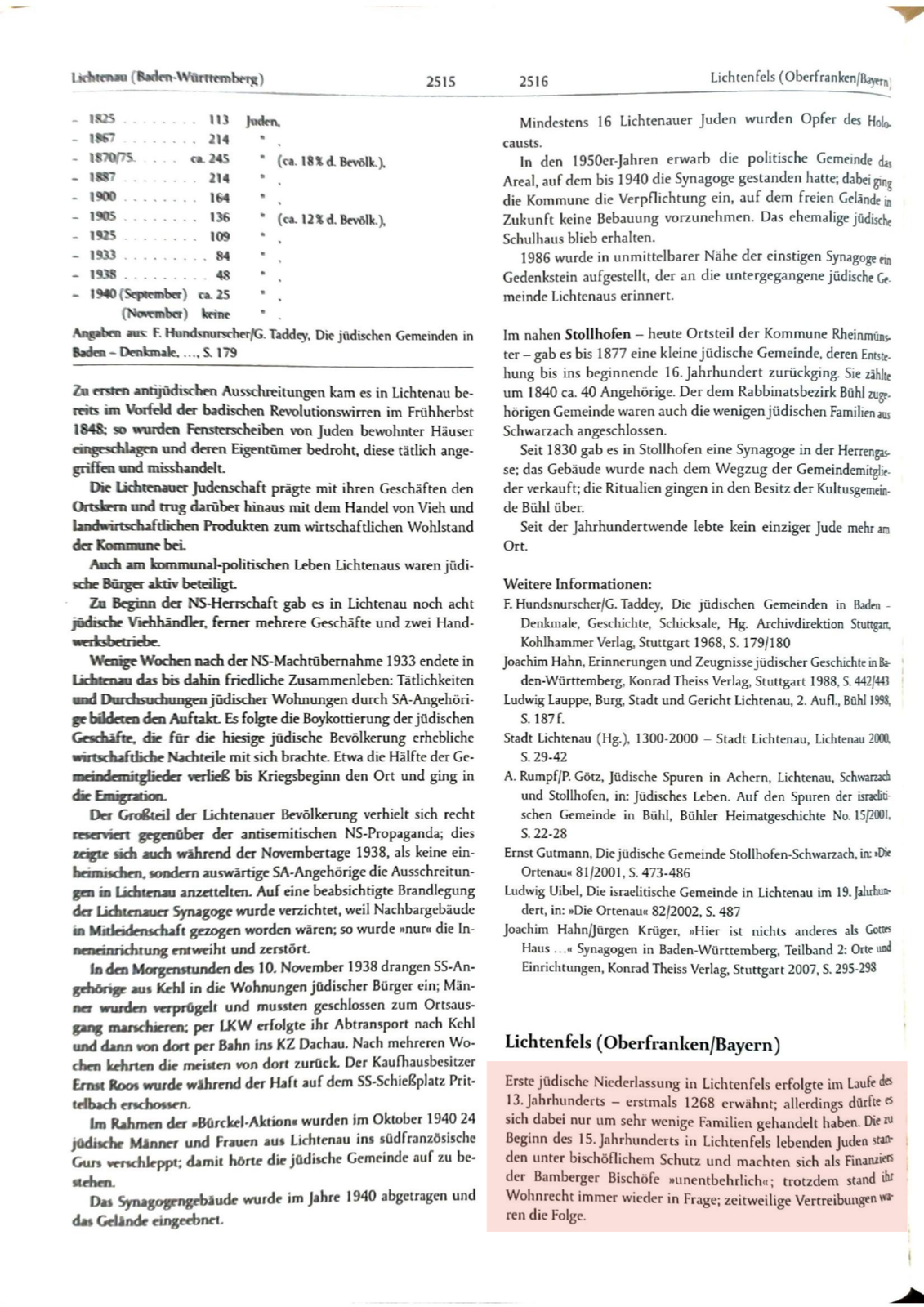
Lichtenfels (66 & 67)
Error
Voigtländer and Voth code a "confirmed Jewish settlement" here during the Black Death. However, their sources do not provide "unambiguous information" to support this.
Reality
Avneri notes a persecution in 1298, after which "all news about Jews in Lichtenfels is missing" („Nach diesem Datum fehlt jede Nachricht über Juden in Lichtenfels").
Alicke corroborates the 13th-century presence but then jumps to the early 15th century.
The existence of a Jewish community during the Black Death is uncertain.
Correction
EXIST1349 1 -> NA; POG1349 0 -> NA
Sources:
Avneri · Page 480
Alicke · Page 2516
Lohr (68)
Error
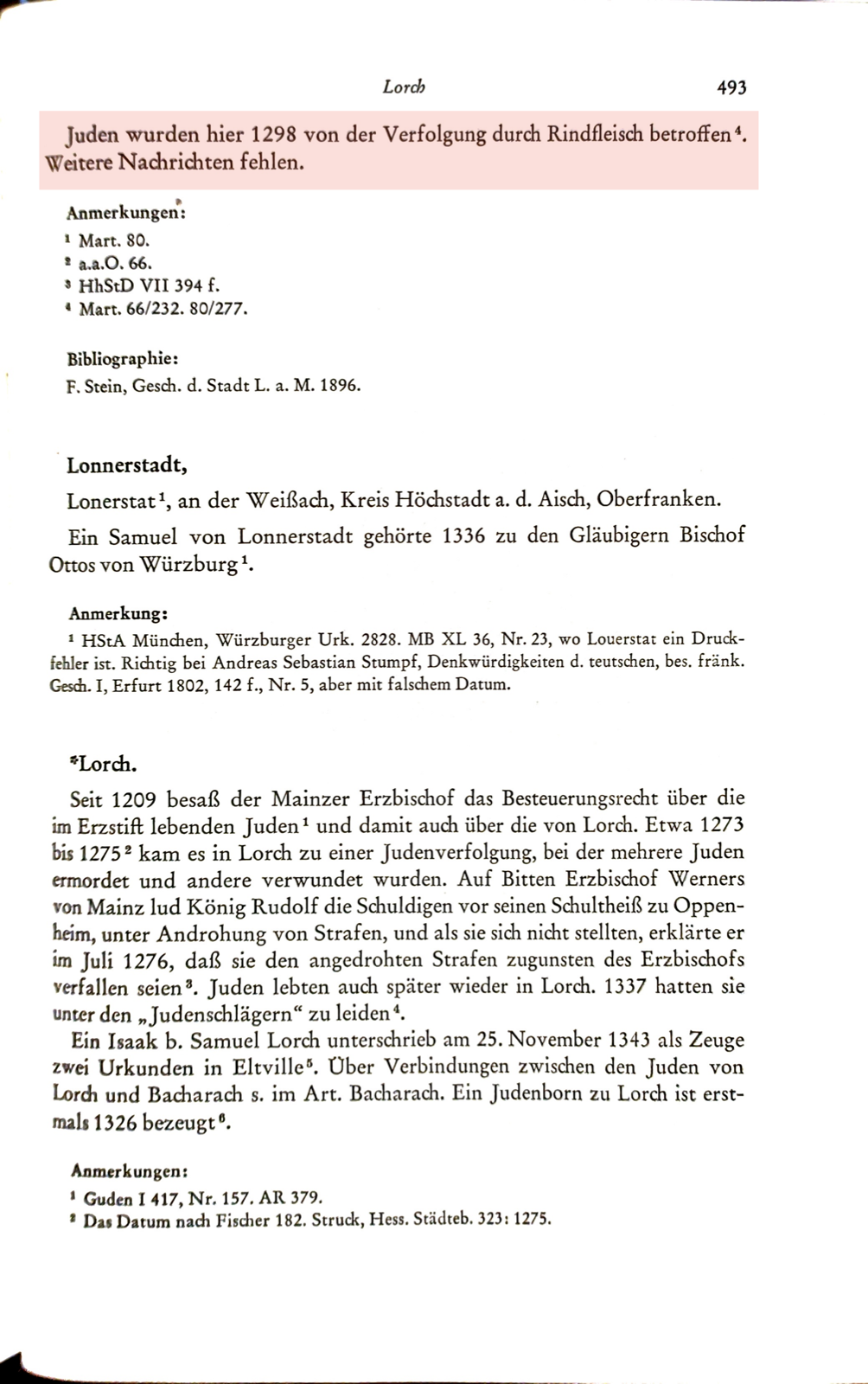
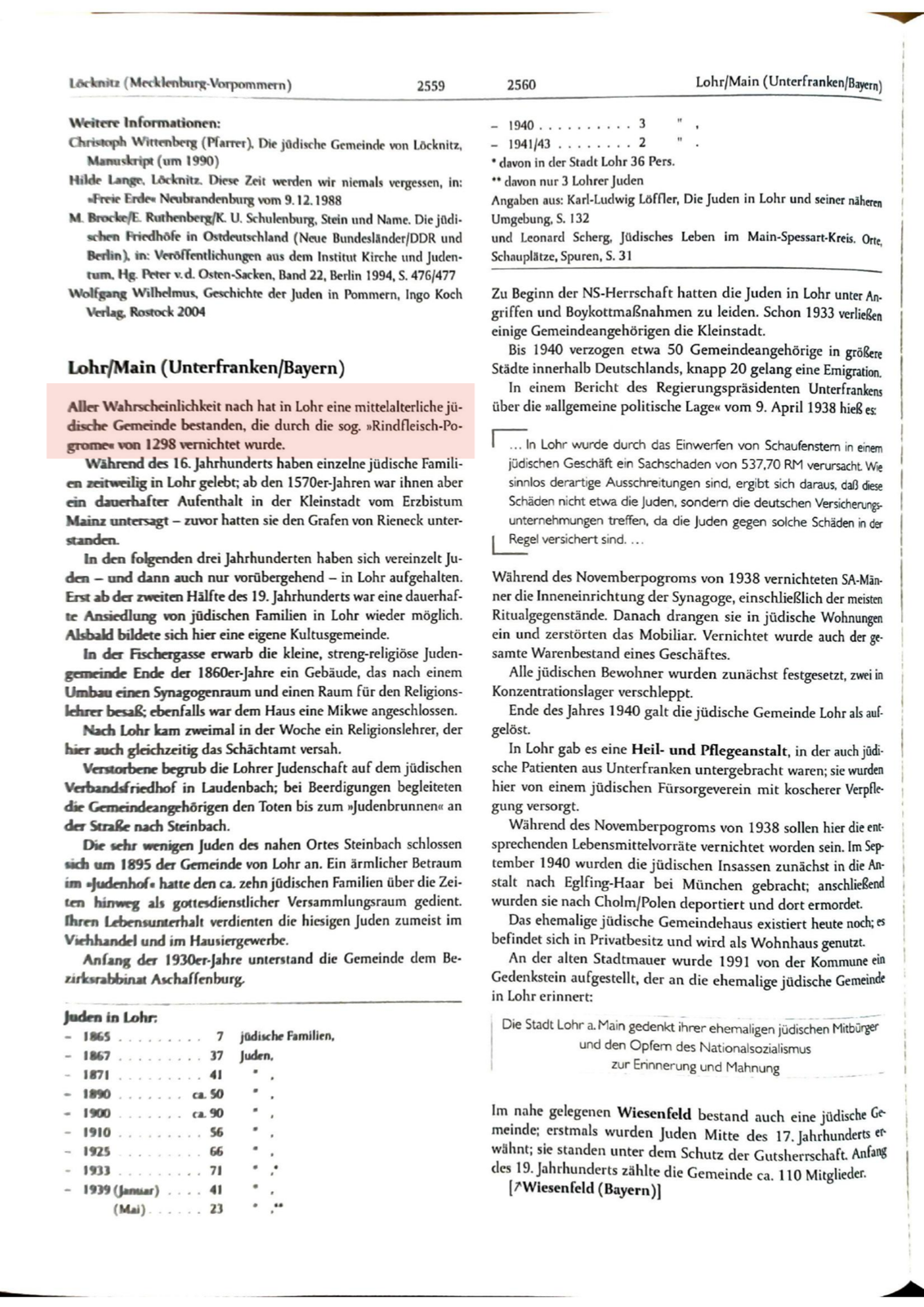
Voigtländer and Voth code a "confirmed Jewish settlement" here during the Black Death. However, their sources provide "unambiguous information" that the community was destroyed before 1349.
Reality
Avneri mentions that Jews in Lohr were affected by the Rindfleisch persecution in 1298 and "[f]urther news is missing" („Weitere Nachrichten fehlen").
Alicke confirms the community "was destroyed by the so-called 'Rintfleisch-Pogrome' of 1298" („durch die sog. ,Rintfleisch-Pogrome' von 1298 [...] vernichtet wurde").
There is unambiguous information that there was no Jewish community in the town during the Black Death.
Correction
EXIST1349 1 -> 0
Sources:
Avneri · Page 493
Alicke · Page 2559
Malchin (69 & 70)
Error
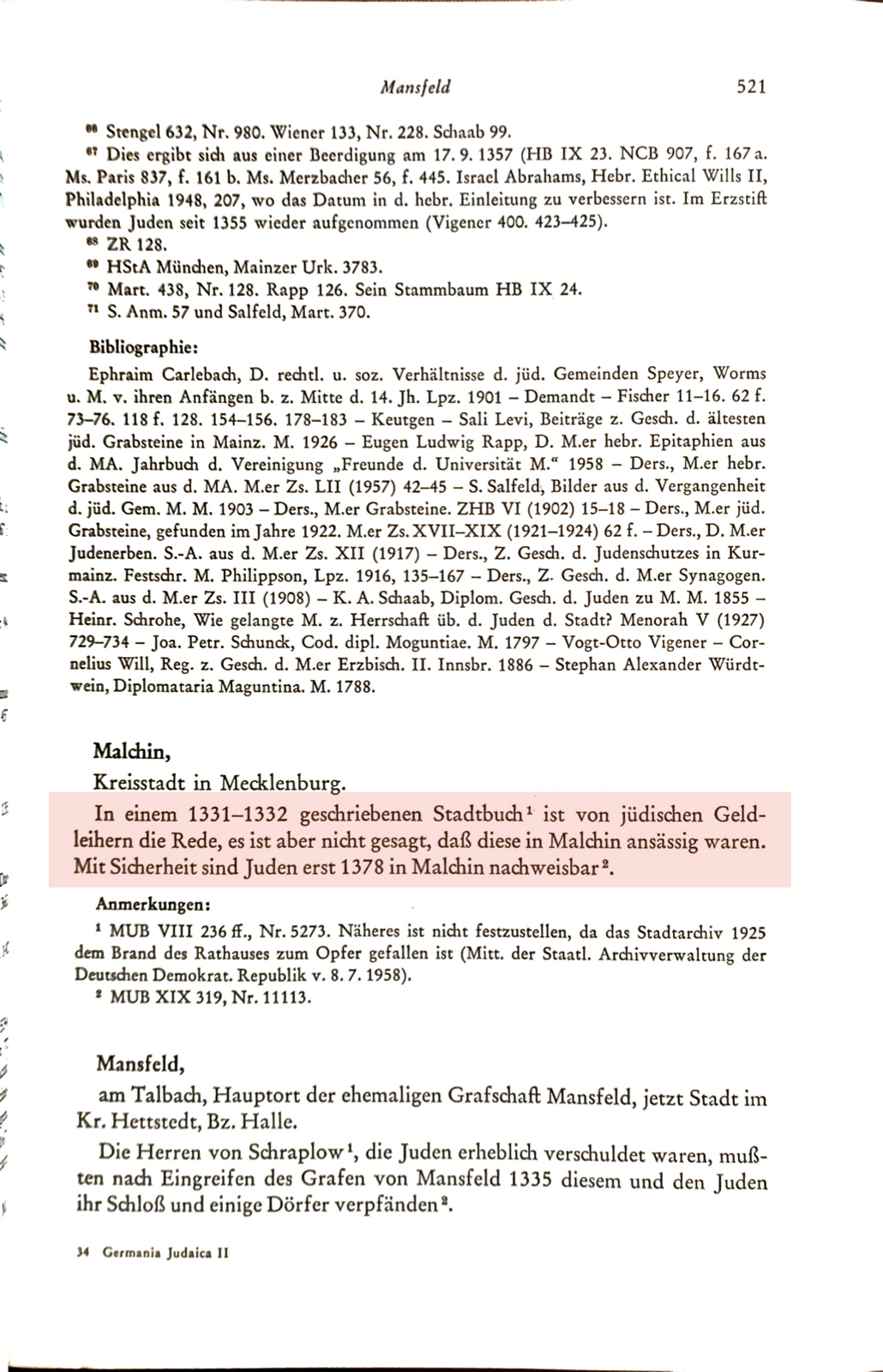
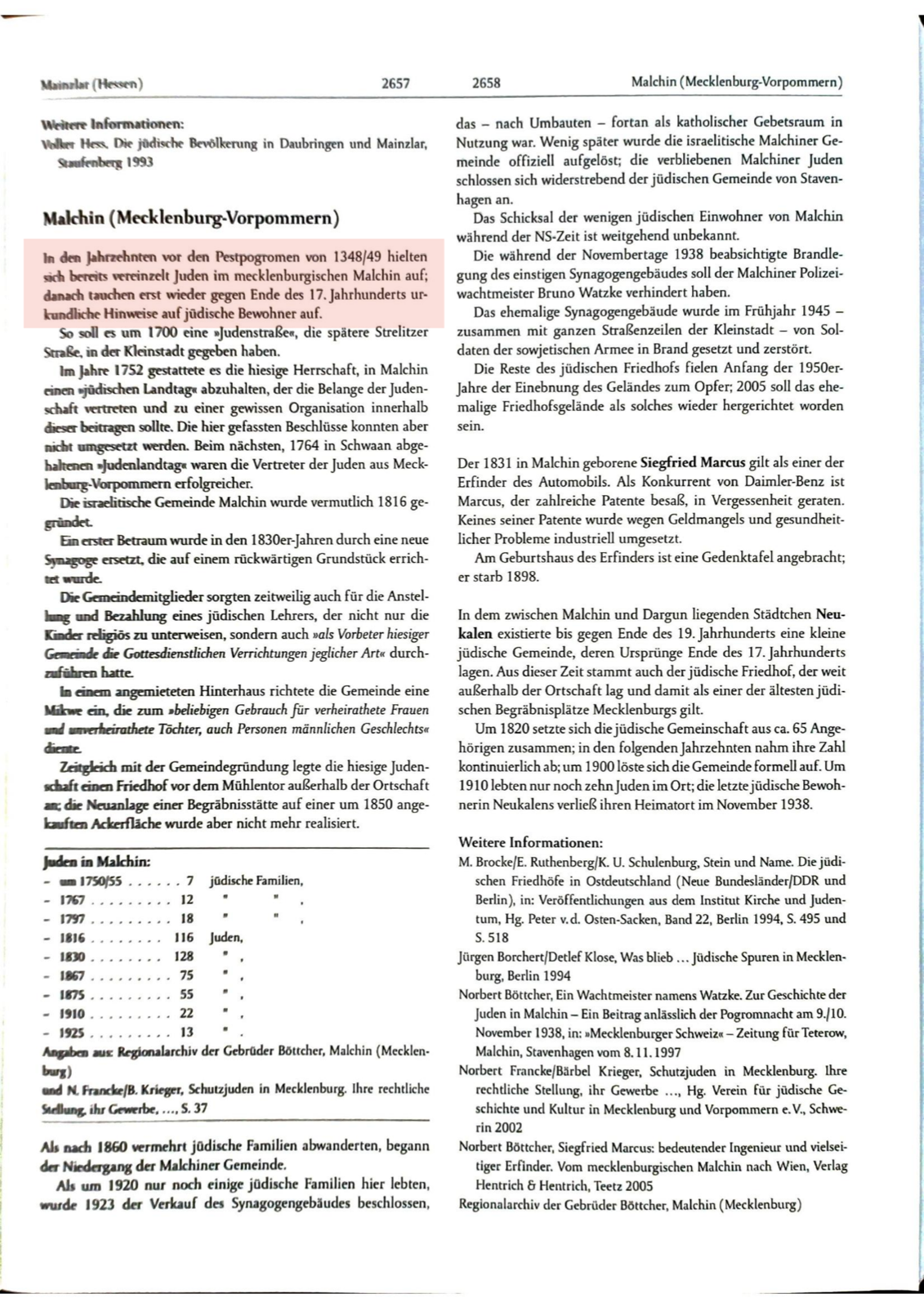
Voigtländer and Voth code a "confirmed Jewish settlement" here during the Black Death. However, their sources do not provide "unambiguous information" to support this.
Reality
Avneri states that while Jewish moneylenders are mentioned in 1331-1332, "it is not said that these were residents of Malchin" („es ist aber nicht gesagt, daß diese in Malchin ansässig waren").
Alicke notes only that "individual Jews were already present" („vereinzelt Juden") before the plague pogroms.
The existence of a confirmed Jewish settlement during the Black Death is uncertain.
Correction
EXIST1349 1 -> NA; POG1349 0 -> NA
Sources:
Avneri · Page 521
Alicke · Page 2657
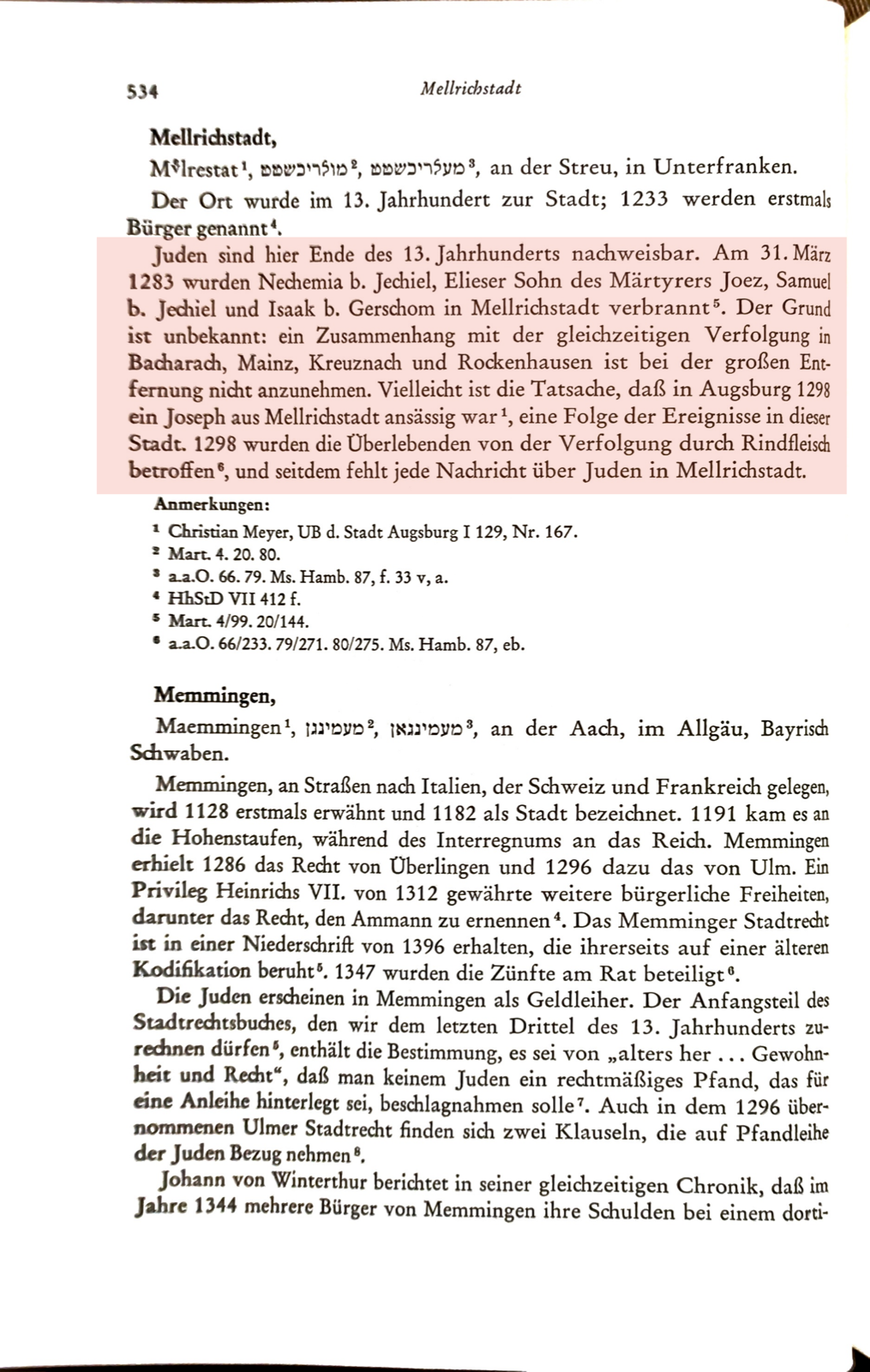
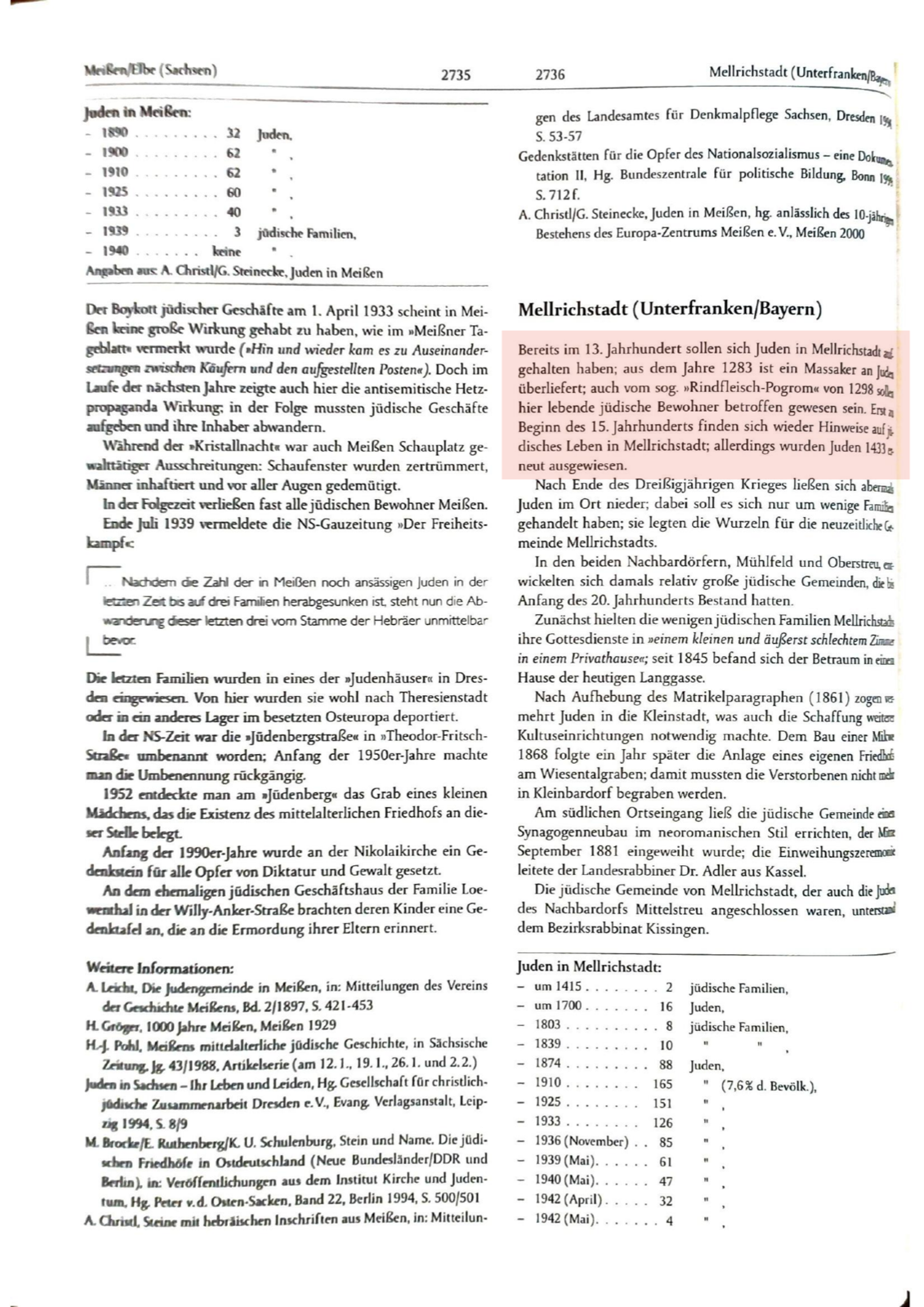
Mellrichstadt (71)
Error
Voigtländer and Voth code a "confirmed Jewish settlement" here during the Black Death. However, their sources provide "unambiguous information" that the community was absent at the time.
Reality
Avneri notes the Rindfleisch persecution in 1298 and states that "since then, all news about Jews in Mellrichstadt is missing" („seitdem fehlt jede Nachricht über Juden in Mellrichstadt").
Alicke notes that indications of Jewish life only reappear at the beginning of the fifteenth century.
There is unambiguous information that there was no Jewish community in the town during the Black Death.
Correction
EXIST1349 1 -> 0
Sources:
Avneri · Page 534
Alicke · Page 2736
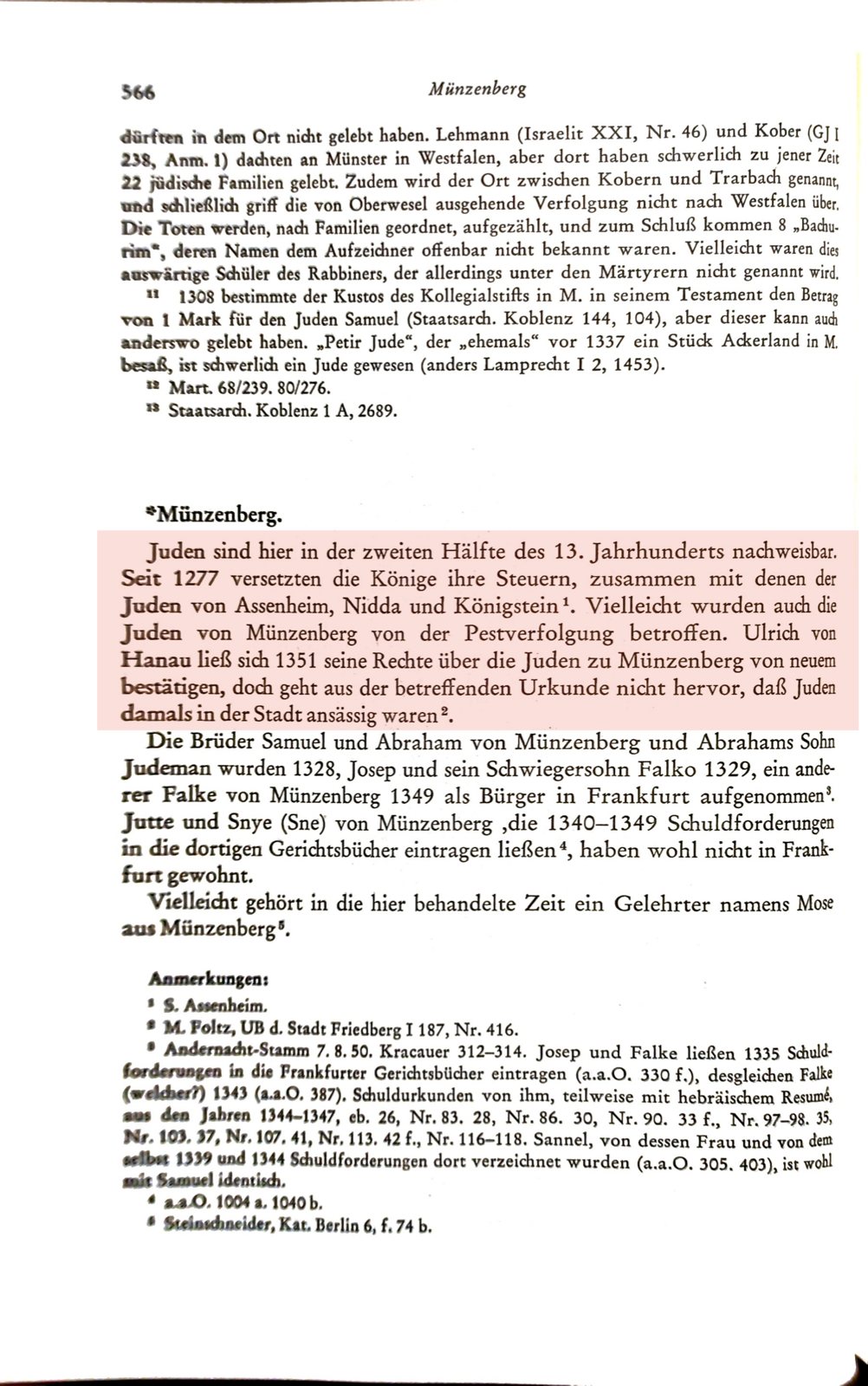
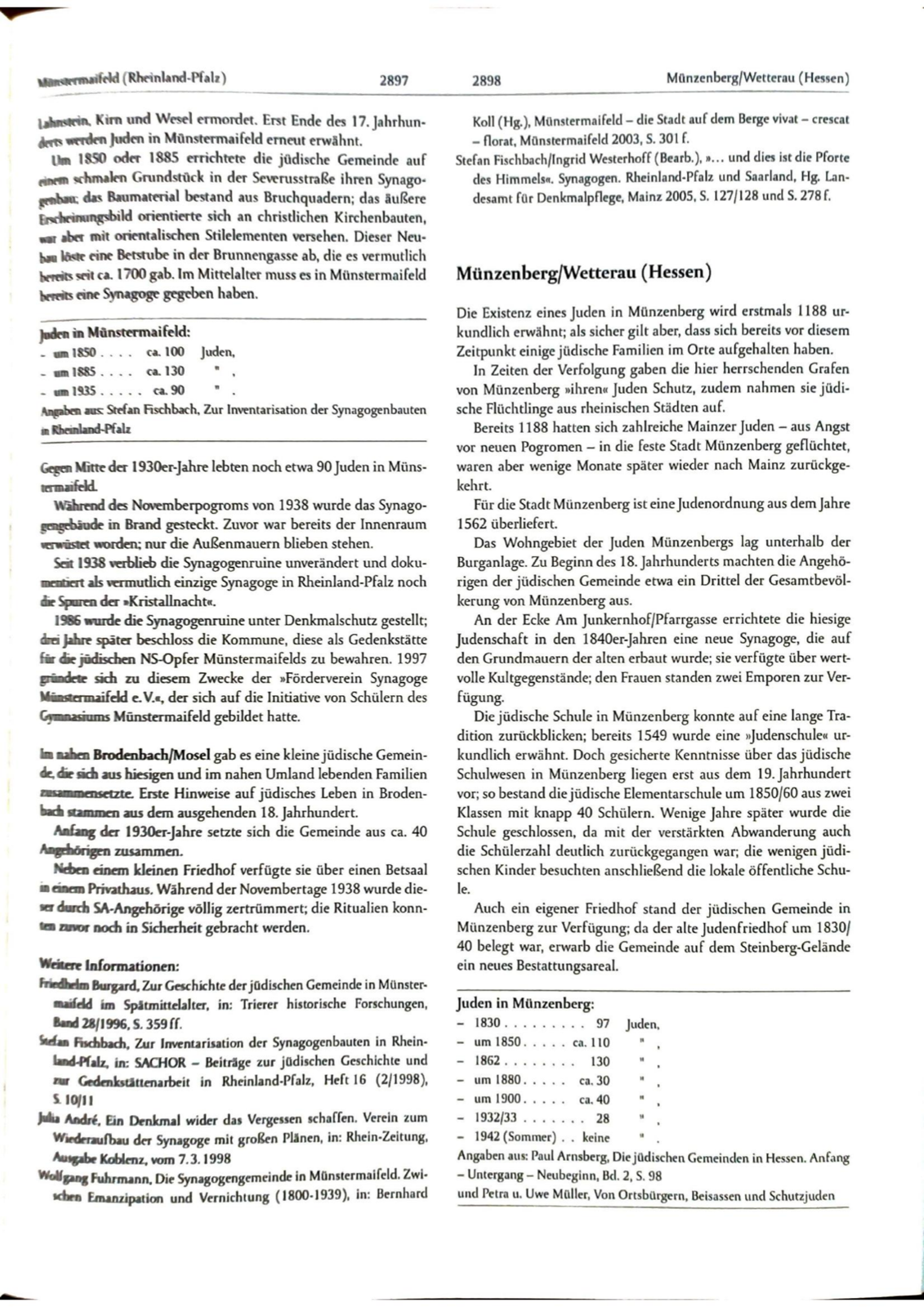
Münzenberg-Wetterau (72)
Error
Voigtländer and Voth code "unambiguous information" that no pogrom occurred here during the Black Death. However, their sources indicate ambiguity.
Reality
Avneri notes that "perhaps the Jews of Münzenberg were also affected by the plague persecution" („Vielleicht wurden auch die Juden von Münzenberg von der Pestverfolgung betroffen").
Alicke makes no mention of persecution during the Black Death.
Avneri's speculative "perhaps" (vielleicht) falls short of unambiguous information, and the absence of corroboration in Alicke means this entry cannot be coded as either 0 or 1.
Correction
POG1349 0 -> NA
Sources:
Avneri · Page 566
Alicke · Page 2898
Neuleiningen (73 & 74)
Error
Voigtländer and Voth failed to code a "confirmed Jewish settlement" here during the Black Death, despite "unambiguous information" in their sources.
Reality
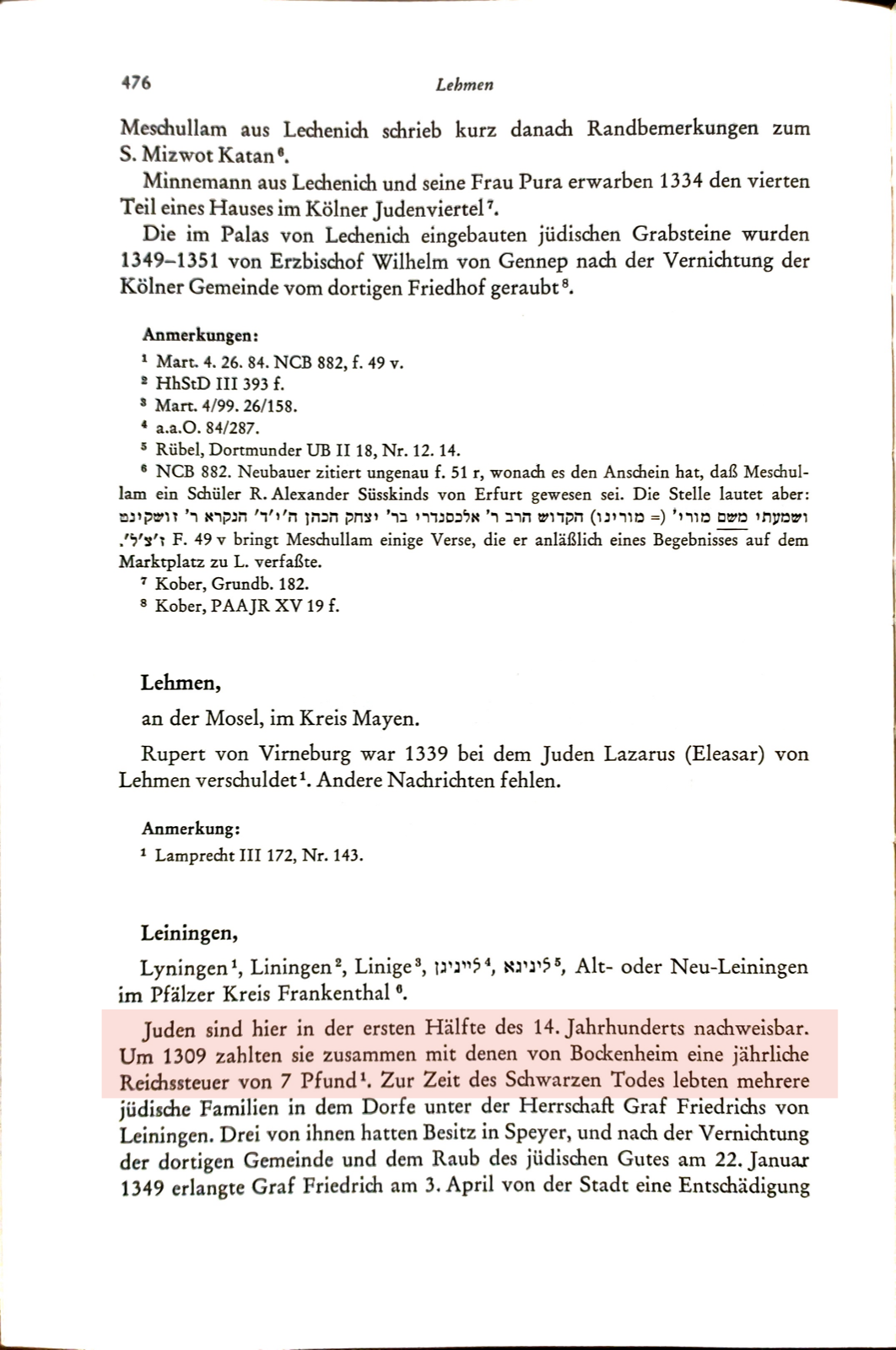
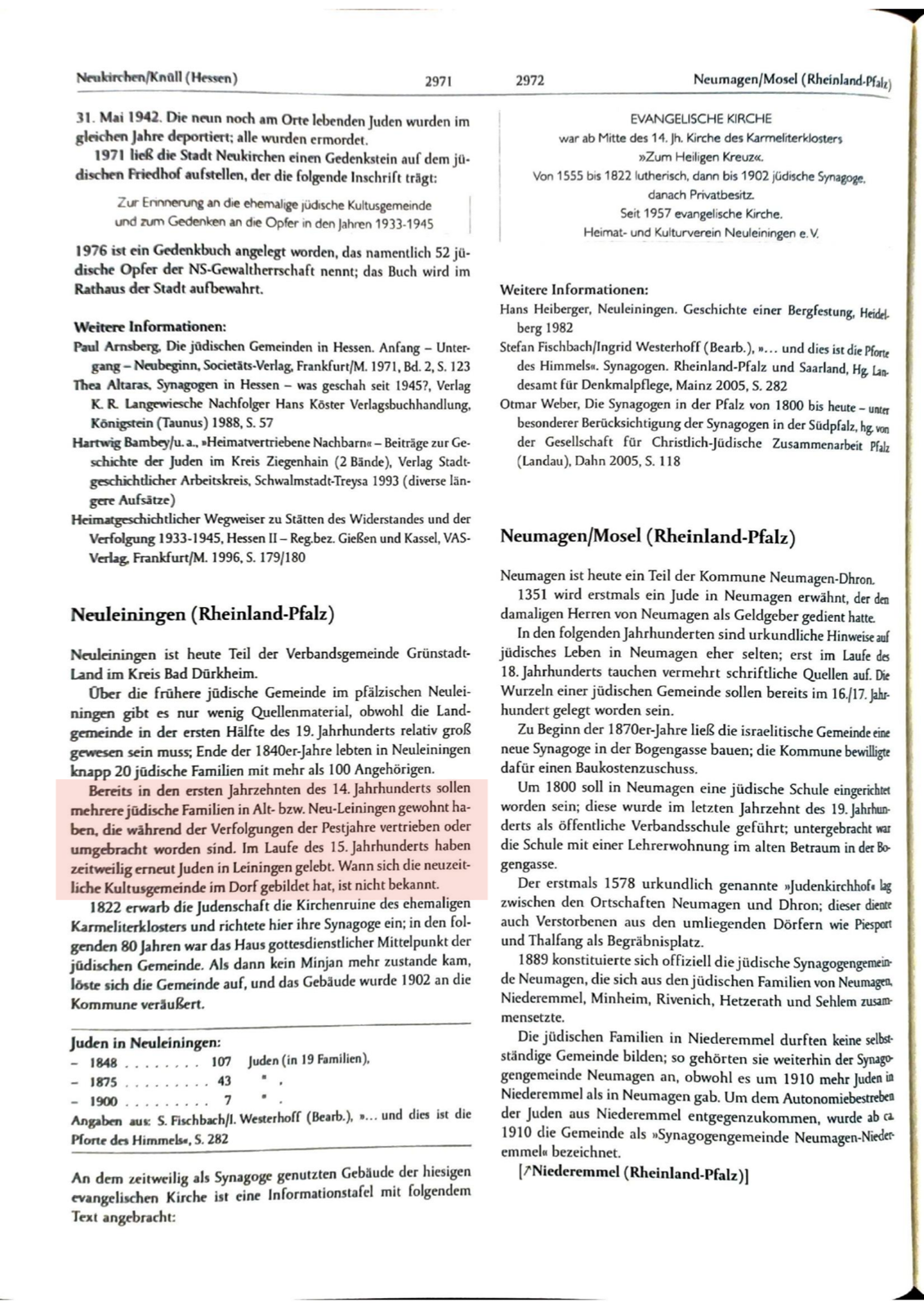
Avneri explicitly states that "at the time of the Black Death, several Jewish families lived in the village" („Zur Zeit des Schwarzen Todes lebten mehrere jüdische Familien in dem Dorfe").
Alicke corroborates that several families lived there in the early 14th century.
There is unambiguous evidence that there was a Jewish community in the town during the Black Death.
Correction
EXIST1349 0 -> 1; POG1349 NA -> 1
Sources:
Avneri · Page 476
Alicke · Page 2971
Neuruppin (75)
Error
Voigtländer and Voth failed to code a 0 for a pogrom here during the Black Death, despite their rule that a lack of information should be coded as 0.
Reality
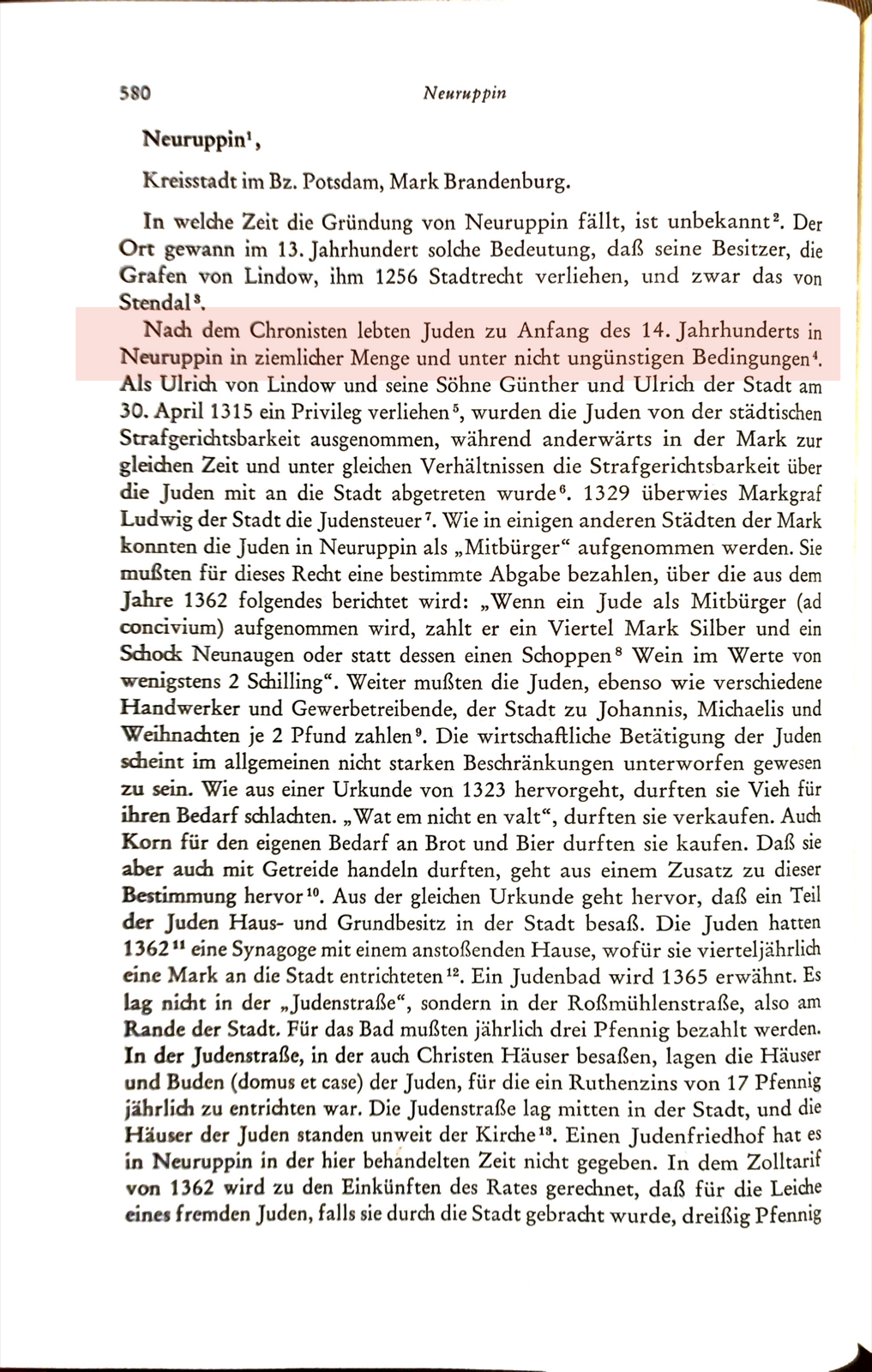
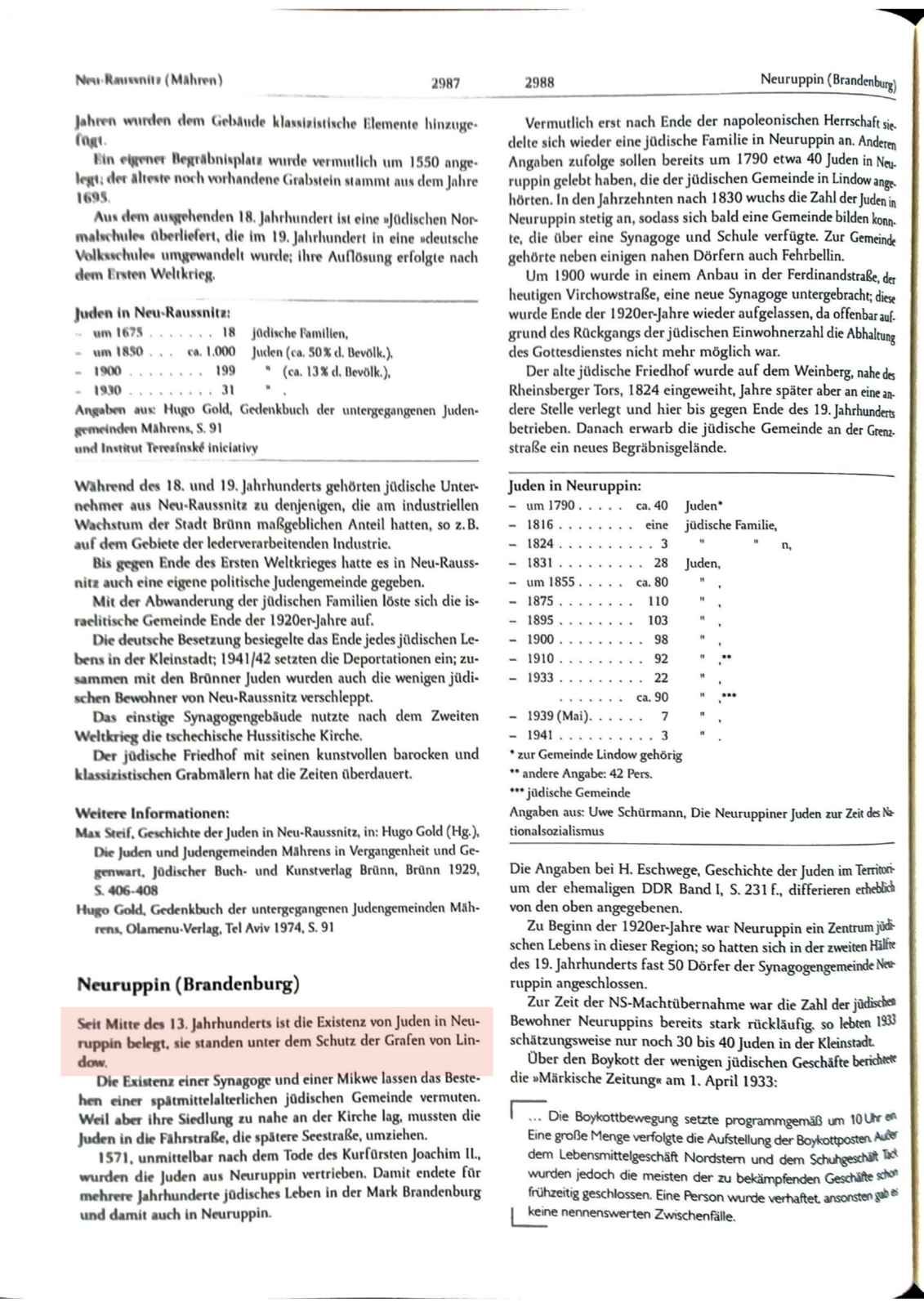
Avneri and Alicke both confirm a Jewish presence in the early 14th century, but neither source reports any pogroms during the Black Death.
Following Voigtländer and Voth's rules, this should be coded as 0.
Correction
POG1349 NA -> 0
Sources:
Avneri · Page 580
Alicke · Page 2987
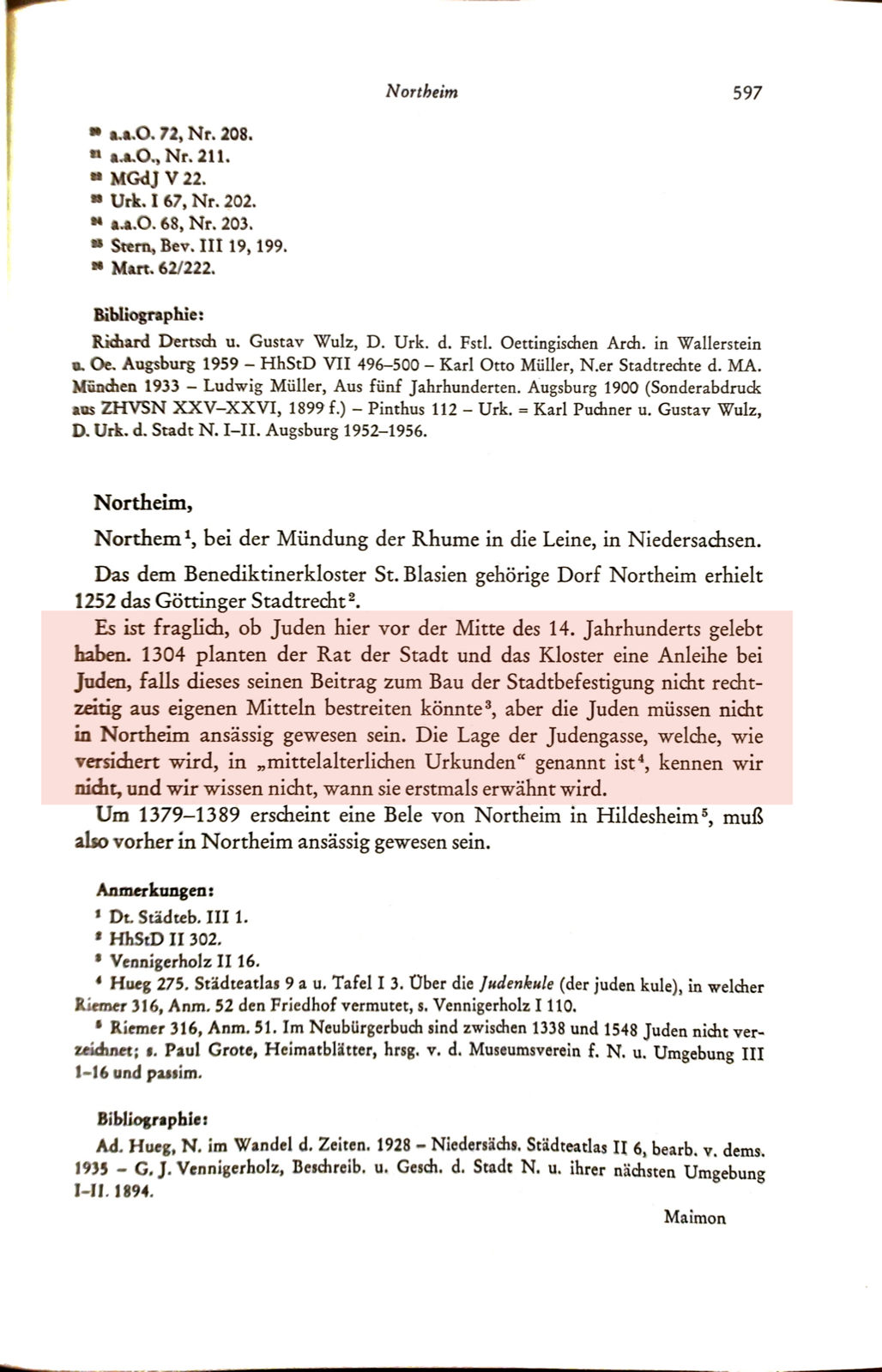
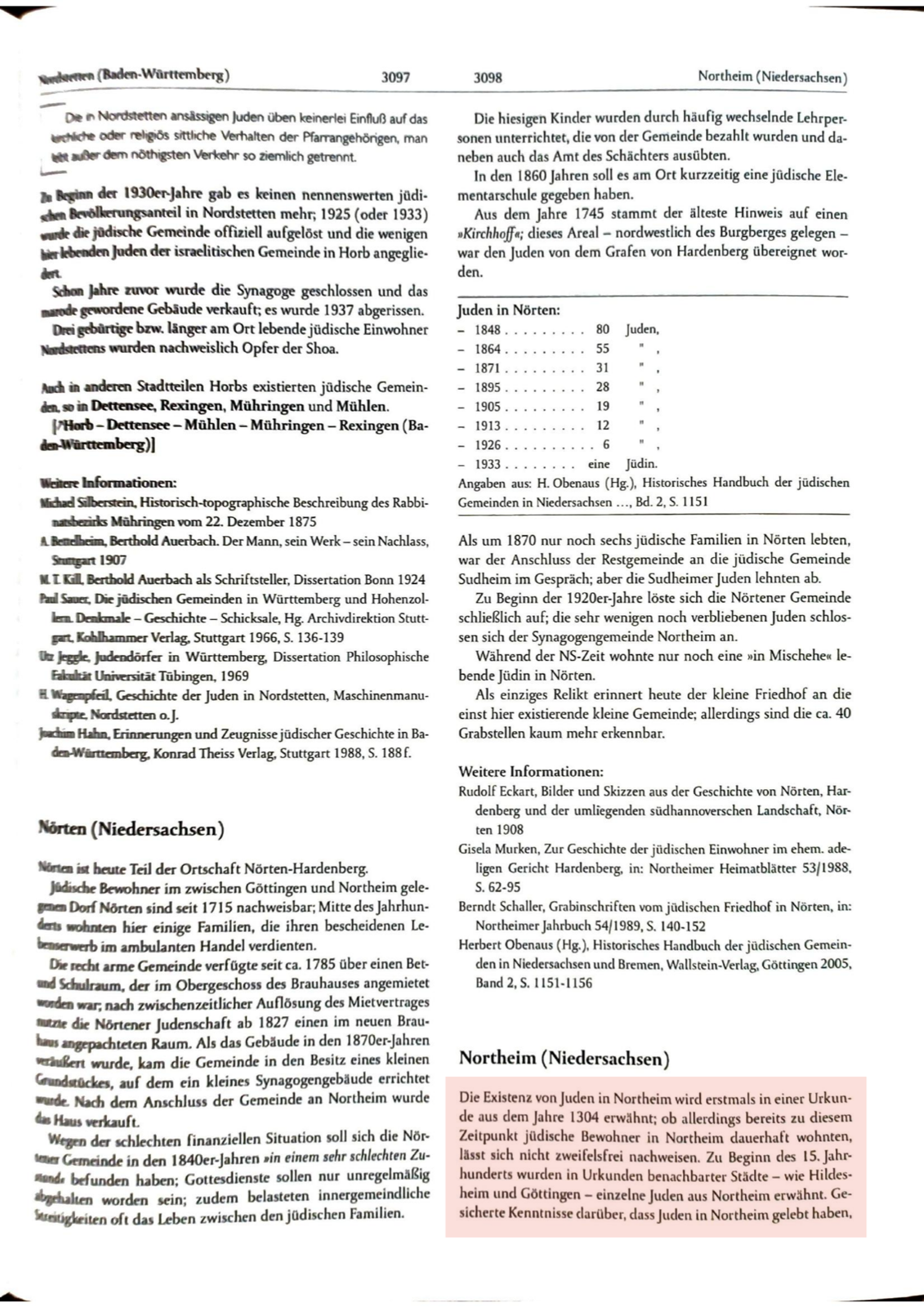
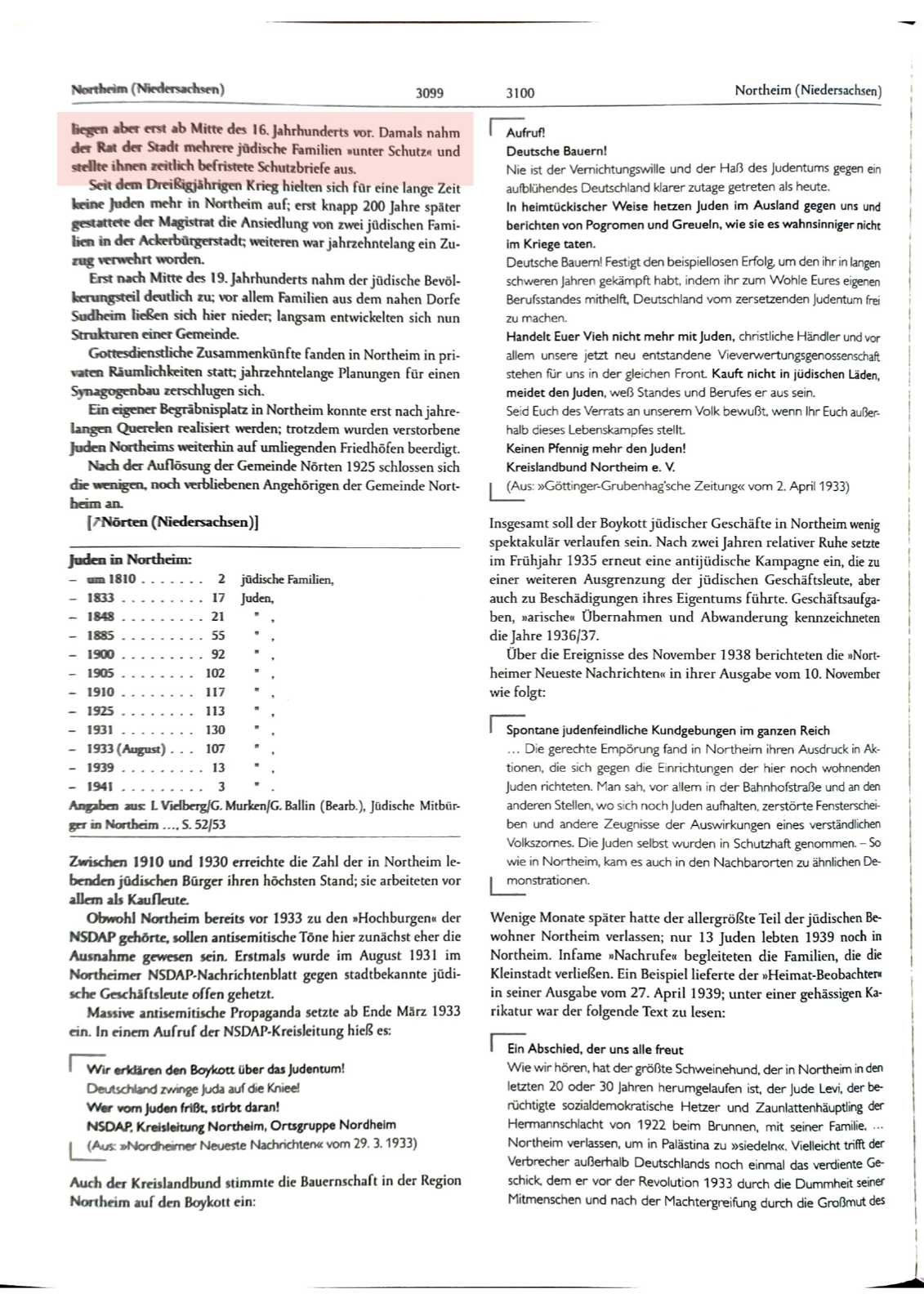
Northeim (76 & 77)
Error
Voigtländer and Voth code a "confirmed Jewish settlement" here during the Black Death. However, their sources do not provide "unambiguous information" to support this.
Reality
Avneri states that "it is questionable whether Jews lived here before the mid-fourteenth century" („Es ist fraglich, ob Juden hier vor der Mitte des 14. Jahrhunderts gelebt haben").
Alicke agrees that it "cannot be proven beyond doubt" („lässt sich nicht zweifelsfrei nachweisen").
The existence of a Jewish community during the Black Death is uncertain.
Correction
EXIST1349 1 -> NA; POG1349 0 -> NA
Sources:
Avneri · Page 597
Alicke · Page 3098
Alicke · Page 3099
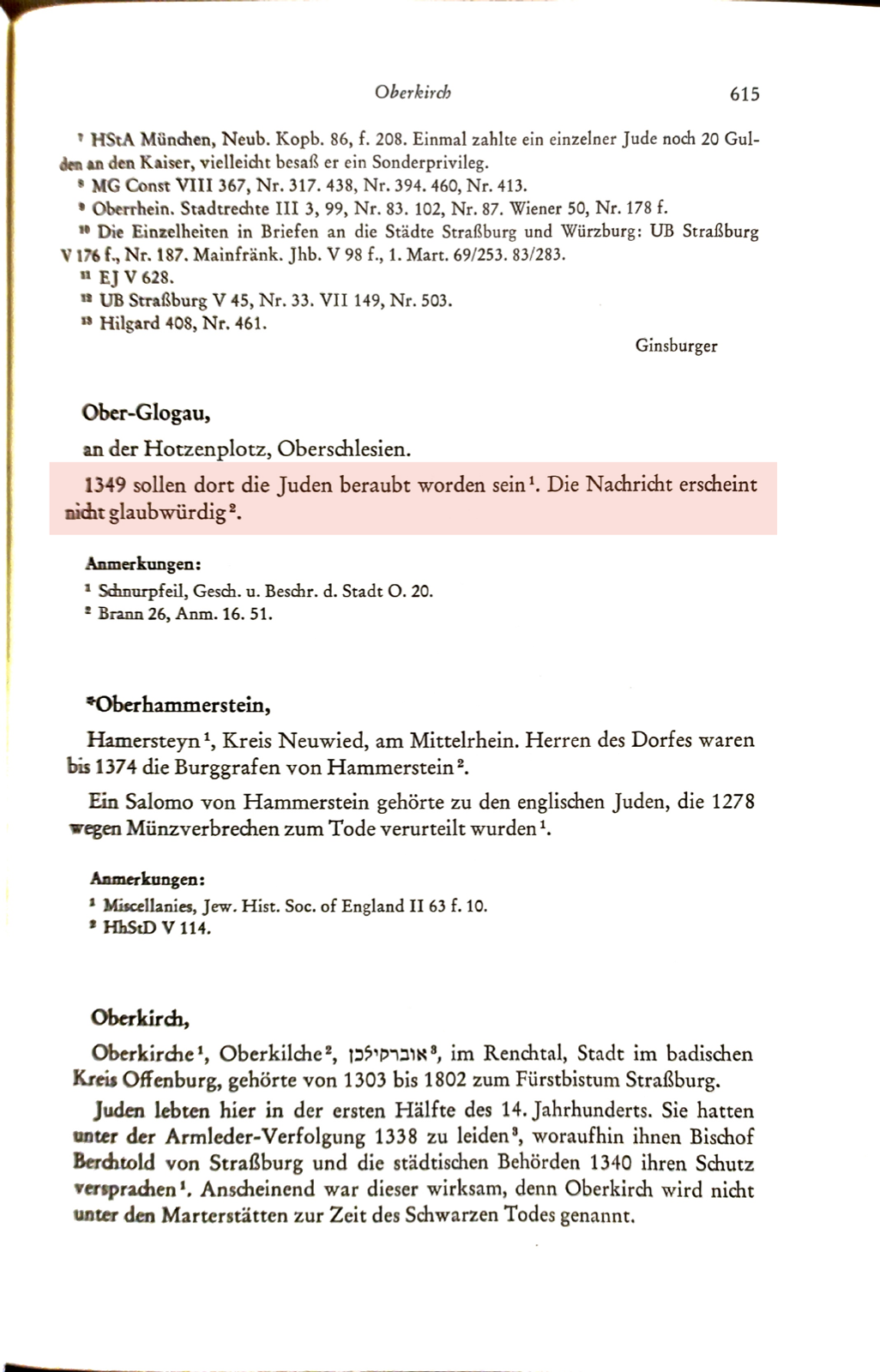
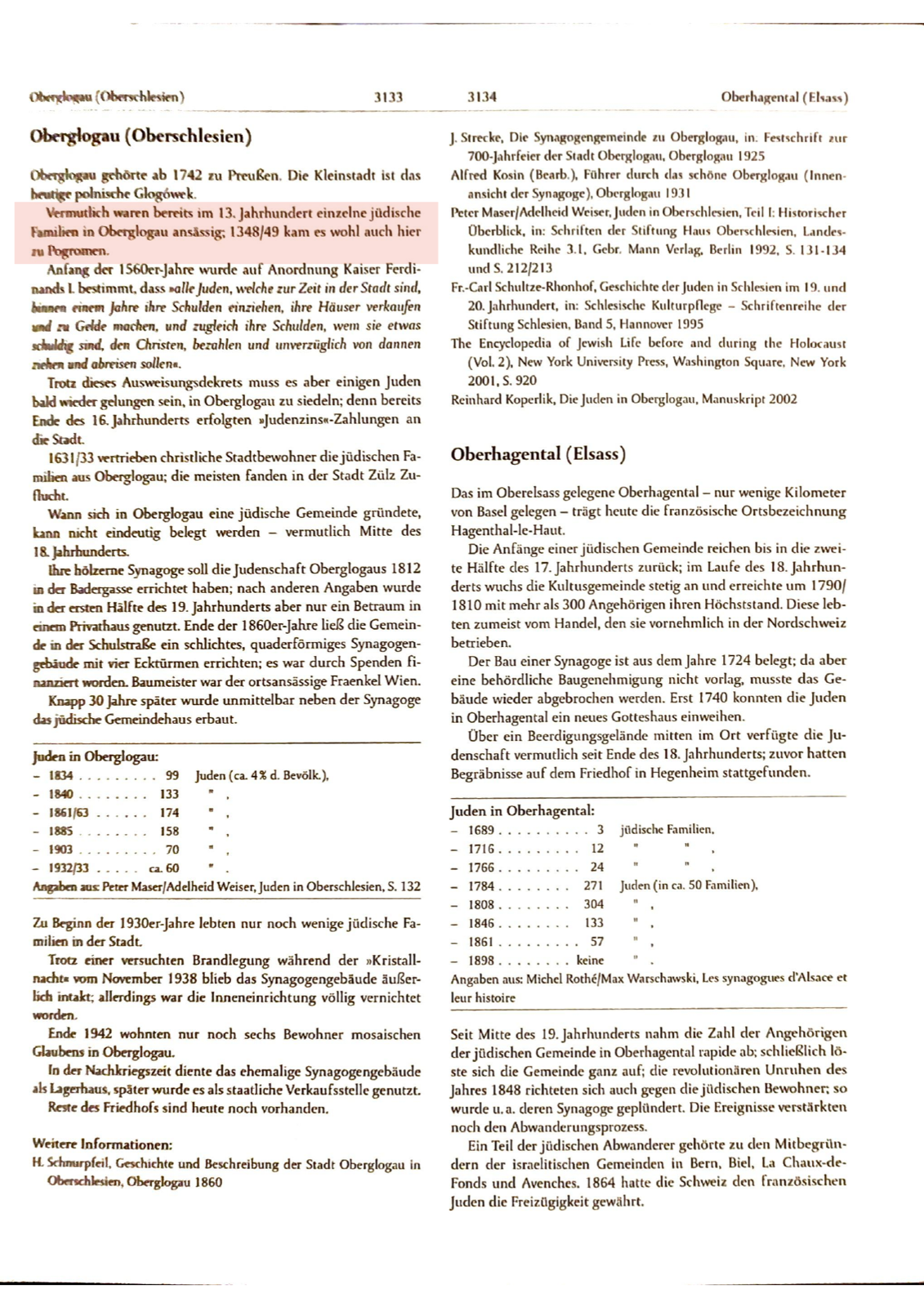
Oberglogau (78)
Error
Voigtländer and Voth failed to code a pogrom here during the Black Death, despite their rule to code as unity if Alicke mentions "violent attacks".
Reality
Avneri mentions a report that "in 1349 the Jews are said to have been robbed there" but immediately adds that "the news does not appear credible" („Die Nachricht erscheint nicht glaubwürdig").
Alicke independently states that "in 1348/49, pogroms probably also occurred here" („1348/49 kam es wohl auch hier zu Pogromen").
Alicke's positive account, which does not appear to rely on the same source Avneri questioned, constitutes sufficient evidence of a pogrom under Voigtländer and Voth's coding rules.
Correction
POG1349 NA -> 1
Sources:
Avneri · Page 615
Alicke · Page 3133
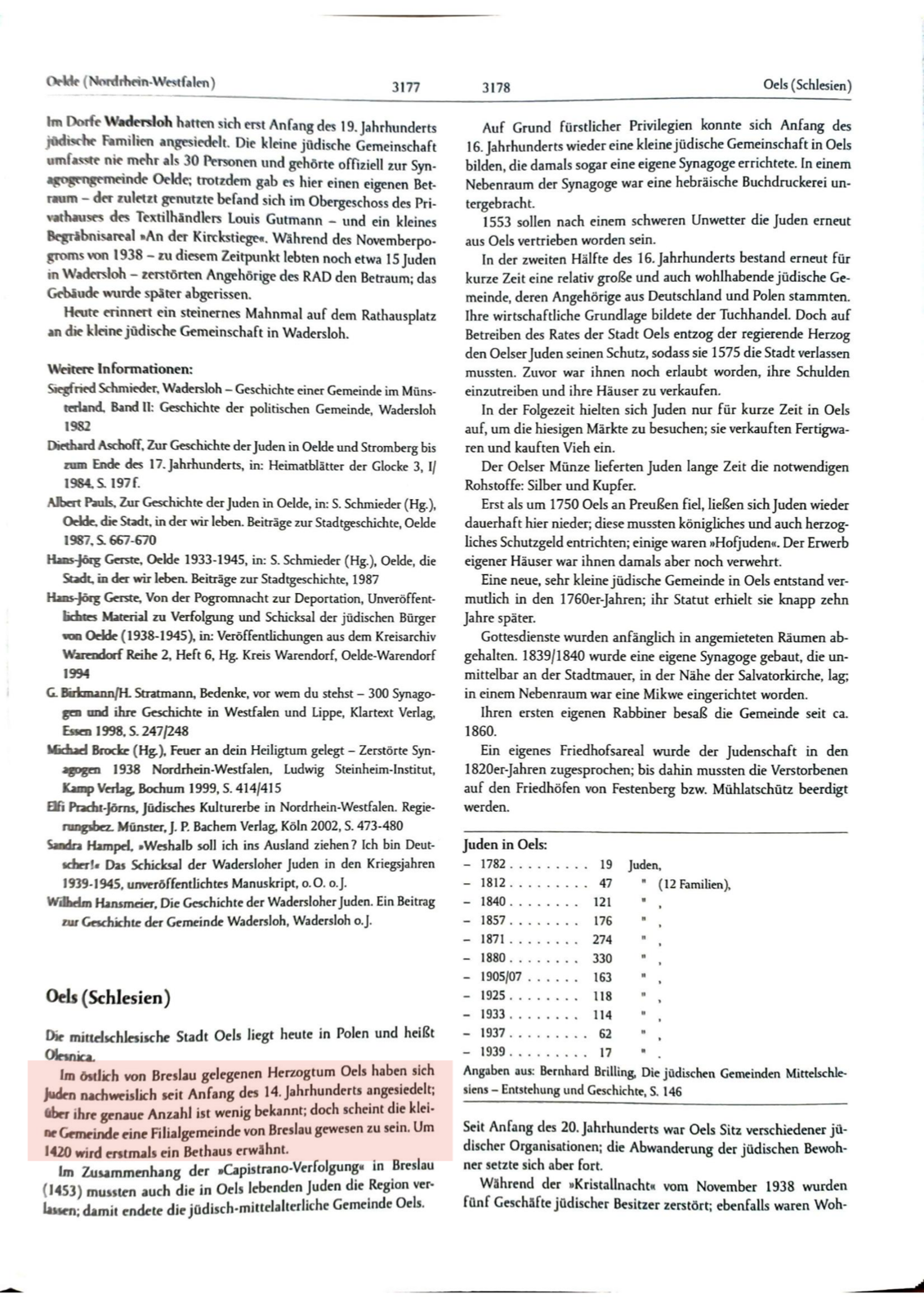
Oels (79 & 80)
Error
Voigtländer and Voth failed to code a "confirmed Jewish settlement" here during the Black Death, despite "unambiguous information" in their sources.
Reality
Alicke explicitly states that in Oels, "Jews demonstrably settled since the beginning of the fourteenth century" („haben sich Juden nachweislich seit Anfang des 14. Jahrhunderts angesiedelt").
There is unambiguous evidence that there was a Jewish community in the town during the Black Death.
Correction
EXIST1349 0 -> 1; POG1349 NA -> 0
Source:
Alicke · Page 3177
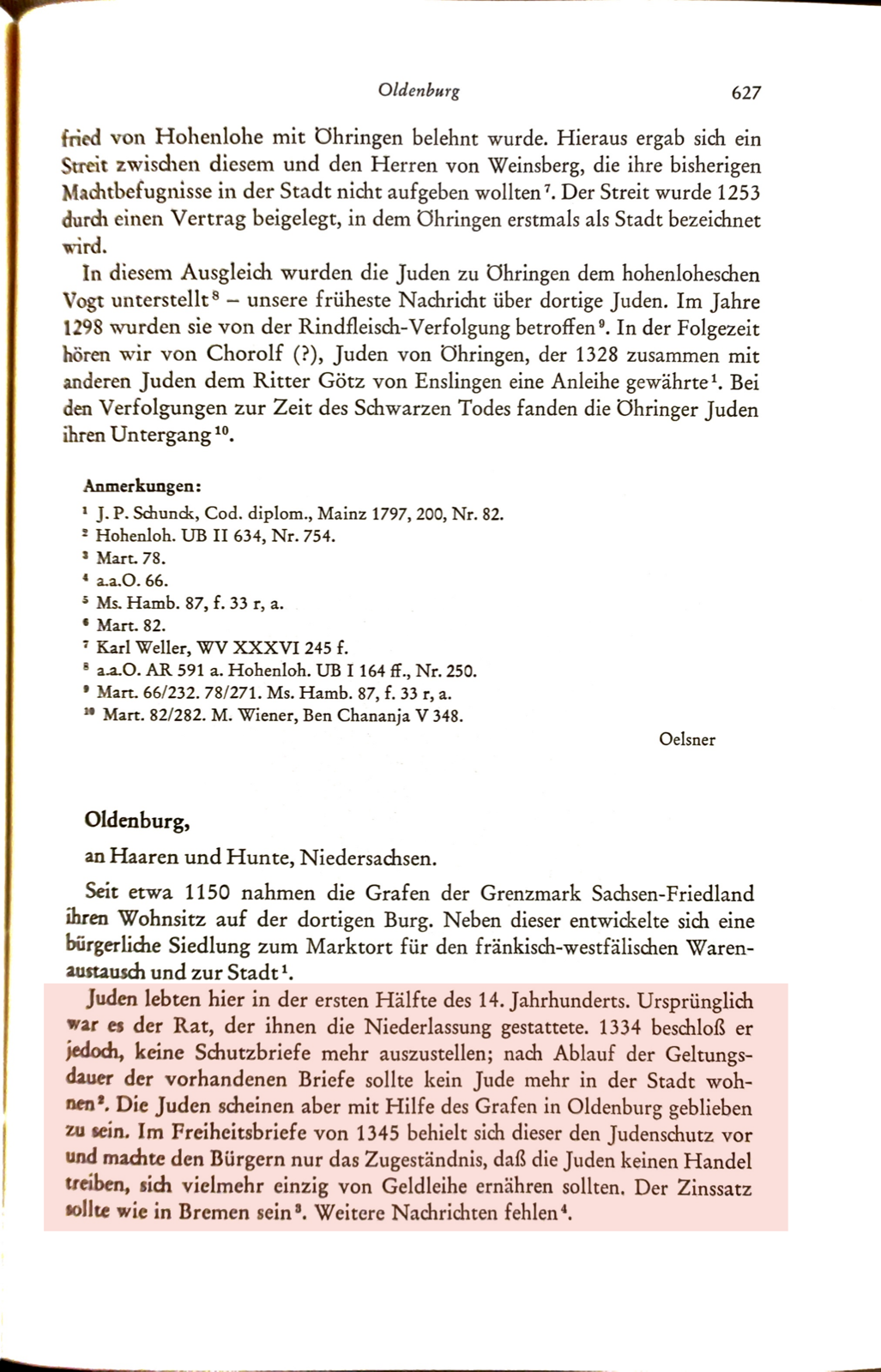
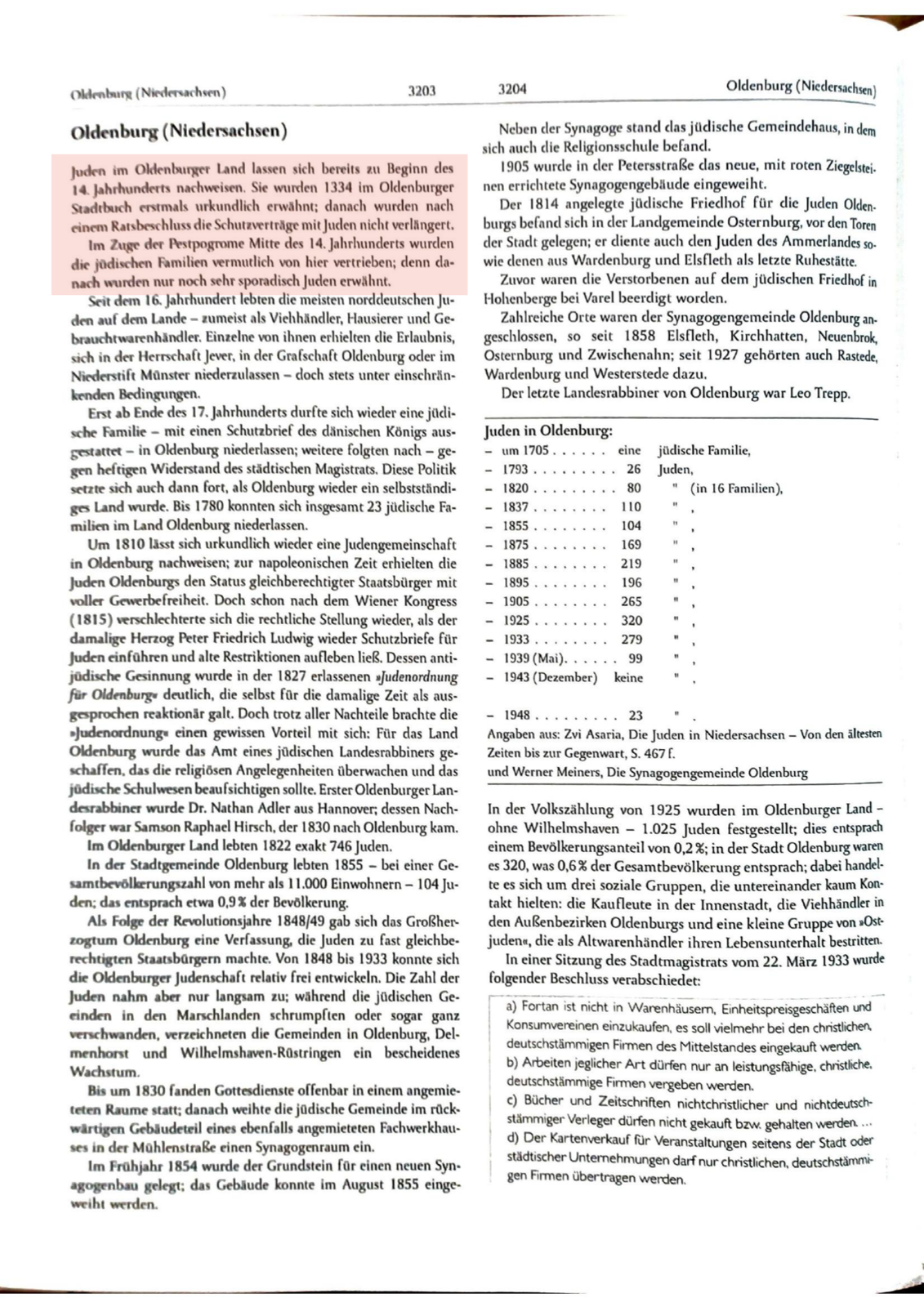
Oldenburg (81)
Error
Voigtländer and Voth failed to code a pogrom here during the Black Death, despite their rule to code as unity if Alicke mentions "expulsion" or "violent attacks".
Reality
Avneri confirms a Jewish presence but adds "further news is missing".
However, Alicke provides specific information, noting that "in the course of the plague pogroms in the middle of the fourteenth century, the Jewish families were probably expelled from here" („Im Zuge der Pestpogrome [...] wurden die jüdischen Familien vermutlich von hier vertrieben").
The occurrence of a pogrom is confirmed by the primary source.
Correction
POG1349 0 -> 1
Sources:
Avneri · Page 627
Alicke · Page 3203
Pretzfeld (82)
Error
Voigtländer and Voth failed to code a 0 for a pogrom here during the Black Death, despite their rule that a lack of information should be coded as 0.
Reality
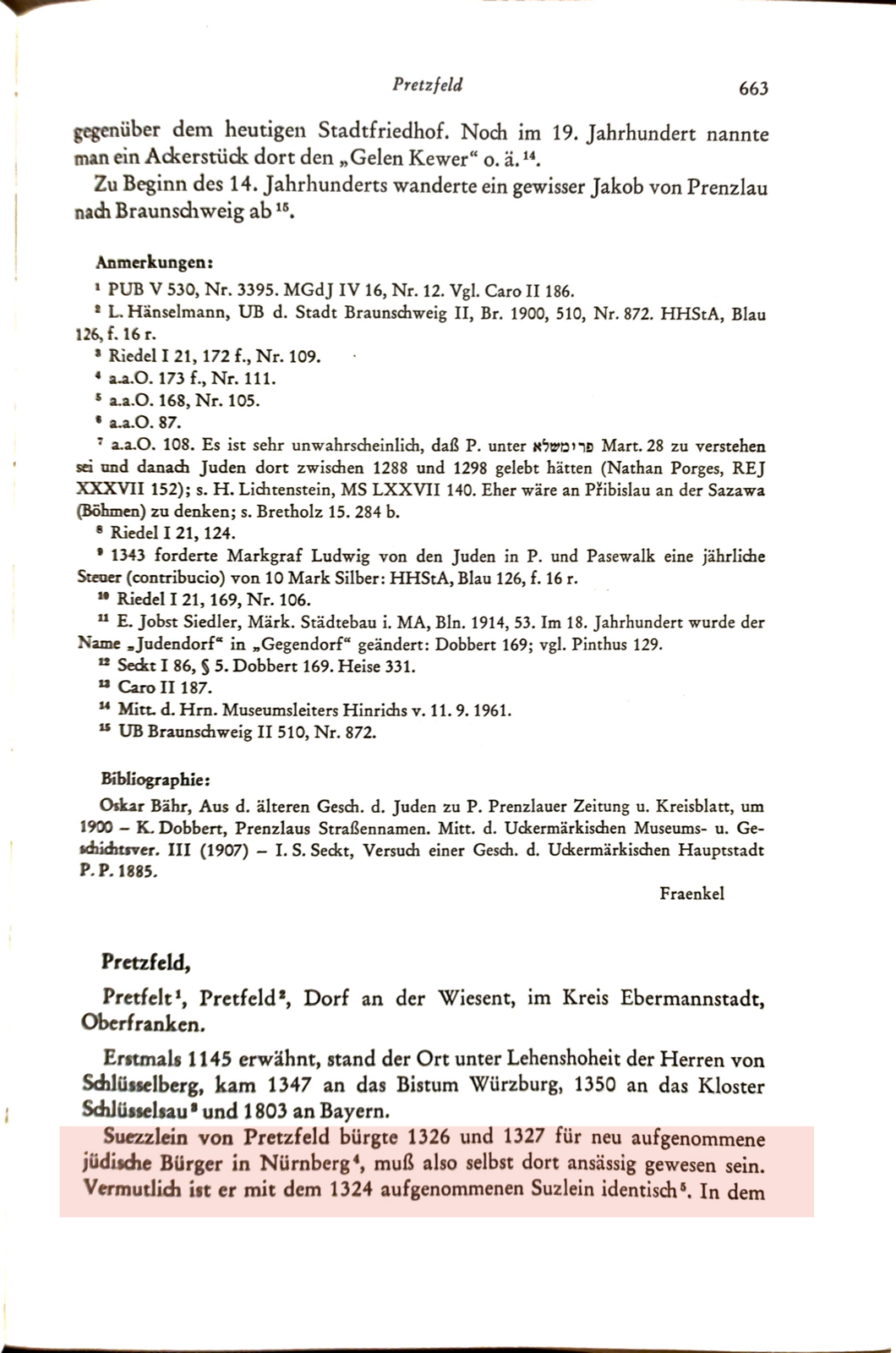
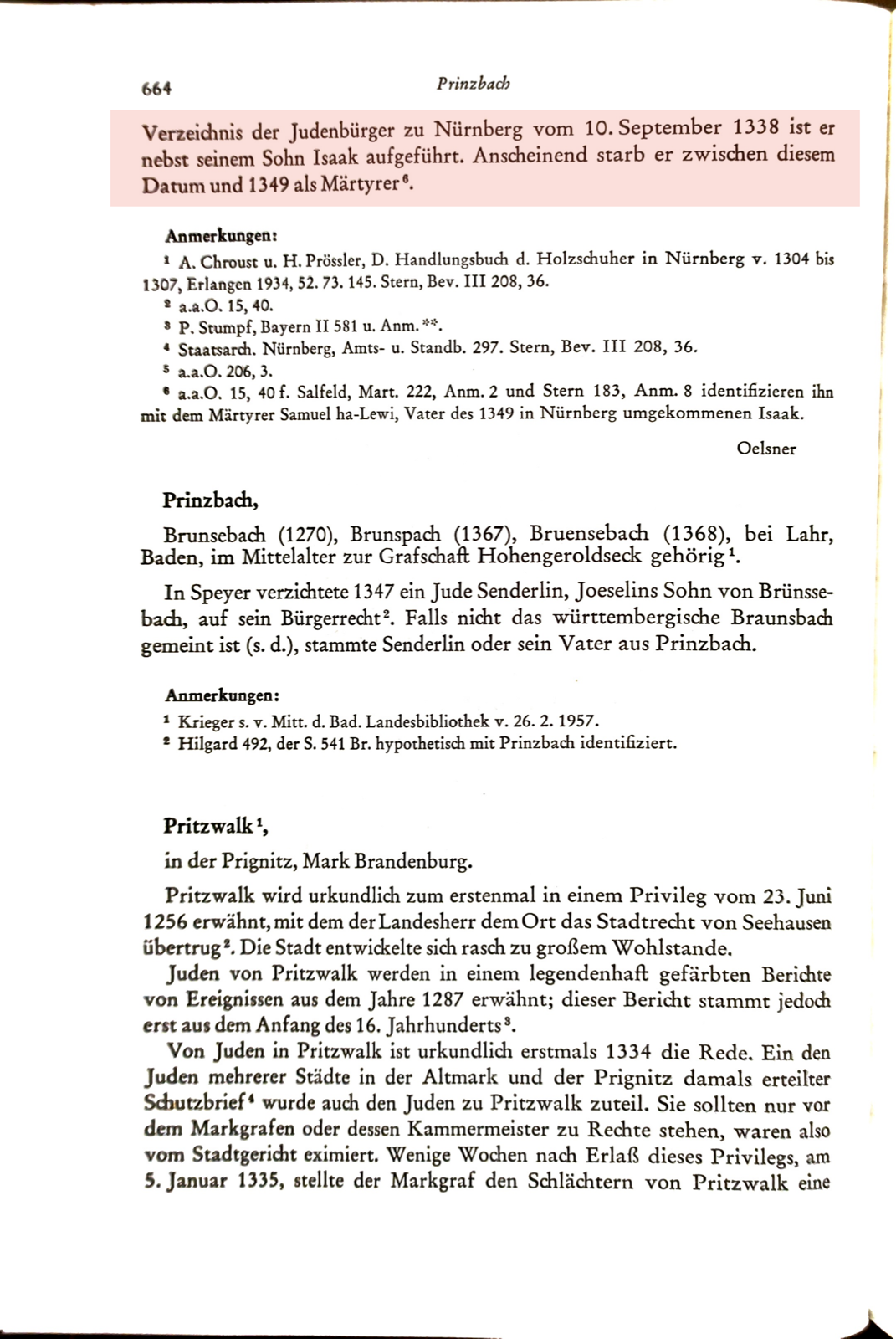
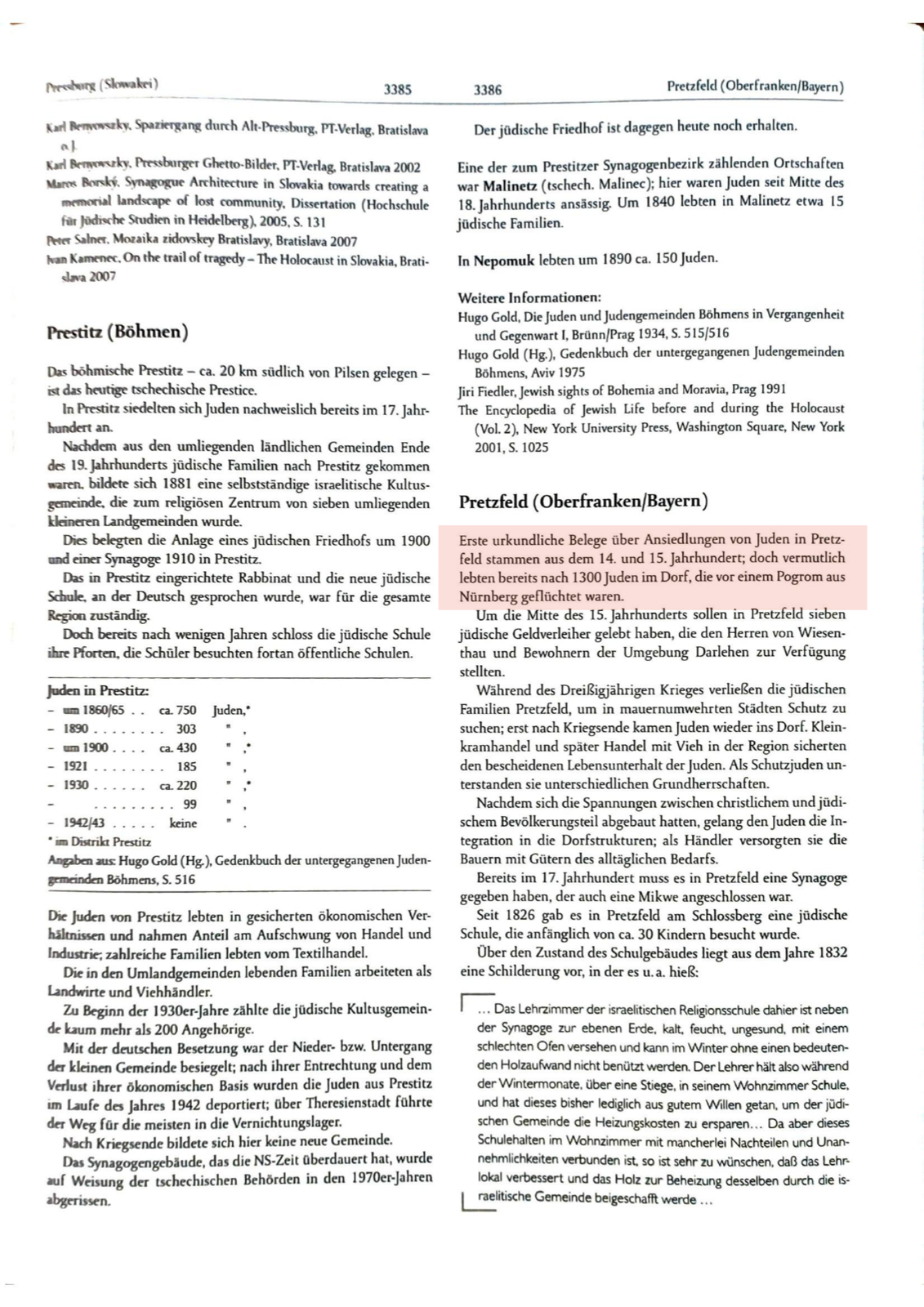
Avneri mentions a martyr, but the individual was a citizen of Nuremberg, implying the martyrdom occurred there.
Alicke notes that Jews "presumably lived in the village after 1300, having fled a pogrom from Nuremberg" („die vor einem Pogrom aus Nürnberg geflüchtet waren"). Neither source mentions a pogrom in Pretzfeld during the Black Death.
This should be coded as 0.
Correction
POG1349 NA -> 0
Sources:
Avneri · Page 663
Avneri · Page 664
Alicke · Page 3386
Rathenow (83)
Error
Voigtländer and Voth failed to code a 0 for a pogrom here during the Black Death, despite their rule that a lack of information should be coded as 0.
Reality
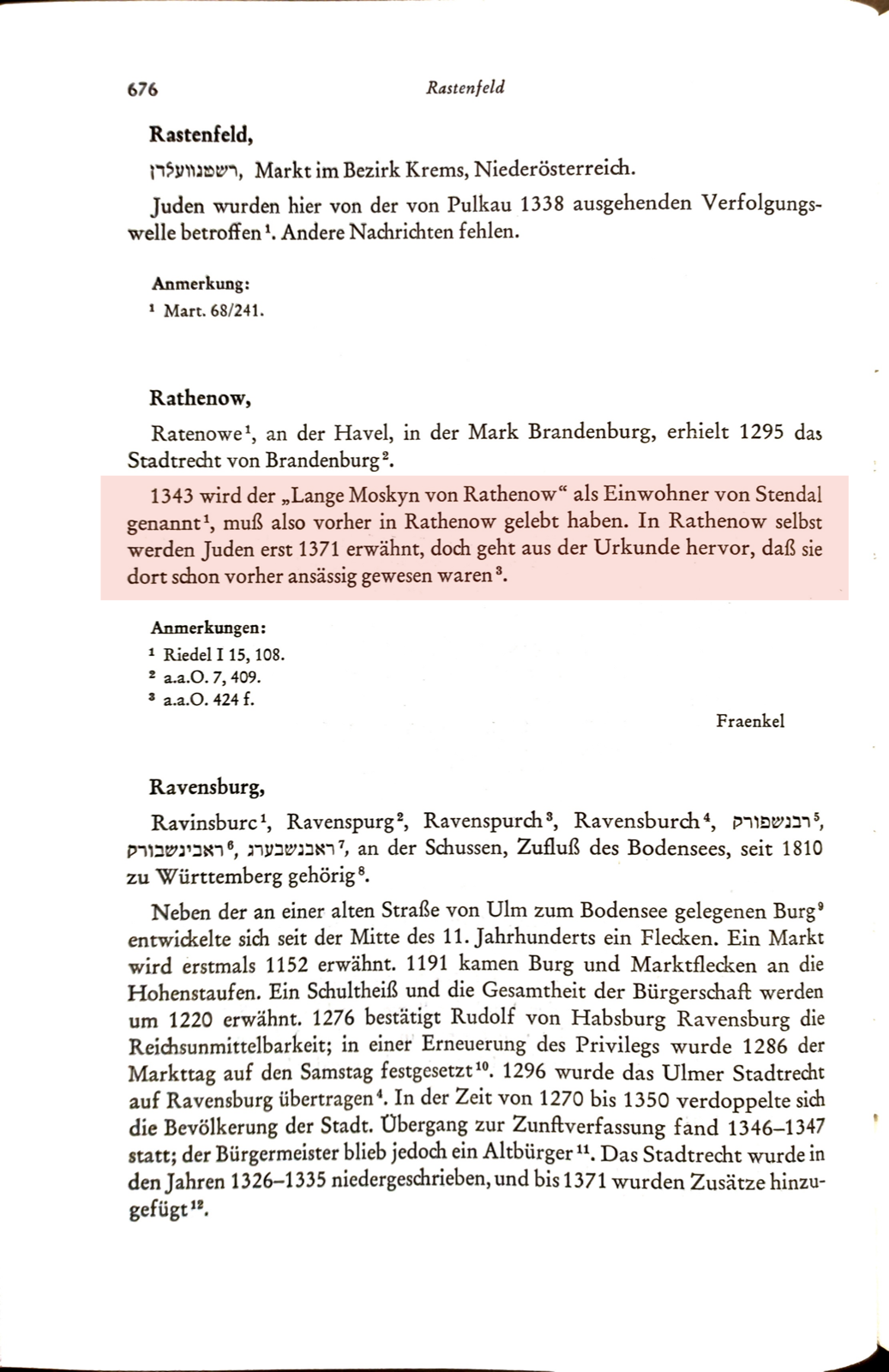
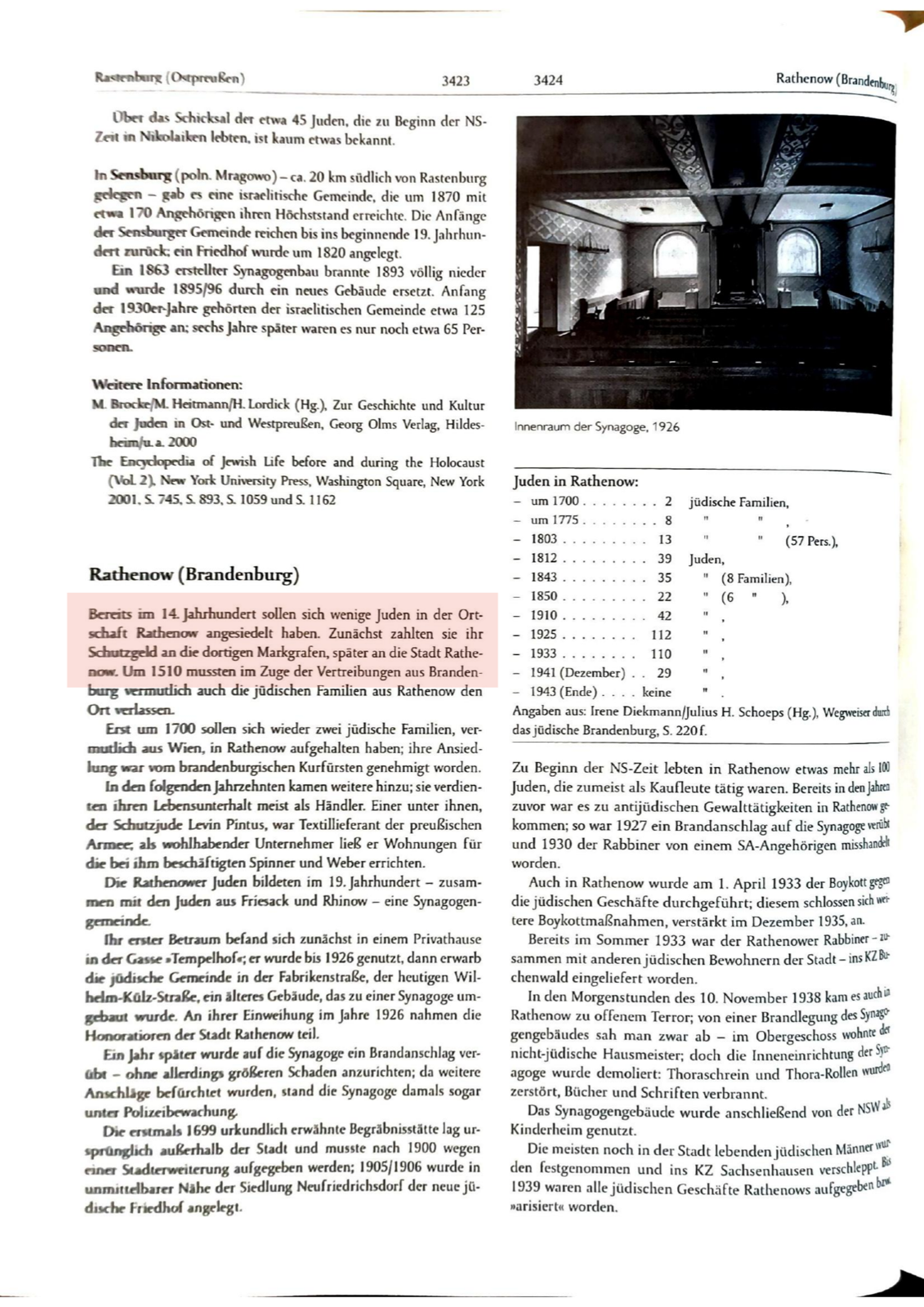
Avneri and Alicke both indicate that Jews settled in Rathenow in the fourteenth century, but neither source mentions persecution during the Black Death.
This should be coded as 0.
Correction
POG1349 NA -> 0
Sources:
Avneri · Page 676
Alicke · Page 3423
Reichenbach (84 & 85)
Error
Voigtländer and Voth failed to code a "confirmed Jewish settlement" here during the Black Death, despite "unambiguous information" in their sources.
Reality
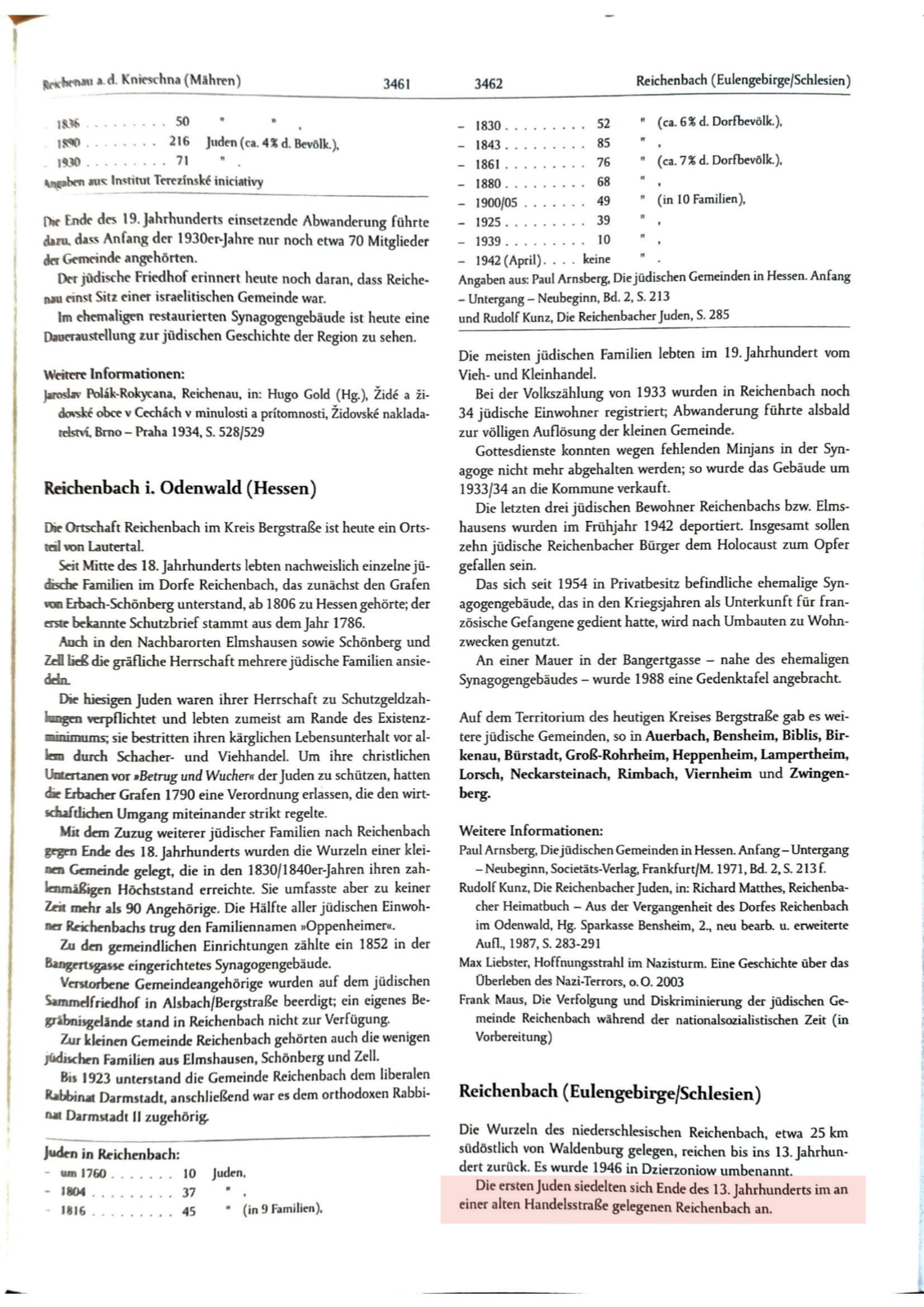
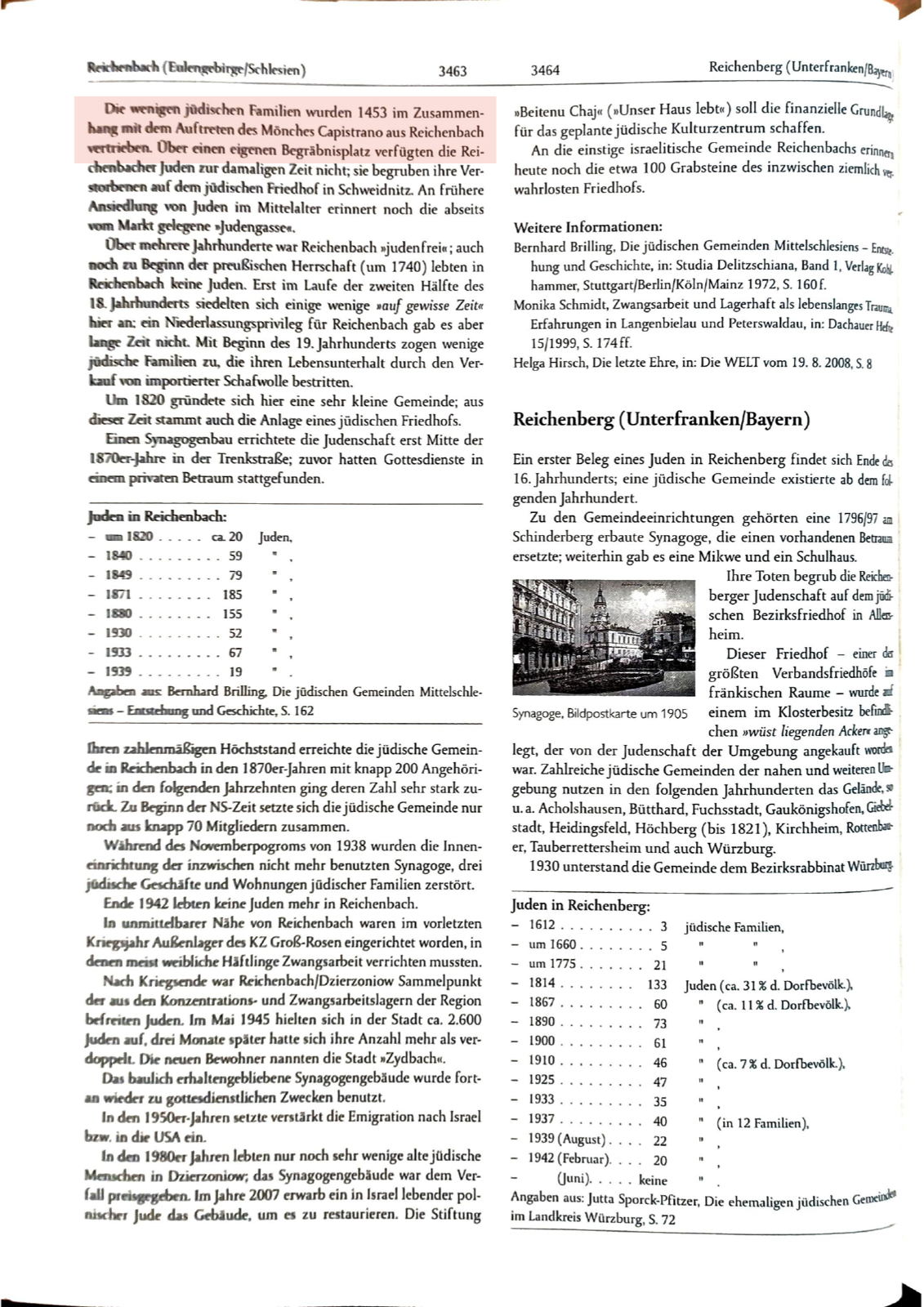
Alicke states that "the first Jews settled in Reichenbach at the end of the thirteenth century" („Die ersten Juden siedelten sich Ende des 13. Jahrhunderts [...] an"). He makes no mention of persecution during the Black Death, and notes that the community was not expelled until 1453 in connection with the Capistrano persecutions.
Settlement from the late thirteenth century, with no documented interruption before the fifteenth century, provides unambiguous evidence of Jewish presence during the Black Death.
Correction
EXIST1349 0 -> 1; POG1349 NA -> 0
Sources:
Alicke · Page 3462
Alicke · Page 3463
Rotenburg an der Fulda (86 & 87)
Error
Voigtländer and Voth code a "confirmed Jewish settlement" here during the Black Death. However, their sources do not provide "unambiguous information" to support this.
Reality
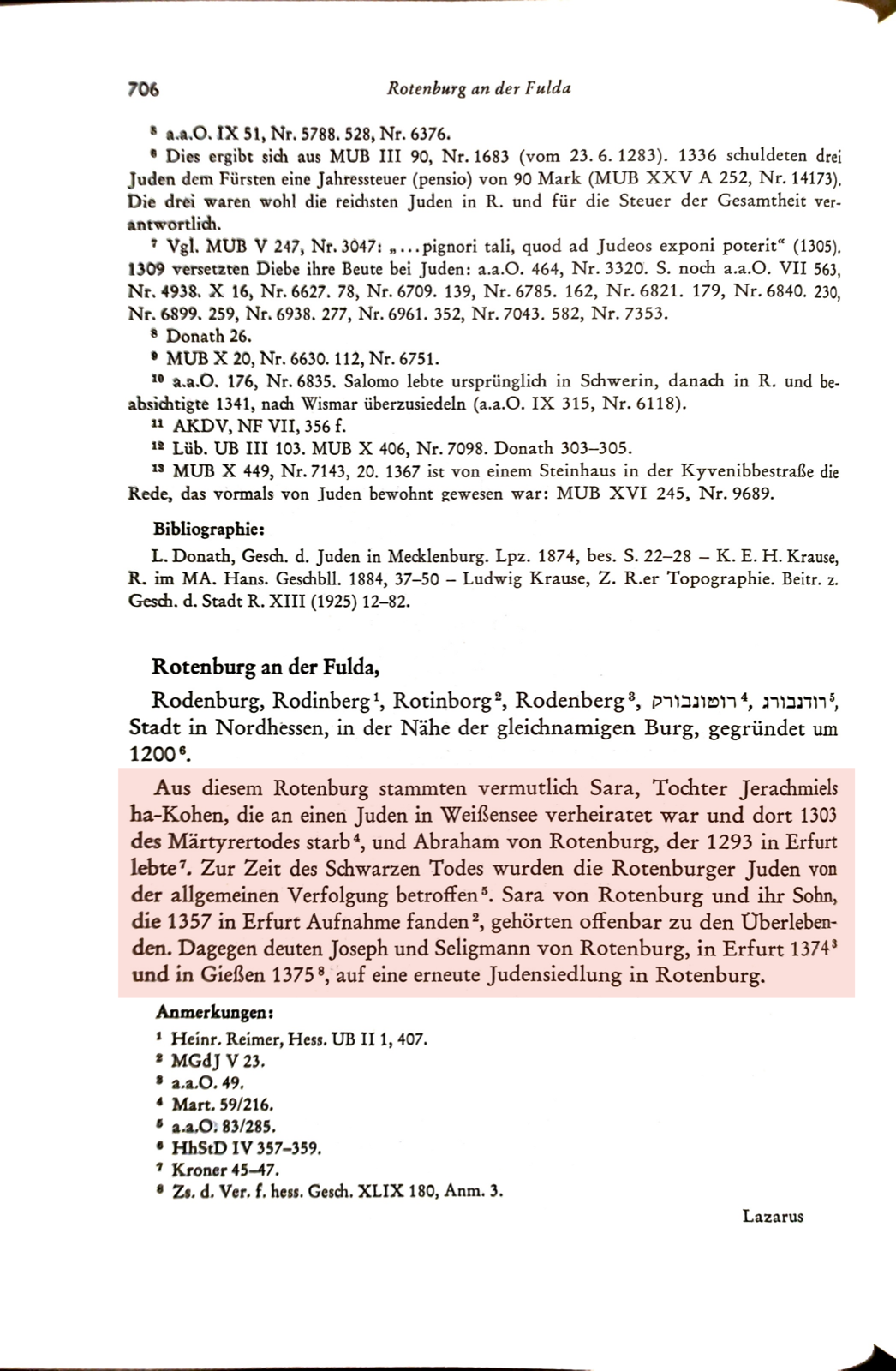
Avneri states that "at the time of the Black Death, the Jews of Rotenburg were affected by the general persecution" („Zur Zeit des Schwarzen Todes wurden die Rotenburger Juden von der allgemeinen Verfolgung betroffen"), and mentions that Sara of Rotenburg and her son found refuge in Erfurt in 1357, implying both Jewish presence and survival.
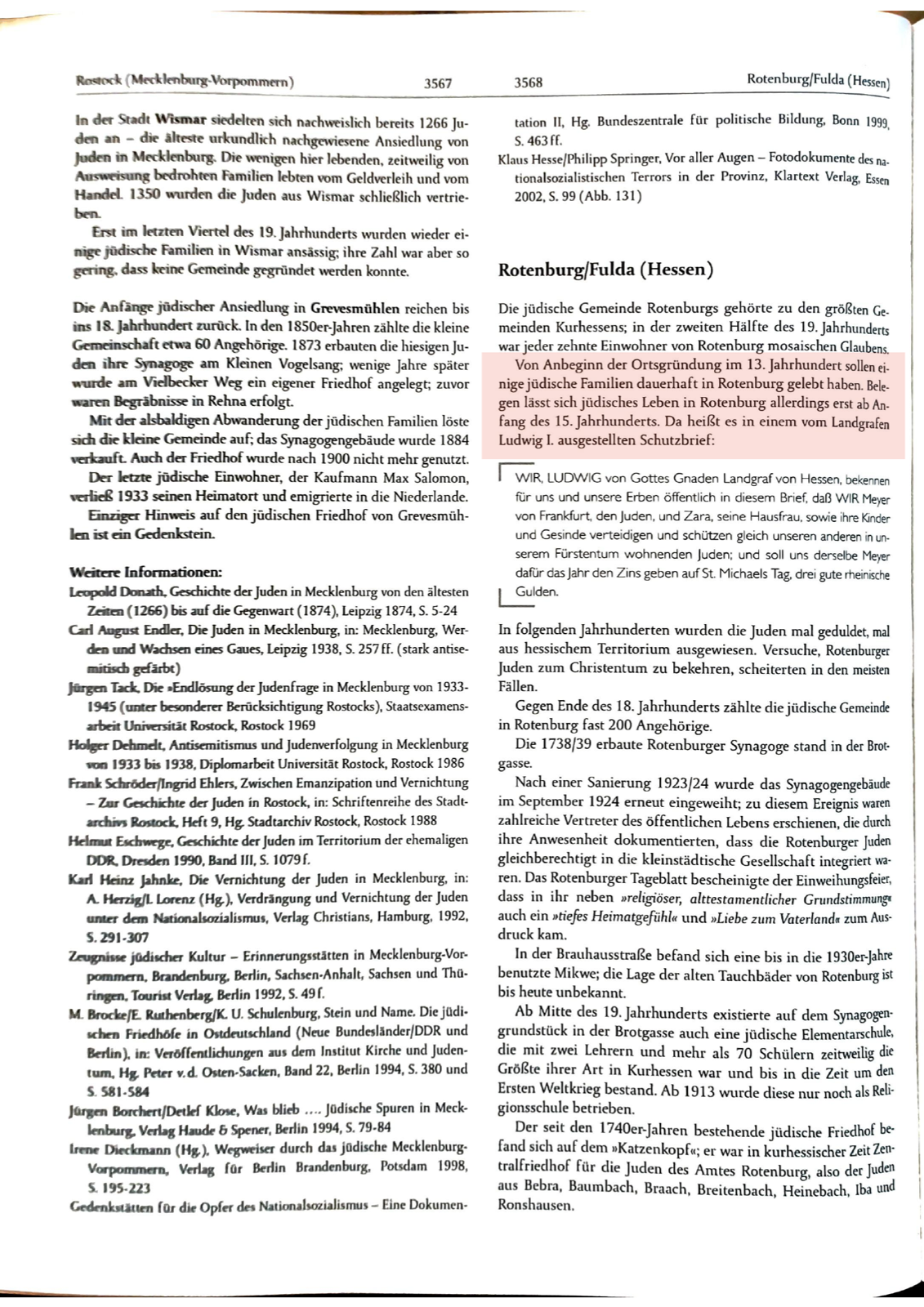
Alicke, however, notes that while some Jewish families are said to have lived in Rotenburg from the town's founding, Jewish life "can only be proven from the beginning of the fifteenth century" („Belegen lässt sich jüdisches Leben in Rotenburg allerdings erst ab Anfang des 15. Jahrhunderts").
Given Alicke's explicit statement that documentary evidence begins only in the fifteenth century, the existence of a Jewish settlement during the Black Death is uncertain.
Correction
EXIST1349 1 -> NA; POG1349 1 -> NA
Sources:
Avneri · Page 706
Alicke · Page 3568
Rüthen (88 & 89)
Error
Voigtländer and Voth code a "confirmed Jewish settlement" here during the Black Death. However, their sources do not provide "unambiguous information" to support this.
Reality
Avneri does not explicitly state the existence of a community in the mid-fourteenth century.
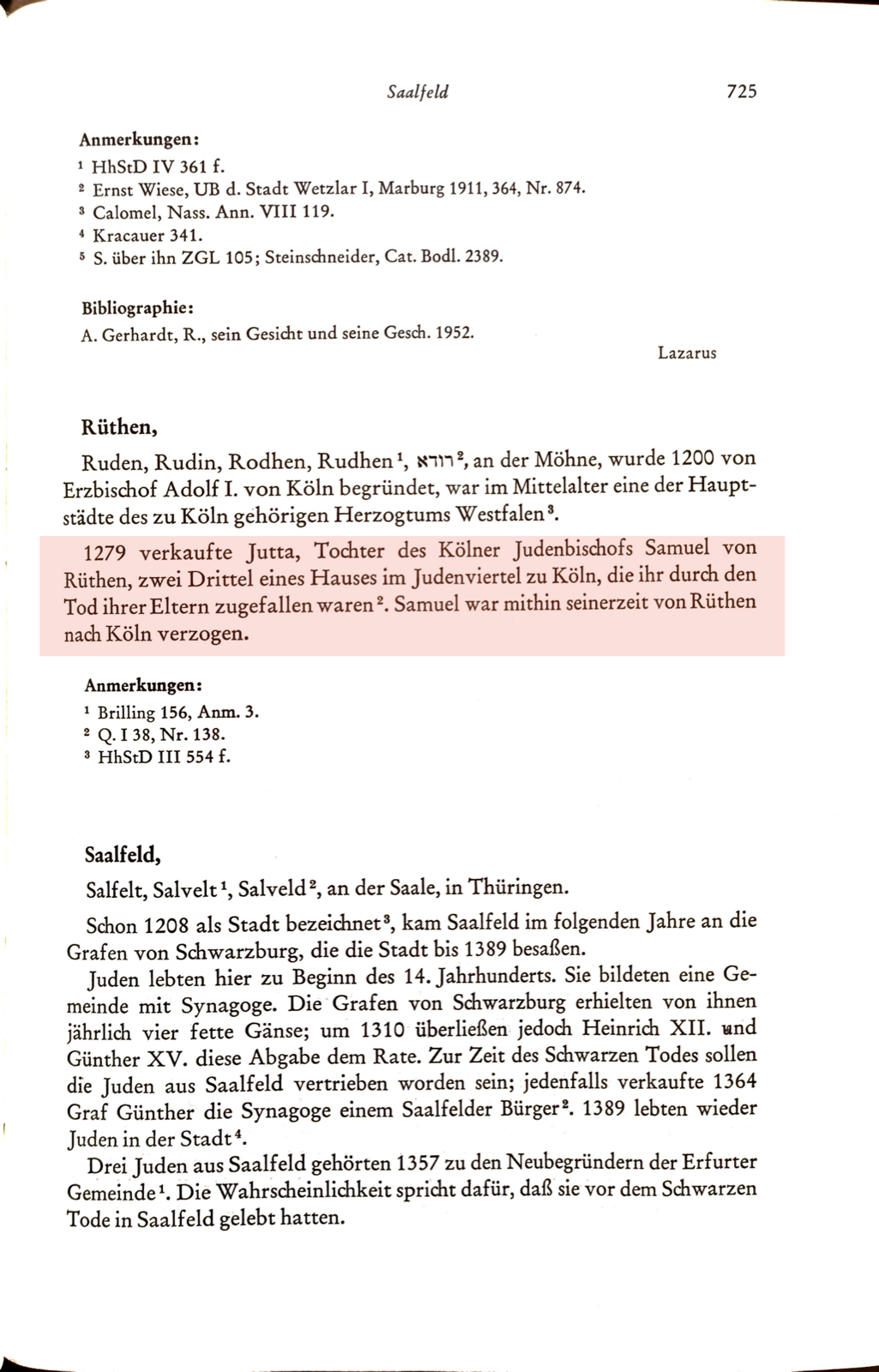
Alicke states that "already around 1270 some are said to have lived here" but notes that "since the mid-fifteenth century, Jews lived---documented---in the locality" („Seit Mitte des 15. Jahrhunderts wohnten Juden -- urkundlich nachweisbar -- in der Ortschaft Rüthen").
The existence of a Jewish community during the Black Death is uncertain.
Correction
EXIST1349 1 -> NA; POG1349 0 -> NA
Sources:
Avneri · Page 725
Alicke · Page 3603
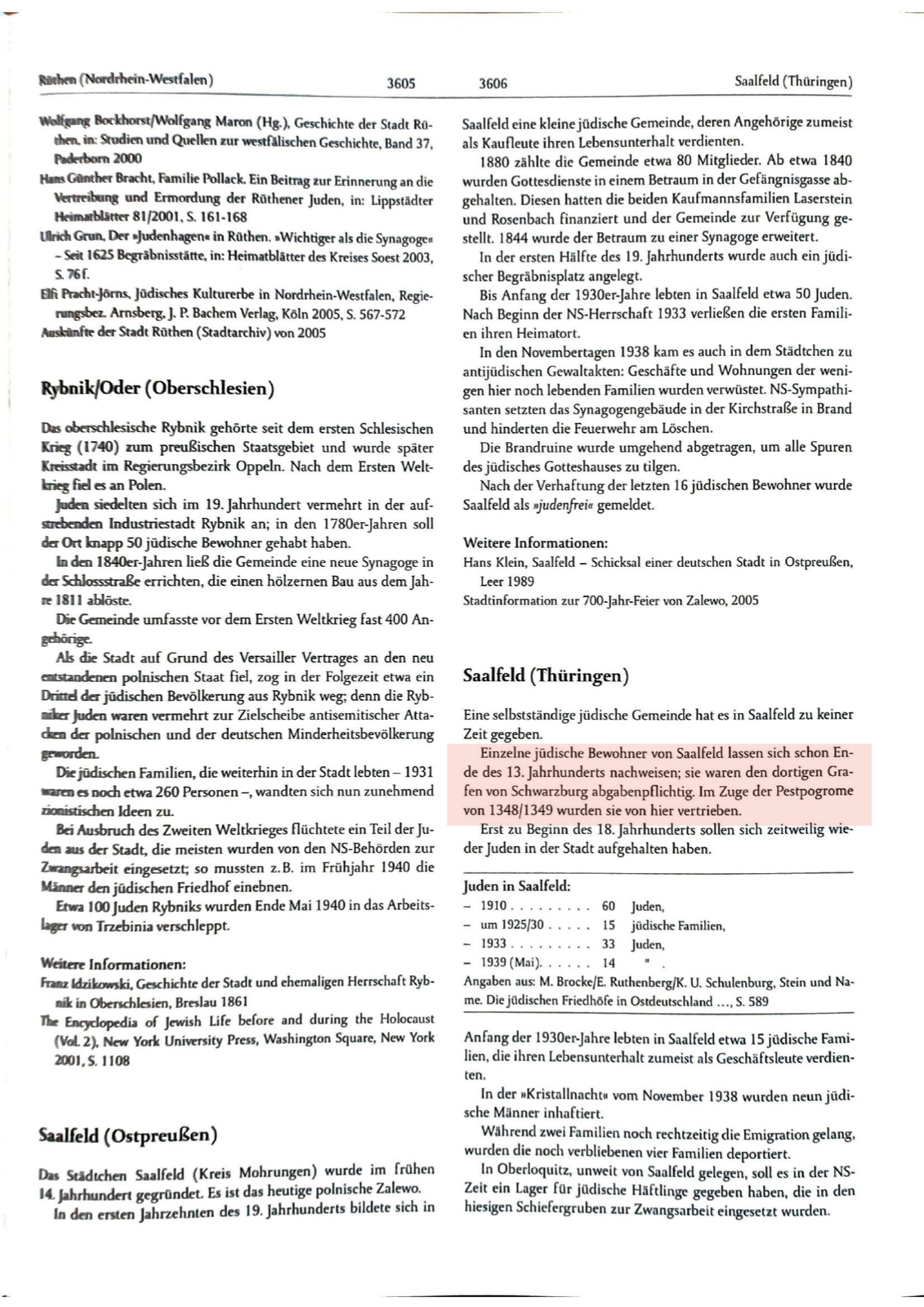
Saalfeld (90)
Error
Voigtländer and Voth failed to code a pogrom here during the Black Death, despite their rule to code as unity if GJ or Alicke mentions "expulsion" or "violent attacks".
Reality
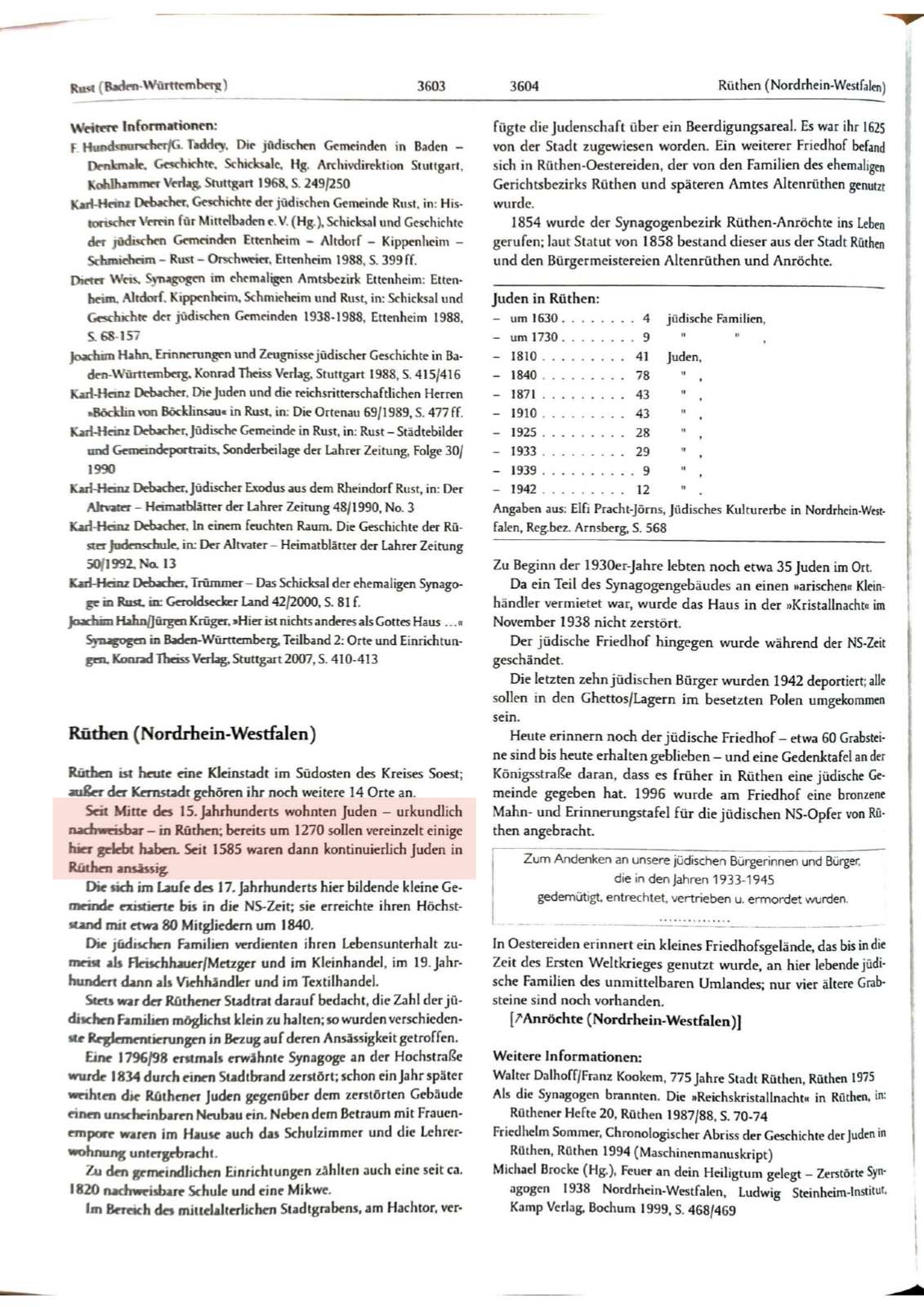
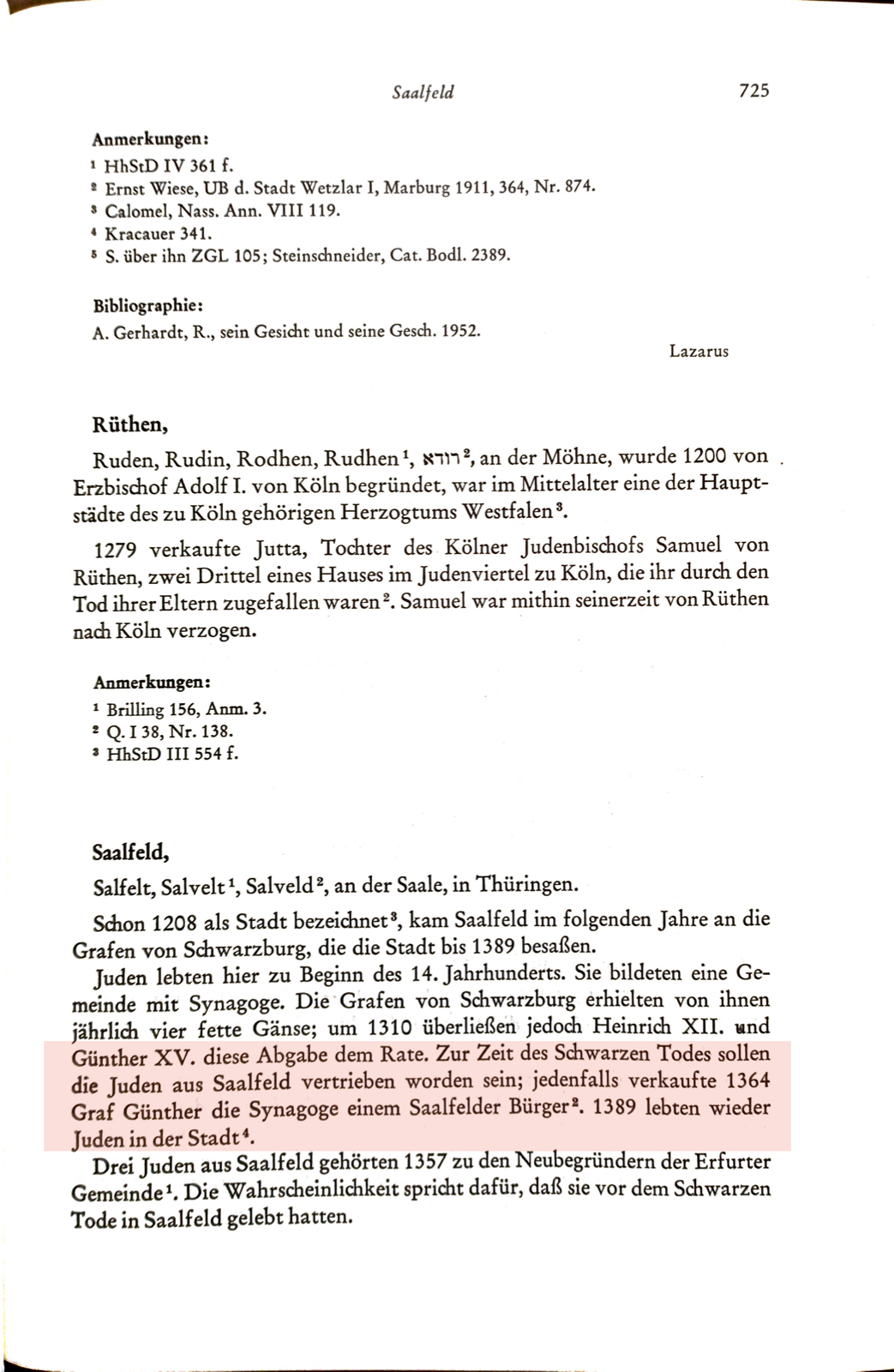
Avneri reports that "at the time of the Black Death, the Jews are said to have been expelled from Saalfeld" („Zur Zeit des Schwarzen Todes sollen die Juden aus Saalfeld vertrieben worden sein").
Alicke confirms this: "[i]n the course of the plague pogroms of 1348-1349, they were expelled from here" („Im Zuge der Pestpogrome von 1348/1349 wurden sie von hier vertrieben").
The occurrence of a pogrom is confirmed by the primary sources.
Correction
POG1349 NA -> 1
Sources:
Avneri · Page 725
Alicke · Page 3606
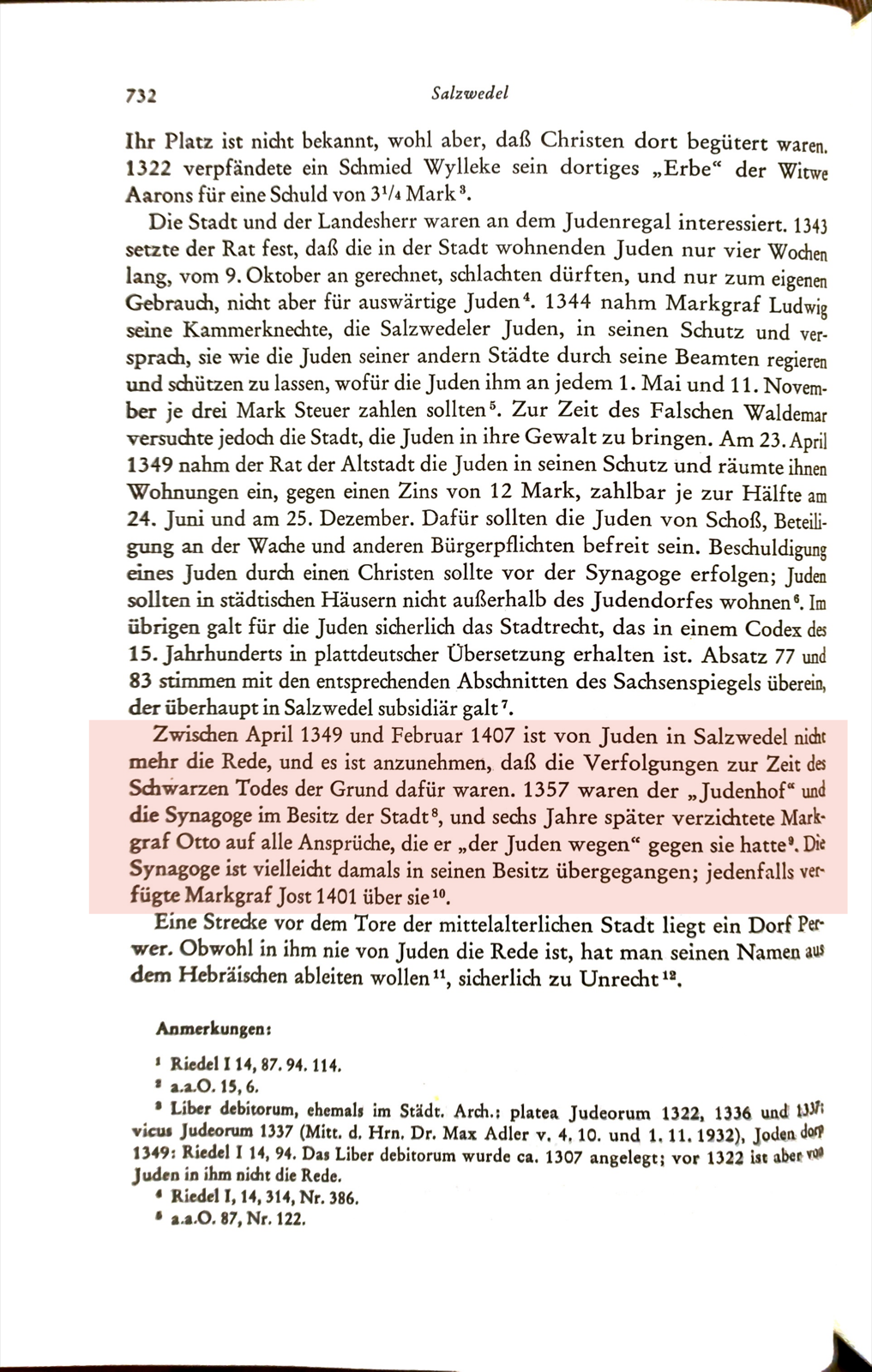
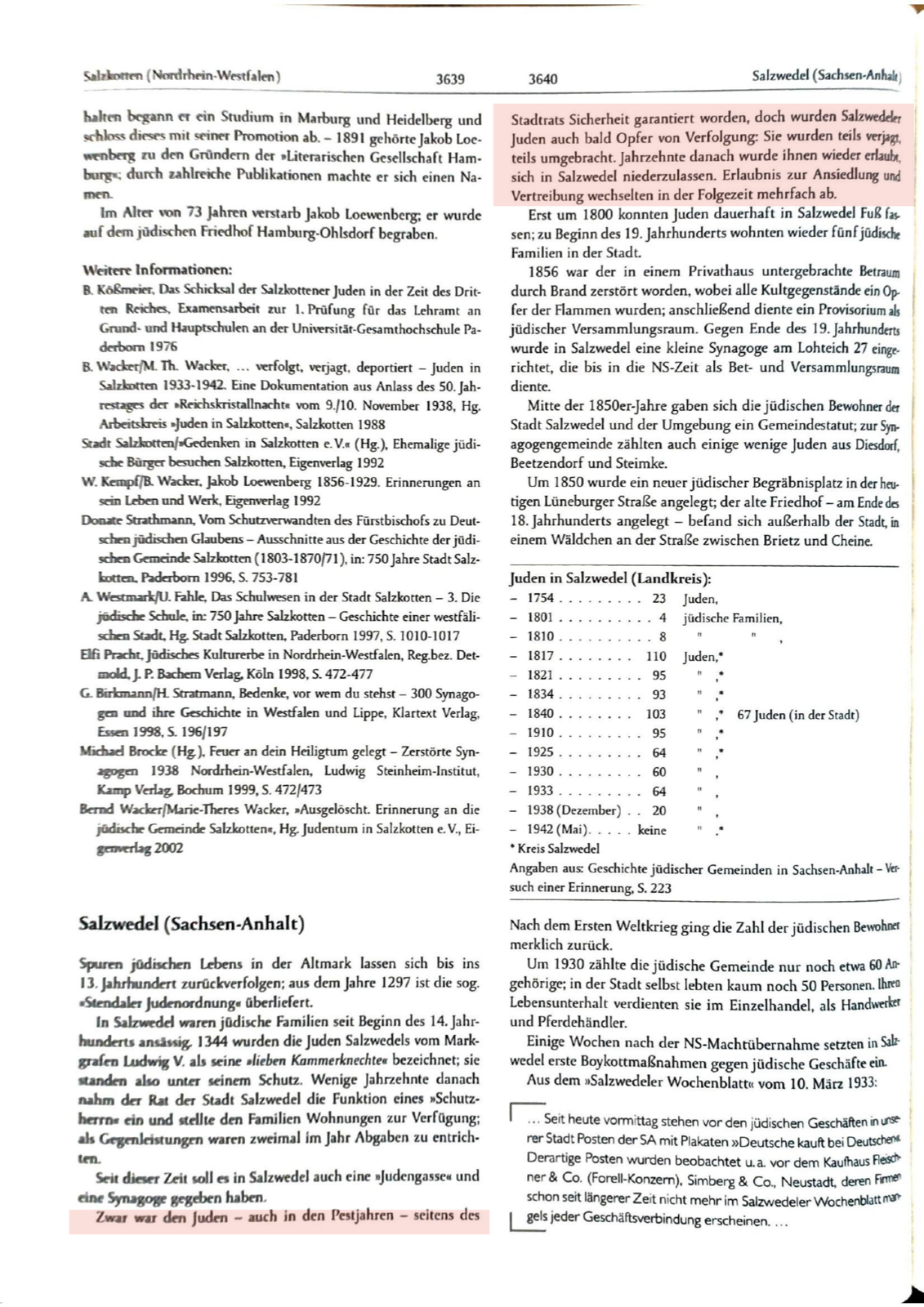
Salzwedel (91)
Error
Voigtländer and Voth failed to code a pogrom here during the Black Death, despite their rule to code as unity if Alicke mentions "killed" or "violent attacks".
Reality
Avneri notes that mentions of Jews cease between 1349 and 1407, assuming persecution.
Alicke corroborates this, stating that "Salzwedel Jews soon became victims of persecution: they were partly expelled, partly killed" („wurden Salzwedeler Juden auch bald Opfer von Verfolgung: Sie wurden teils verjagt, teils umgebracht").
The occurrence of a pogrom is confirmed by the primary sources.
Correction
POG1349 NA -> 1
Sources:
Avneri · Page 732
Alicke · Page 3639-3640
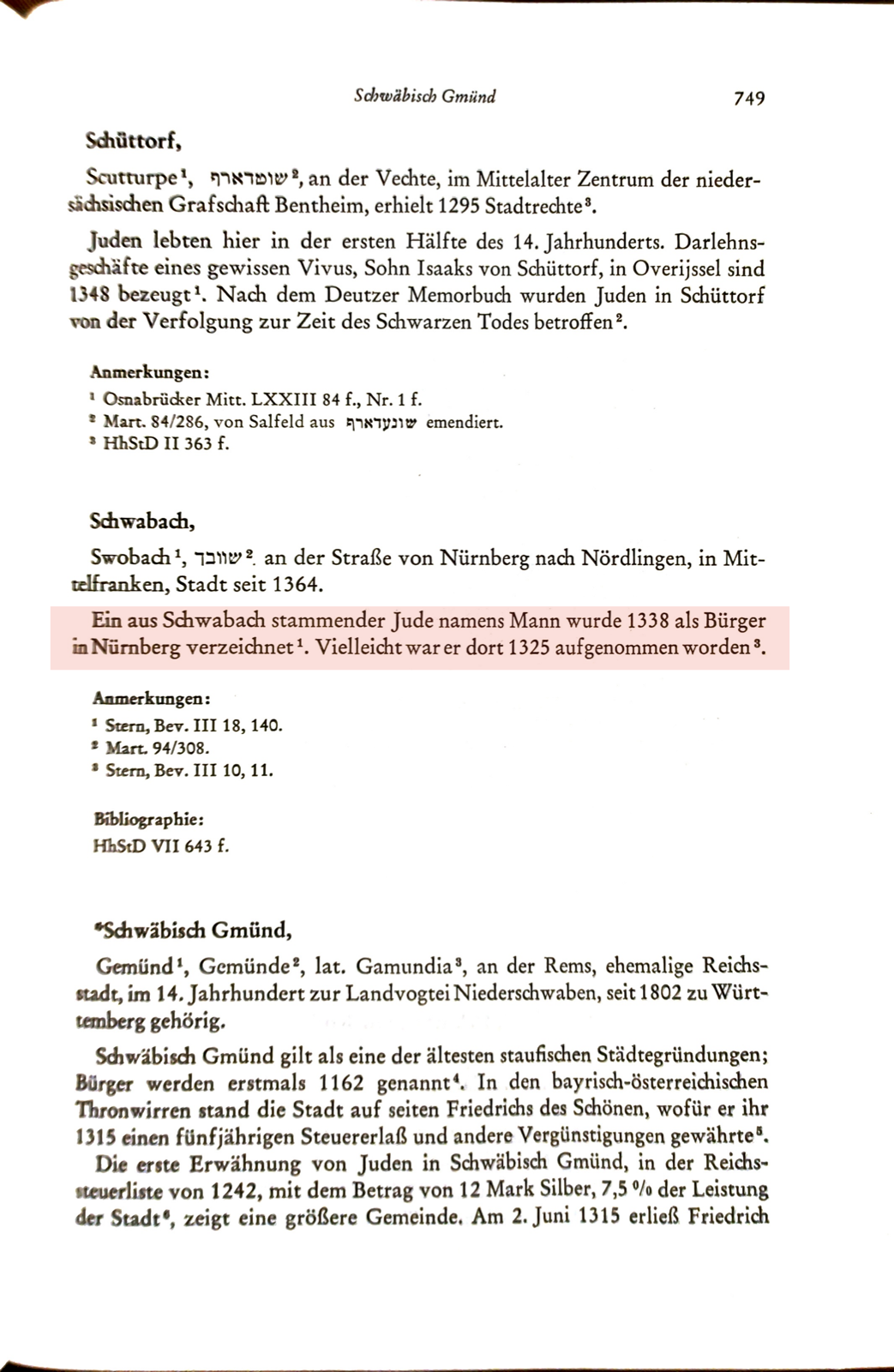
Schwabach (92)
Error
Voigtländer and Voth failed to code a 0 for a pogrom here during the Black Death, despite their rule that a lack of information should be coded as 0.
Reality
Avneri mentions a Jew from Schwabach in 1338 but provides no information regarding persecutions.
Alicke notes that "in 1384 a pogrom is said to have occurred here" (1384 soll es hier zu einem Pogrom gekommen sein), but makes no mention of persecution during the Black Death.
This should be coded as 0.
Correction
POG1349 NA -> 0
Sources:
Avneri · Page 749
Alicke · Page 3728
Sternberg (93 & 94)
Error
Voigtländer and Voth failed to code a "confirmed Jewish settlement" here during the Black Death, despite "unambiguous information" in their sources.
Reality
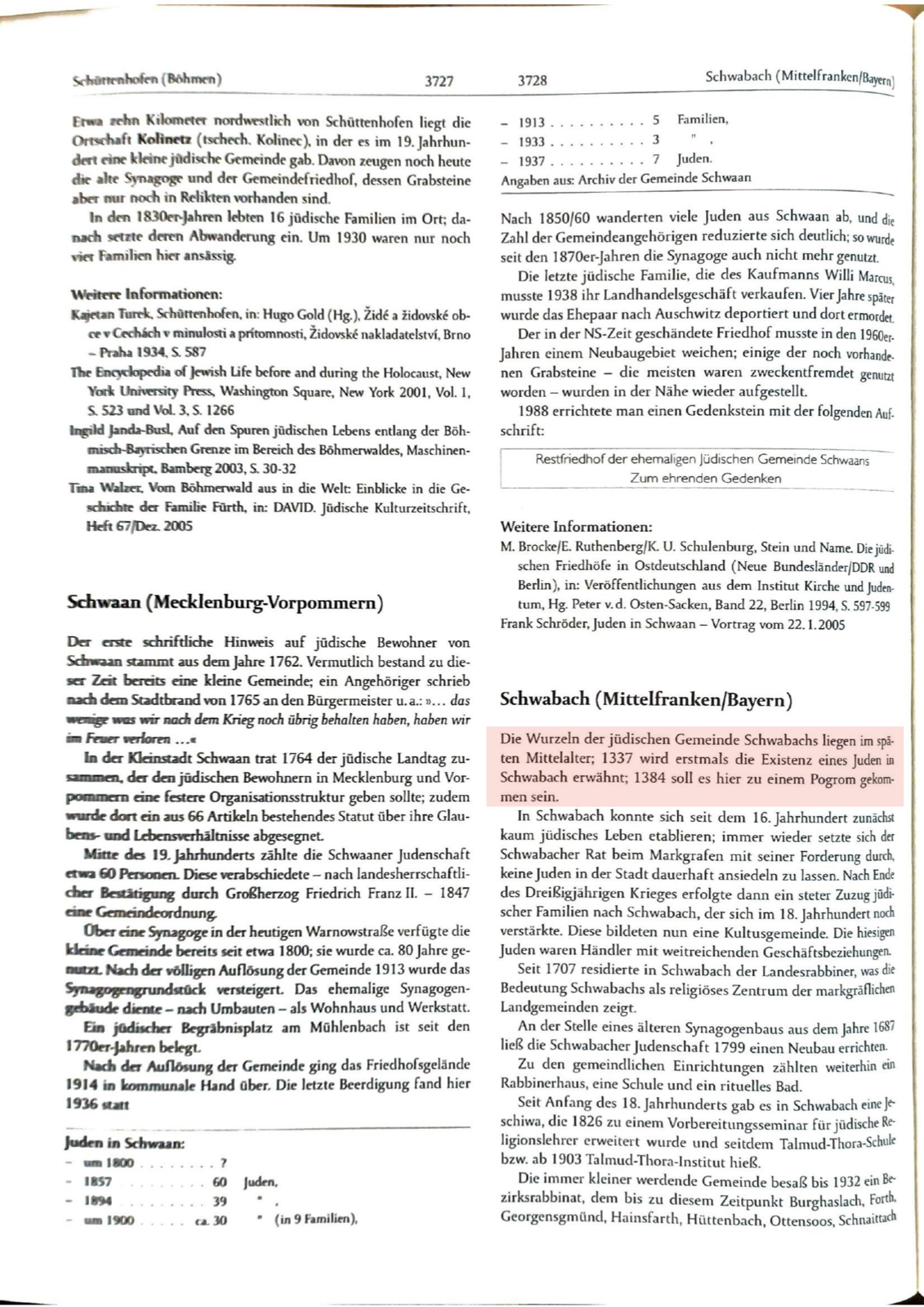
Alicke describes how "the persecution of Jews in Mecklenburg, which had already reached a first peak around 1325–1330, culminated again in 1492, when Jews were found guilty of 'host desecration' and subsequently burned at the stake outside the gates of the small town of Sternberg" („Die Verfolgung der Juden in Mecklenburg, die bereits um 1325/30 einen ersten Höhepunkt erreicht hatte, kulminierte nochmals 1492, als Juden des ‚Hostienfrevels' schuldig gesprochen und daraufhin vor den Toren des kleinen Städtchens Sternberg auf dem Scheiterhaufen verbrannt wurden").
The reference to Jewish persecution in Mecklenburg around 1325–1330, combined with the documented presence of a Jewish community in Sternberg by 1492, implies continuous settlement in the town spanning the Black Death period.
Correction
EXIST1349 0 -> 1; POG1349 NA -> 0
Source:
Alicke · Page 3947
Stettin (95)
Error
Voigtländer and Voth failed to code a pogrom here during the Black Death, despite their rule to code as unity if Alicke mentions "expulsion" or "violent attacks".
Reality
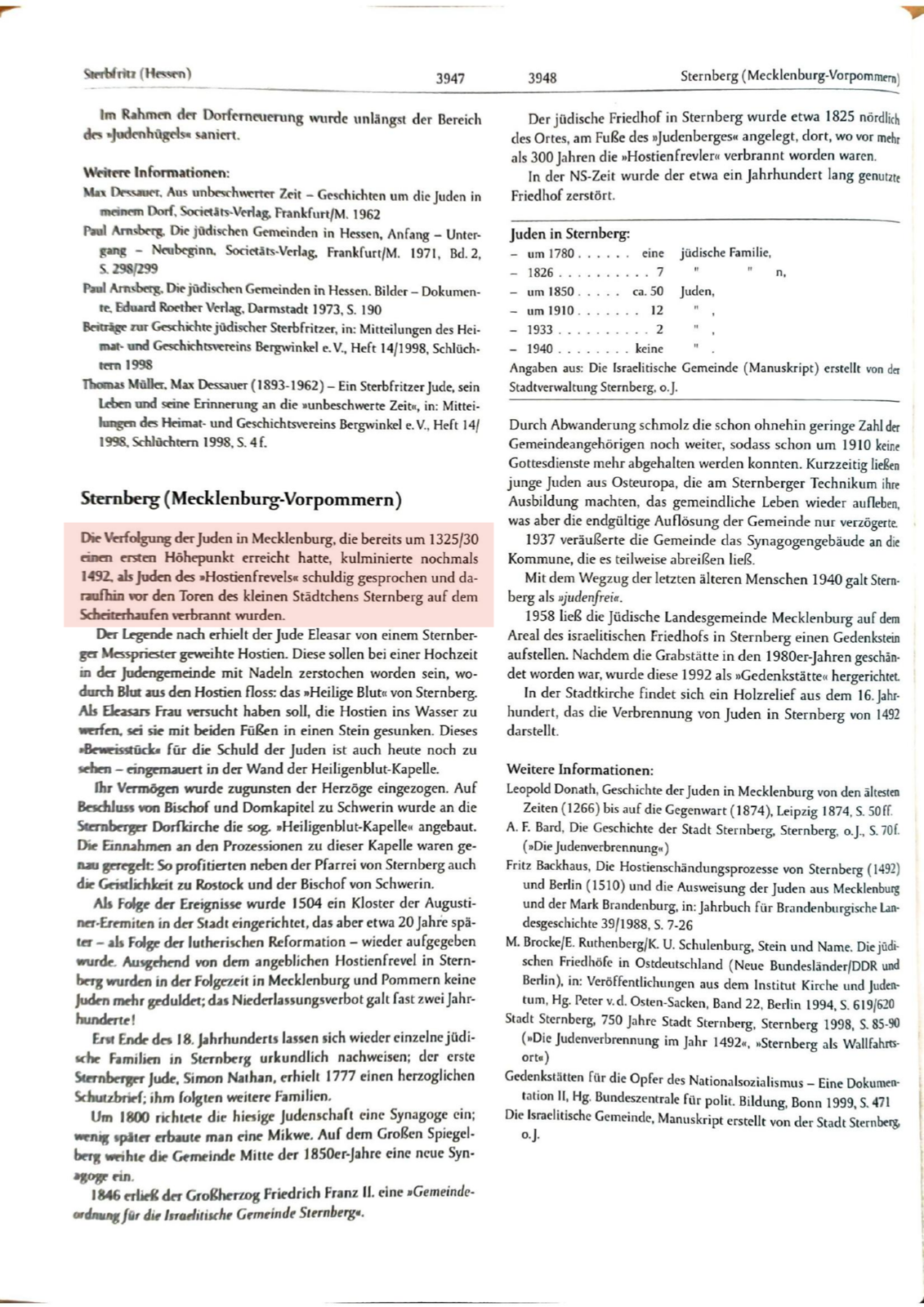
While Avneri states that "nothing is verifiable about persecutions at the time of the Black Death",
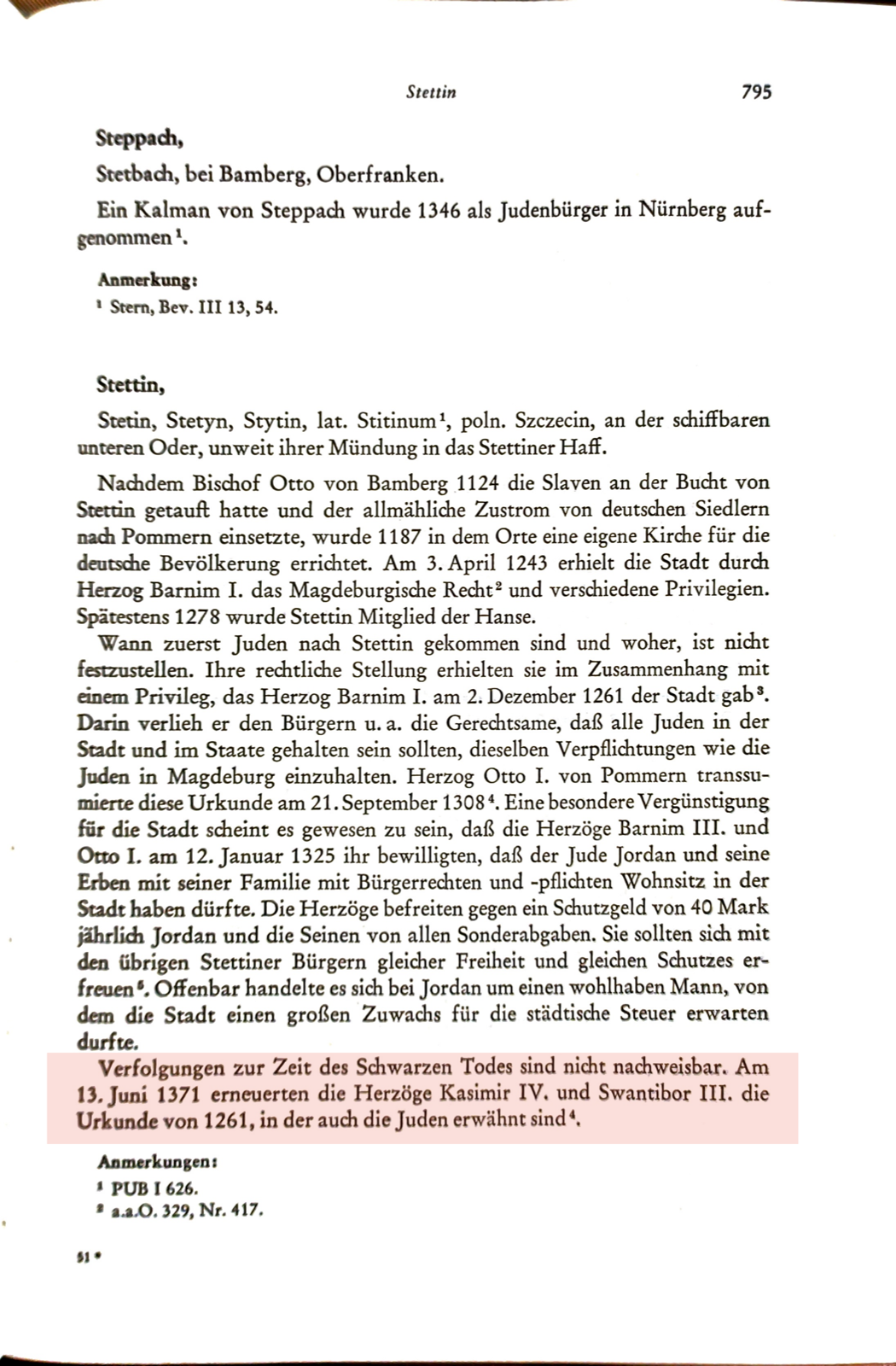
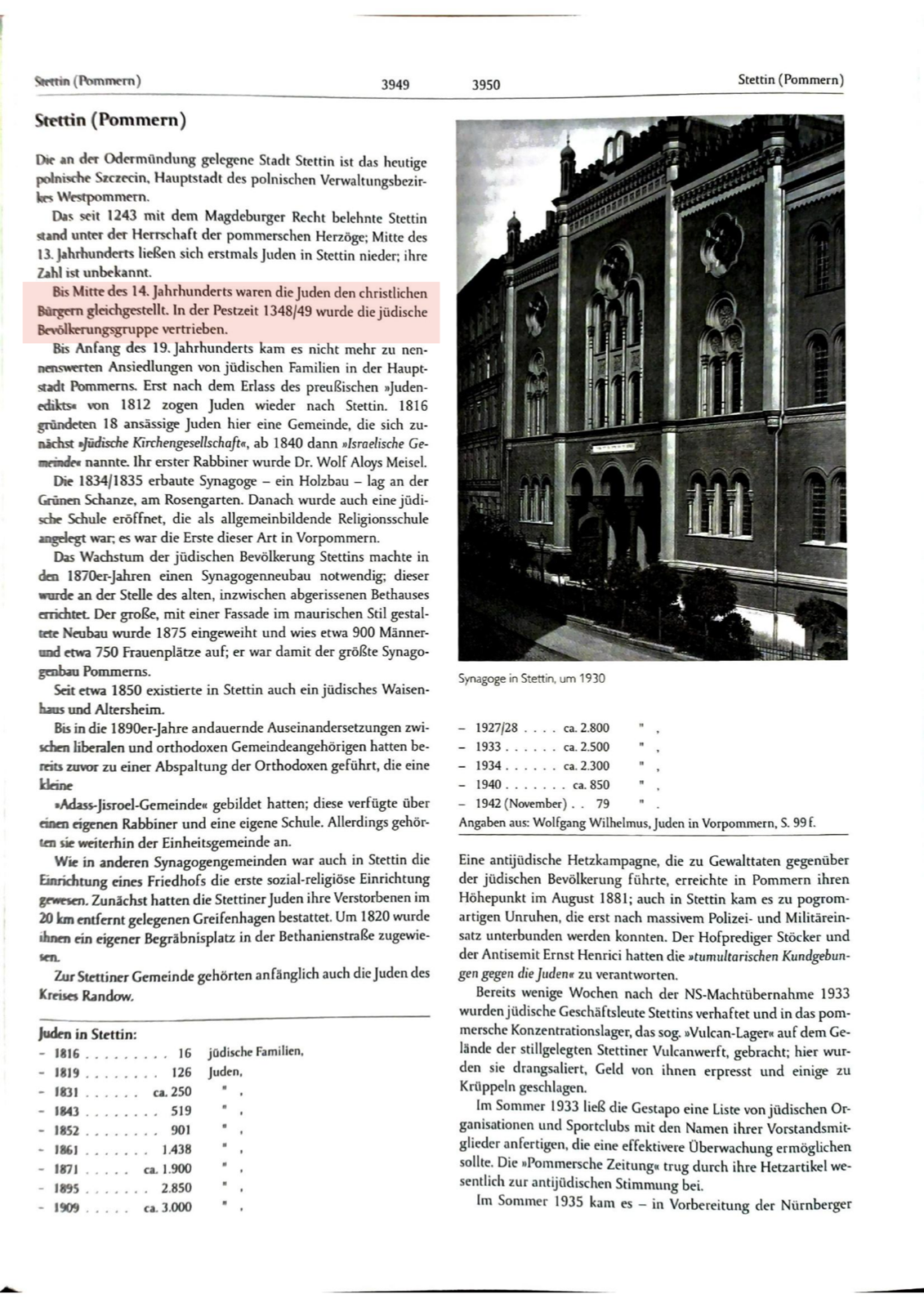
Alicke explicitly states that "[d]uring the plague period 1348-1349, the Jewish population was expelled" („In der Pestzeit 1348/49 wurde die jüdische Bevölkerungsgruppe vertrieben").
The occurrence of a pogrom is confirmed by the primary source.
Correction
POG1349 NA -> 1
Sources:
Avneri · Page 795
Alicke · Page 3949
Stralsund (96)
Error
Voigtländer and Voth failed to code a pogrom here during the Black Death, despite their rule to code as unity if GJ mentions "extermination" or "violent attacks".
Reality
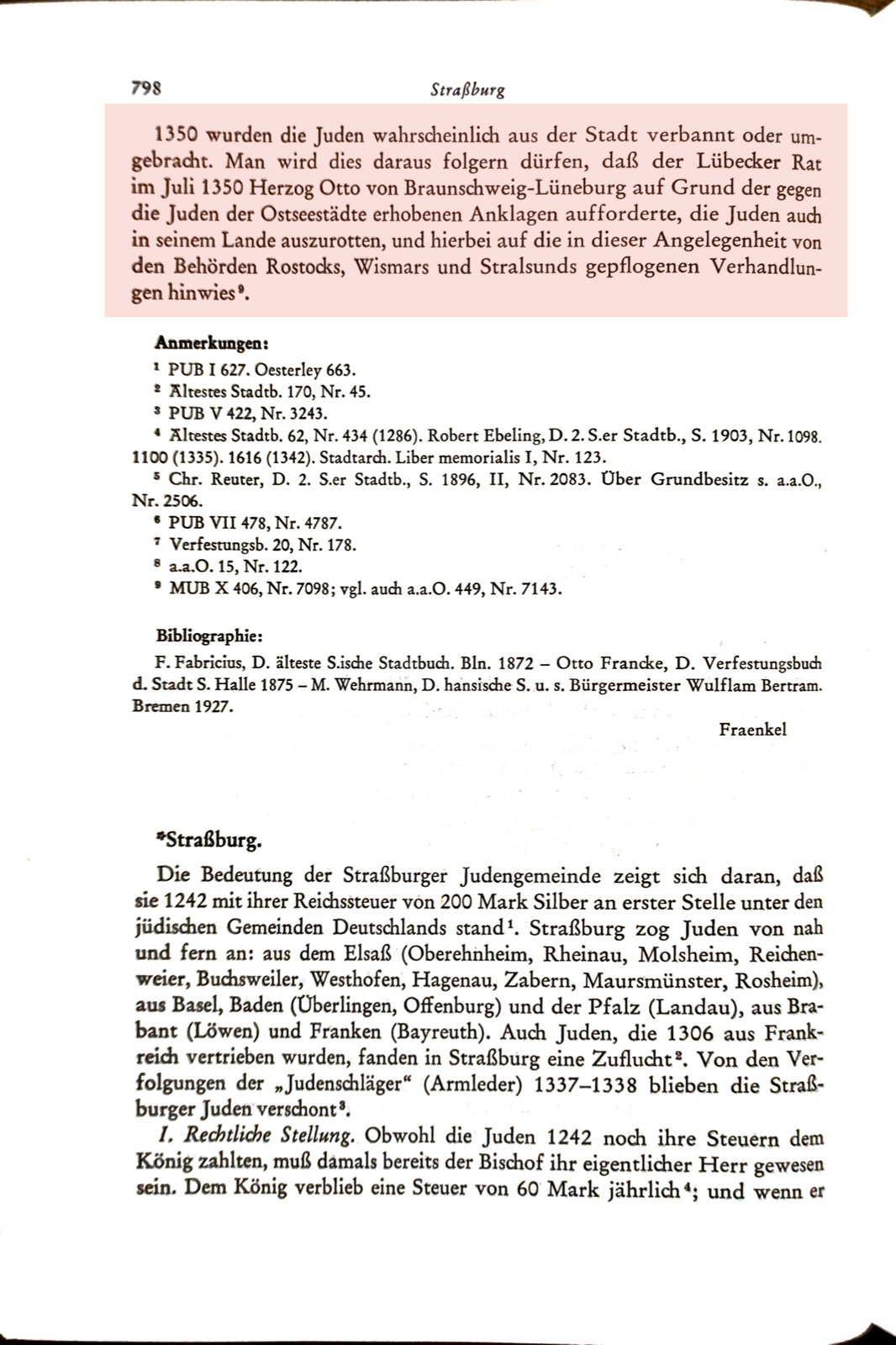
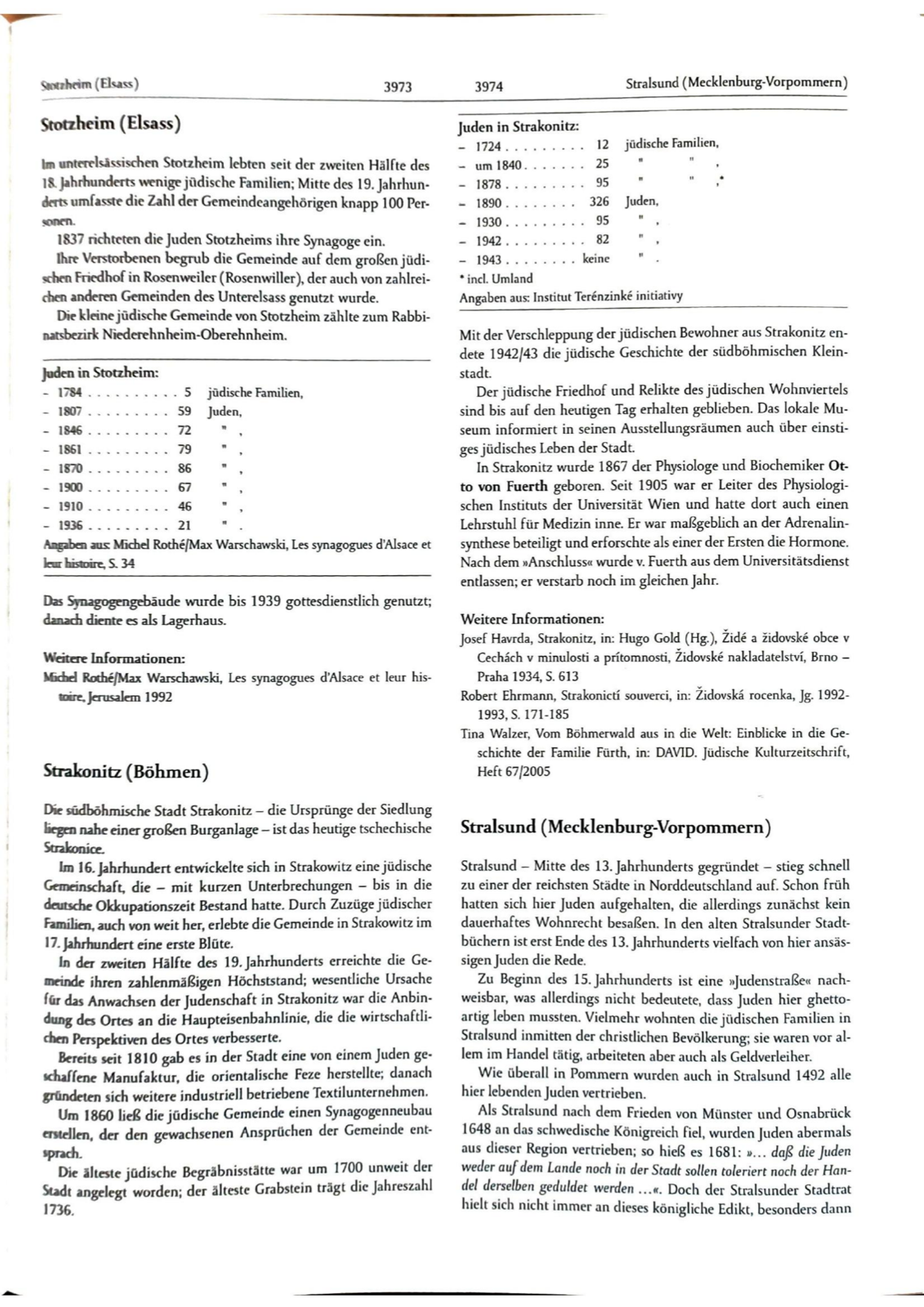
Avneri states that in 1350, "the Jews were probably expelled from the city or killed" (1350 wurden die Juden wahrscheinlich aus der Stadt verbannt oder umgebracht) and references the Lübeck council's call "to also exterminate the Jews" following negotiations with Stralsund authorities.
The occurrence of a pogrom is confirmed by the primary source.
Correction
POG1349 NA -> 1
Sources:
Avneri · Page 798
Alicke · Page 3974
Trebnitz (97)
Error
Voigtländer and Voth failed to code a 0 for a pogrom here during the Black Death, despite their rule that a lack of information should be coded as 0.
Reality
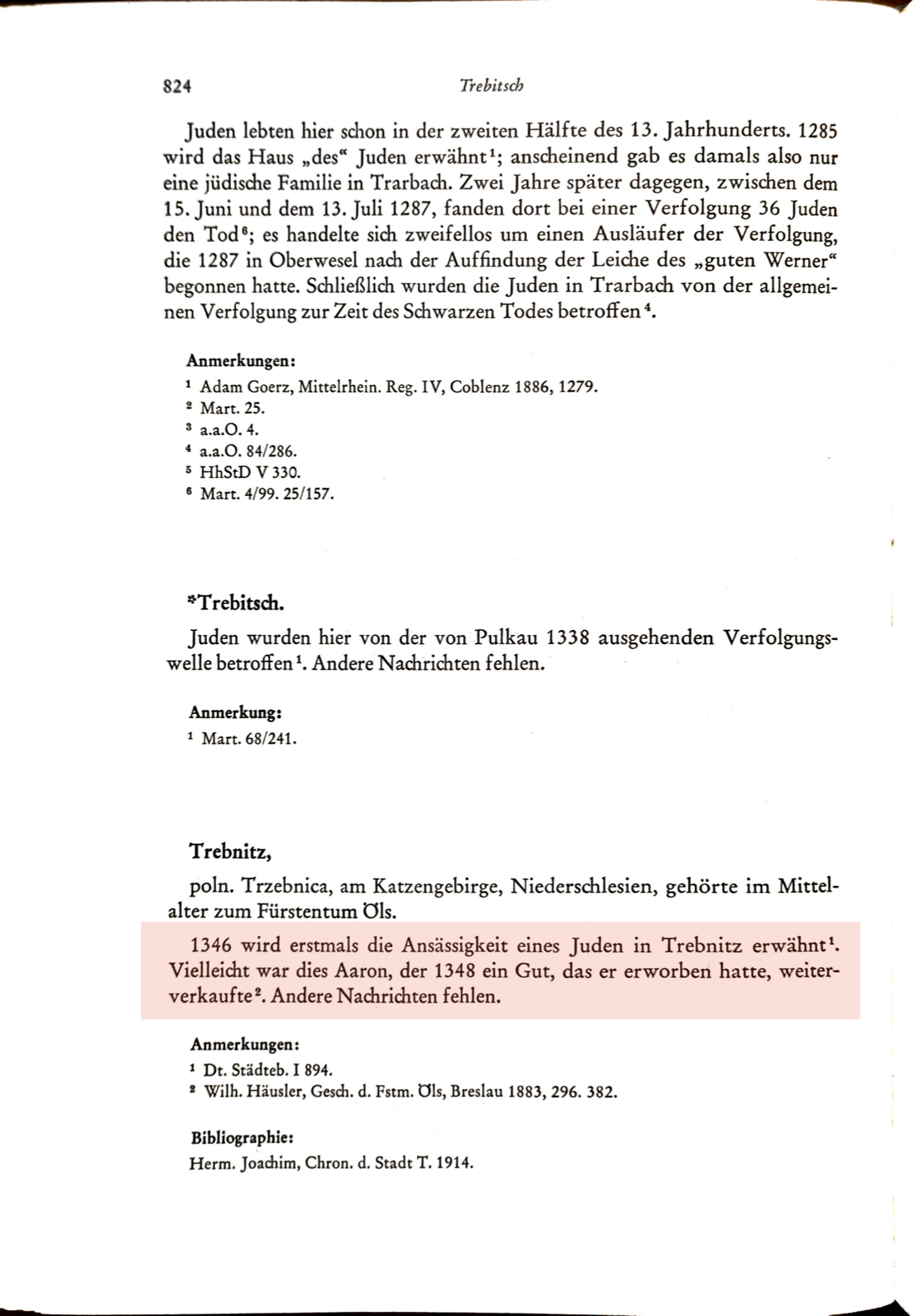
Avneri confirms Jewish presence before 1349 but notes that "other reports are missing" („Andere Nachrichten fehlen").
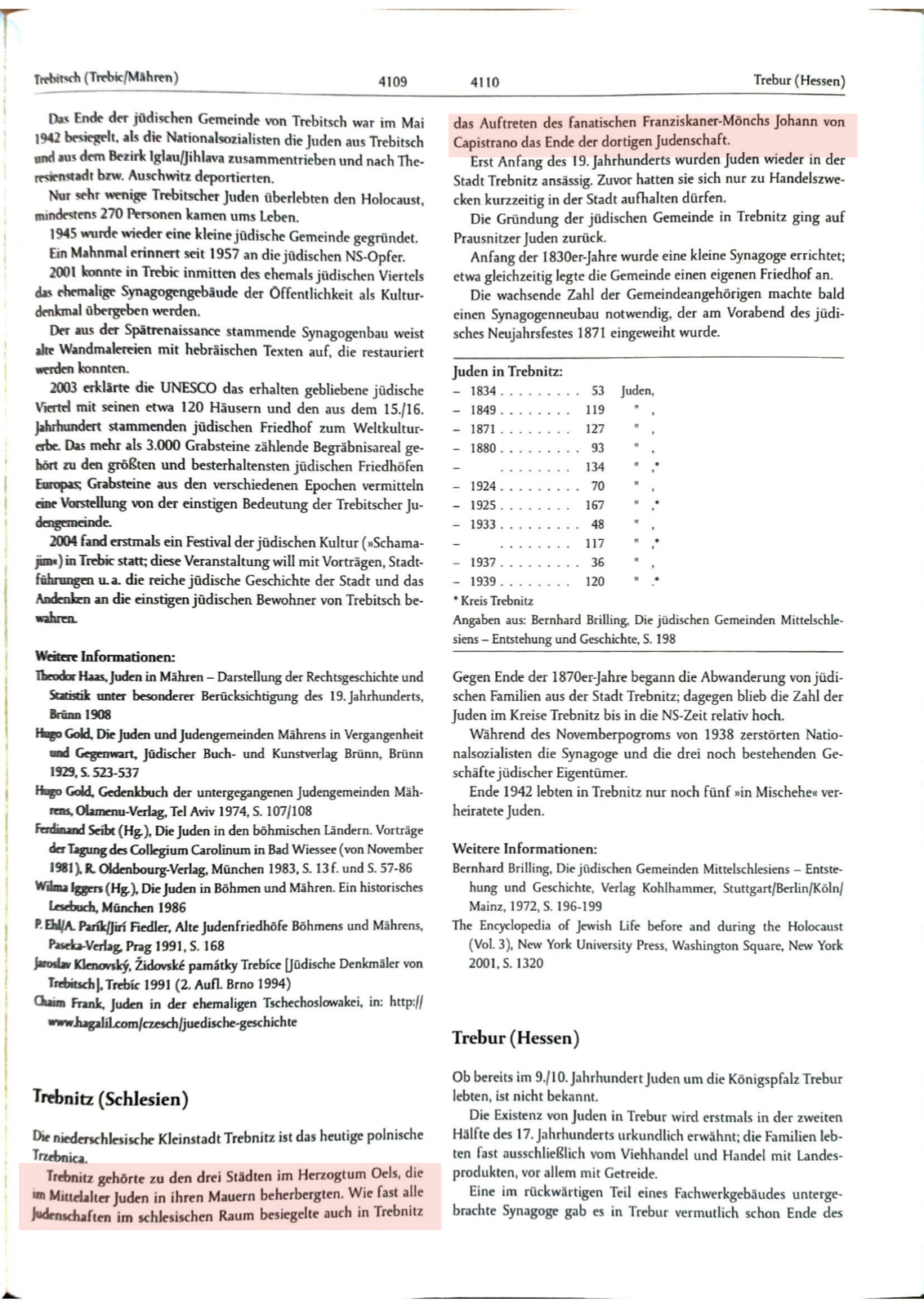
Alicke similarly states that Trebnitz housed Jews in the Middle Ages until 1453. There is no record of persecution during the Black Death.
This should be coded as 0.
Correction
POG1349 NA -> 0
Sources:
Avneri · Page 824
Alicke · Page 4109-4110
Tübingen (98)
Error
Voigtländer and Voth failed to code a pogrom here during the Black Death, despite their rule to code as unity if Alicke mentions "expulsion" or "violent attacks".
Reality
While Avneri notes no mention of persecutions,
Alicke states that during the plague years, Jews "were probably expelled from the city" („in den Pestjahren wurden sie vermutlich aus der Stadt vertrieben").
The occurrence of a pogrom is confirmed by the primary source.
Correction
POG1349 0 -> 1
Sources:
Avneri · Page 835
Alicke · Page 4141
Ulrichstein-Vogelsberg (99)
Error
Voigtländer and Voth failed to code a 0 for a pogrom here during the Black Death, despite their rule that a lack of information should be coded as 0.
Reality
Avneri is unsure if Jews settled there, but Alicke believes that "presumably a few Jewish families already lived in the small town of Ulrichstein in the fourteenth century" („Vermutlich haben bereits im 14. Jahrhundert wenige jüdische Familien im kleinen Orte Ulrichstein gelebt"). Neither mentions any persecution during the Black Death.
This should be coded as 0.
Correction
POG1349 NA -> 0
Sources:
Avneri · Page 846
Alicke · Page 4173
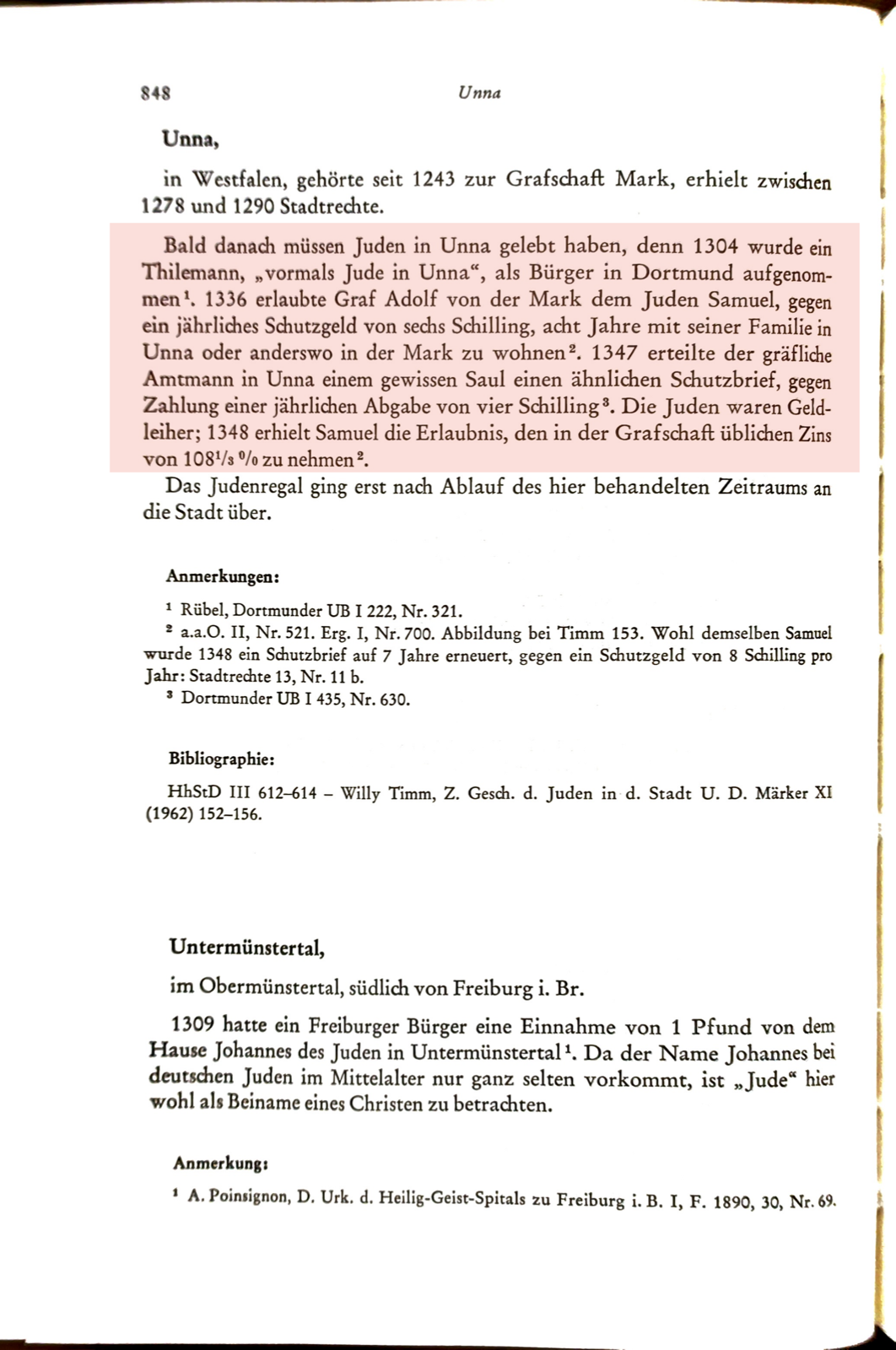
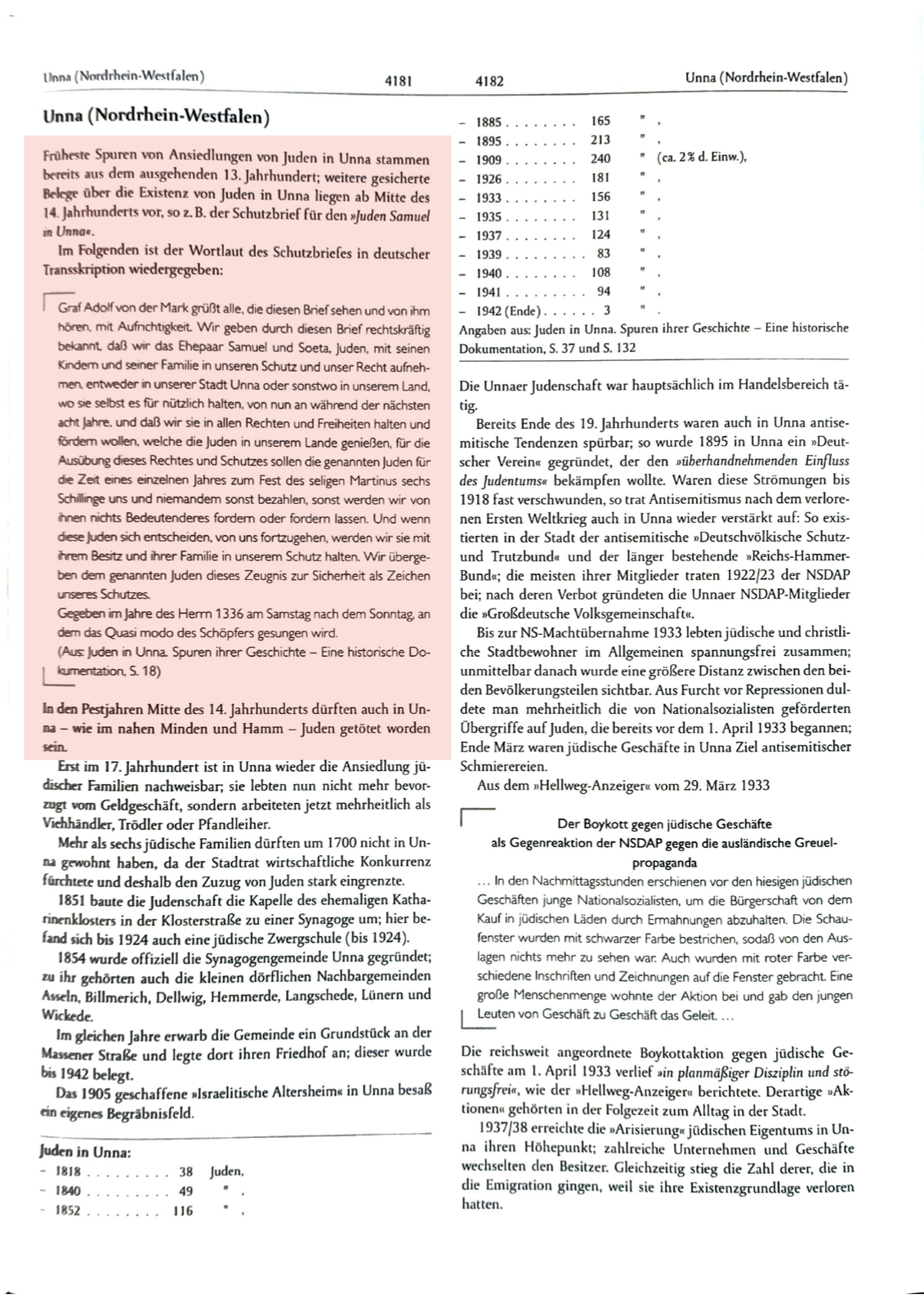
Unna (100)
Error
Voigtländer and Voth failed to code a pogrom here during the Black Death, despite their rule to code as unity if Alicke mentions "killed" or "violent attacks".
Reality
Avneri and Alicke both confirm Jewish settlement during the Black Death period. Regarding the Black Death, Alicke explicitly states that "in the plague years of the mid-fourteenth century, Jews are also likely to have been killed in Unna" („In den Pestjahren [...] dürften auch in Unna [...] Juden getötet worden sein").
The occurrence of a pogrom is confirmed by the primary source.
Correction
POG1349 NA -> 1
Sources:
Avneri · Page 848
Alicke · Page 4181
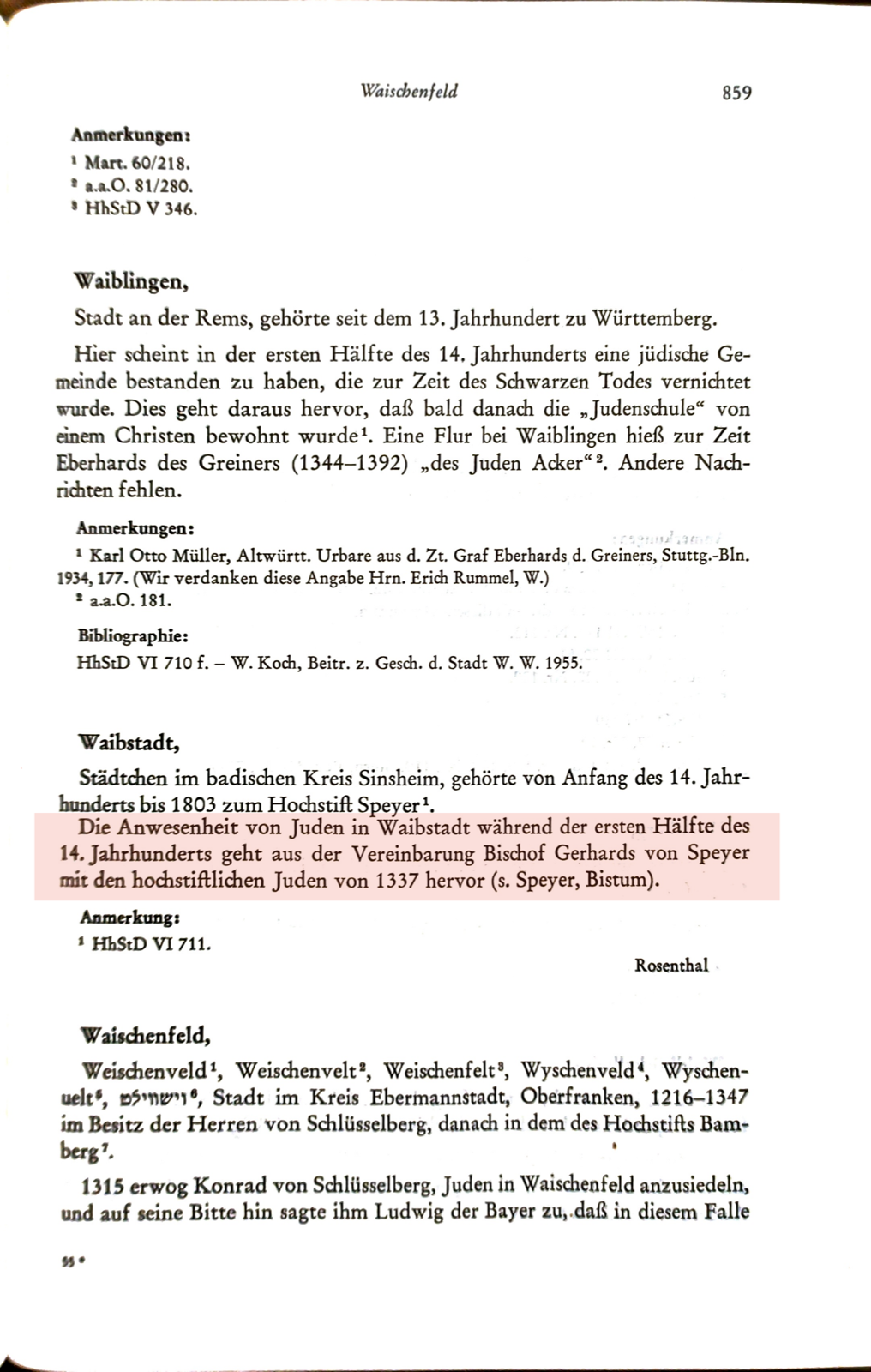
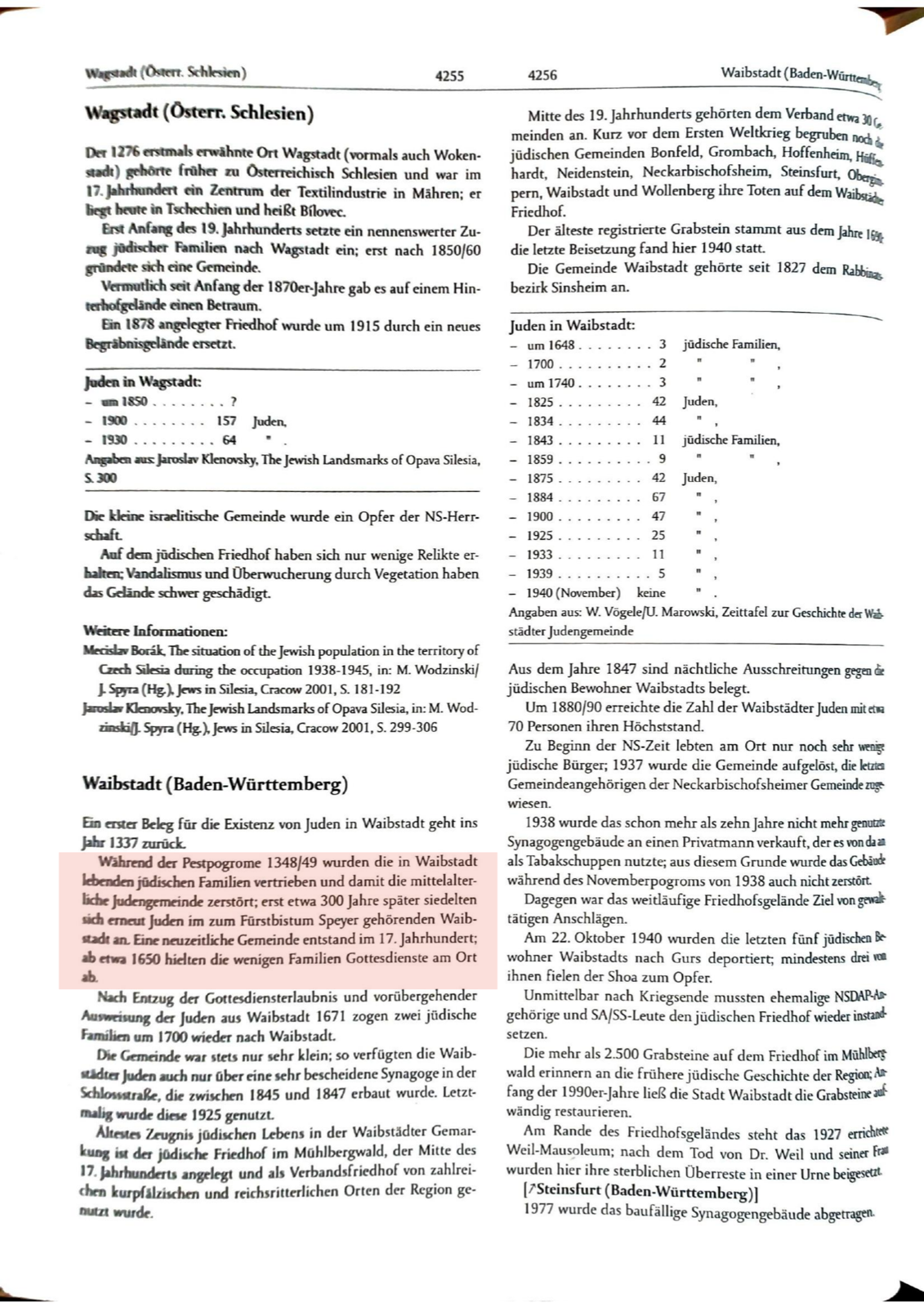
Waibstadt (101)
Error
Voigtländer and Voth failed to code a pogrom here during the Black Death, despite their rule to code as unity if Alicke mentions "expulsion" or "violent attacks".
Reality
Avneri provides no information, but Alicke states that "the Jewish families living in Waibstadt were expelled and thus the medieval Jewish community was destroyed" („Während der Pestpogrome 1348/49 wurden die in Waibstadt lebenden jüdischen Familien vertrieben und damit die mittelalterliche Judengemeinde zerstört").
The occurrence of a pogrom is confirmed by the primary source.
Correction
POG1349 0 -> 1
Sources:
Avneri · Page 859
Alicke · Page 4255
Warendorf (102 & 103)
Error
Voigtländer and Voth failed to code a "confirmed Jewish settlement" here during the Black Death, despite "unambiguous information" in their sources.
Reality
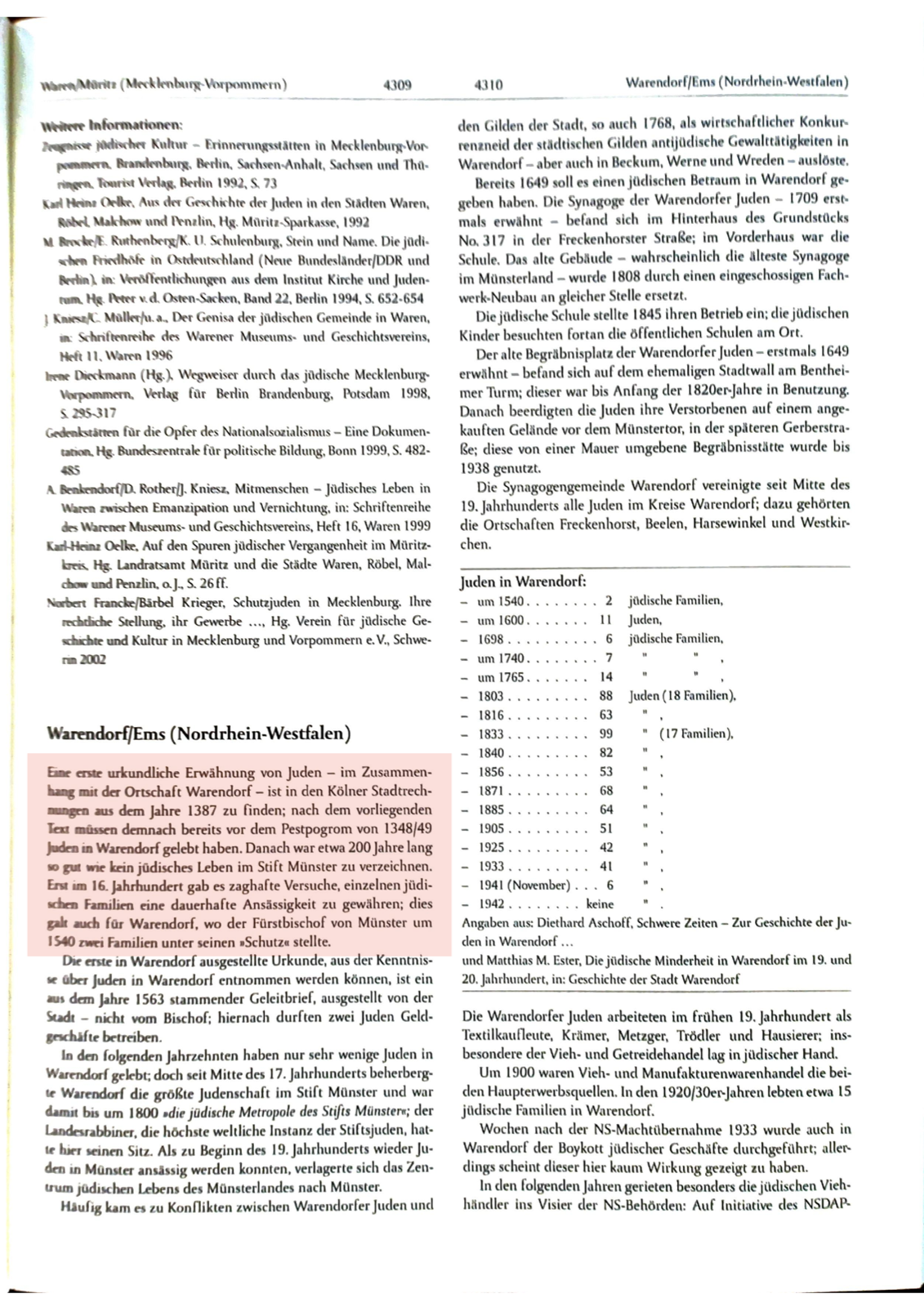
Alicke explicitly states that "Jews must have lived in Warendorf even before the plague pogrom of 1348-1349" („nach dem vorliegenden Text müssen demnach bereits vor dem Pestpogrom von 1348/49 Juden in Warendorf gelebt haben").
There is unambiguous evidence that there was a Jewish community in the town during the Black Death.
Correction
EXIST1349 0 -> 1; POG1349 NA -> 1
Source:
Alicke · Page 4309
Wetter (104 & 105)
Error
Voigtländer and Voth failed to code a "confirmed Jewish settlement" here during the Black Death, despite "unambiguous information" in their sources.
Reality
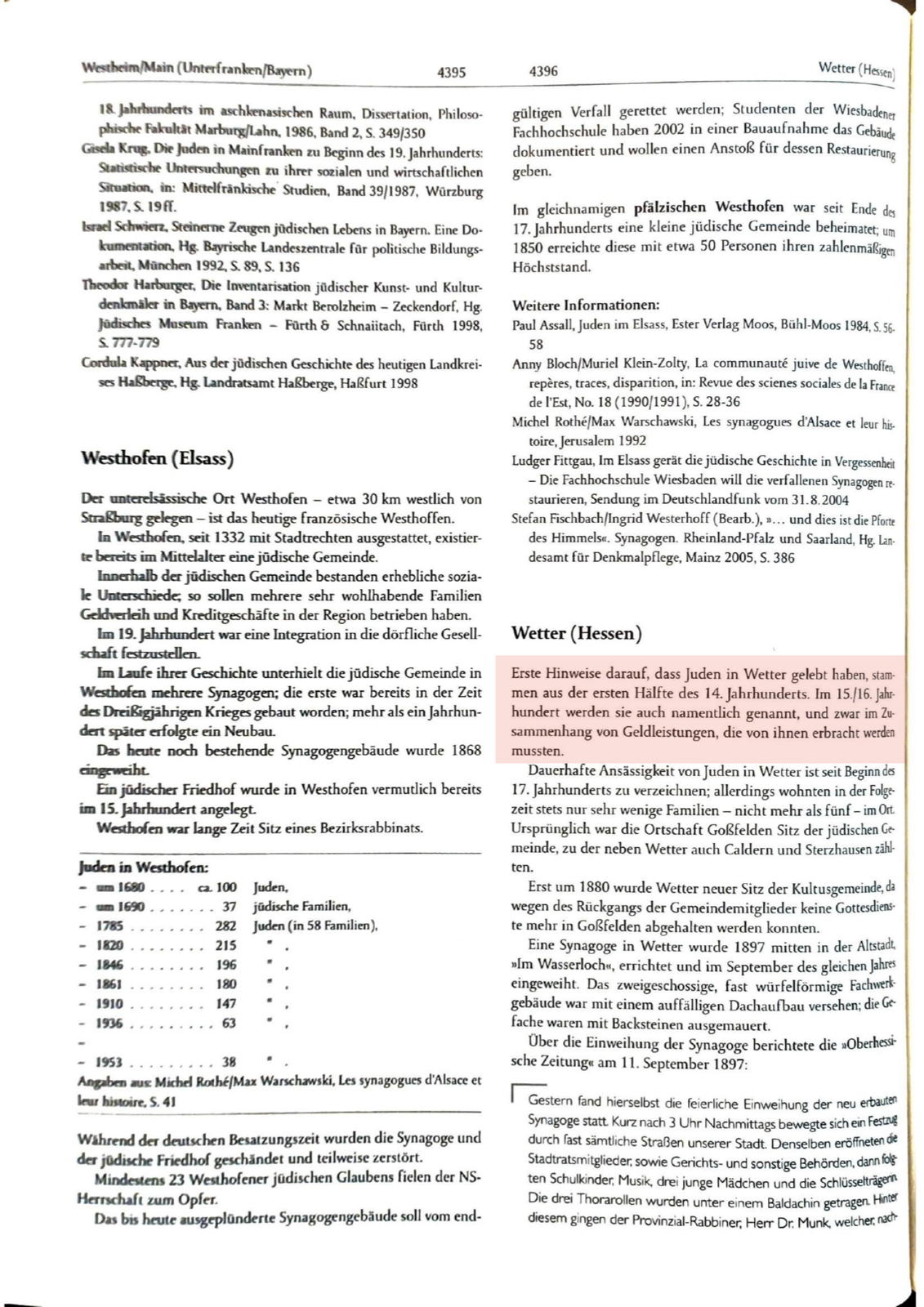
Alicke states that "first indications that Jews lived in Wetter date from the first half of the fourteenth century" („Erste Hinweise darauf, dass Juden in Wetter gelebt haben, stammen aus der ersten Hälfte des 14. Jahrhunderts").
There is unambiguous evidence that there was a Jewish community in the town during the Black Death.
Correction
EXIST1349 0 -> 1; POG1349 NA -> 0
Source:
Alicke · Page 4396
Wiesbaden (106)
Error
Voigtländer and Voth failed to code a 0 for a pogrom here during the Black Death, despite their rule that a lack of information should be coded as 0.
Reality
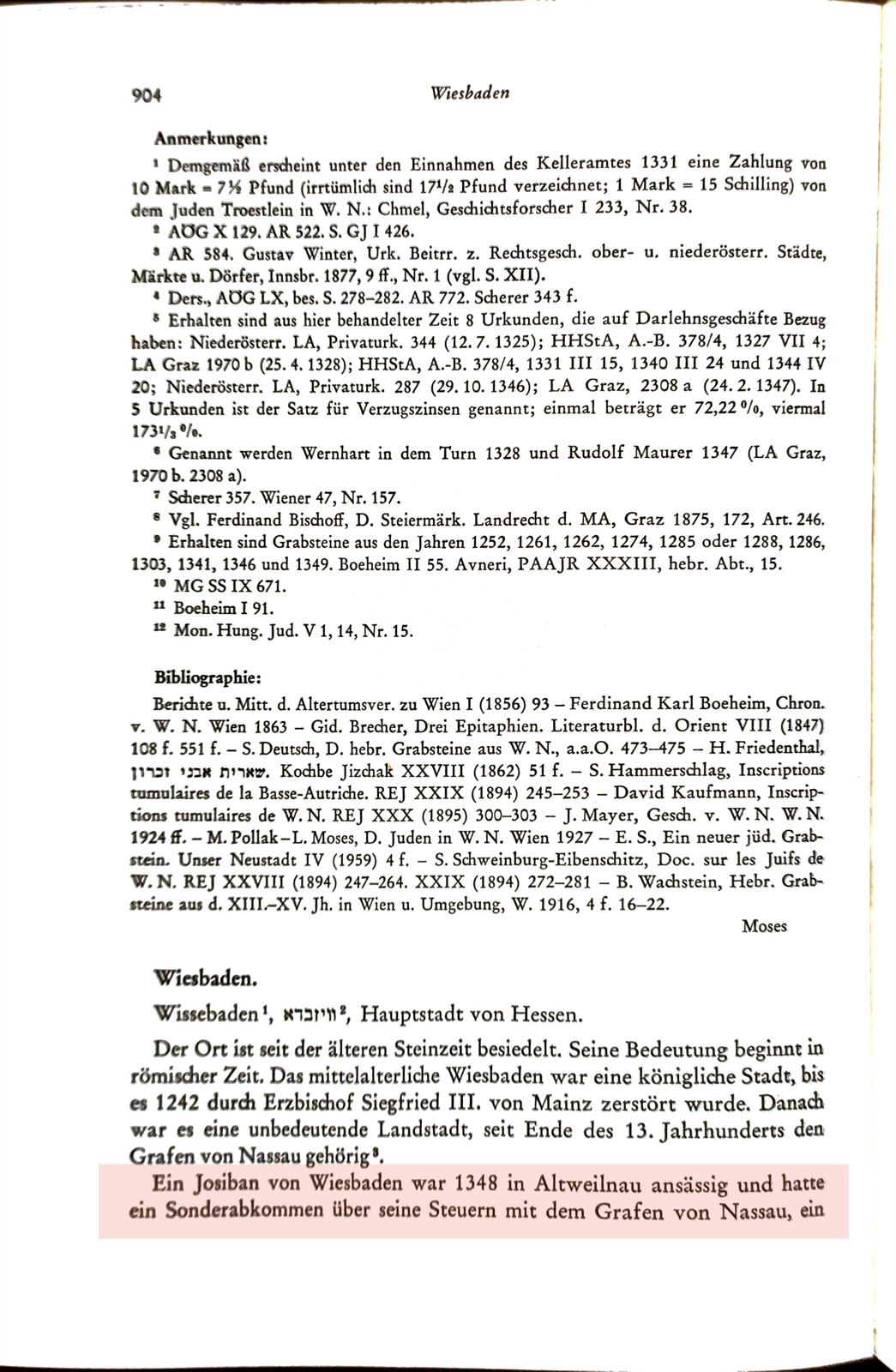
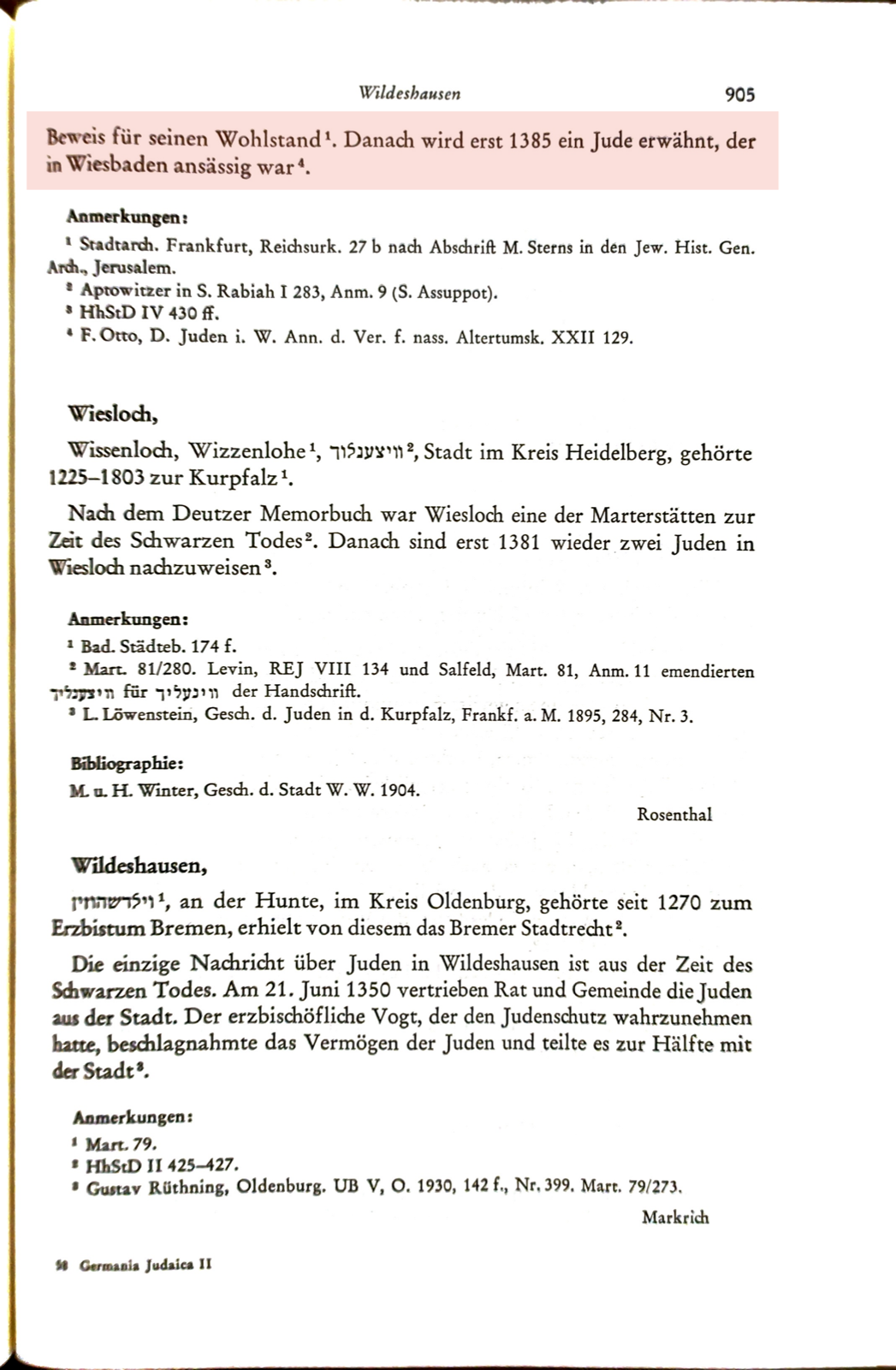
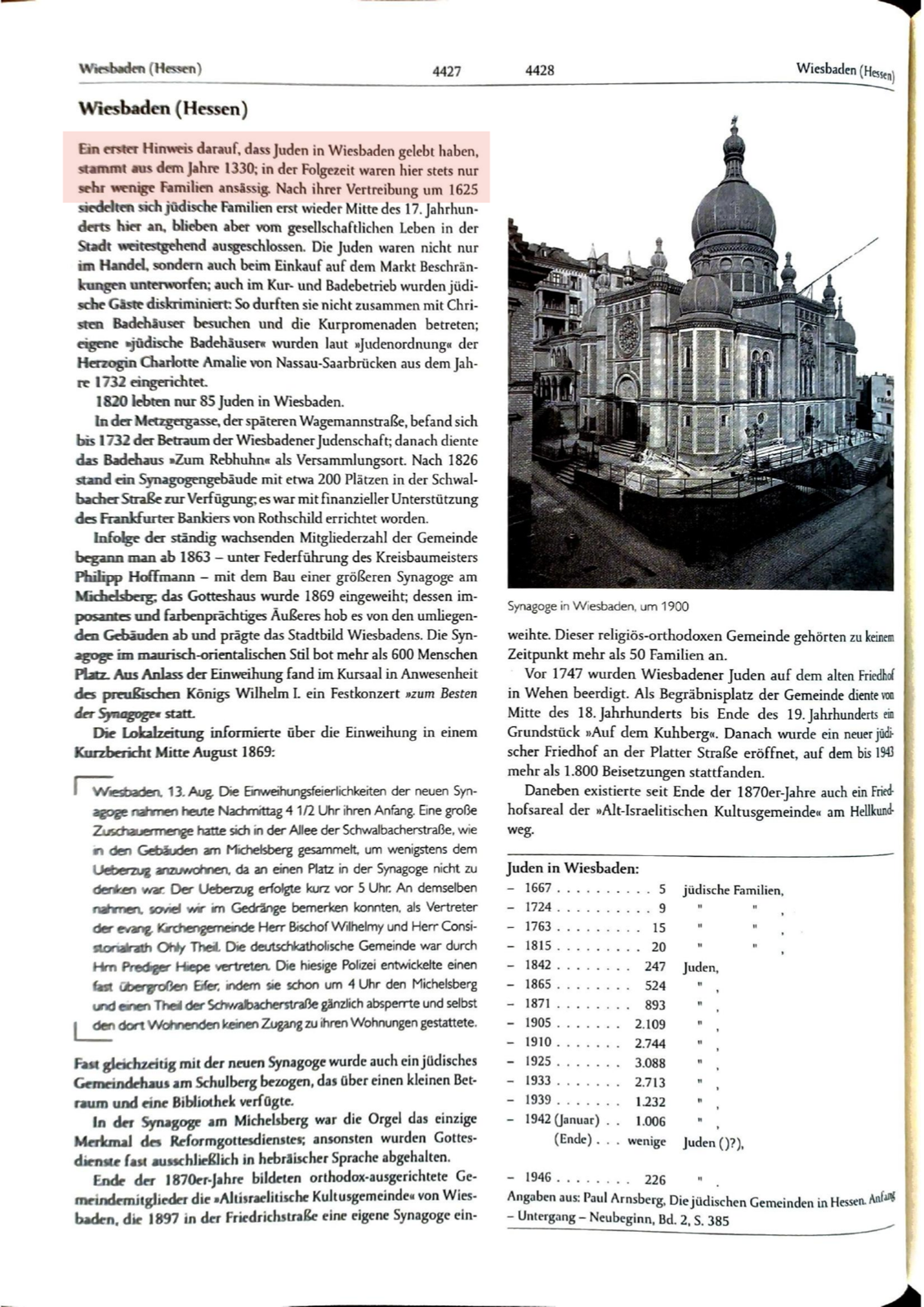
Avneri mentions a Jew from Wiesbaden in 1348, and Alicke notes indications of Jews from 1330. Neither source reports any persecution during the Black Death.
This should be coded as 0.
Correction
POG1349 NA -> 0
Sources:
Avneri · Page 904
Avneri · Page 905
Alicke · Page 4427
Wildeshausen (107 & 108)
Error
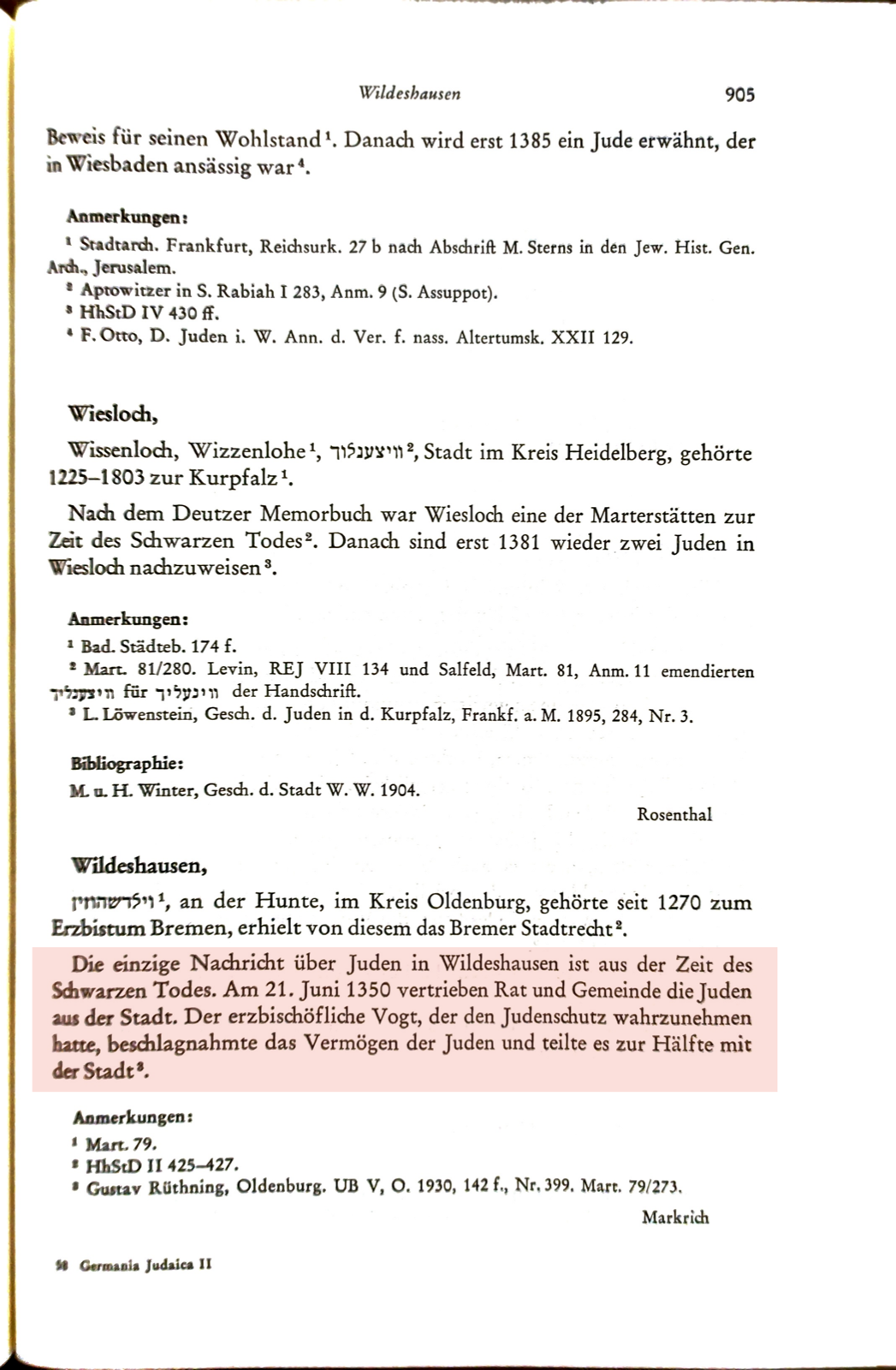
Voigtländer and Voth failed to code a "confirmed Jewish settlement" here during the Black Death, despite "unambiguous information" in their sources.
Reality
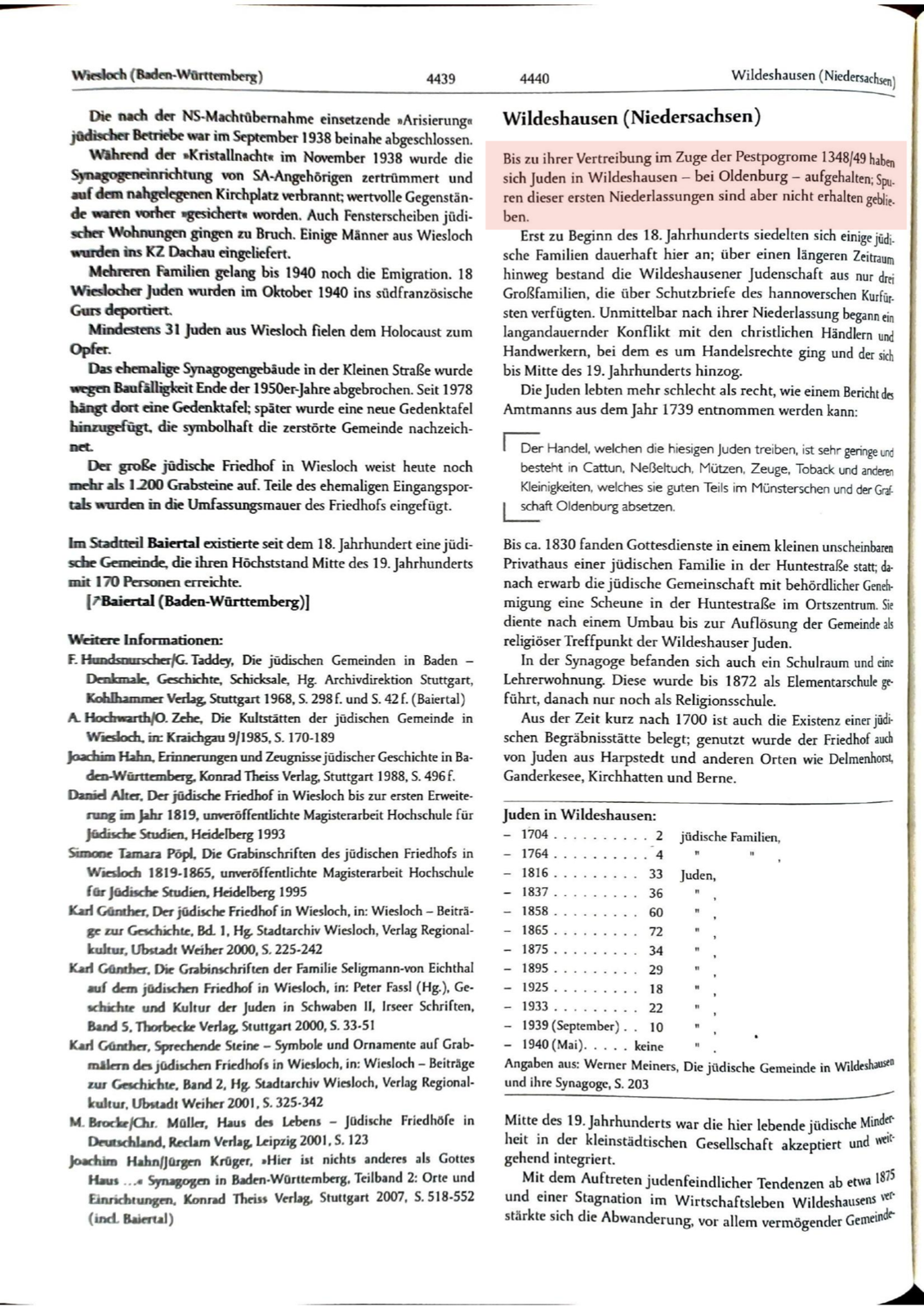
Avneri states that "on June 21, 1350, the council and community expelled the Jews from the city".
Alicke similarly notes that "Jews resided in Wildeshausen [...] until their expulsion in the course of the plague pogroms" („Bis zu ihrer Vertreibung im Zuge der Pestpogrome 1348/49 haben sich Juden in Wildeshausen [...] aufgehalten").
There is unambiguous evidence that there was a Jewish community in the town during the Black Death.
Correction
EXIST1349 0 -> 1; POG1349 0 -> 1
Sources:
Avneri · Page 905
Alicke · Page 4440
Wittenberg-Elbe (109)
Error
Voigtländer and Voth failed to code a 0 for a pogrom here during the Black Death, despite their rule that a lack of information should be coded as 0.
Reality
Avneri mentions expulsions in 1304, and Alicke mentions expulsions at the beginning of the 14th century and in 1440. There is no mention of persecution during the Black Death.
This should be coded as 0.
Correction
POG1349 NA -> 0
Sources:
Avneri · Page 915
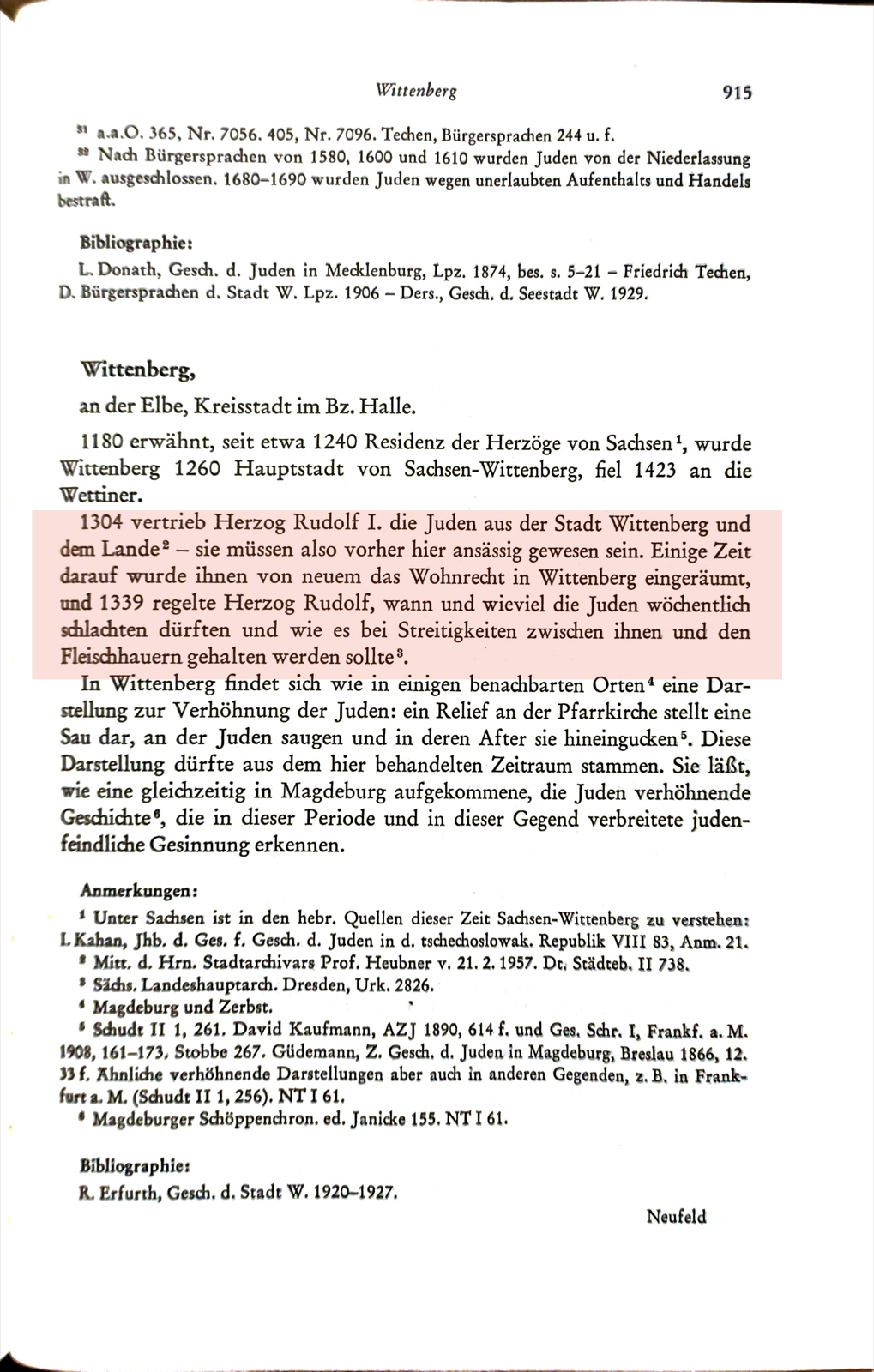
Alicke · Page 4472
Wunstorf (110)
Error
Voigtländer and Voth failed to code a 0 for a pogrom here during the Black Death, despite their rule that a lack of information should be coded as 0.
Reality
Avneri and Alicke both confirm Jewish settlement from the beginning of the fourteenth century, but neither source reports any persecution during the Black Death.
This should be coded as 0.
Correction
POG1349 NA -> 0
Sources:
Avneri · Page 927
Alicke · Page 4525
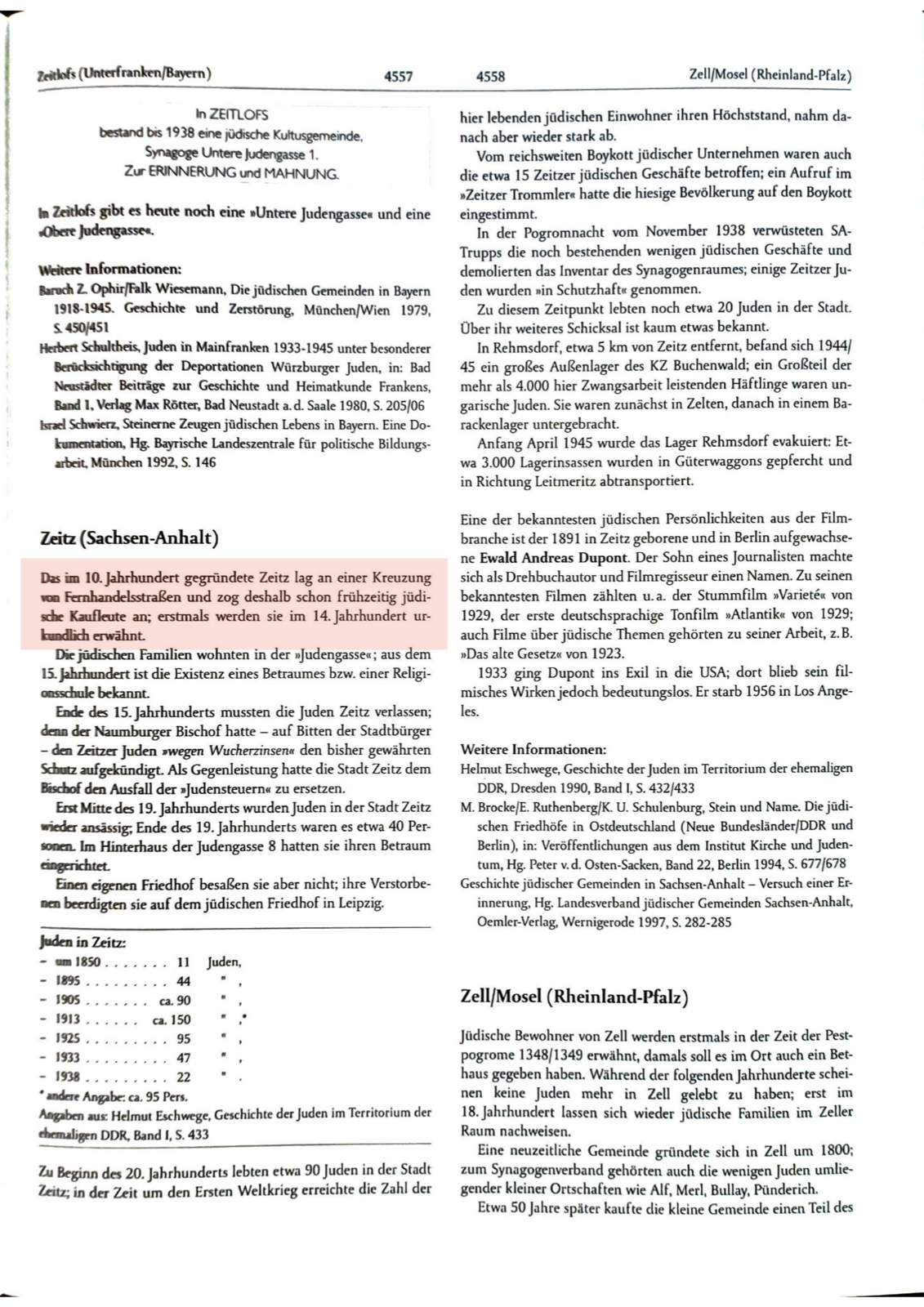
Zeitz (111)
Error
Voigtländer and Voth failed to code a 0 for a pogrom here during the Black Death, despite their rule that a lack of information should be coded as 0.
Reality
Avneri and Alicke both confirm that Jews lived in Zeitz in the 14th century, noting taxes levied in 1329 and 1350. Neither source reports any persecution during the Black Death.
This should be coded as 0.
Correction
POG1349 NA -> 0
Sources:
Avneri · Page 938
Alicke · Page 4557
Zülpich (112)
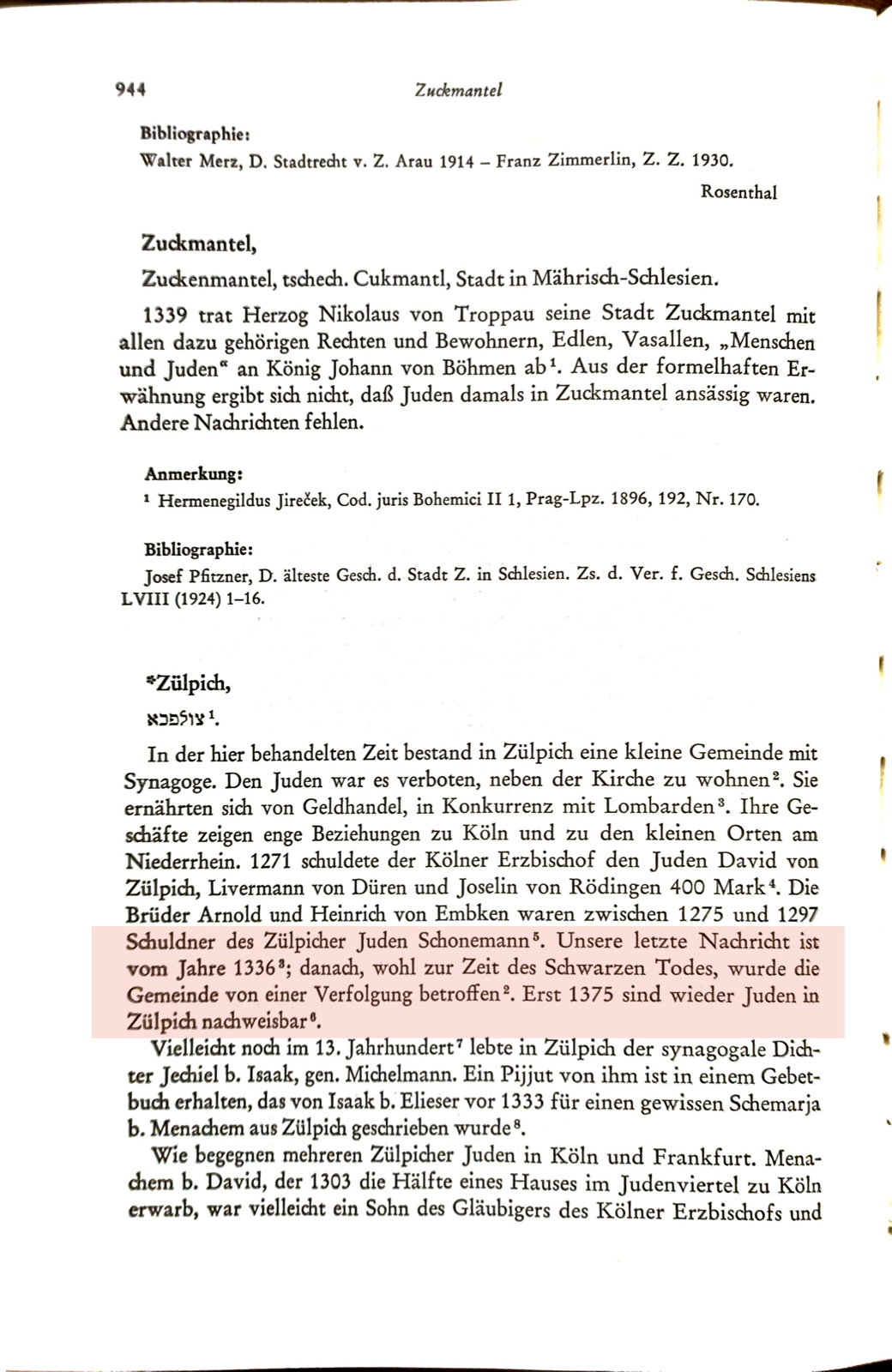
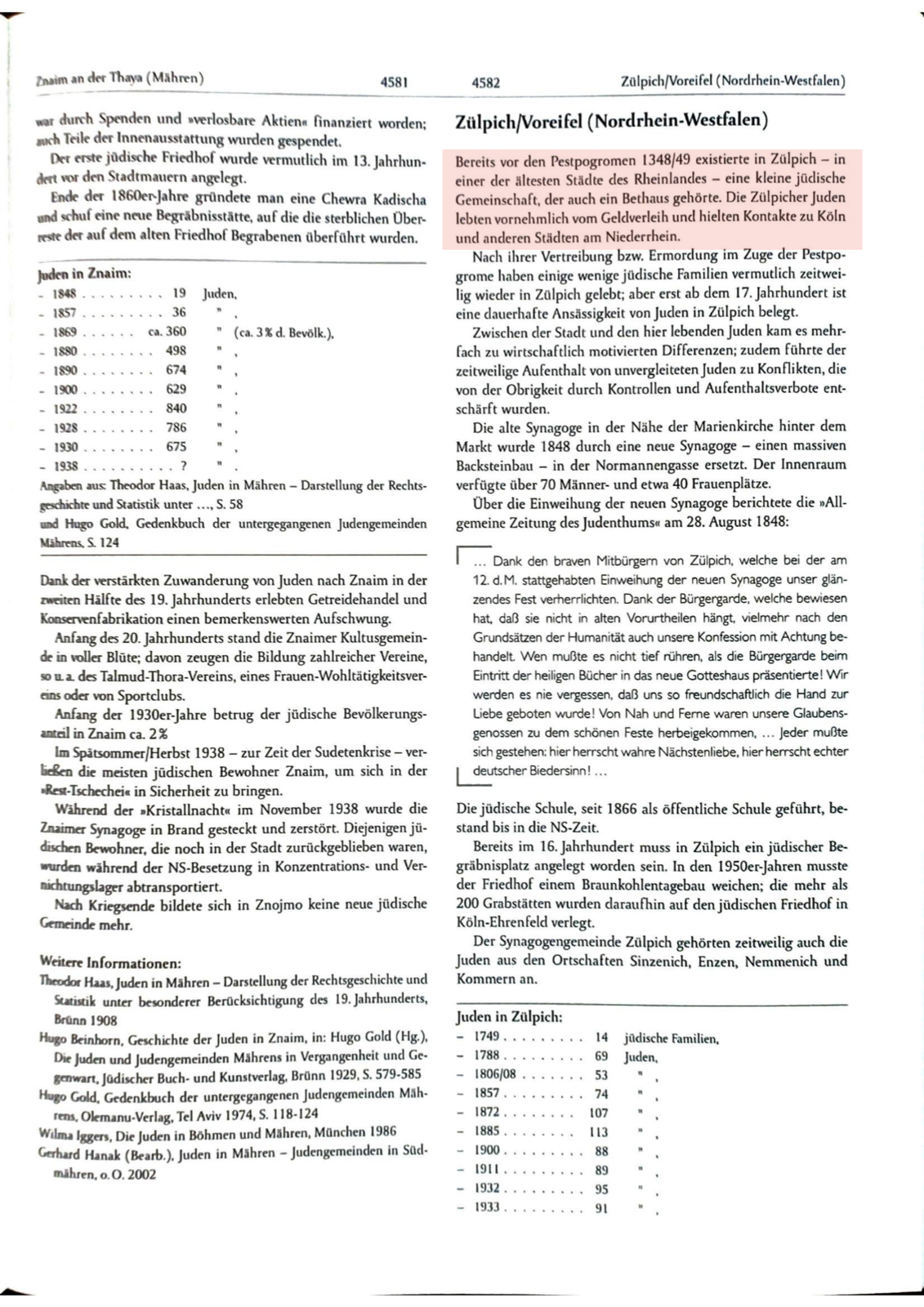
Error
Voigtländer and Voth failed to code a pogrom here during the Black Death, despite their rule to code as unity if Alicke mentions "violent attacks" or "extermination".
Reality
Avneri states that "probably at the time of the Black Death, the community was affected by a persecution".
Alicke confirms this, noting their "expulsion or murder in the course of the plague pogroms" („Nach ihrer Vertreibung bzw. Ermordung im Zuge der Pestpogrome").
The occurrence of a pogrom is confirmed by the primary sources.
Correction
POG1349 NA -> 1
Sources:
Avneri · Page 944
Alicke · Page 4582
Zwickau (113)
Error
Voigtländer and Voth failed to code a 0 for a pogrom here during the Black Death, despite their rule that a lack of information should be coded as 0.
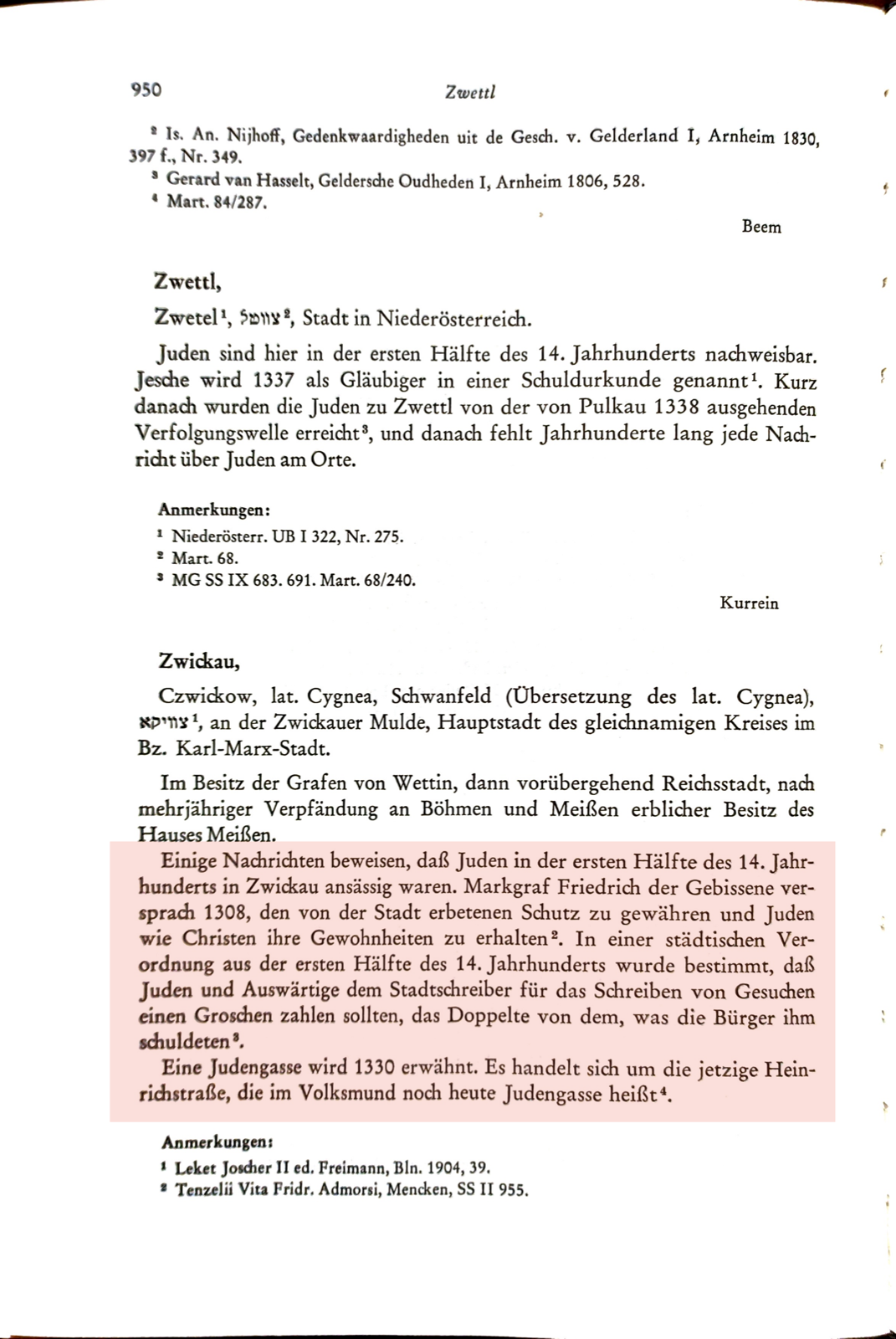
Reality
Avneri and Alicke both confirm a Jewish presence in Zwickau in the first half of the fourteenth century. Neither source reports any persecution during the Black Death.
This should be coded as 0.
Correction
POG1349 NA -> 0
Sources:
Avneri · Page 950
Alicke · Page 4600
1920s Pogroms
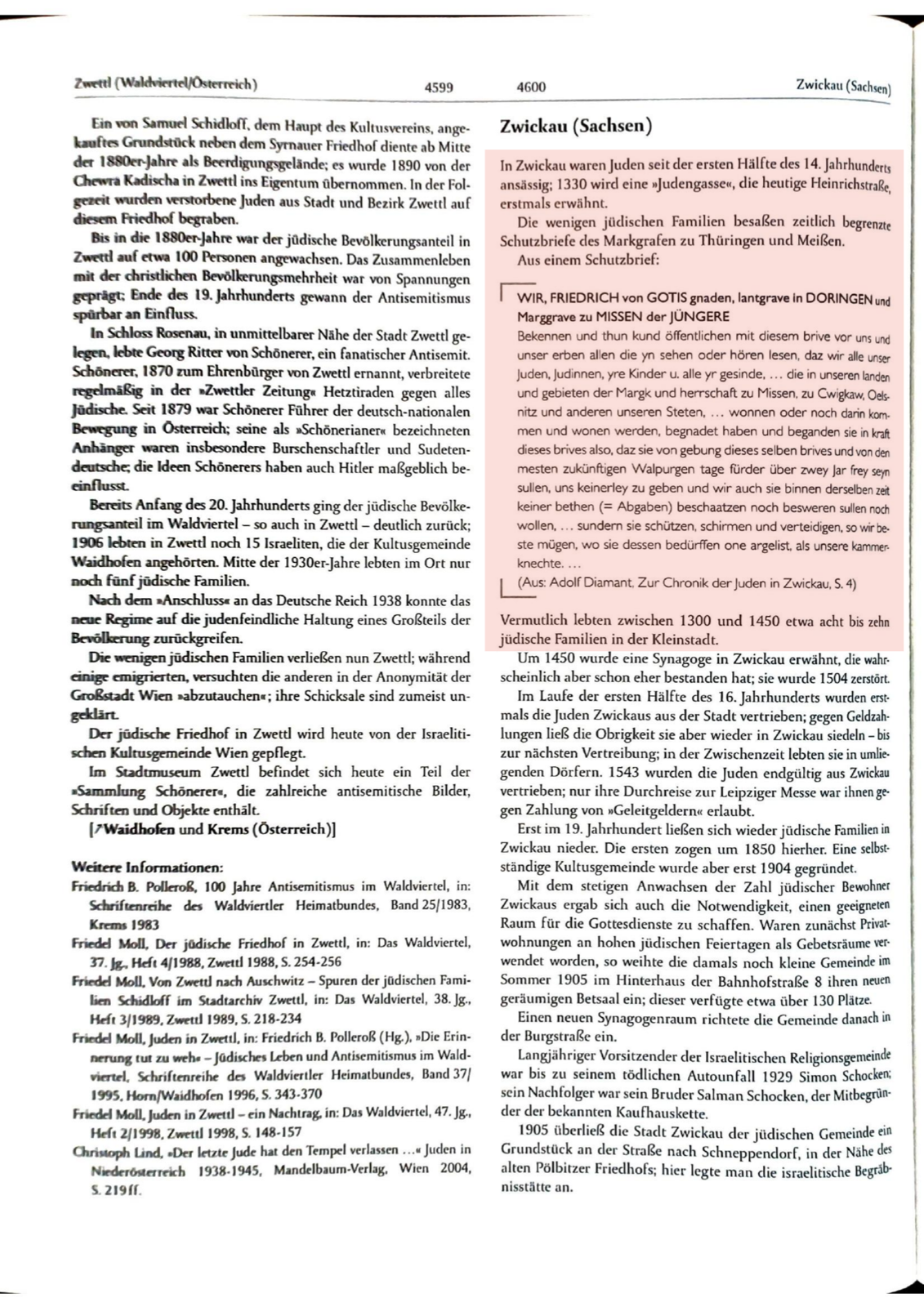
Altenburg (114)
Error
Voigtländer and Voth coded a pogrom in the 1920s here, despite their rule requiring explicit mention of "physical violence against and/or the killings of people".
Reality
Alicke documents that an "anti-Jewish hate campaign began in Altenburg [...] with insults, threats, and graffiti" („mit Beleidigungen, Bedrohungen und Schmierereien wurden die jüdischen Familien verängstigt").
There is no mention of physical violence, so this should not be coded as a pogrom.
In a response to a first draft of Francis' paper, Voigtländer and Voth stated that their coding was based on a newspaper article from the online version of Alicke. However, the online version of Alicke only appeared in 2014, while Voigtländer and Voth's article was published in 2012. The newspaper article does not appear in the printed version of Alicke that they had access to at the time.
Correction
POG20S 1 -> 0
Source:
Alicke · Page 70
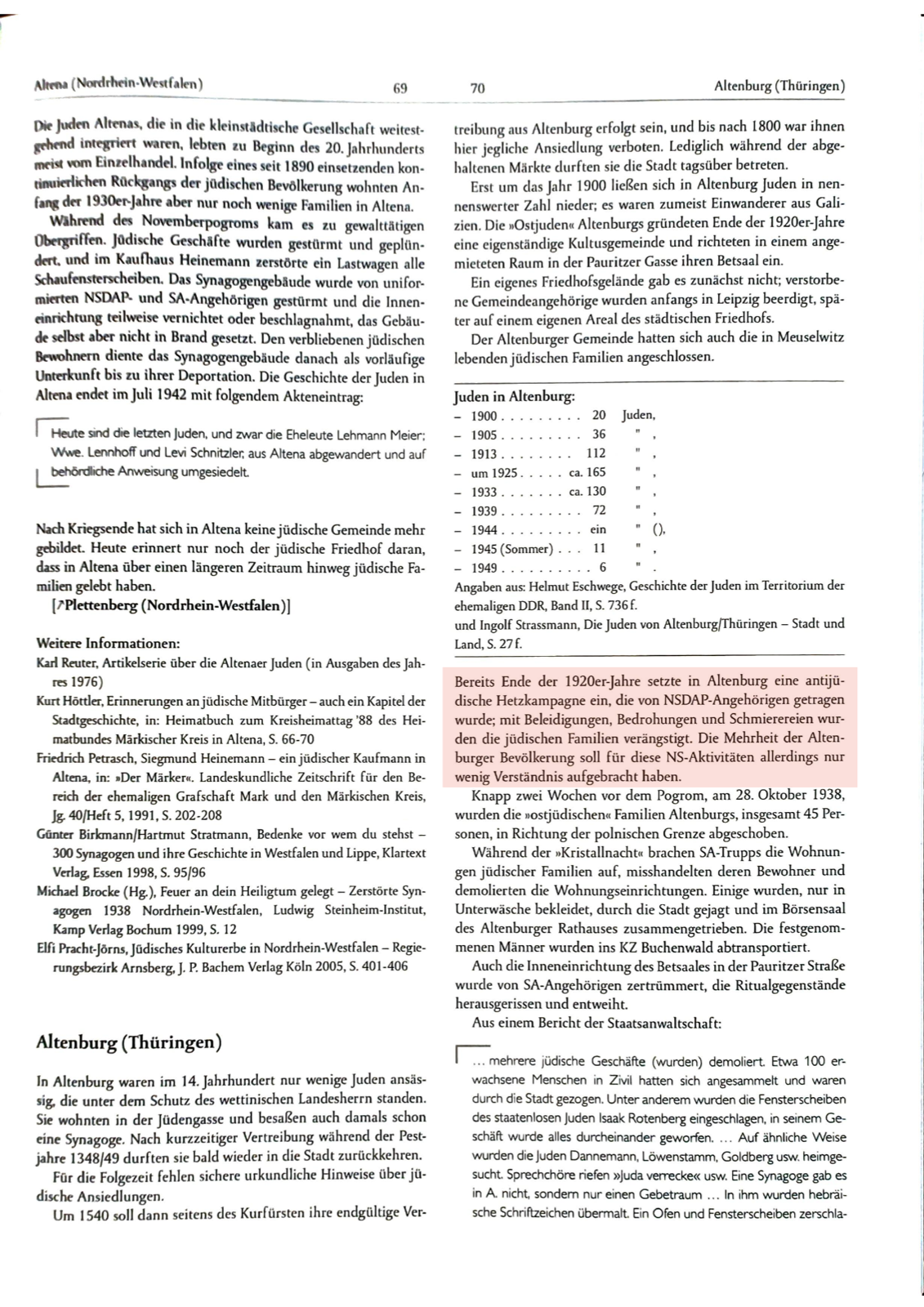
Bad Bergzabern (115)
Error
Voigtländer and Voth coded a pogrom in the 1920s here, claiming "unambiguous information" of physical violence.
Reality
Alicke notes that at the end of the 1920s the Jews "were confronted with the first antisemitic attacks" („Mit ersten antisemitischen Attacken waren die Juden Bergzaberns Ende der 1920er-Jahre konfrontiert"), carried out by NSDAP members agitating with slogans such as "We don't need a Jewish republic" and "Jews out of the country."
The only evidence Alicke provides consists of verbal slogans. It is unclear whether the term "attacks" (Attacken) refers to physical violence or only to political agitation of this kind.
Correction
POG20S 1 -> NA
Source:
Alicke · Page 201
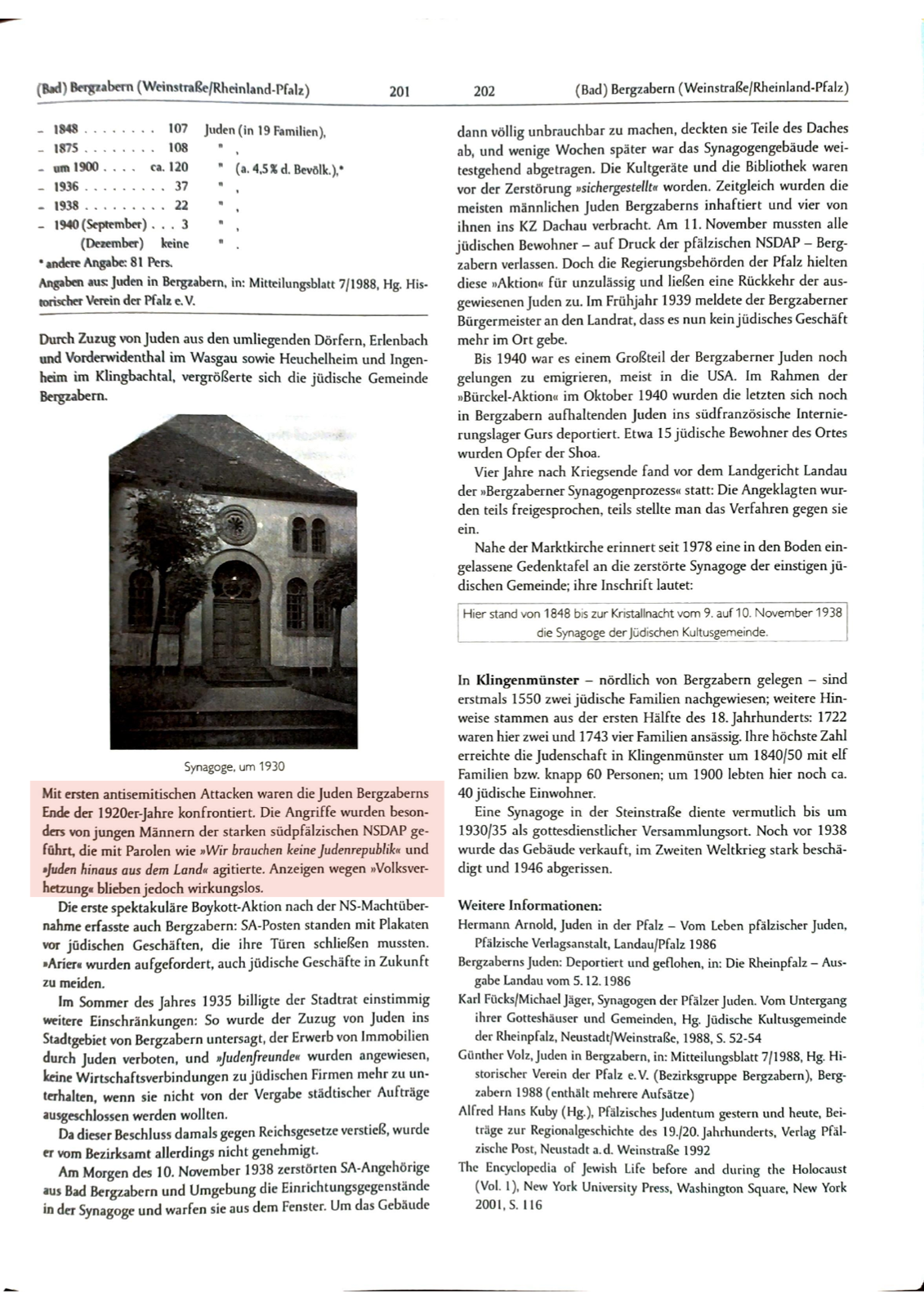
Bad Hersfeld (116)
Error
Voigtländer and Voth coded a pogrom in the 1920s here, despite their rule requiring explicit mention of "physical violence against and/or the killings of people".
Reality
Alicke describes anti-Jewish incidents in the mid-1920s, including punishment of "synagogue desecrators" („Synagogenschänder") and an incident in which a Jewish doctor and his companions were "provoked" („provoziert") and then "rudely jostled" („angerempelt") outside a café.
Beyond this jostling, there is no mention of physical violence against people before January 30, 1933. Voigtländer and Voth's codebook requires explicit evidence of physical violence or killings; "rudely jostled" does not meet this threshold.
Correction
POG20S 1 -> 0
Source:
Alicke · Page 227-228
Berlin (117)
Error
Voigtländer and Voth failed to code a 0 for a 1920s pogrom in Berlin, despite their rule that a lack of positive information should be coded as 0.
Reality
Alicke does not mention any physical violence against Jews in Berlin from 1920 to January 30, 1933.
This should be coded as 0.
Correction
POG20S NA -> 0
Source:
Alicke · Page 432
Braunschweig (118)
Error
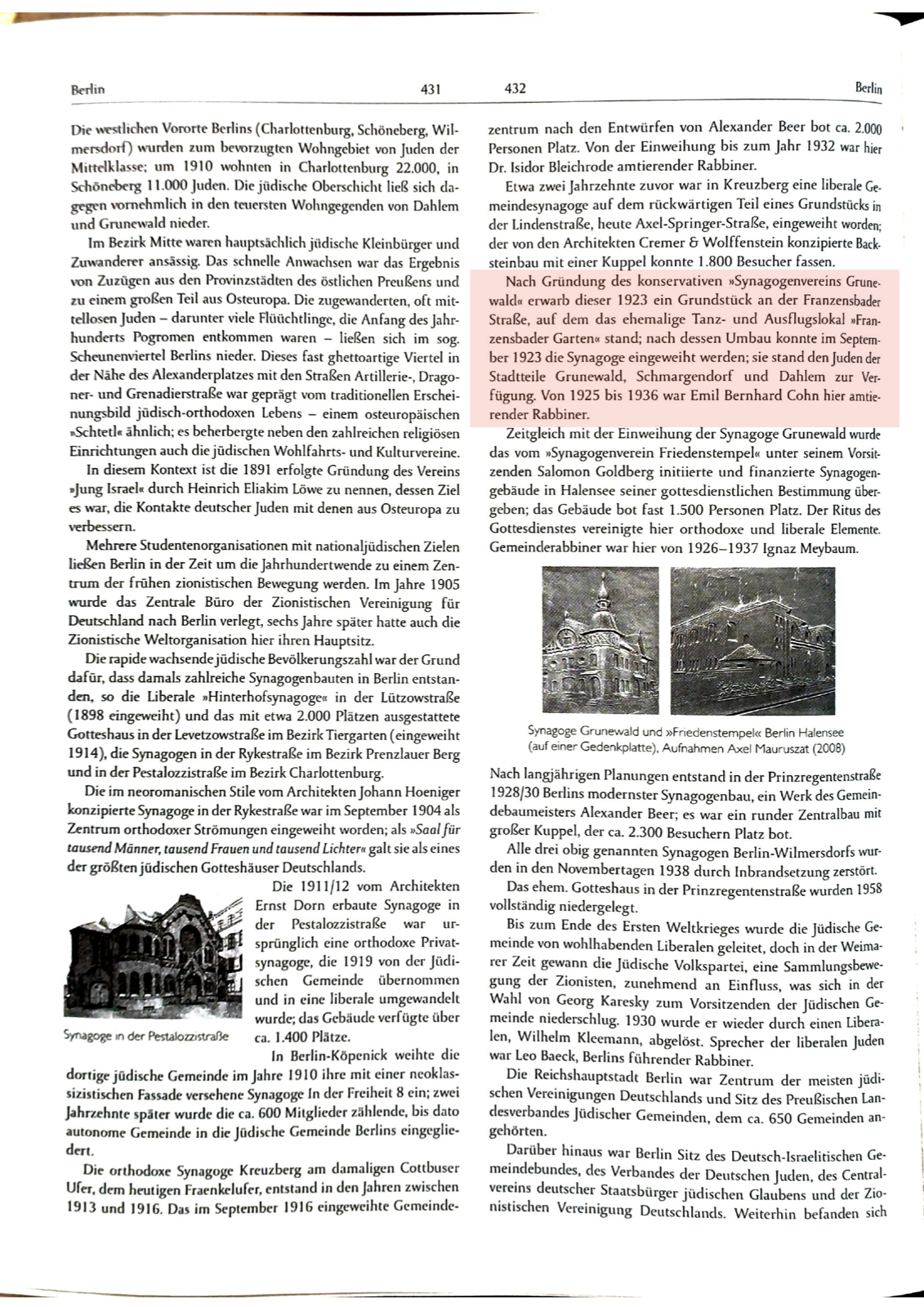
Voigtländer and Voth coded a pogrom in the 1920s here, despite their explicit rule that "the desecration of cemeteries" or property damage are "not coded as pogroms".
Reality
Alicke notes that "in 1928-1929 the synagogue was desecrated several times" (1928/29 wurde die Synagoge einige Male geschändet).
Beyond property damage, there is no mention of physical violence against Jews before January 30, 1933.
Correction
POG20S 1 -> 0
Source:
Alicke · Page 632
Buchen-Odenwald (119)
Error
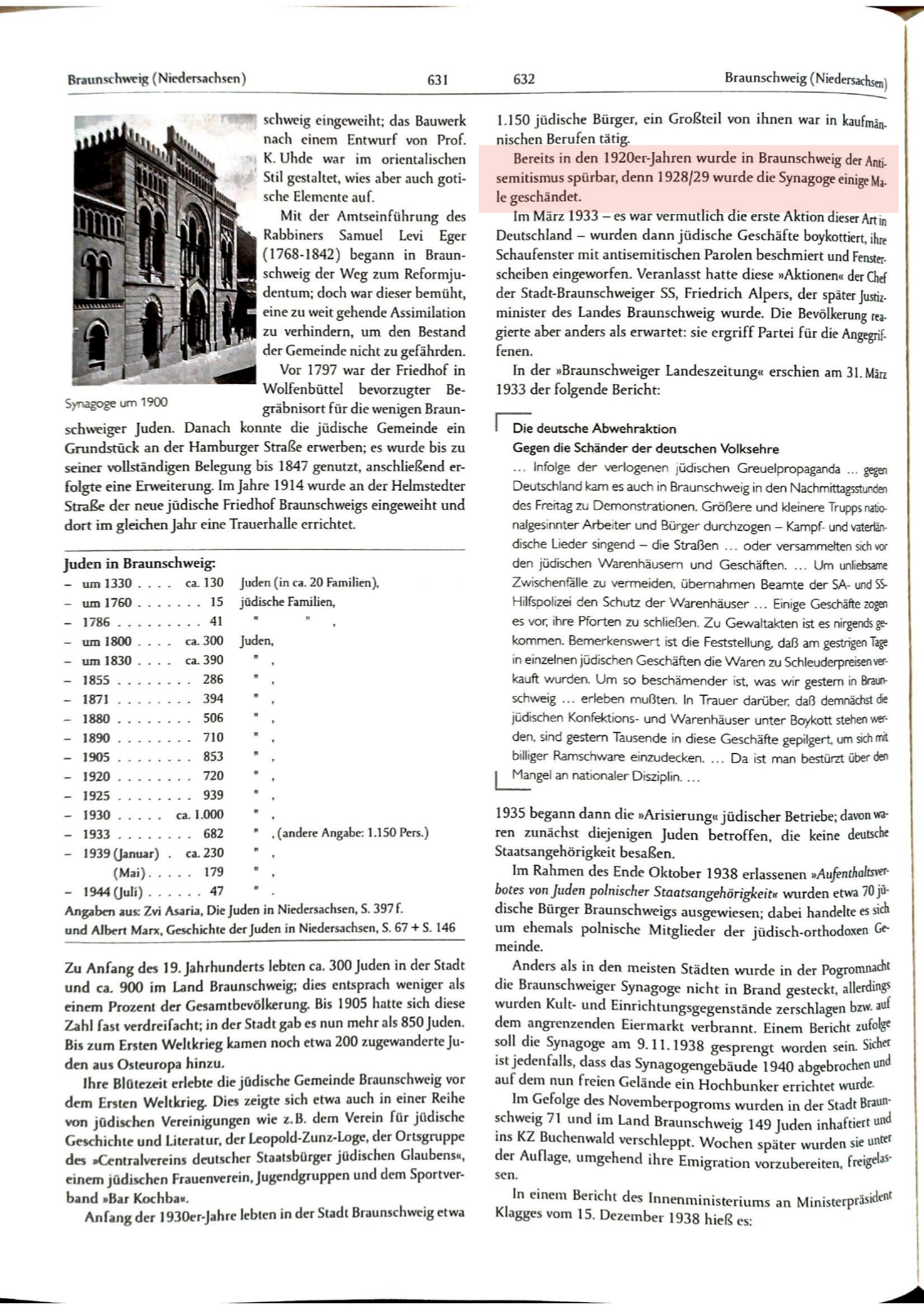
Voigtländer and Voth coded a pogrom in the 1920s here, despite their explicit rule that property damage is not coded as a pogrom.
Reality
Alicke reports that in August 1931, "the synagogue was the target of an attack" („war die Synagoge erstmals Ziel eines Anschlages").
Beyond property damage, there is no mention of physical violence against Jews before January 30, 1933.
Correction
POG20S 1 -> 0
Source:
Alicke · Page 705
Burgau (120 & 121)
Error
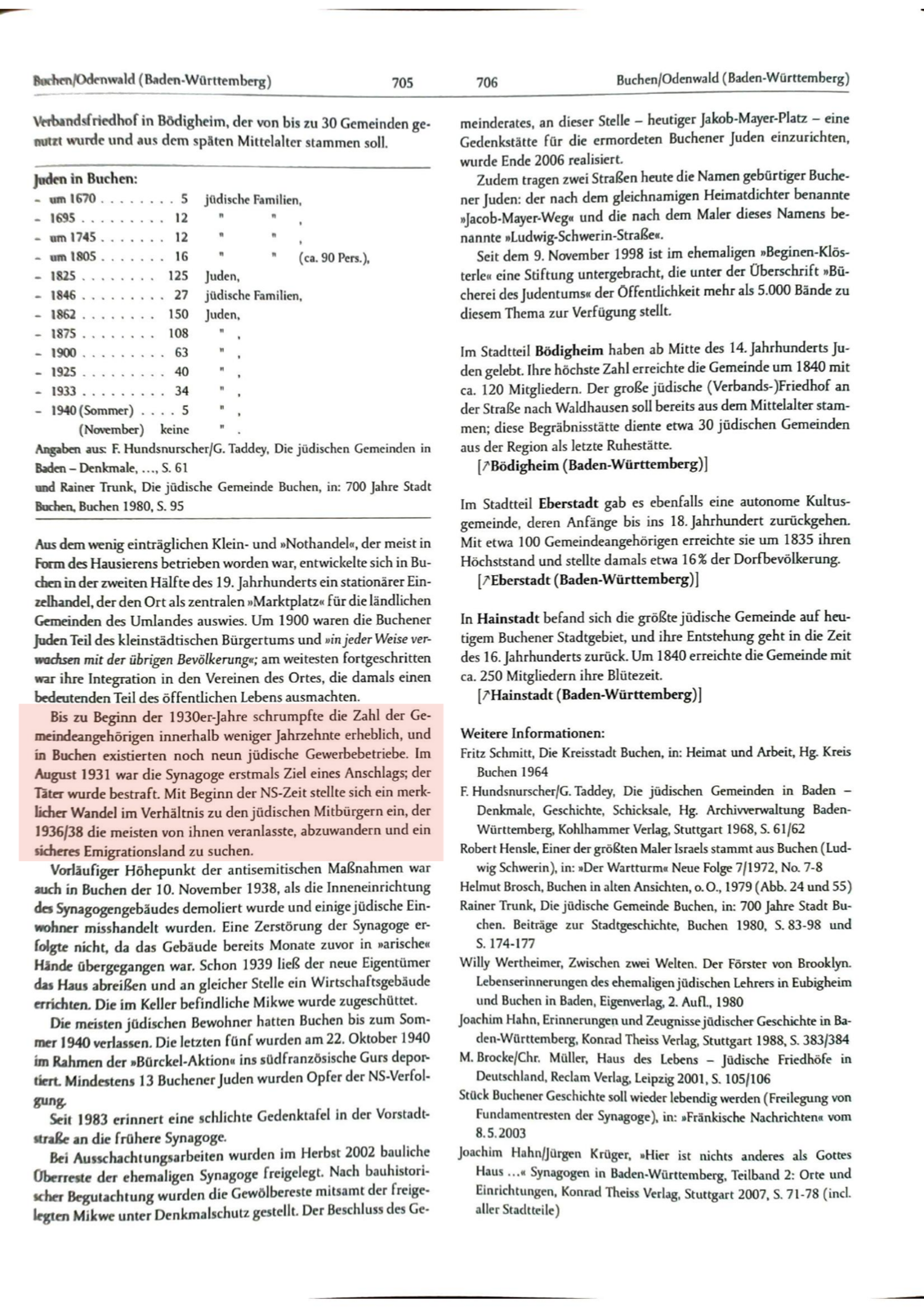
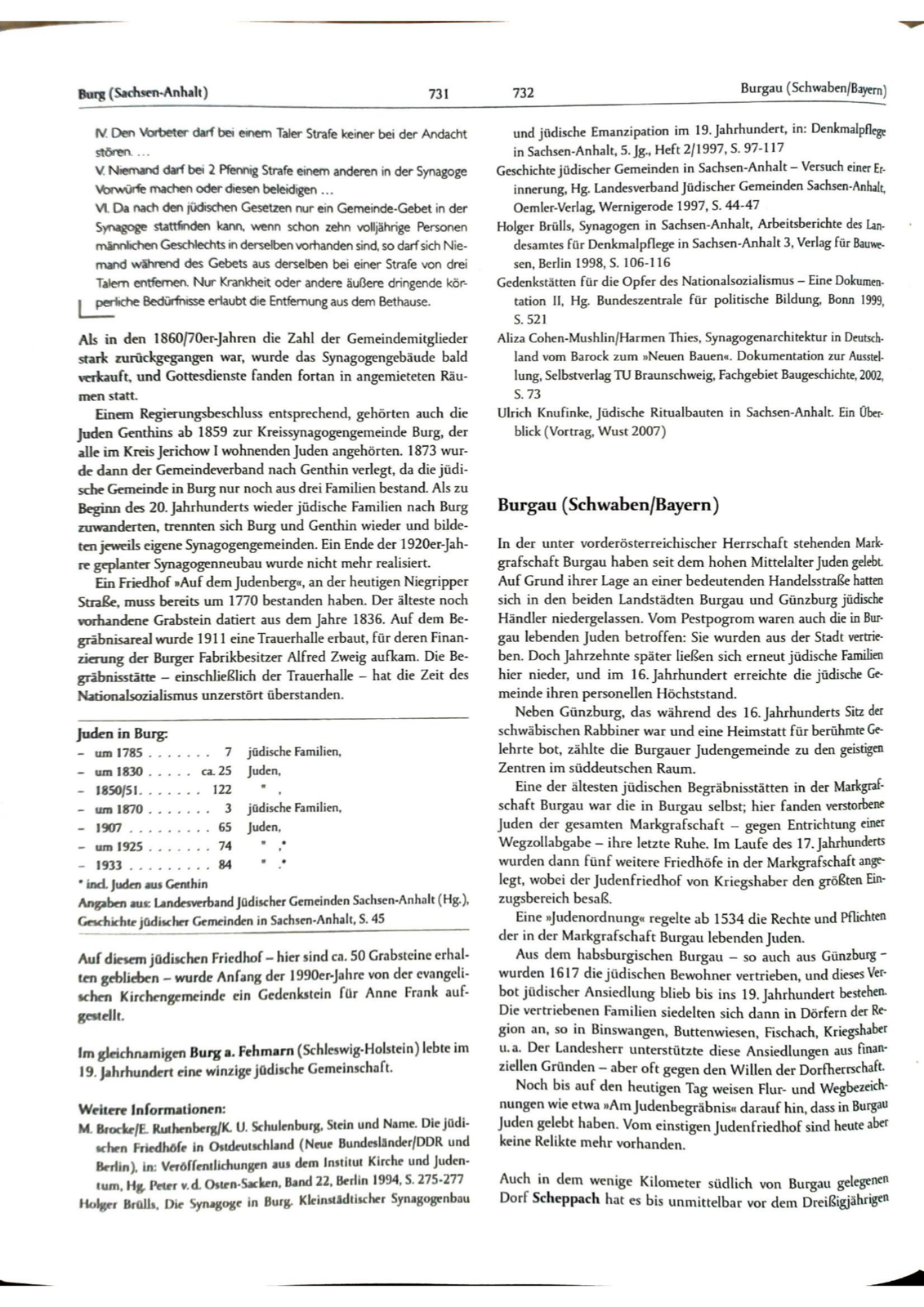
Voigtländer and Voth implicitly coded a Jewish presence in Burgau in the 1920s, despite no evidence of a community.
Voigtländer and Voth failed to code a 0 for a 1920s pogrom in Burgau, despite their rule that a lack of positive information should be coded as 0.
Reality
Alicke's account for Burgau ends in the nineteenth century and gives no indication that there were Jews present in the 1920s.
The coding of a 1920s presence is incorrect.
Alicke's account for Burgau ends in the nineteenth century and gives no indication that there were Jews present in the 1920s, let alone any physical violence against them.
This should be coded as 0.
Correction
EXIST20S 1 -> 0; POG20S NA -> 0
Sources:
Alicke · Page 732
Alicke · Page 733
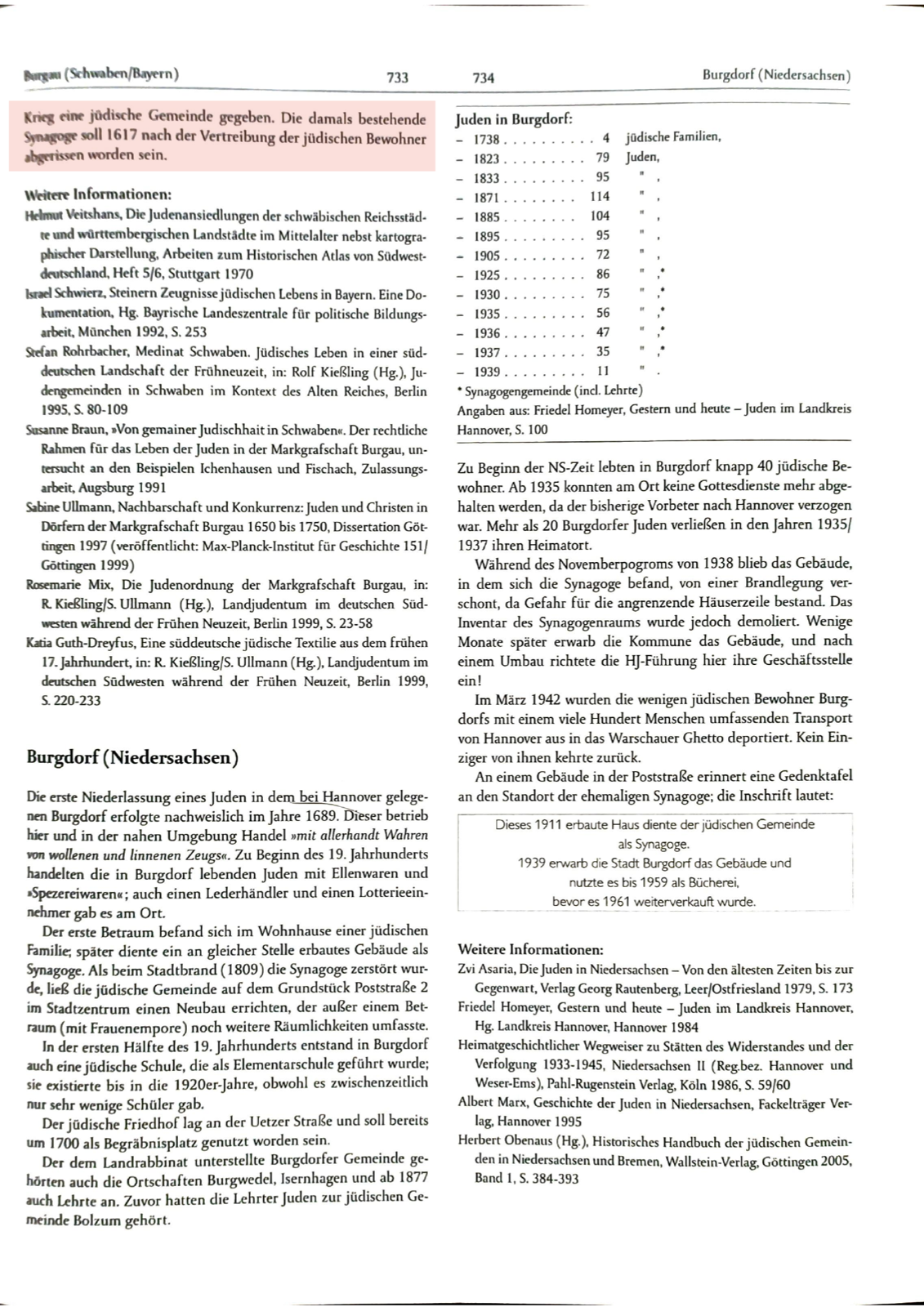
Dormagen (122)
Error
Voigtländer and Voth failed to code a 0 for a 1920s pogrom in Dormagen, despite their rule that a lack of positive information should be coded as 0.
Reality
Alicke notes increasing "economic and social discrimination" („wirtschaftlichen und gesellschaftlichen Diskriminierung"), but no physical violence is mentioned before January 30, 1933.
This should be coded as 0.
Correction
POG20S NA -> 0
Source:
Alicke · Page 953
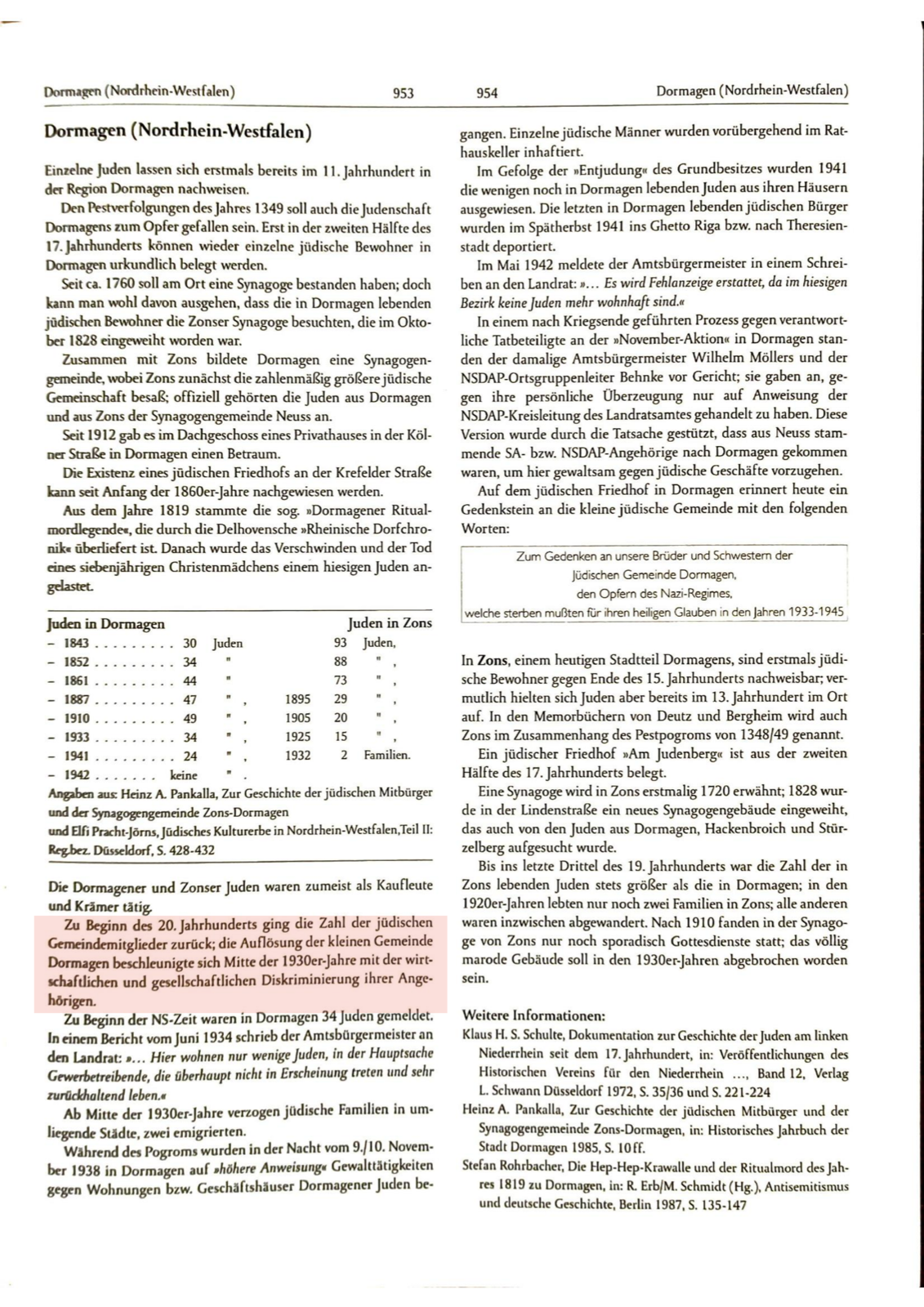
Duisburg (123)
Error
Voigtländer and Voth coded a pogrom in the 1920s here, despite their rule requiring explicit mention of "physical violence against and/or the killings of people".
Reality
Alicke notes "antisemitic excesses" and "harassment" („Belästigungen") of children in the summer of 1930. Crucially, the text states that SA and SS members only resorted to "open violence" („offenen Gewalt") starting from the end of February 1933.
This suggests there was no physical violence before Hitler became Chancellor, so it should not be coded as a pogrom.
Correction
POG20S 1 -> 0
Source:
Alicke · Page 998
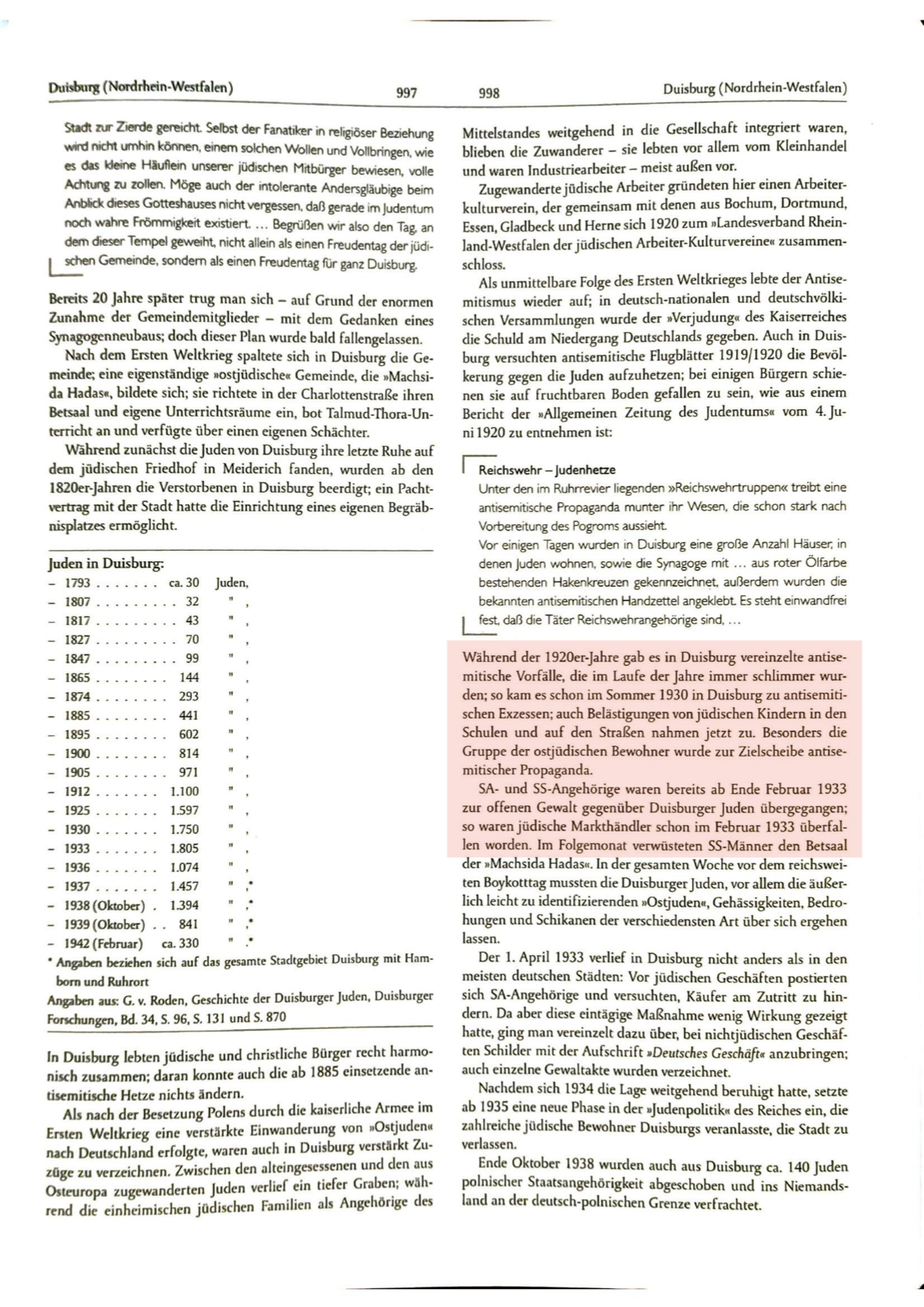
Erfurt (124)
Error
Voigtländer and Voth coded a pogrom in the 1920s here, despite their explicit rule that property damage is not coded as a pogrom.
Reality
Alicke notes that during and after the First World War antisemitism became more noticeable in Erfurt, and that in 1924 "the Erfurt synagogue was defaced with Nazi slogans for the first time" („1924 wurde die Erfurter Synagoge erstmals mit NS-Parolen beschmiert").
Beyond this property damage, there is no mention of physical violence against people before January 30, 1933.
Correction
POG20S 1 -> 0
Source:
Alicke · Page 1137
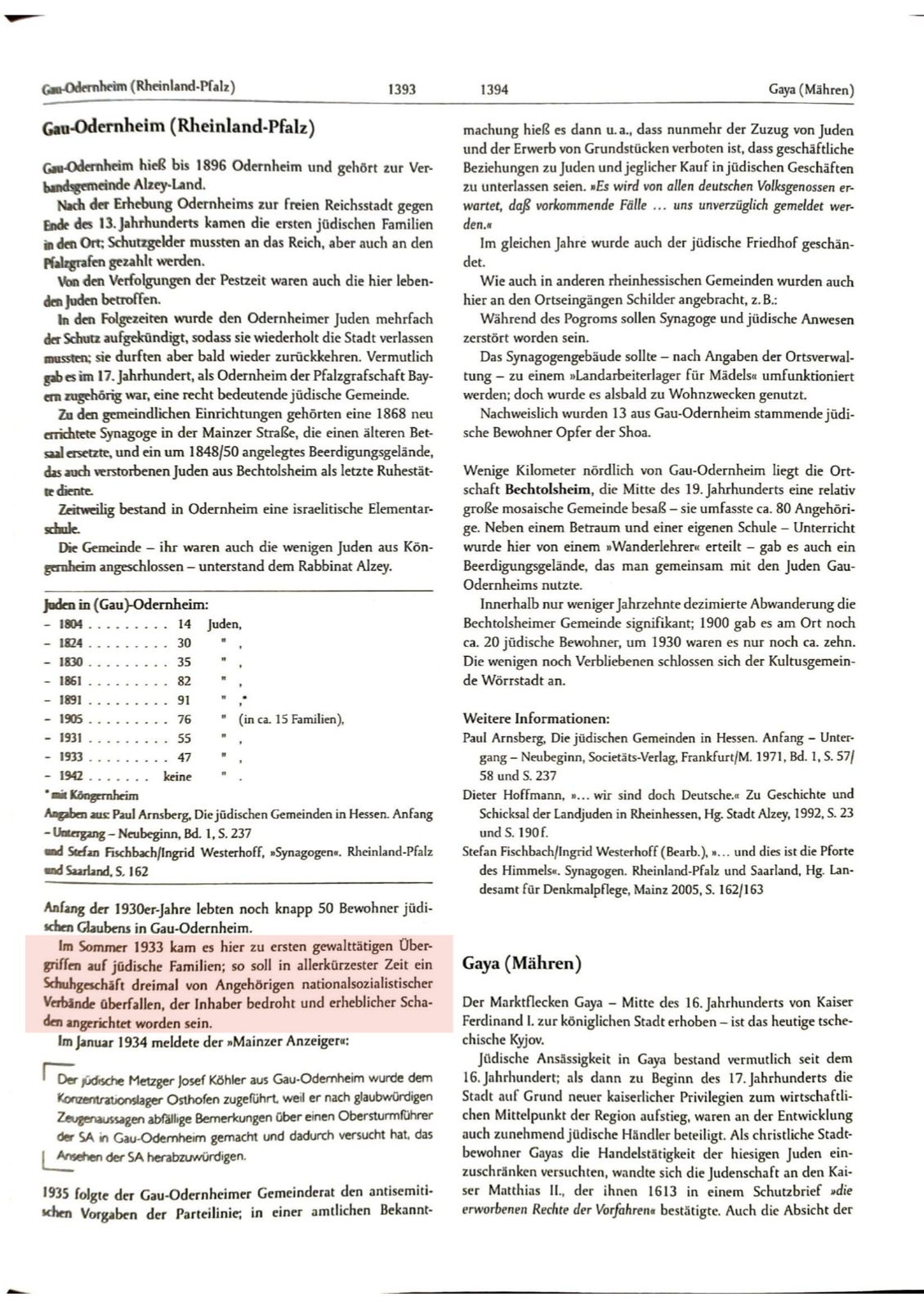
Gau-Odernheim (125)
Error
Voigtländer and Voth coded a pogrom in the 1920s here, despite the physical violence occurring after their cutoff date of January 30, 1933.
Reality
Alicke documents the "first violent attacks on Jewish families" („ersten gewalttätigen Übergriffen auf jüdische Familien") occurring in the summer of 1933, which is after Hitler became Chancellor.
The coding of a 1920s pogrom is incorrect.
Correction
POG20S 1 -> 0
Source:
Alicke · Page 1393
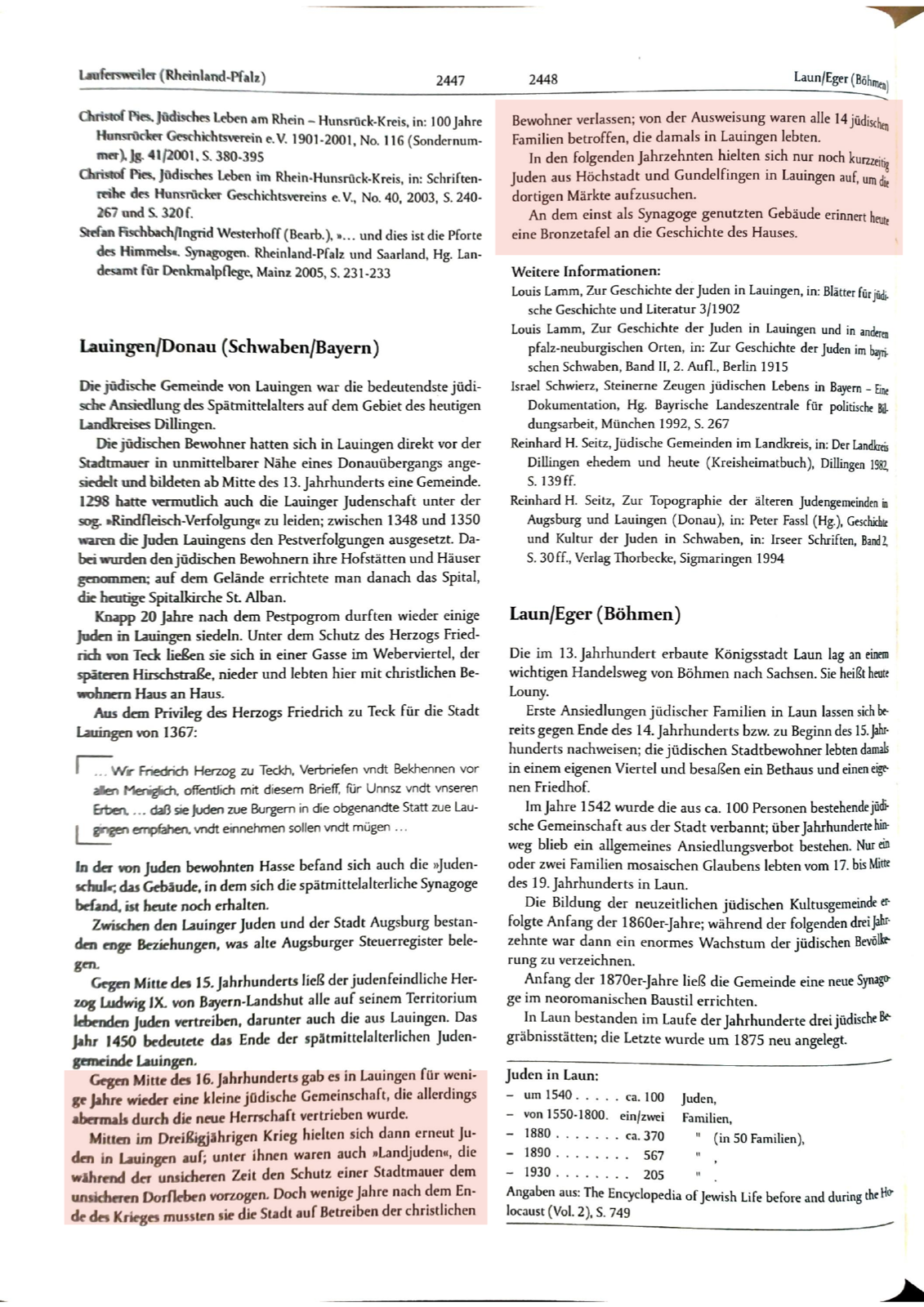
Lauingen-Donau (126)
Error
Voigtländer and Voth implicitly coded a Jewish presence in Lauingen-Donau in the 1920s, despite no evidence of a community.
Reality
Alicke's account ends in the sixteenth century, after which there appears to have been no permanent Jewish presence in the town.
The coding of a 1920s presence is incorrect.
Correction
EXIST20S 1 -> 0
Source:
Alicke · Page 2447-2448
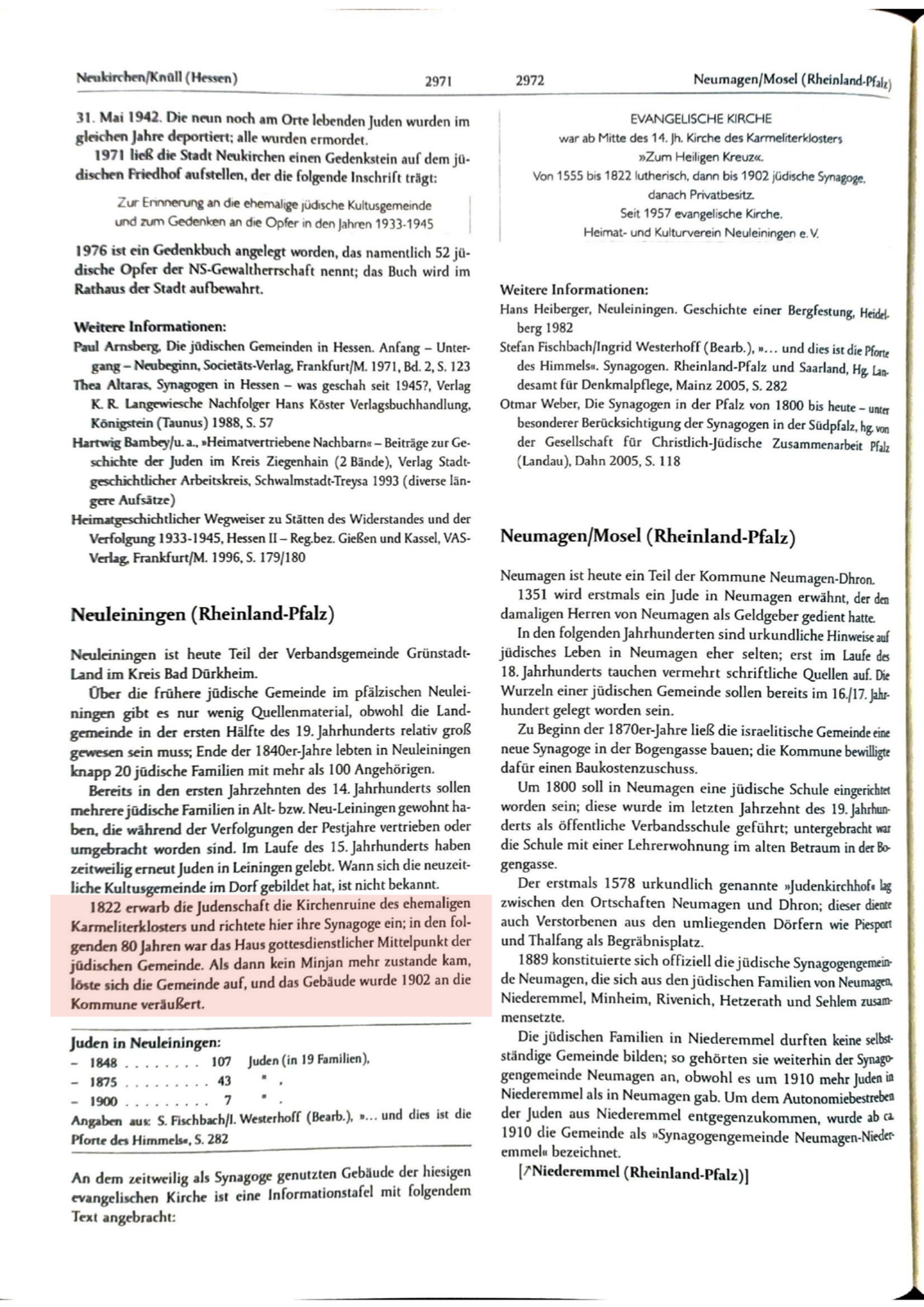
Neuleiningen (127 & 128)
Error
Voigtländer and Voth implicitly coded a Jewish presence in Neuleiningen in the 1920s, despite evidence that the community had already dissolved.
Reality
Alicke indicates that the Jewish community in Neuleiningen dissolved in 1902, "when no Minyan could be formed anymore" („Als dann kein Minjan mehr zustandekam, löste sich die Gemeinde auf"), and the building was sold.
The coding of a 1920s presence is incorrect.
Correction
EXIST20S 1 -> 0; POG20S NA -> 0
Source:
Alicke · Page 2971
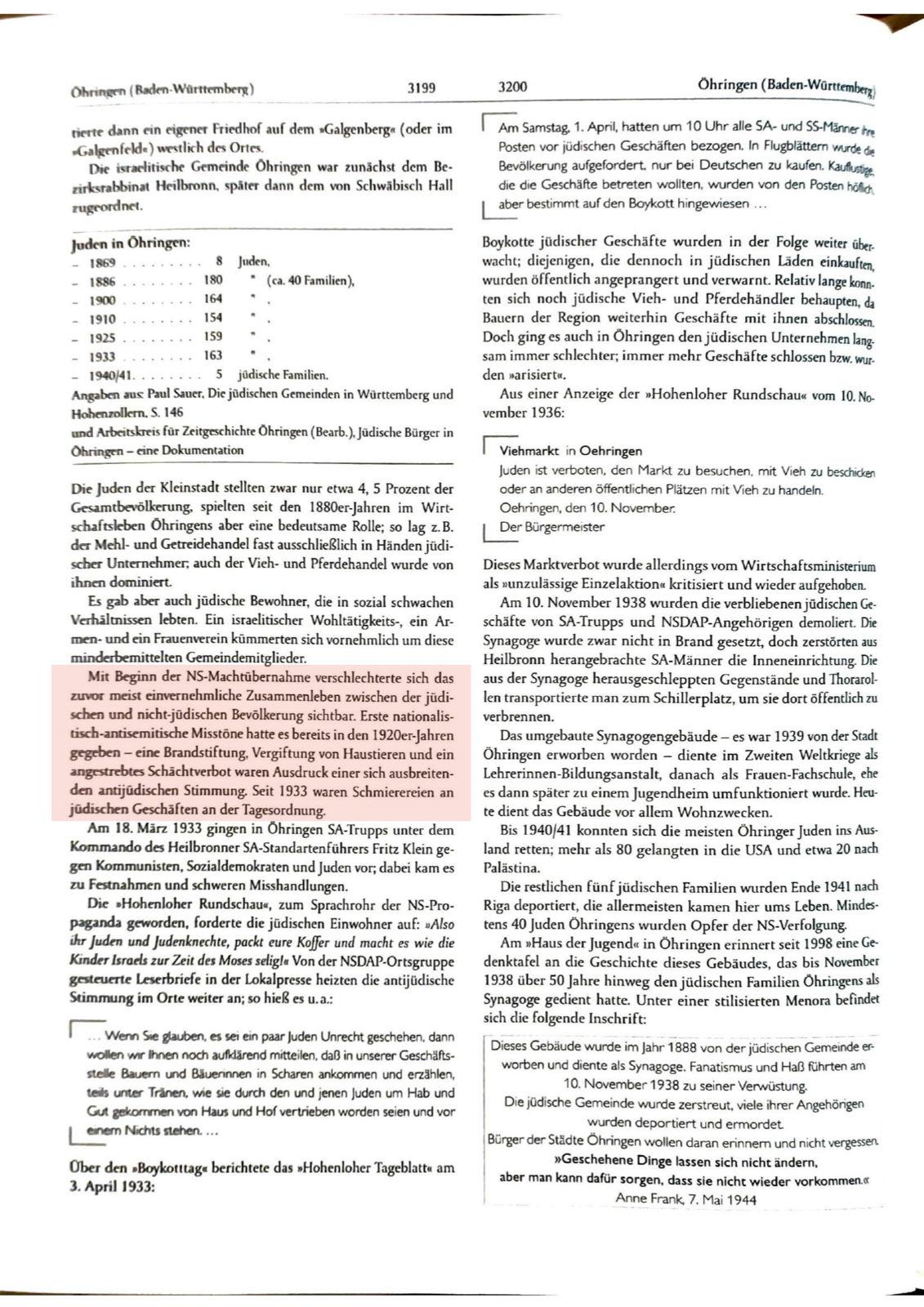
Öhringen (129)
Error
Voigtländer and Voth coded a pogrom in the 1920s here, despite their rule requiring explicit mention of "physical violence against and/or the killings of people".
Reality
Alicke notes that in the 1920s there was "arson, poisoning of domestic animals, and a proposed ban on ritual slaughter" („eine Brandstiftung, Vergiftung von Haustieren und ein angestrebtes Schächtverbot").
But there is no mention of physical violence against people before January 30, 1933.
In a response to a first draft of Francis' paper, Voigtländer and Voth argued that their coding was based on the evidence of arson. However, their own criteria indicate that violence against persons is required.
Correction
POG20S 1 -> 0
Source:
Alicke · Page 3199
Perleberg (130)
Error
Voigtländer and Voth failed to code a 0 for a 1920s pogrom in Perleberg, despite their rule that a lack of positive information should be coded as 0.
Reality
Alicke notes that "only a few Jews lived in the city" when the Nazis came to power, but reports no physical violence against them before January 30, 1933.
This should be coded as 0.
Correction
POG20S NA -> 0
Source:
Alicke · Page 3297
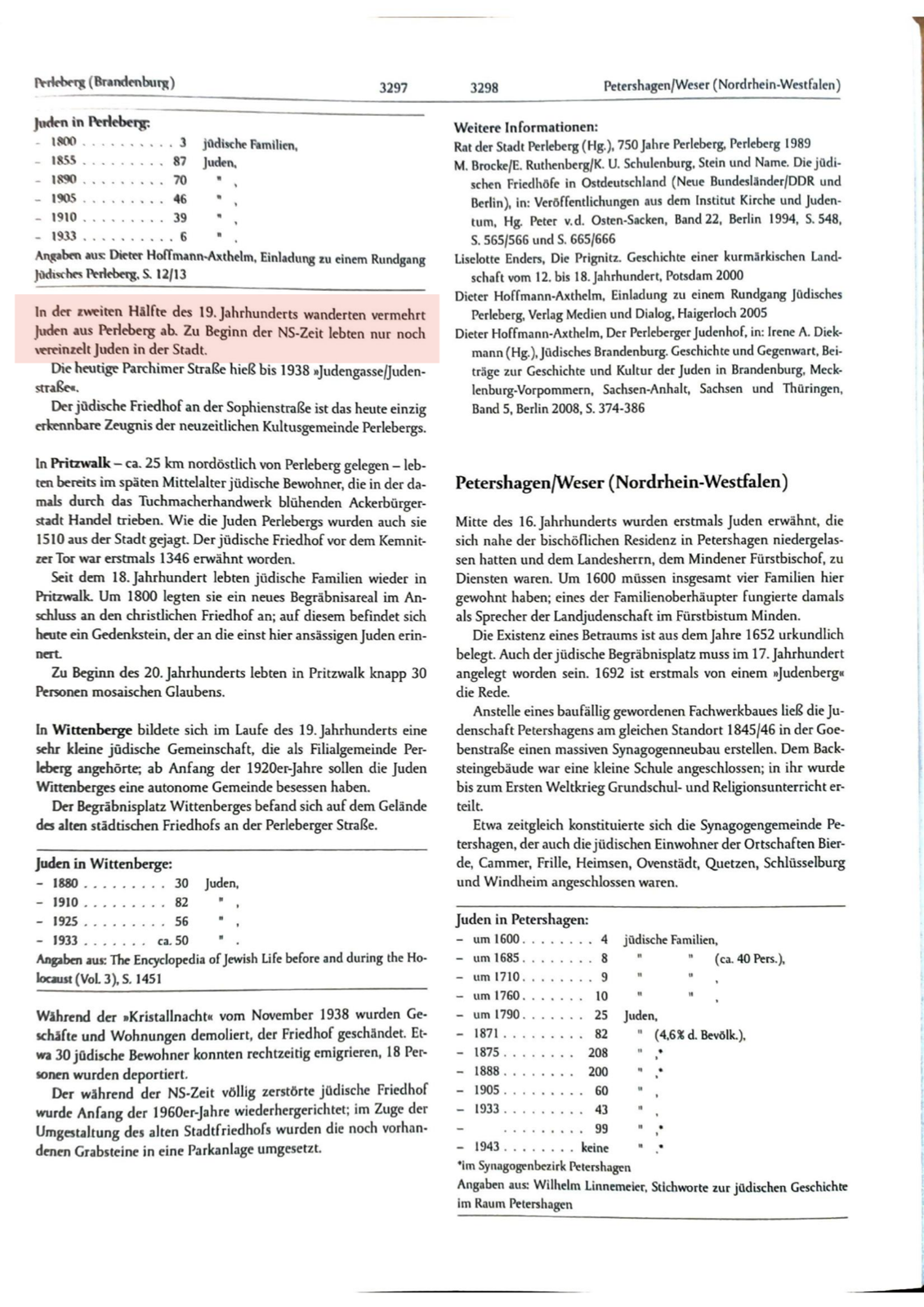
Rastatt (131)
Error
Voigtländer and Voth failed to code a 0 for a 1920s pogrom in Rastatt, despite their rule that a lack of positive information should be coded as 0.
Reality
Alicke provides no reports of physical violence against Jews before January 30, 1933.
This should be coded as 0.
Correction
POG20S NA -> 0
Source:
Alicke · Page 3420
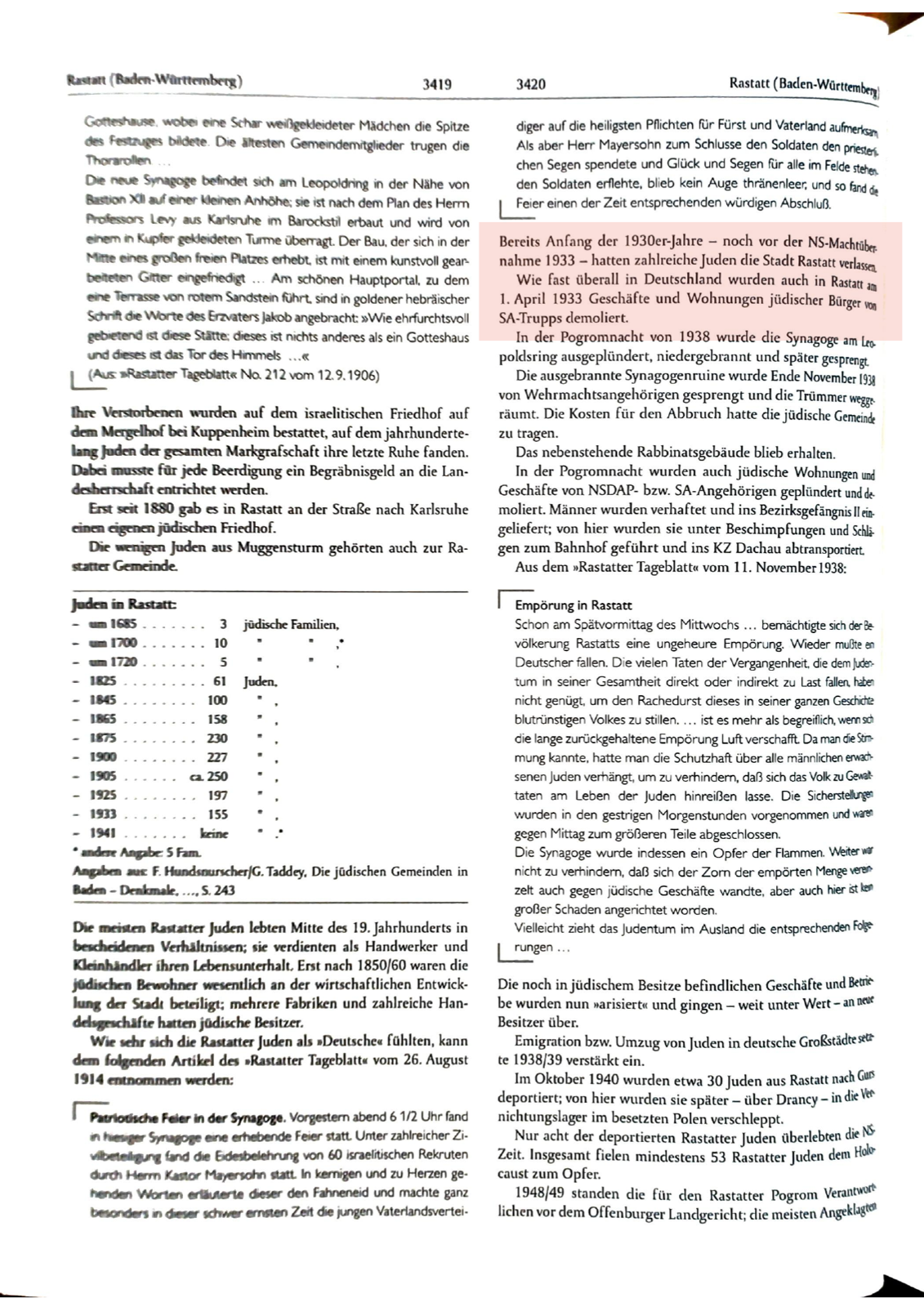
Saalfeld (132)
Error
Voigtländer and Voth failed to code a 0 for a 1920s pogrom in Saalfeld, despite their rule that a lack of positive information should be coded as 0.
Reality
Alicke does not report any physical violence against Jews before January 30, 1933.
This should be coded as 0.
Correction
POG20S NA -> 0
Source:
Alicke · Page 3606
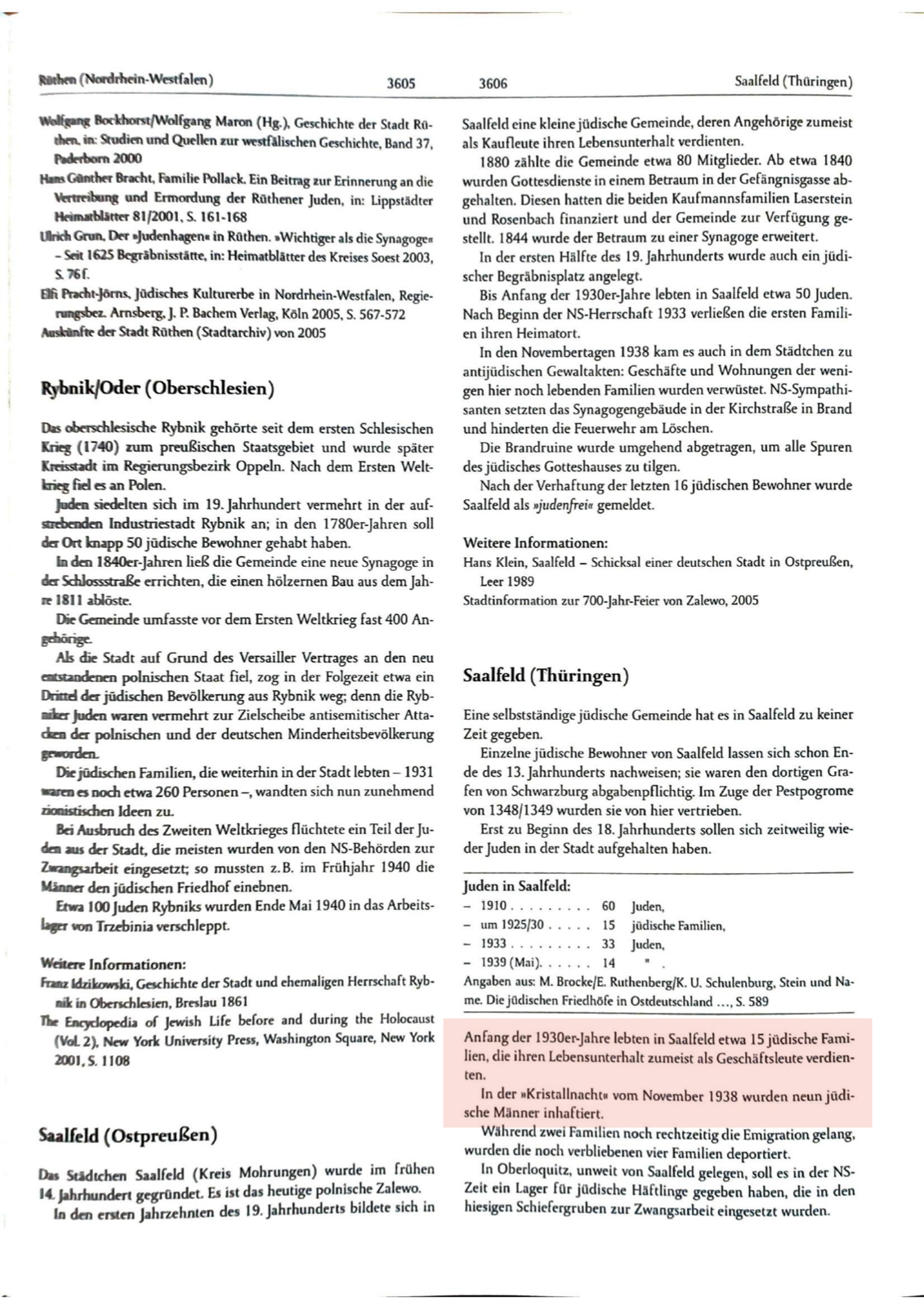
Wittenberg-Elbe (133)
Error
Voigtländer and Voth failed to code a 0 for a 1920s pogrom here, despite their explicit rule that property damage is not coded as a pogrom.
Reality
Alicke notes that at the beginning of the 1920s, "antisemitic graffiti appeared on house walls" („antisemitischen Schmierereien an Hauswänden"), and "incidents" accumulated in 1925.
Yet there is no indication that these involved physical violence against people.
Correction
POG20S NA -> 0
Source:
Alicke · Page 4472
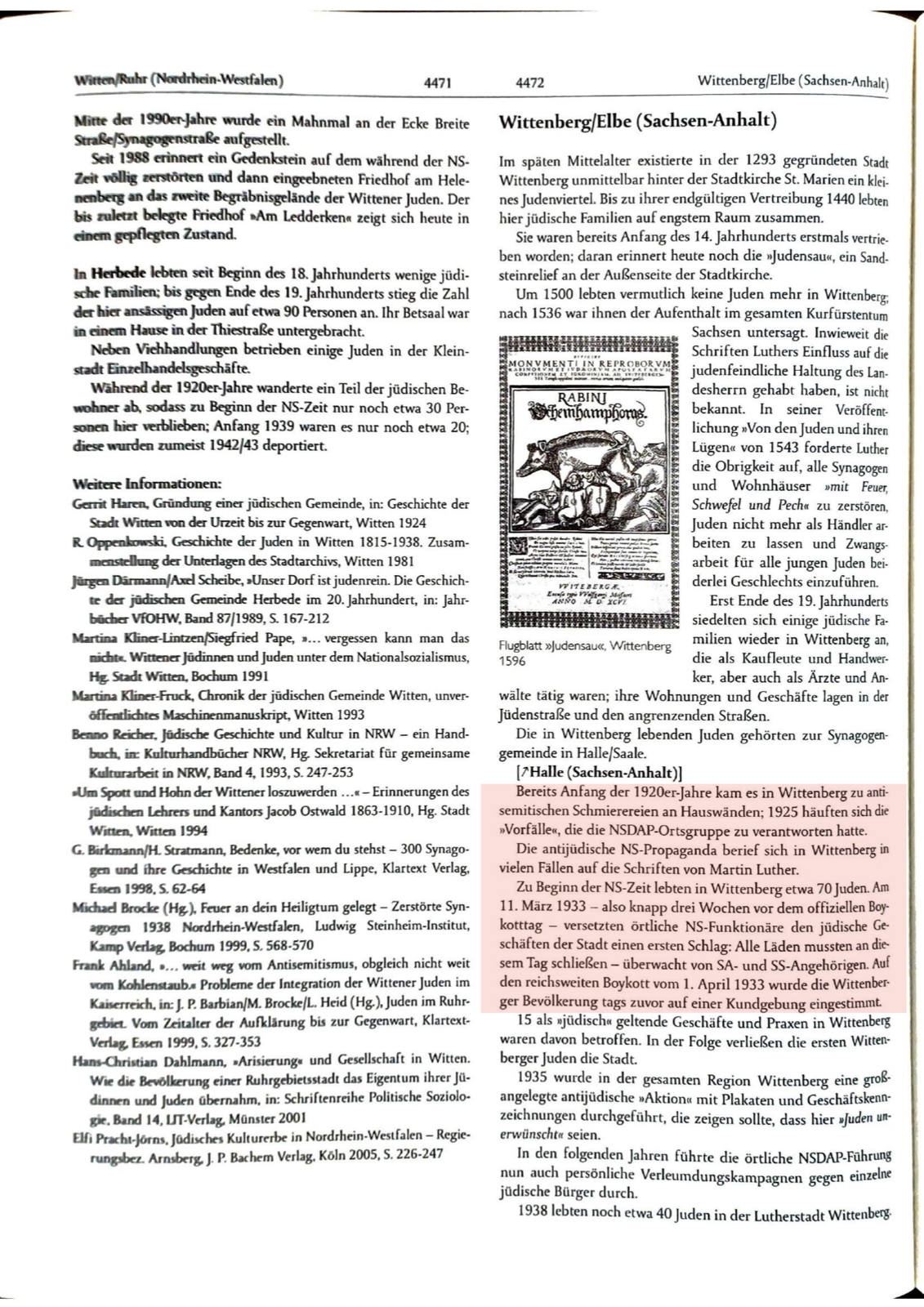
Synagogue Attacks (1938)
Altenburg (134 & 135)
Error
Voigtländer and Voth failed to code a synagogue or prayer room here, despite Alicke explicitly mentioning one.
Reality
Alicke documents that the Jewish community in Altenburg "at the end of the 1920s [...] established their prayer room in a rented back room in Pauritzer Gasse" („gegen Ende der 1920er Jahre [...] richteten in einem angemieteten Raum [...] ihren Betsaal ein").
This should be coded as 1.
Correction
SYN30S 0 -> 1; SYNATTACK 0 -> 1
Source:
Alicke · Page 70
Arnstein (136)
Error
Voigtländer and Voth claim a synagogue existed in Arnstein in 1938 when Kristallnacht occurred, but it had already been closed.
Reality
Alicke documents that "in 1938 the Jewish community was declared dissolved and the synagogue building was sold" (1938 wurde die jüdische Gemeinde für aufgelöst erklärt, das Synagogenegebäude verkauft).
The coding of an active synagogue is incorrect.
Correction
SYN30S 1 -> 0
Source:
Alicke · Page 150
Bad Königshofen i Grabfeld (137 & 138)
Error
Voigtländer and Voth failed to code a synagogue here, despite Alicke explicitly mentioning one.
Reality
Alicke documents the inauguration of a new synagogue in July 1904: "the Jewish community inaugurated its new synagogue in the neo-Gothic style on Bamberger Straße" („weihte die jüdische Gemeinde [...] ihre neue [...] Synagoge in der Bamberger Straße ein").
This should be coded as 1.
Correction
SYN30S 0 -> 1; SYNATTACK 0 -> 1
Sources:
Alicke · Page 243
Alicke · Page 245
Bad Orb (139)
Error
Voigtländer and Voth claim a synagogue existed in Bad Orb when Kristallnacht occurred, but it had already been sold.
Reality
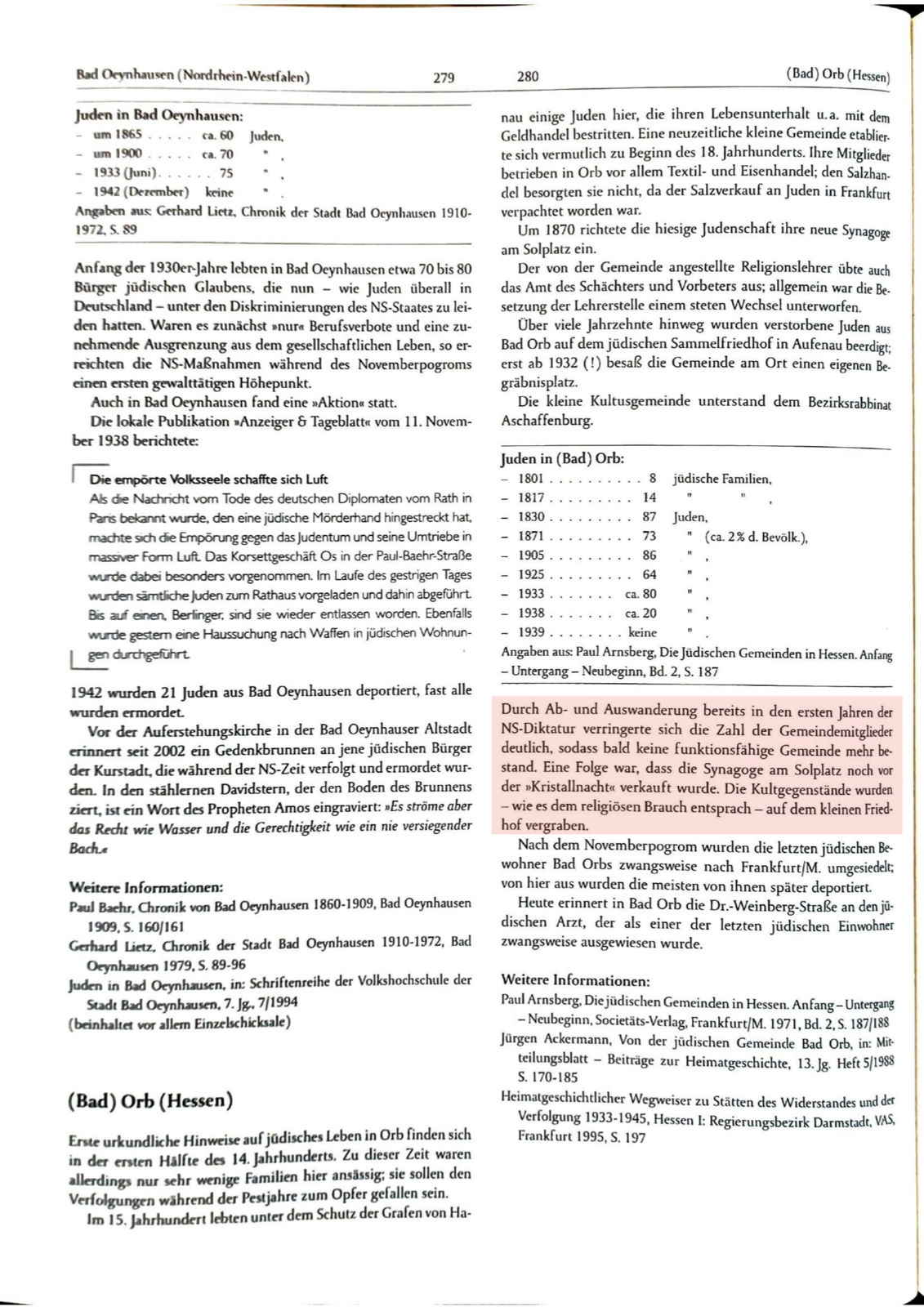
Alicke reports that the synagogue building on Solplatz was sold to a non-Jewish family before Kristallnacht („noch vor der ,Kristallnacht' an eine nichtjüdische Familie verkauft wurde").
The coding of an active synagogue is incorrect.
Correction
SYN30S 1 -> 0
Source:
Alicke · Page 280
Bad Windsheim (140)
Error
Voigtländer and Voth failed to code a synagogue here, despite Alicke explicitly mentioning one.
Reality
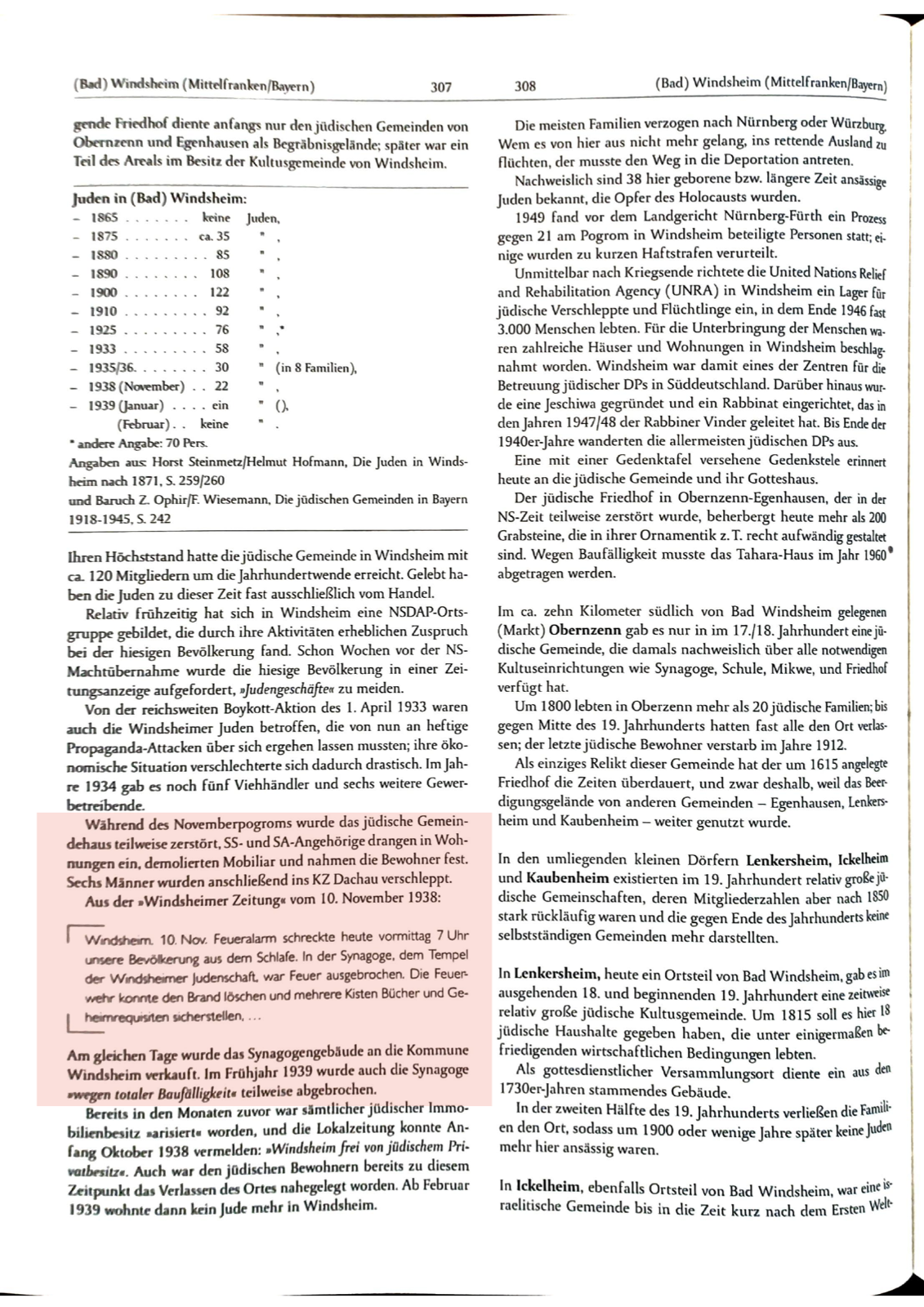
Alicke cites a newspaper report from November 10, 1938, stating that "in the synagogue [...] fire had broken out" („In der Synagoge [...] war Feuer ausgebrochen"). The synagogue was sold the same day and "partially demolished in spring 1939 'due to total dilapidation'" („im Frühjahr 1939 ‚wegen totaler Baufälligkeit' teilweise abgebrochen"). A memorial plaque commemorates the "destroyed house of worship" and explicitly states that the synagogue "was set on fire" („in Brand gesetzt").
This constitutes unambiguous evidence of a synagogue attack.
Correction
SYN30S 1
Source:
Alicke · Page 307
Bendorf-Rhein (141 & 142)
Error
Voigtländer and Voth failed to code a synagogue here, despite Alicke explicitly mentioning one.
Reality
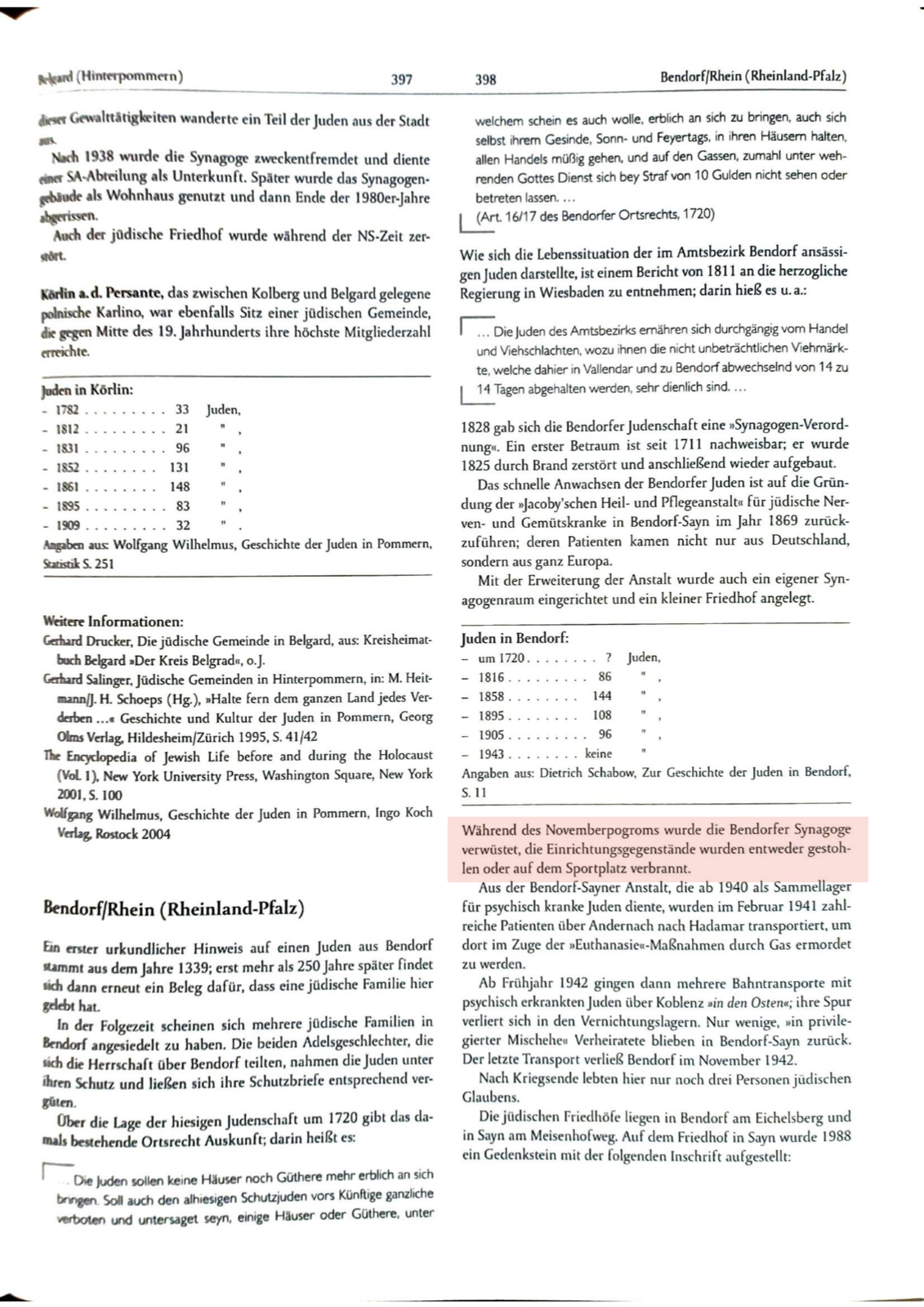
Alicke writes that "During the November pogrom, the Bendorf synagogue was devastated" („Während des Novemberpogroms wurde die Bendorfer Synagoge verwüstet").
This should be coded as 1.
Correction
SYN30S 0 -> 1; SYNATTACK 0 -> 1
Source:
Alicke · Page 398
Bödigheim (143)
Error
Voigtländer and Voth failed to code a synagogue here, despite Alicke explicitly mentioning one.
Reality
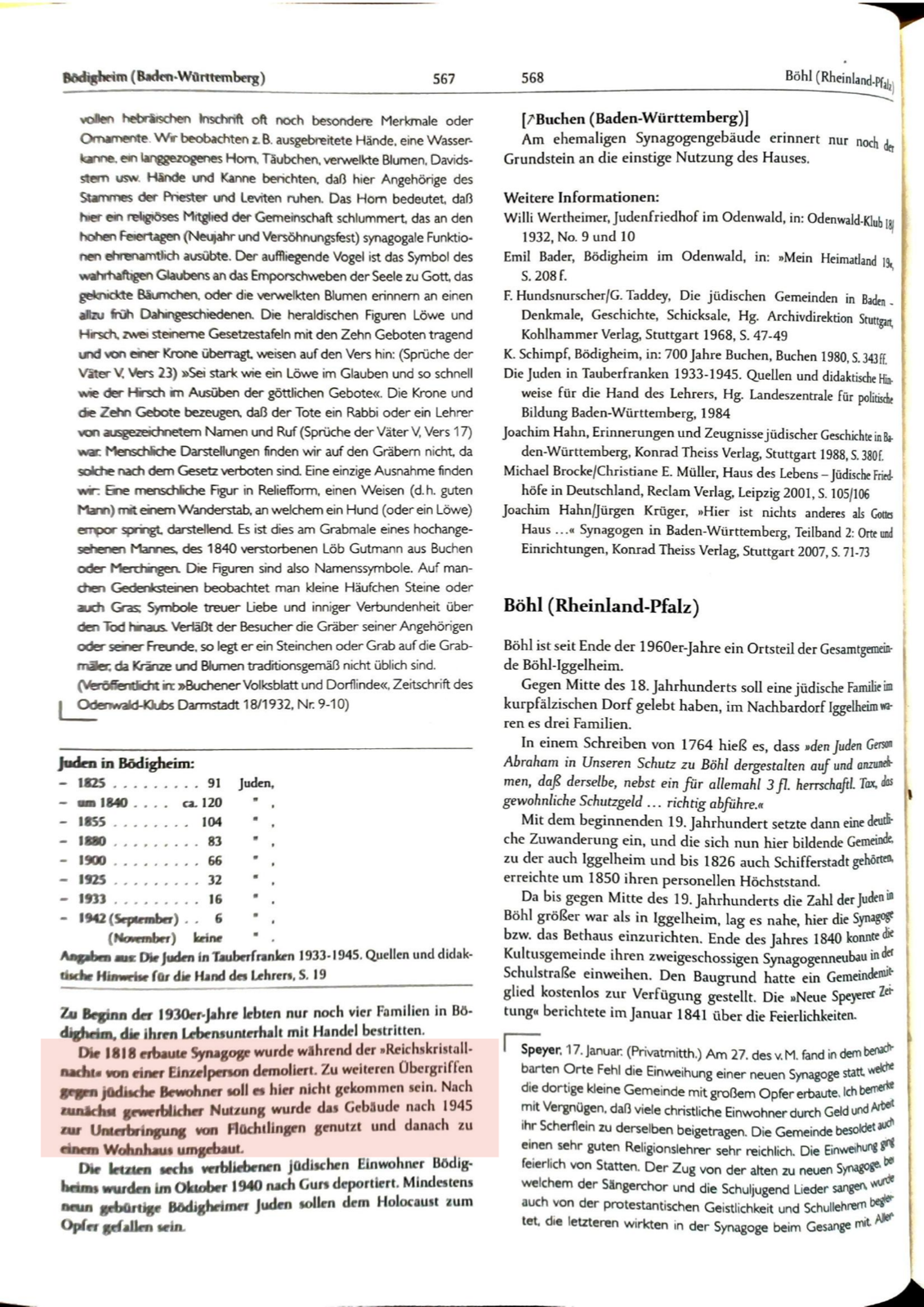
Alicke documents that the synagogue built in 1818 was "demolished by an individual during the 'Reichskristallnacht'" („Die 1818 erbaute Synagoge wurde während der ,Reichskristallnacht' von einer Einzelperson demoliert").
This should be coded as 1.
Correction
SYN30S 1
Source:
Alicke · Page 567
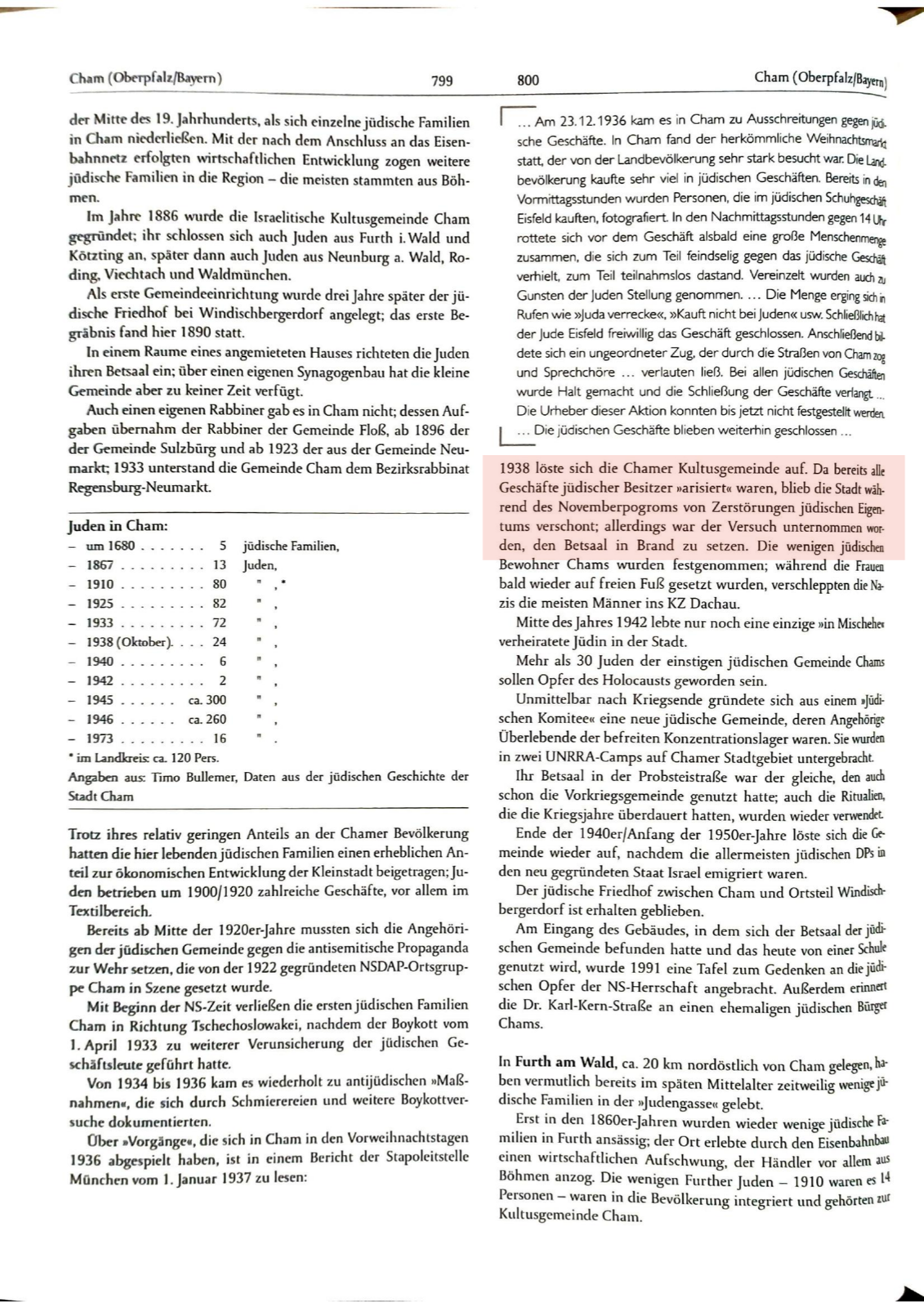
Cham (144 & 145)
Error
Voigtländer and Voth failed to code a prayer room here, despite Alicke explicitly mentioning one.
Reality
Alicke describes how "an attempt had been made to set the prayer room on fire" during the November pogrom of 1938 („allerdings war der Versuch unternommen worden, den Betsaal in Brand zu setzen").
This should be coded as 1.
Correction
SYN30S 0 -> 1; SYNATTACK 0 -> 1
Source:
Alicke · Page 800
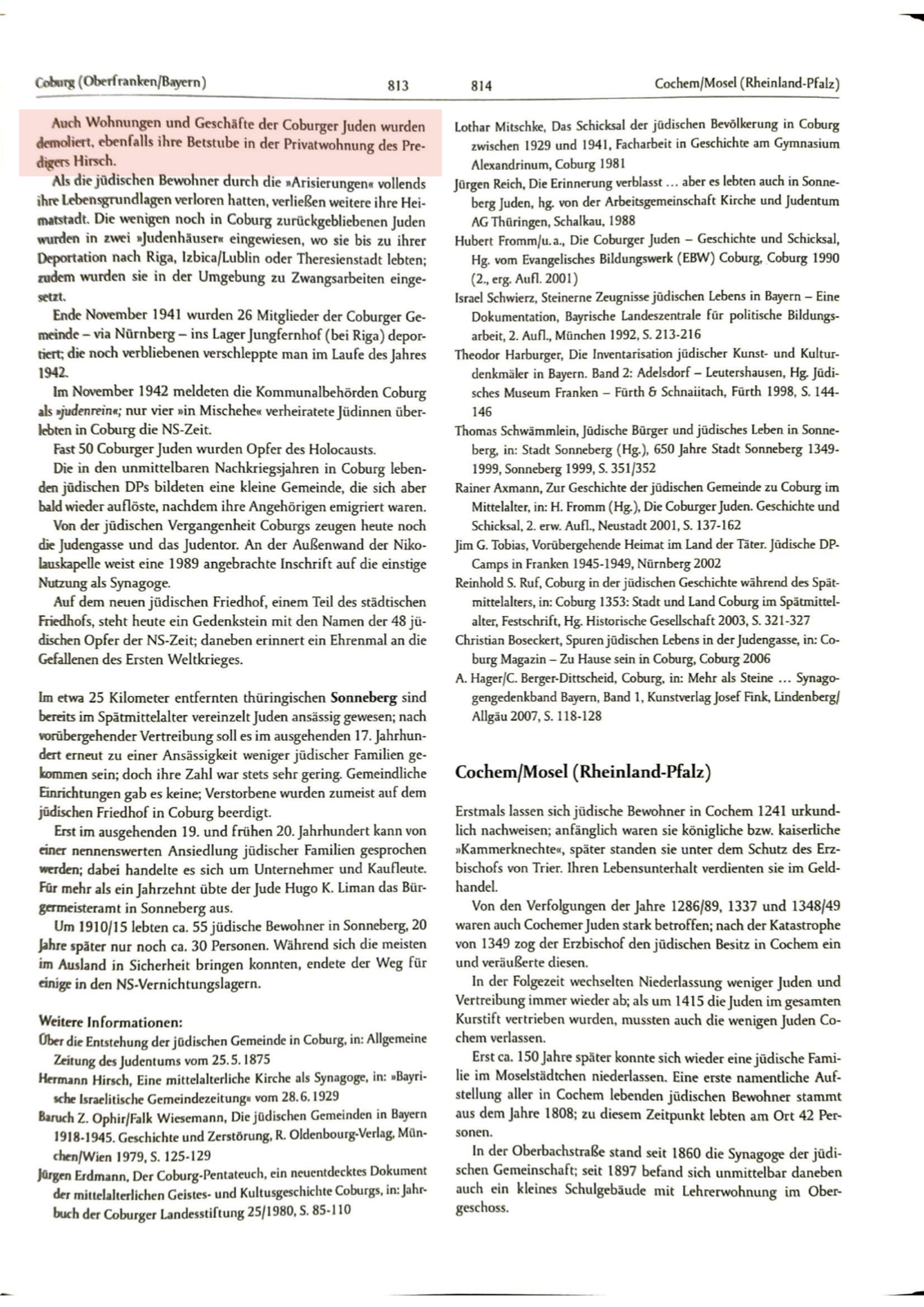
Coburg (146 & 147)
Error
Voigtländer and Voth failed to code a prayer room here, despite Alicke explicitly mentioning one.
Reality
Alicke documents that during the November 1938 pogrom, the Jews' "prayer room in the private residence of Preacher Hirsch" was demolished („ebenfalls ihre Betstube in der Privatwohnung des Predigers Hirsch").
This should be coded as 1.
Correction
SYN30S 0 -> 1; SYNATTACK 0 -> 1
Source:
Alicke · Page 813
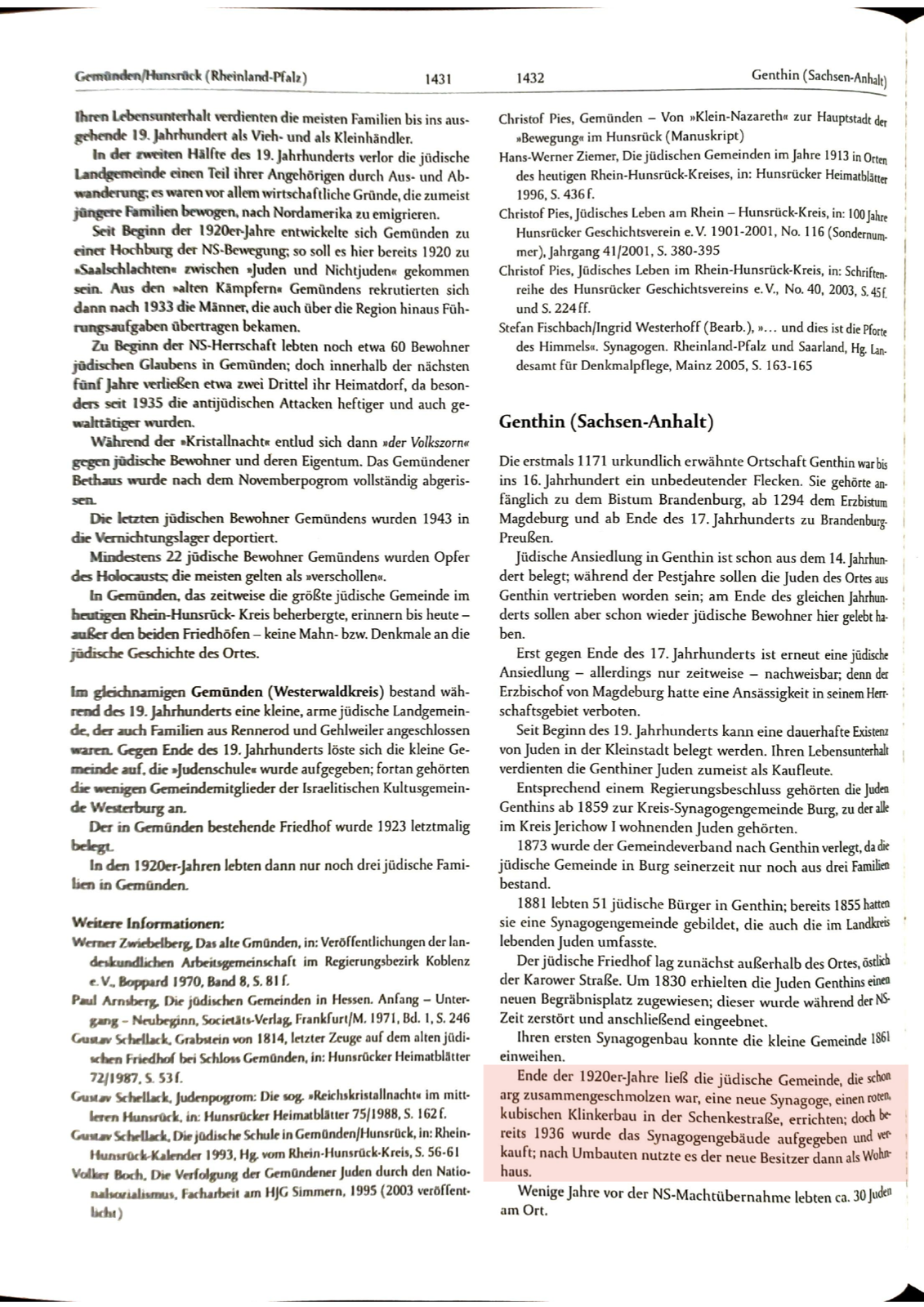
Genthin (148)
Error
Voigtländer and Voth claim a synagogue existed in Genthin when Kristallnacht occurred, but it had already been sold.
Reality
Alicke reports that "already in 1936, the synagogue building, used for only a few years, was abandoned and sold; after renovations, the new owner then used it as a residential house" („bereits im Jahre 1936 wurde das nur wenige Jahre genutzte Synagogengebäude aufgegeben und verkauft").
The coding of an active synagogue is incorrect.
Correction
SYN30S 1 -> 0
Source:
Alicke · Page 1432
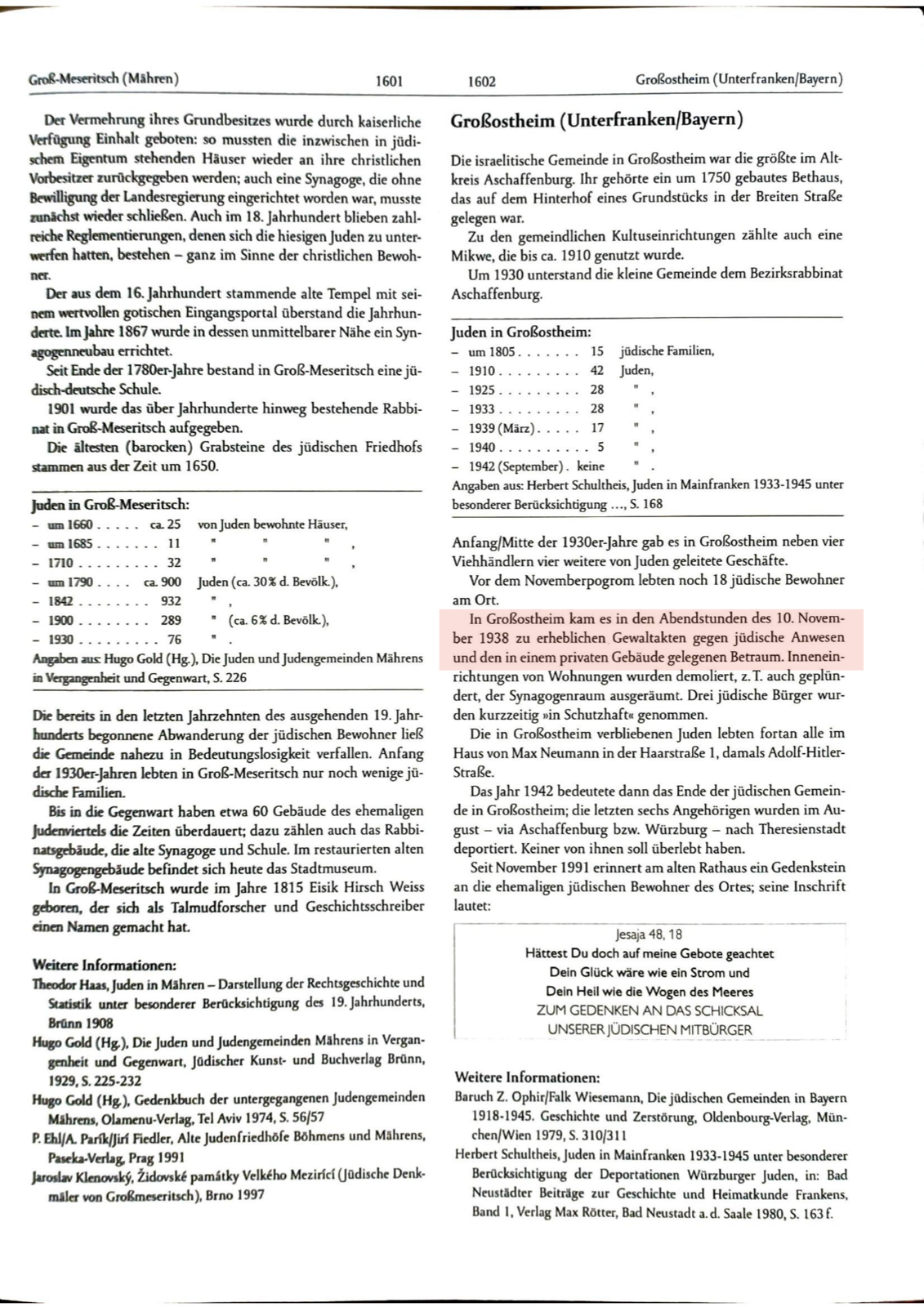
Grossostheim (149 & 150)
Error
Voigtländer and Voth failed to code a prayer room here, despite Alicke explicitly mentioning one.
Reality
Alicke states that in November 1938, "significant acts of violence against [...] the prayer room located in a private building" occurred („erheblichen Gewaltakten gegen [...] den in einem privaten Gebäude gelegenen Betraum").
This should be coded as 1.
Correction
SYN30S 0 -> 1; SYNATTACK 0 -> 1
Source:
Alicke · Page 1602
Grünsfeld (151 & 152)
Error
Voigtländer and Voth failed to code a prayer room here, despite Alicke explicitly mentioning one.
Reality
Alicke states that during the November pogrom, the "prayer room was plundered" („Betraum durch [...] geplündert").
This should be coded as 1.
Correction
SYN30S 0 -> 1; SYNATTACK 0 -> 1
Source:
Alicke · Page 1617
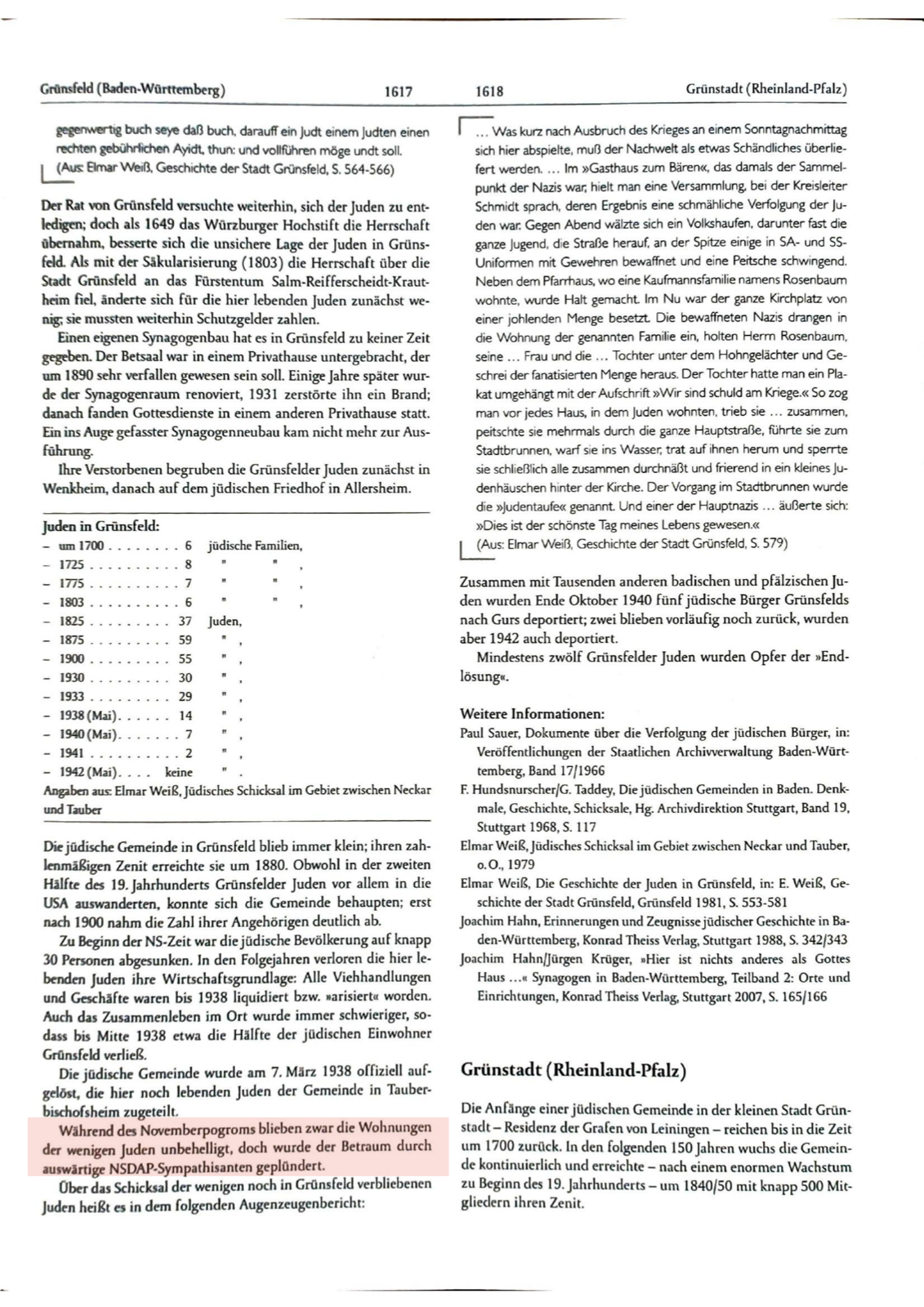
Harburg-Wörnitz (153)
Error
Voigtländer and Voth claim an active synagogue existed here, but Alicke notes the building was empty.
Reality
Alicke reports that while the synagogue building was spared from arson during the November pogrom, the "empty building was plundered by neighbors" („das leerstehende Gebäude von Nachbarn geplündert").
It was not an active synagogue.
Correction
SYN30S 1
Source:
Alicke · Page 1757
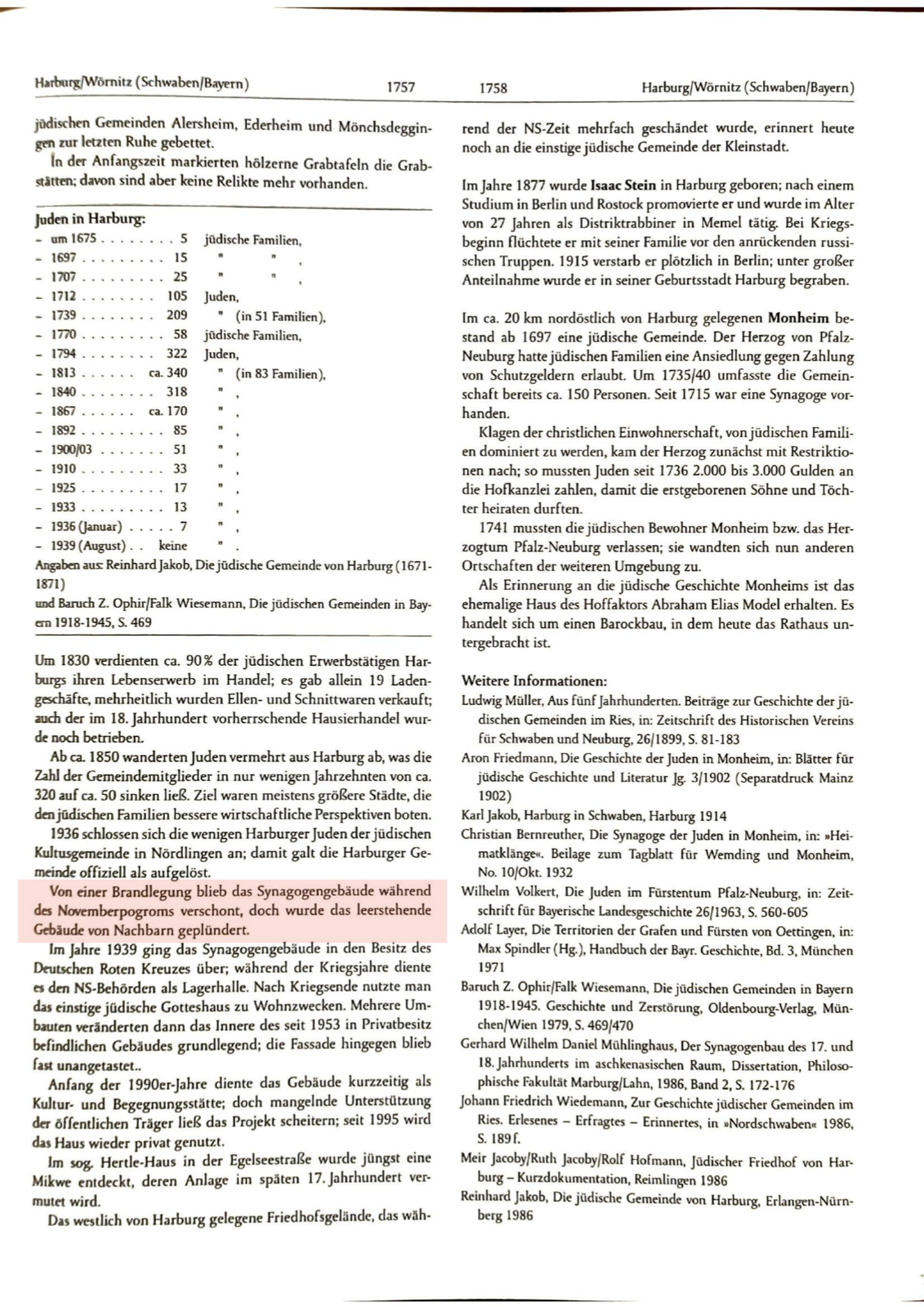
Horb-Neckar (154 & 155)
Error
Voigtländer and Voth failed to code a prayer room here, despite Alicke explicitly mentioning one.
Reality
Alicke describes a memorial plaque on the building where the prayer room was located, stating that it "was devastated after the pogrom night of November 9-10, 1938" („Er wurde nach der Pogromnacht 9./10.November 1938 verwüstet").
This should be coded as 1.
Correction
SYN30S 0 -> 1; SYNATTACK 0 -> 1
Source:
Alicke · Page 1972
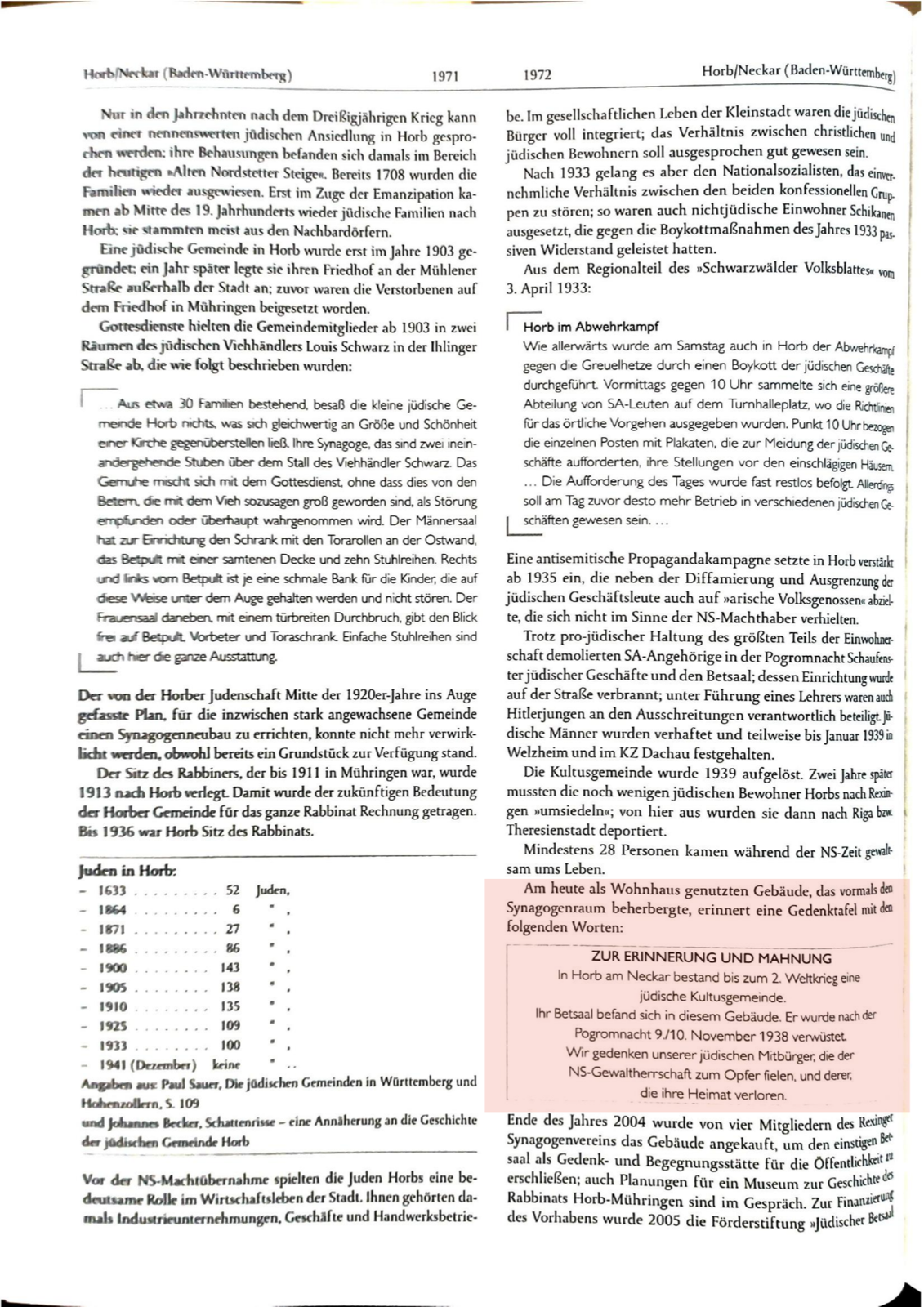
Ingolstadt (156 & 157)
Error
Voigtländer and Voth failed to code a prayer room here, despite Alicke explicitly mentioning one.
Reality
Alicke details the attack during the November pogrom of 1938, noting SA men "destroyed the inventory of the prayer room and ritual objects" („zerstörten SA-Leuten das Inventar des Betsaales").
This should be coded as 1.
Correction
SYN30S 0 -> 1; SYNATTACK 0 -> 1
Source:
Alicke · Page 2059
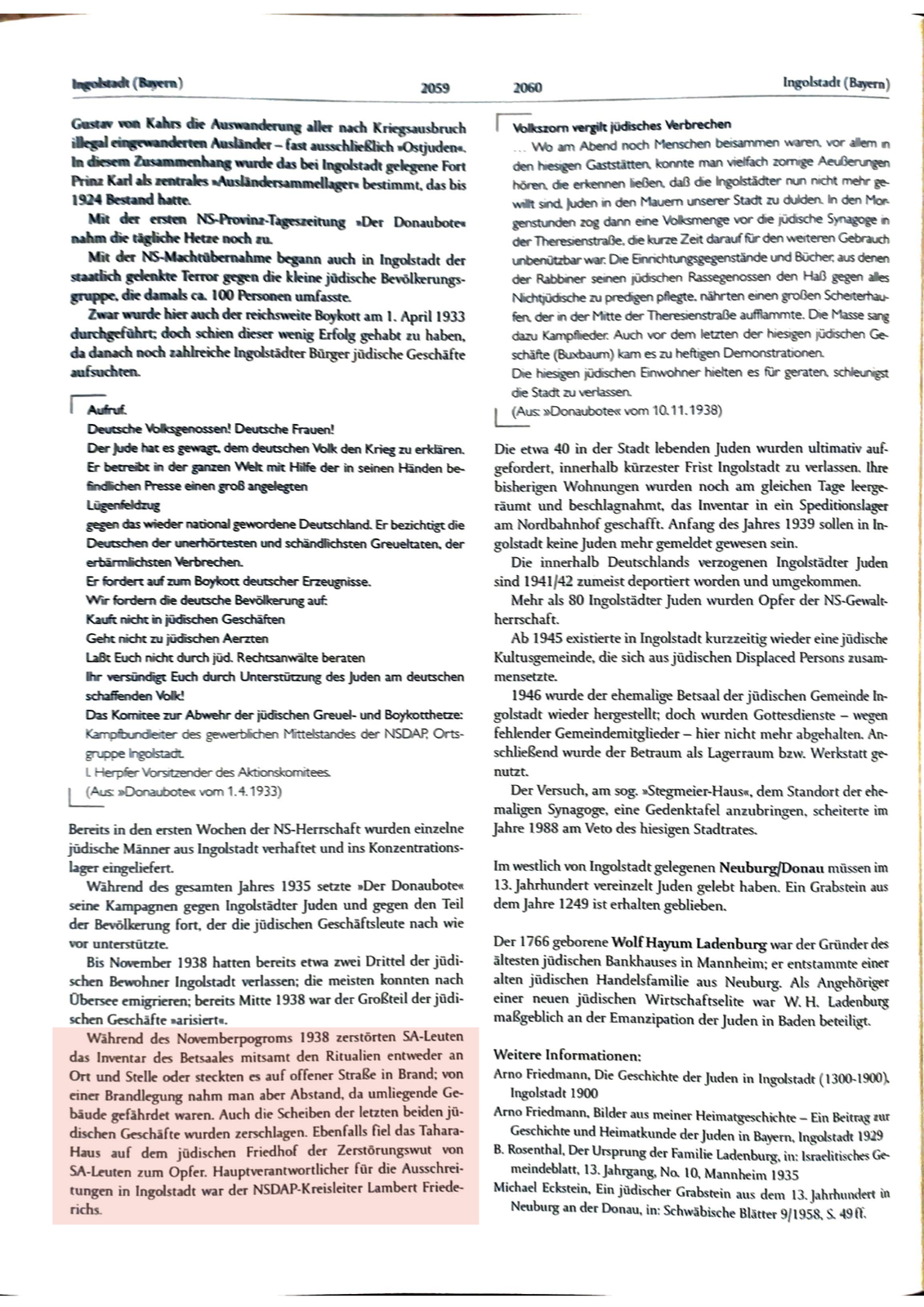
Kamen (158)
Error
Voigtländer and Voth claim an active synagogue existed here, but Alicke notes it was a "former" synagogue.
Reality
Alicke refers to the building as the "former synagogue building" („ehemalige Synagogengebäude"). While a memorial plaque claims it was destroyed, it was not an active place of worship.
The coding is incorrect.
Correction
SYN30S 1
Source:
Alicke · Page 2131
Neuruppin (159)
Error
Voigtländer and Voth claim an active synagogue existed in Neuruppin when Kristallnacht occurred, but it had already been given up.
Reality
Alicke documents that the synagogue "was given up again at the end of the 1920s, as apparently due to the decline in the Jewish population, the holding of services was no longer possible" („diese wurde Ende der 1920er-Jahre wieder aufgegeben").
The coding of an active synagogue is incorrect.
Correction
SYN30S 1 -> 0
Source:
Alicke · Page 2988
Pappenheim-Altmühl (160)
Error
Voigtländer and Voth claim an active synagogue existed here when Kristallnacht occurred, but the last Jewish family had already left.
Reality
According to Alicke, "[t]he last Jewish family left in the early summer of 1936" („Die letzte jüdische Familie verließ im Frühsommer 1936"). there was no active synagogue in 1938.
The coding is incorrect.
Correction
SYN30S 1 -> 0
Source:
Alicke · Page 3276
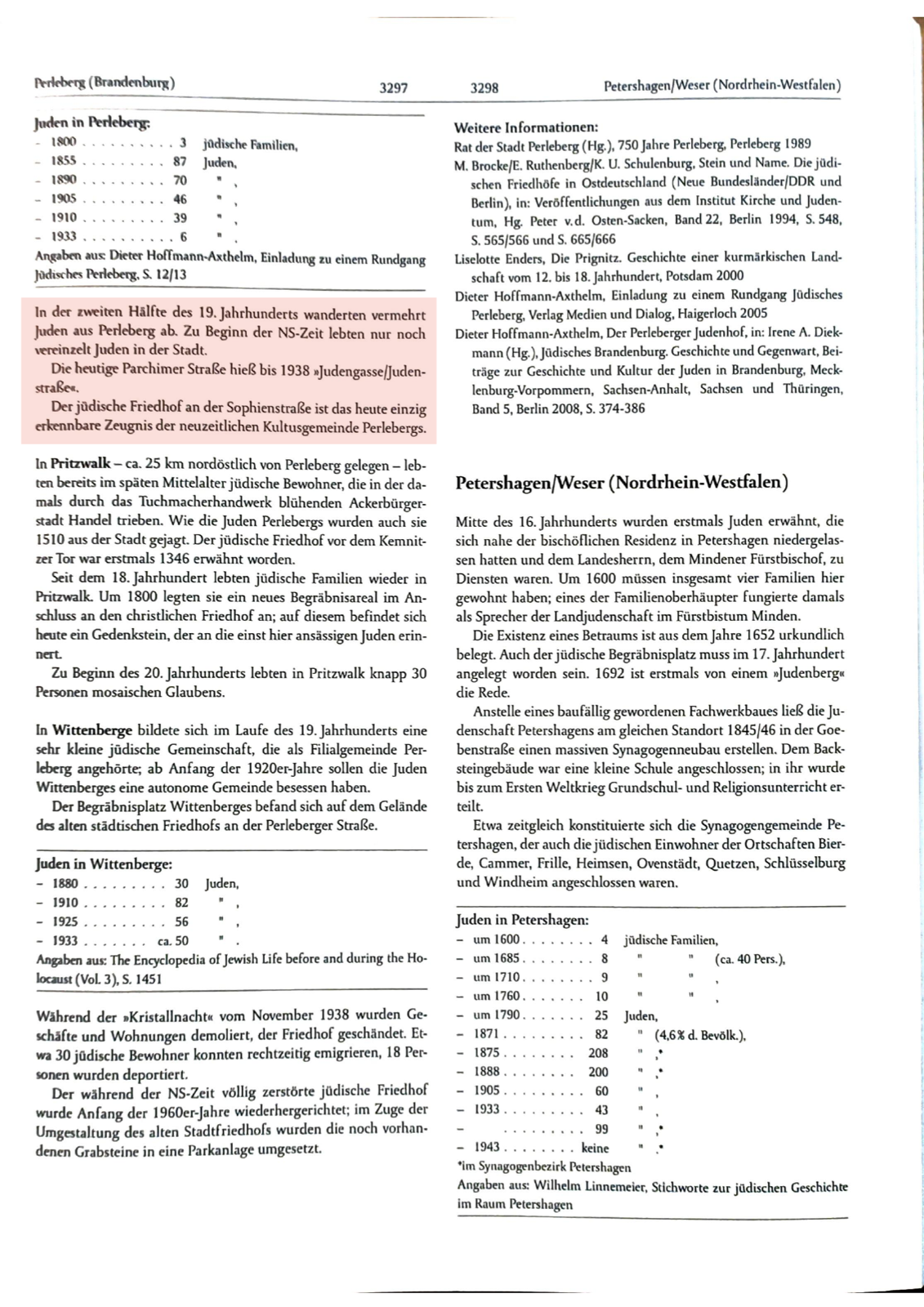
Perleberg (161 & 162)
Error
Voigtländer and Voth claim "unambiguous information" that no synagogue existed here. However, the sources are ambiguous.
Reality
Alicke describes a meeting room being established in the nineteenth century, but it is unclear whether it functioned as a prayer room or still existed in the 1930s.
The coding is uncertain.
Correction
SYN30S 0 -> NA; SYNATTACK 0 -> NA
Sources:
Alicke · Page 3296
Alicke · Page 3297
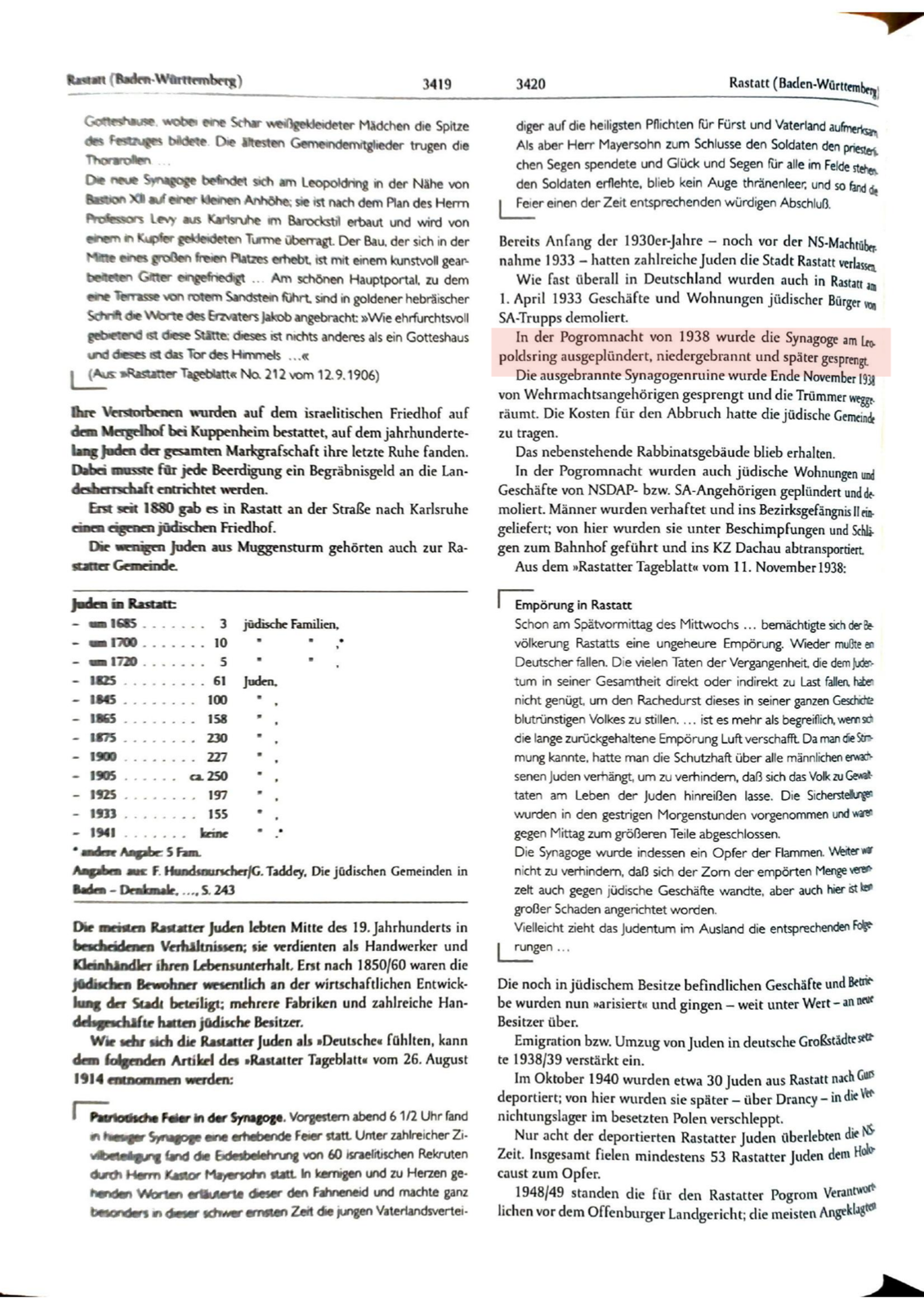
Rastatt (163 & 164)
Error
Voigtländer and Voth failed to code a synagogue here, despite Alicke explicitly mentioning one.
Reality
Alicke states that during the November 1938 pogrom, "the synagogue on Leopoldsring was plundered, burned down, and later blown up" („die Synagoge am Leopoldsring ausgeplündert, niedergebrannt und später gesprengt").
This should be coded as 1.
Correction
SYN30S 0 -> 1; SYNATTACK 0 -> 1
Source:
Alicke · Page 3420
Rothenburg ob der Tauber (165 & 166)
Error
Voigtländer and Voth claim an active synagogue existed here when Kristallnacht occurred, but the Jews had already been expelled.
Reality
Alicke writes that on October 22, 1938, the residents were gathered in the synagogue and told to leave the town immediately, and five days later Rothenburg declared itself 'free of Jews' („Befreiung von den Juden").
There was no active synagogue during Kristallnacht.
Correction
SYN30S 1 -> 0; SYNATTACK 1 -> 0
Source:
Alicke · Page 3577
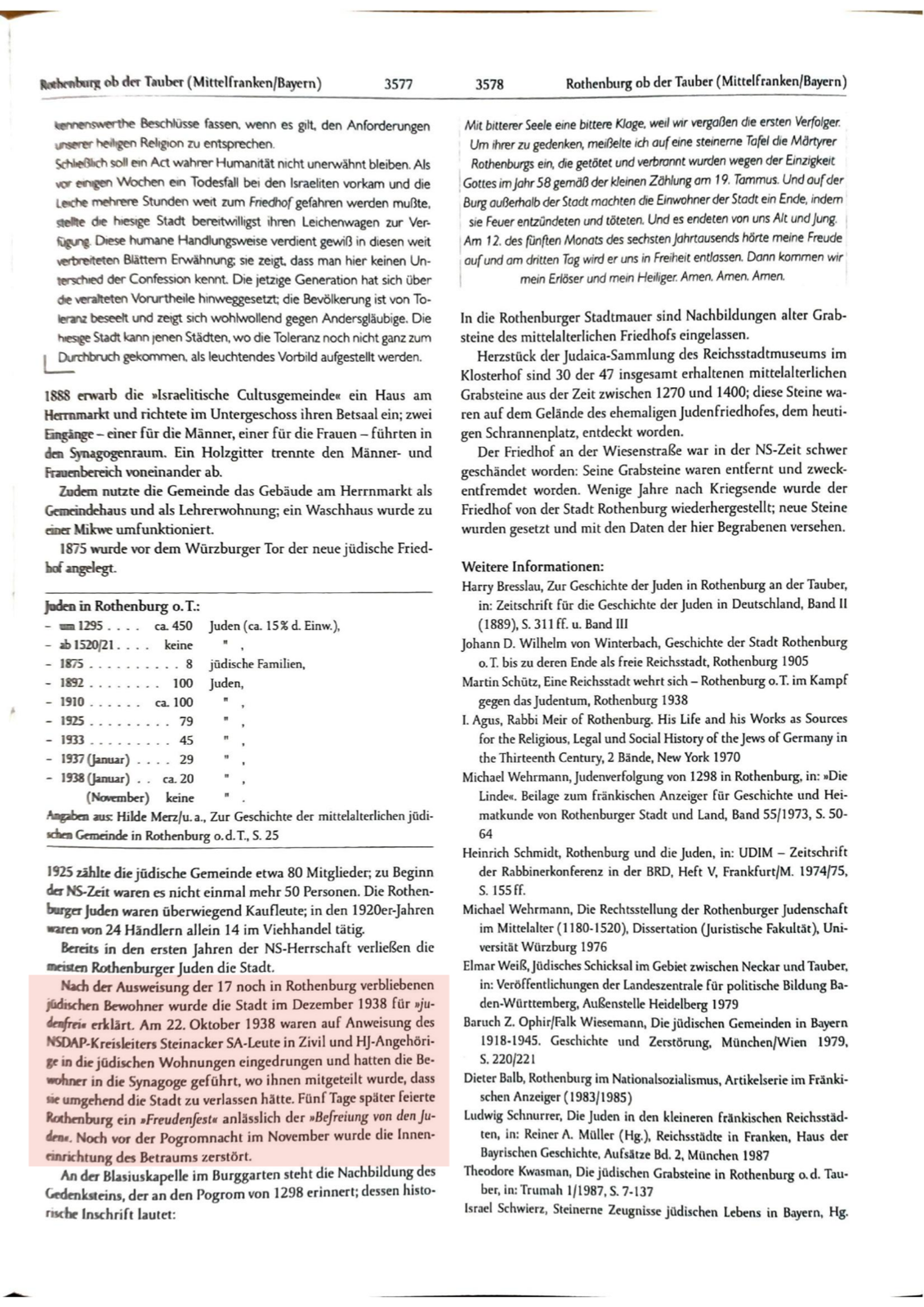
Stade (167 & 168)
Error
Voigtländer and Voth claim an active synagogue existed here, but the sources are ambiguous.
Reality
Alicke notes that a room was rented permanently in the mid-nineteenth century, but "services were held only very irregularly" („fanden Gottesdienste nur sehr unregelmäßig statt"). It is unclear whether the prayer room still existed in the 1930s.
The coding is uncertain.
Correction
SYN30S 1 -> NA; SYNATTACK 0 -> NA
Source:
Alicke · Page 3895-3896
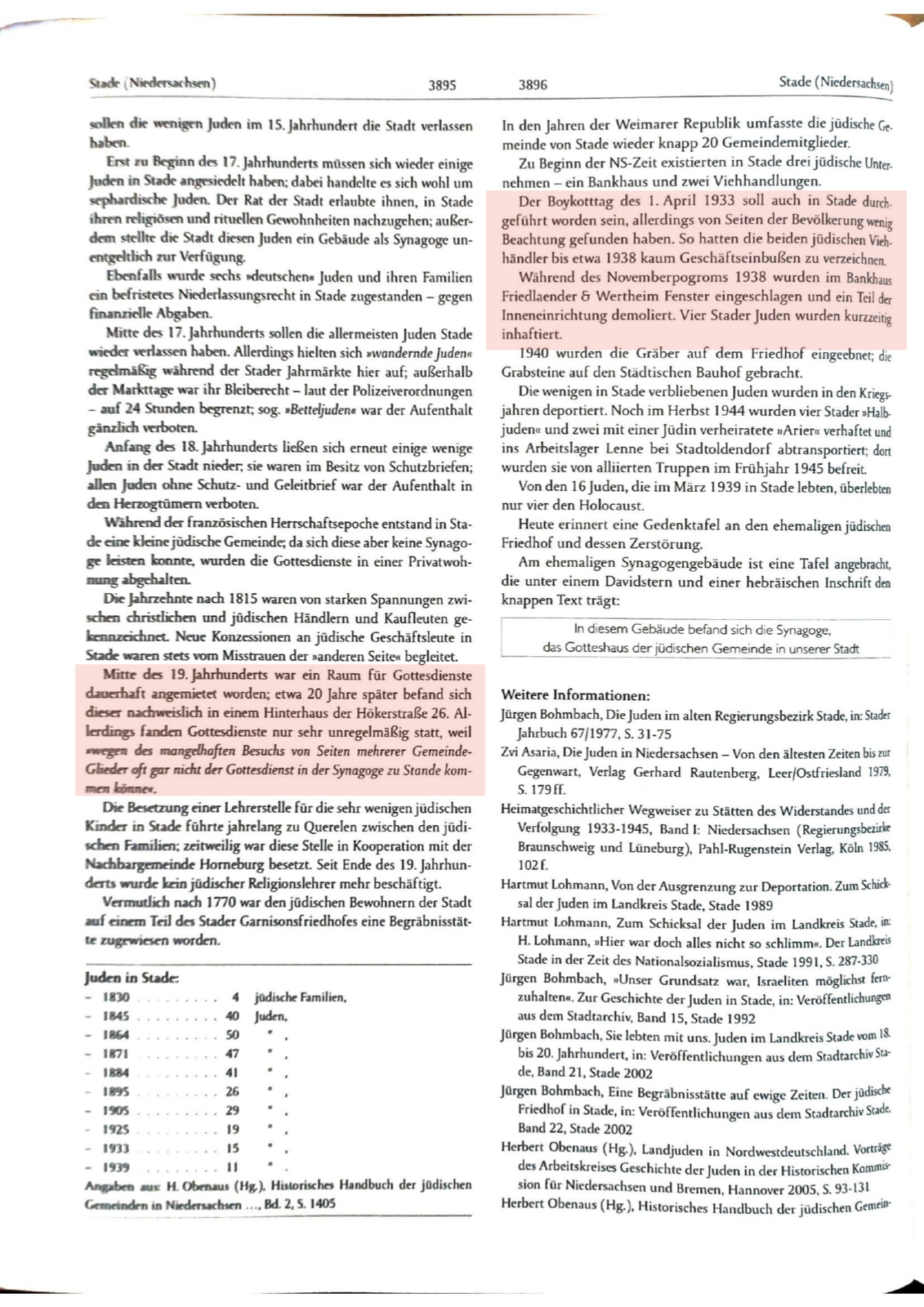
Walldürn-Odenwald (169)
Error
Voigtländer and Voth claim an active prayer room existed here when Kristallnacht occurred, but it had already been given up.
Reality
Alicke documents that after 1933, the prayer room was "given up and the house sold" („wurde der Betsaal aufgegeben und das Haus verkauft"). Furthermore, the community "finally dissolved completely in 1937" (1937 löste sich die jüdische Gemeinde schließlich vollständig auf).
The coding is incorrect.
Correction
SYN30S 1 -> 0
Source:
Alicke · Page 4273
×
![]()